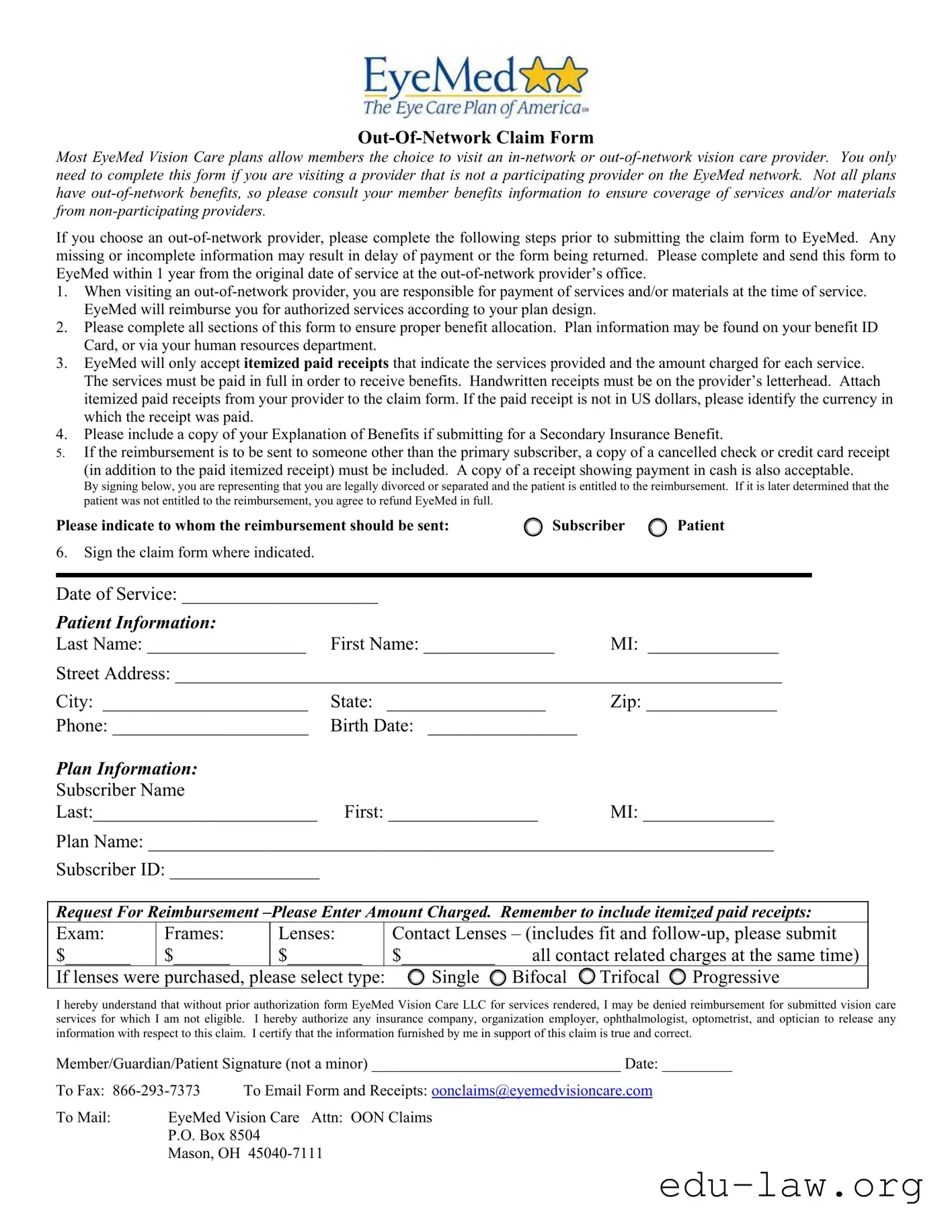
When navigating the world of vision care, understanding the EyeMed Claim Form is essential for those who choose to visit out-of-network providers. This form serves as a crucial tool for members who seek reimbursement for services rendered by non-participating vision care professionals. It's important to note that not all EyeMed plans offer out-of-network benefits, so reviewing your specific member benefits is a wise first step. Completing the form correctly is key to ensuring a smooth claims process; any missing or incomplete information could lead to delays or even rejection of your claim. Members are responsible for paying the provider upfront, but EyeMed will reimburse for authorized services according to the plan design. To facilitate this reimbursement, individuals must submit itemized paid receipts that detail the services provided and the associated costs. Additionally, if you are claiming for secondary insurance benefits, including an Explanation of Benefits is necessary. The form also includes specific instructions for cases where reimbursement is directed to someone other than the primary subscriber, emphasizing the need for proper documentation. By following the outlined steps and providing accurate information, members can effectively navigate the claims process and ensure they receive the benefits they are entitled to.

Most EyeMed Vision Care plans allow members the choice to visit an
If you choose an
1.When visiting an
2.Please complete all sections of this form to ensure proper benefit allocation. Plan information may be found on your benefit ID Card, or via your human resources department.
3.EyeMed will only accept itemized paid receipts that indicate the services provided and the amount charged for each service. The services must be paid in full in order to receive benefits. Handwritten receipts must be on the provider’s letterhead. Attach itemized paid receipts from your provider to the claim form. If the paid receipt is not in US dollars, please identify the currency in which the receipt was paid.
4.Please include a copy of your Explanation of Benefits if submitting for a Secondary Insurance Benefit.
5.If the reimbursement is to be sent to someone other than the primary subscriber, a copy of a cancelled check or credit card receipt
(in addition to the paid itemized receipt) must be included. A copy of a receipt showing payment in cash is also acceptable.
By signing below, you are representing that you are legally divorced or separated and the patient is entitled to the reimbursement. If it is later determined that the patient was not entitled to the reimbursement, you agree to refund EyeMed in full.
Please indicate to whom the reimbursement should be sent: |
Subscriber |
Patient |
6.Sign the claim form where indicated.
Date of Service: _____________________ |
|
Patient Information: |
|
Last Name: _________________ First Name: ______________ |
MI: ______________ |
Street Address: _________________________________________________________________
City: ______________________ |
State: _________________ |
Zip: ______________ |
Phone: _____________________ |
Birth Date: ________________ |
|
Plan Information: |
|
|
Subscriber Name |
|
|
Last:________________________ |
First: ________________ |
MI: ______________ |
Plan Name: ___________________________________________________________________
Subscriber ID: ________________
Request For Reimbursement
Exam: |
Frames: |
Lenses: |
|
Contact Lenses – (includes fit and |
|||
$_______ |
$______ |
$________ |
|
$__________ |
all contact related charges at the same time) |
||
If lenses were purchased, please SELECT type: |
Single |
Bifocal |
Trifocal |
Progressive |
|||
I hereby understand that without prior authorization form EyeMed Vision Care LLC for services rendered, I may be denied reimbursement for submitted vision care services for which I am not eligible. I hereby authorize any insurance company, organization employer, ophthalmologist, optometrist, and optician to release any information with respect to this claim. I certify that the information furnished by me in support of this claim is true and correct.
Member/Guardian/Patient Signature (not a minor) ________________________________ Date: _________
To Fax: |
To Email Form and Receipts: [email protected] |
|
To Mail: |
EyeMed Vision Care Attn: OON Claims |
|
|
P.O. Box 8504 |
|
|
Mason, OH |
|

Fraud Warning Statements
Arizona: For your protection Arizona law requires the following statement to appear on this form. Any person who knowingly presents a false or fraudulent claim for payment of a loss is subject to criminal and civil penalties.
Alaska: A person who knowingly and with intent to injure, defraud, or deceive an insurance company files a claim containing false, incomplete, or misleading information may be prosecuted under state law.
Arkansas: Any person who knowingly presents a false or fraudulent claim for payment of a loss or benefit or knowingly presents false information in an application for insurance is guilty of a crime and may be subject to fines and confinement in prison.
California: For your protection California law requires the following to appear on this form: Any person who knowingly presents false or fraudulent claim for the payment of a loss is guilty of a crime and may be subject to fines and confinement in state prison.
Colorado: It is unlawful to knowingly provide false, incomplete, or misleading facts or information to an insurance company for the purpose of defrauding or attempting to defraud the company. Penalties may include imprisonment, fines, denial of insurance and civil damages. Any insurance company or agent of an insurance company who knowingly provides false, incomplete or misleading facts or information to a policyholder or claimant for the purpose of defrauding or attempting to defraud a policyholder or claimant with regard to a settlement or award payable from insurance proceeds shall be reported to the Colorado Department of Insurance within the department of regulatory agencies.
District of Columbia: WARNING: It is a crime to provide false or misleading information to an insurer for the purpose of defrauding the insurer or any other person. Penalties include imprisonment and/or fines. In addition, an insurer may deny insurance benefits if false information materially related to a claim was provided by the applicant.
Florida: Any person who knowingly and with intent to injure, defraud, or deceive any insurer files a statement of claim or an application containing any false, incomplete or misleading information is guilty of a felony of the third degree.
Hawaii: For your protection, Hawaii law requires you to be informed that presenting a fraudulent claim for payment of a loss or benefit is a crime punishable by fines or imprisonment, or both.
Idaho: Any person who knowingly and with intent to defraud or deceive any insurance company, files a statement or claim containing a false, incomplete or misleading information is guilty of a felony.
Indiana: A person who knowingly and with intent to defraud an insurer files a statement of claim containing any false, incomplete or misleading information commits a felony.
Kentucky: Any person who knowingly and with intent to defraud any insurance company or other person files an application or claim for insurance containing any materially false information or conceals, for the purpose of misleading, information concerning any fact material thereto commits a fraudulent act, which is a crime.
Maine: It is a crime to knowingly provide false, incomplete or misleading information to an insurance company for the purpose of defrauding the company. Penalties may include imprisonment, fines or a denial of insurance benefits.
Minnesota: A person who files a claim with intent to defraud or helps commit a fraud against an insurer is guilty of a crime.
New Hampshire: Any person who, with a purpose to injure, defraud or deceive any insurance company, files a statement of claim containing any false, incomplete or misleading information is subject to prosecution and punishment for insurance fraud, as provided in § 638.20.
New Jersey: Any person who knowingly files a statement of claim containing any false or misleading information is subject to criminal and civil penalties.
New Mexico: Any person who knowingly presents a false or fraudulent claim for payment of a loss or benefit or knowingly presents false information in an application for insurance is guilty of a crime and may be subject to civil fines and criminal penalties.
New York: Any person who knowingly and with intent to defraud insurance company or other person files an application for insurance or statement of claim containing any materially false information or conceals for the purpose of misleading, information concerning any fact material thereto, commits a fraudulent act, which is a crime and shall also be subject to a civil penalty not to exceed $5,000 and the stated value of the claim for each such violation.
Ohio: Any person who, with intent to defraud, or knowing that he is facilitating a fraud against an insurer, submits an application or false claim containing a false or deceptive statement is guilty of insurance fraud.
Oklahoma: WARNING: Any person who knowingly and with intent to injure, defraud, or deceive any insurer makes any claim for the proceeds of an insurance policy containing any false, incomplete or misleading information is guilty of a felony.
Texas: Any person who knowingly presents a false or fraudulent claim for the payment of a loss is guilty of a crime and may be subject to fines and confinement in state prison.
Virginia: It is a crime to knowingly provide false, incomplete or misleading information to an insurance company for the purpose of defrauding the company. Penalties include imprisonment, fines and denial of insurance benefits.
| Fact Name | Details |
|---|---|
| Out-of-Network Provider Usage | Members may visit either in-network or out-of-network vision care providers. The claim form is only necessary for out-of-network services. |
| Payment Responsibility | When using an out-of-network provider, members must pay for services at the time of service. EyeMed will reimburse based on the plan design. |
| Submission Deadline | The claim form must be submitted to EyeMed within one year from the original date of service to ensure reimbursement. |
| Itemized Receipts Requirement | EyeMed requires itemized paid receipts that detail the services provided and amounts charged. Handwritten receipts must be on the provider's letterhead. |
| Secondary Insurance Documentation | For claims involving secondary insurance benefits, a copy of the Explanation of Benefits must be included with the claim form. |
| Fraud Warning Statements | Each state has specific laws regarding fraudulent claims. For example, in California, knowingly presenting a false claim is a crime punishable by fines and imprisonment. |
To submit a claim to EyeMed for out-of-network services, you need to complete the EyeMed Claim Form. Follow the steps below to ensure that your claim is processed smoothly and efficiently. Missing or incomplete information can lead to delays, so pay close attention to each section.
1. What is the EyeMed Out-Of-Network Claim Form used for?
The EyeMed Out-Of-Network Claim Form is necessary when you visit a vision care provider who is not part of the EyeMed network. This form allows you to request reimbursement for eligible services and materials received from non-participating providers. Ensure that your plan includes out-of-network benefits before submitting the claim.
2. How do I fill out the claim form?
To complete the claim form, fill in all required sections, including patient information, date of service, and plan details. Attach itemized paid receipts that detail the services provided and the amounts charged. Ensure that the receipts are in US dollars or clearly indicate the currency used. Incomplete forms may delay processing.
3. What types of receipts are accepted?
EyeMed requires itemized paid receipts that specify the services rendered and the total amount charged. Handwritten receipts must be on the provider's letterhead. Only receipts showing full payment are acceptable. If the receipt is not in US dollars, indicate the currency.
4. How long do I have to submit the claim?
You must submit the claim form to EyeMed within one year from the date of service. Timely submission is crucial to ensure that you receive your reimbursement without unnecessary delays.
5. What if I have secondary insurance?
If you are submitting a claim for secondary insurance benefits, include a copy of your Explanation of Benefits (EOB) along with the claim form and itemized receipts. This documentation helps EyeMed coordinate benefits between the two insurance providers.
6. Can someone else receive the reimbursement?
If you want the reimbursement sent to someone other than the primary subscriber, you must include a copy of a canceled check or credit card receipt, in addition to the itemized paid receipt. A cash payment receipt is also acceptable. You must also confirm that the patient is entitled to the reimbursement.
7. How do I submit the claim form?
You can submit the completed claim form and receipts by fax, email, or mail. For faxing, send to 866-293-7373. To email, use [email protected]. If mailing, address it to EyeMed Vision Care, Attn: OON Claims, P.O. Box 8504, Mason, OH 45040-7111. Choose the method that is most convenient for you.
Failing to complete all sections of the claim form. This can lead to delays in processing or the form being returned. It's important to provide all requested information.
Not including itemized paid receipts. EyeMed requires receipts that show the services provided and the amounts charged for each service. Receipts must be paid in full to receive benefits.
Submitting handwritten receipts that are not on the provider’s letterhead. Only itemized receipts from the provider’s office are accepted. If the receipt is in a foreign currency, the currency must be identified.
Omitting a copy of the Explanation of Benefits when submitting for a Secondary Insurance Benefit. This documentation is necessary for proper processing of the claim.
Not including documentation if the reimbursement is to be sent to someone other than the primary subscriber. A cancelled check or credit card receipt must be attached, along with the paid itemized receipt.
The EyeMed Claim Form is essential for members seeking reimbursement for services received from out-of-network vision care providers. Along with this form, several other documents may be required to ensure a smooth claims process. Below is a list of commonly used forms and documents that can assist in submitting a claim effectively.
Gathering these documents in advance can significantly streamline the claims process with EyeMed. Ensure all forms are completed accurately and submitted within the required timeframe to avoid delays in reimbursement.
The Health Insurance Claim Form (CMS-1500) is widely used for outpatient services in the United States. Similar to the EyeMed Claim Form, it requires detailed patient and provider information. Both forms ask for the date of service, the patient’s personal details, and the services rendered. The CMS-1500 also mandates itemized billing, ensuring that all charges are documented clearly, which helps in processing claims efficiently.
The Dental Claim Form is another document that shares similarities with the EyeMed Claim Form. It is specifically designed for dental services and requires similar information such as the patient’s name, address, and the services provided. Both forms require itemized receipts to validate the charges. Additionally, both documents emphasize the importance of accuracy in the information provided to avoid delays in reimbursement.
The Medicare Claim Form is used by beneficiaries to claim reimbursement for medical services. Like the EyeMed Claim Form, it requires the completion of various sections, including patient and provider information. Both forms necessitate itemized statements of services and emphasize the need for timely submission to ensure payment. The Medicare form also includes a section for secondary insurance, mirroring the EyeMed form's requirement for an Explanation of Benefits.
The Workers' Compensation Claim Form is utilized when employees seek compensation for work-related injuries. Similar to the EyeMed Claim Form, it requires detailed information about the incident and the services provided. Both forms require signatures and may necessitate supporting documents, such as medical reports or itemized bills, to substantiate the claim. Timeliness is crucial in both forms to avoid delays in processing.
The Flexible Spending Account (FSA) Claim Form allows individuals to claim reimbursements for eligible medical expenses. Like the EyeMed Claim Form, it requires itemized receipts and personal information from the claimant. Both documents stress the importance of providing accurate details to ensure that reimbursements are processed smoothly. The FSA form may also require a signature, similar to the EyeMed form.
The Short-Term Disability Claim Form is used by employees who are temporarily unable to work due to medical reasons. It shares similarities with the EyeMed Claim Form in that both require detailed personal information and documentation of services received. Both forms also emphasize the need for timely submission and may require additional supporting documents to validate the claim.
The Out-of-Network Claim Form for other insurance providers is similar to the EyeMed Claim Form in that it is specifically for services rendered by non-participating providers. Both forms require the same basic information, including patient details and itemized receipts. Additionally, both forms stress the importance of submitting the claim within a specified time frame to ensure reimbursement.
The Prescription Drug Claim Form is used to claim reimbursement for medications. It is similar to the EyeMed Claim Form in that it requires detailed information about the patient and the services provided. Both forms necessitate itemized receipts and emphasize the importance of accuracy to avoid delays in processing. Timely submission is also a common requirement for both forms.
The Vision Care Claim Form from other vision insurance providers is closely related to the EyeMed Claim Form. It requires similar information, including patient details, services rendered, and itemized billing. Both forms aim to facilitate the reimbursement process for vision-related expenses and highlight the need for accurate and complete information to avoid claim denials.
The Medical Expense Reimbursement Form is used for claiming medical expenses not covered by insurance. Similar to the EyeMed Claim Form, it requires personal information and itemized receipts. Both forms emphasize the importance of submitting claims promptly and accurately to ensure that reimbursements are processed without delay.
When filling out the EyeMed Claim form, consider the following guidelines to ensure a smooth process.
Understanding the EyeMed Claim Form can be tricky, especially with some common misconceptions floating around. Here are six misconceptions clarified:
By clearing up these misconceptions, you can navigate the EyeMed Claim Form process more effectively and ensure that you receive the benefits you are entitled to.
When filling out and using the EyeMed Claim Form, several important considerations should be kept in mind to ensure a smooth reimbursement process.
By adhering to these guidelines, individuals can facilitate a more efficient claims process and enhance the likelihood of receiving the appropriate reimbursement.