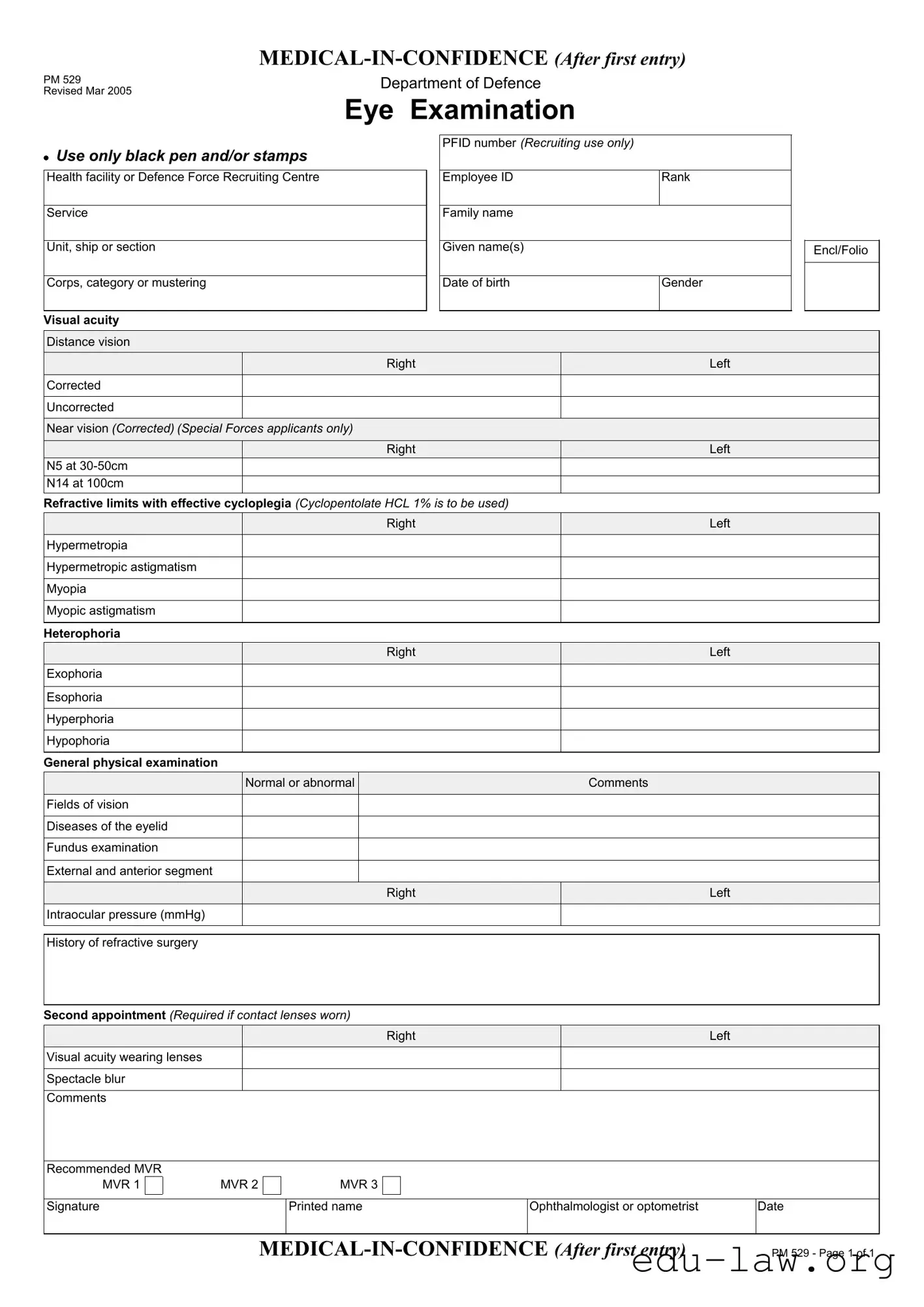
The Eye Examination form serves as a crucial document in assessing and documenting an individual's visual health. It encompasses a range of important information, starting with personal details such as the individual's name, date of birth, and service information, which helps in identifying the patient and their specific context within the military framework. Visual acuity is thoroughly evaluated, with sections dedicated to both distance and near vision, ensuring a comprehensive understanding of the individual's sight capabilities. For applicants to Special Forces, additional near vision assessments are included. The form also addresses refractive errors, detailing conditions such as hypermetropia and myopia, along with their respective astigmatism types. A general physical examination is noted, allowing for the identification of any abnormalities that may affect visual health. Furthermore, the form includes critical assessments of the eyelids, fields of vision, and fundus examination, which are essential for a complete ocular evaluation. Intraocular pressure measurements are recorded to check for potential issues like glaucoma. For those who wear contact lenses, a second appointment is indicated to evaluate visual acuity while wearing lenses, ensuring that the individual’s vision is accurately assessed under different conditions. The form concludes with a signature from a qualified ophthalmologist or optometrist, reinforcing the reliability of the information gathered. This thorough documentation not only supports the individual's health needs but also aligns with military standards for vision requirements.

PM 529 |
Department of Defence |
|
||
Revised Mar 2005 |
|
|||
|
|
|
|
|
|
Eye Examination |
|
||
|
|
|
|
|
|
|
|
PFID number (Recruiting use only) |
|
Use only black pen and/or stamps |
|
|
|
|
|
|
|
|
|
Health facility or Defence Force Recruiting Centre |
|
|
Employee ID |
Rank |
|
|
|
|
|
Service |
|
|
Family name |
|
|
|
|
|
|
Unit, ship or section |
|
|
Given name(s) |
|
|
|
|
|
|
Corps, category or mustering |
|
|
Date of birth |
Gender |
|
|
|
|
|
Visual acuity |
|
|
|
|
Encl/Folio
Distance vision |
|
|
|
|
|
|
|
|
|
|
|
|
Right |
|
|
Left |
|
Corrected |
|
|
|
|
|
|
|
|
|
|
|
|
|
|
|
|
|
Uncorrected |
|
|
|
|
|
|
|
|
|
|
|
|
|
|
|||
Near vision (Corrected) (Special Forces applicants only) |
|
|
|
|
||||
|
|
|
|
Right |
|
|
Left |
|
N5 at |
|
|
|
|
|
|
|
|
|
|
|
|
|
|
|
|
|
N14 at 100cm |
|
|
|
|
|
|
|
|
|
|
|
|
|
|
|||
Refractive limits with effective cycloplegia (Cyclopentolate HCL 1% is to be used) |
|
|
|
|
||||
|
|
|
|
|
|
|
|
|
|
|
|
|
Right |
|
|
Left |
|
Hypermetropia |
|
|
|
|
|
|
|
|
|
|
|
|
|
|
|
|
|
Hypermetropic astigmatism |
|
|
|
|
|
|
|
|
|
|
|
|
|
|
|
|
|
Myopia |
|
|
|
|
|
|
|
|
|
|
|
|
|
|
|
|
|
Myopic astigmatism |
|
|
|
|
|
|
|
|
|
|
|
|
|
|
|
|
|
Heterophoria |
|
|
|
|
|
|
|
|
|
|
|
|
Right |
|
|
Left |
|
|
|
|
|
|
|
|
|
|
Exophoria |
|
|
|
|
|
|
|
|
|
|
|
|
|
|
|
|
|
Esophoria |
|
|
|
|
|
|
|
|
|
|
|
|
|
|
|
|
|
Hyperphoria |
|
|
|
|
|
|
|
|
|
|
|
|
|
|
|
|
|
Hypophoria |
|
|
|
|
|
|
|
|
|
|
|
|
|
|
|
|
|
General physical examination |
|
|
|
|
|
|
|
|
|
|
|
|
|
|
|
|
|
|
|
Normal or abnormal |
|
|
Comments |
|
|
|
Fields of vision |
|
|
|
|
|
|
|
|
|
|
|
|
|
|
|
|
|
Diseases of the eyelid |
|
|
|
|
|
|
|
|
|
|
|
|
|
|
|
|
|
Fundus examination |
|
|
|
|
|
|
|
|
|
|
|
|
|
|
|
|
|
External and anterior segment |
|
|
|
|
|
|
|
|
|
|
|
|
|
|
|
|
|
|
|
|
|
Right |
|
|
Left |
|
Intraocular pressure (mmHg) |
|
|
|
|
|
|
|
|
|
|
|
|
|
|
|
|
|
|
|
|
|
|
|
|
|
|
History of refractive surgery |
|
|
|
|
|
|
|
|
|
|
|
|
|
||||
Second appointment (Required if contact lenses worn) |
|
|
|
|
||||
|
|
|
|
|
|
|
|
|
|
|
|
|
Right |
|
|
Left |
|
Visual acuity wearing lenses |
|
|
|
|
|
|
|
|
|
|
|
|
|
|
|
|
|
Spectacle blur |
|
|
|
|
|
|
|
|
|
|
|
|
|
|
|
|
|
Comments |
|
|
|
|
|
|
|
|
|
|
|
|
|
|
|
|
|
Recommended MVR |
|
|
|
|
|
|
|
|
MVR 1 |
MVR 2 |
MVR 3 |
|
|
|
|
||
|
|
|
|
|
|
|
|
|
Signature |
|
|
Printed name |
Ophthalmologist or optometrist |
|
Date |
||
|
|
|
|
|
|
|
|
|
PM 529 - Page 1 of 1
| Fact Name | Description |
|---|---|
| Form Title | This is the Eye Examination form, designated as PM 529. |
| Confidentiality Notice | The form is marked as "MEDICAL-IN-CONFIDENCE," indicating the sensitive nature of the information. |
| Usage | It is used primarily by the Department of Defence for eye examinations of recruits. |
| Required Pen | Only black pens or stamps should be used to complete the form. |
| Personal Information | The form collects essential personal details, including name, rank, and date of birth. |
| Visual Acuity Assessment | It includes sections for both distance and near vision assessments, with corrected and uncorrected options. |
| Refractive Limits | Refractive limits are assessed with effective cycloplegia using Cyclopentolate HCL 1%. |
| Physical Examination | A general physical examination is conducted, and results are noted as normal or abnormal. |
| Intraocular Pressure | Intraocular pressure is measured in mmHg as part of the examination. |
| Signature Requirement | The form must be signed by an ophthalmologist or optometrist, along with their printed name and date. |
Filling out the Eye Examination form is a straightforward process. It’s essential to provide accurate information to ensure proper assessment and care. After completing the form, it will be submitted to the appropriate health facility or recruiting center for review.
What is the purpose of the Eye Examination form?
The Eye Examination form is designed to assess the visual health of individuals, particularly those applying for service in the Defence Force. It collects essential information about a person's visual acuity, history of refractive surgery, and any existing eye conditions. This helps ensure that candidates meet the necessary vision standards for their roles.
What information do I need to provide on the form?
You will need to fill out personal details such as your name, date of birth, and employee ID. Additionally, the form requires information about your visual acuity for both distance and near vision, as well as any history of refractive surgery. If you wear contact lenses, a second appointment may be necessary to evaluate your vision while wearing them.
How is visual acuity measured on the form?
Visual acuity is measured for both distance and near vision. For distance vision, you will provide information about your corrected and uncorrected vision for each eye. Near vision is specifically assessed for Special Forces applicants, who must indicate their ability to read at specified distances. This data helps determine if your vision meets the required standards.
What happens after I submit the Eye Examination form?
Once you submit the form, an ophthalmologist or optometrist will review your information and conduct a thorough eye examination. They will assess your visual health and provide recommendations based on their findings. If necessary, you may be asked to return for a follow-up appointment, especially if you wear contact lenses or have any specific concerns regarding your vision.
Failing to use the correct writing instrument. The instructions specify the use of a black pen or stamps. Using other colors or types of pens can lead to confusion or illegibility.
Omitting essential personal information. Information such as family name, given name(s), and date of birth must be filled out accurately. Missing this information can delay processing and lead to complications.
Inaccurate reporting of visual acuity. It is crucial to provide correct measurements for both corrected and uncorrected vision. Misreporting can affect diagnosis and treatment recommendations.
Neglecting to note any previous eye conditions or surgeries. This history is vital for the eye care professional to understand the patient's background and tailor the examination appropriately.
Forgetting to sign and date the form. The signature of the examining ophthalmologist or optometrist is necessary for validation. Without it, the form may be considered incomplete.
When conducting an eye examination, several other forms and documents are typically used alongside the Eye Examination form. Each of these documents plays a crucial role in ensuring comprehensive patient care and accurate record-keeping. Below is a list of these important forms.
Each of these documents contributes to a well-rounded approach to eye care, ensuring that patients receive thorough evaluations and appropriate treatment plans. By understanding the purpose of each form, patients can feel more engaged in their eye health journey.
The Eye Examination form shares similarities with a Patient Intake Form, which is often the first document completed by a patient during a medical visit. Like the Eye Examination form, the Patient Intake Form collects essential personal information, including the patient’s name, date of birth, and medical history. Both documents aim to gather relevant data to assist healthcare professionals in understanding the patient’s background and current health status. The structured format of these forms ensures that the necessary information is presented clearly, allowing for efficient processing and evaluation by medical staff.
Another document that resembles the Eye Examination form is the Vision Screening Form. This form is typically used in schools or community health settings to quickly assess an individual's vision. Similar to the Eye Examination form, it includes sections for recording visual acuity for each eye, both corrected and uncorrected. The Vision Screening Form is designed to identify potential vision problems early, much like the Eye Examination form, which aims to provide a comprehensive assessment of an individual’s eye health.
The Medical History Form is yet another document akin to the Eye Examination form. This form collects detailed information about a patient’s past and current health conditions, medications, and family medical history. Both forms require personal identification details and focus on understanding the patient's health to tailor appropriate care. The Medical History Form often complements the Eye Examination form by providing context that can influence the findings during an eye exam.
The Referral Form is also similar in purpose and structure to the Eye Examination form. When a patient is referred to an eye specialist, the Referral Form typically includes the patient's basic information and the reason for the referral. Like the Eye Examination form, it ensures that pertinent information is communicated effectively to the specialist, allowing for a seamless transition of care. Both documents are crucial in facilitating comprehensive patient management.
In addition, the Contact Lens Fitting Form bears resemblance to the Eye Examination form, particularly for patients who wear contact lenses. This form captures specific details about the patient's vision and eye health, similar to how the Eye Examination form assesses visual acuity and refractive errors. Both documents are vital for ensuring that the patient receives the correct prescription and fitting for optimal vision correction.
Finally, the Ophthalmology Consultation Report can be compared to the Eye Examination form. This report summarizes the findings from an eye exam and any recommendations made by the ophthalmologist. Like the Eye Examination form, it includes critical information regarding visual acuity, eye health assessments, and any necessary follow-up actions. Both documents are integral to maintaining accurate medical records and ensuring continuity of care for the patient.
When filling out the Eye Examination form, it’s crucial to be thorough and accurate. Here are five important things to do and avoid:
Here are eight common misconceptions about the Eye Examination form:
Filling out the Eye Examination form is an important step in assessing visual health. Here are key takeaways to ensure the process is smooth and effective:
By following these guidelines, individuals can help facilitate a thorough eye examination and ensure their visual health is accurately assessed.