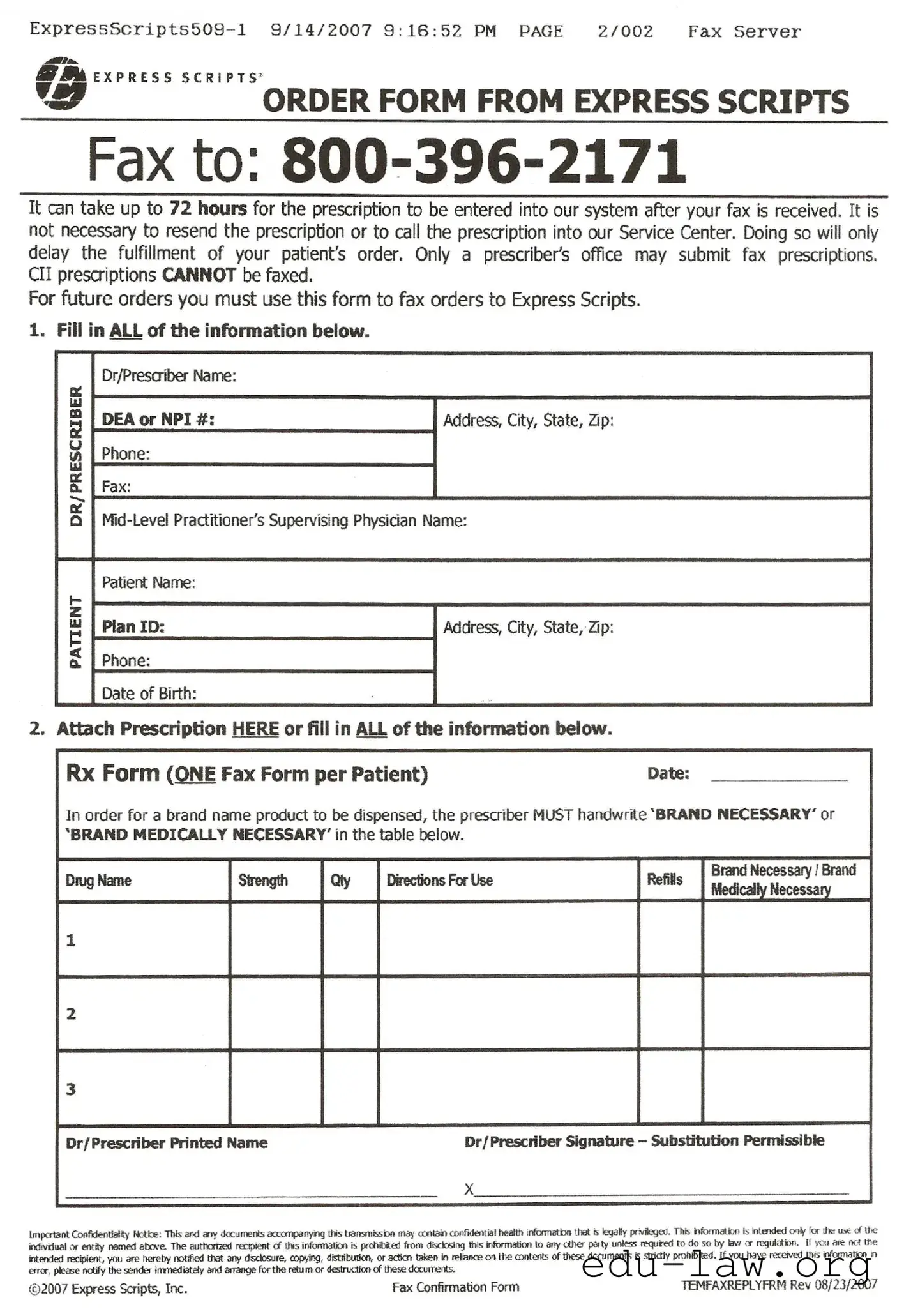
The Express Scripts form is an essential tool for healthcare providers looking to manage prescriptions efficiently. Designed specifically for fax submissions, this form streamlines the ordering process for medications. It is crucial to fill out all required fields, including the prescriber’s information, patient details, and specific medication requests. Notably, the form prohibits faxing prescriptions for controlled substances classified as CII. For a brand-name medication to be dispensed, the prescriber must clearly indicate 'BRAND NECESSARY' or 'BRAND MEDICALLY NECESSARY' on the form. Once submitted, it can take up to 72 hours for the prescription to be processed in the system, so there is no need to resend the request or call the service center, as this may cause further delays. Each patient requires a separate fax form, ensuring that all information is organized and accessible. This careful attention to detail helps to maintain patient confidentiality and compliance with regulations surrounding health information.
_...
~. ORDER FORM FROM EXPRESS SCRIPTS
FAX TO:
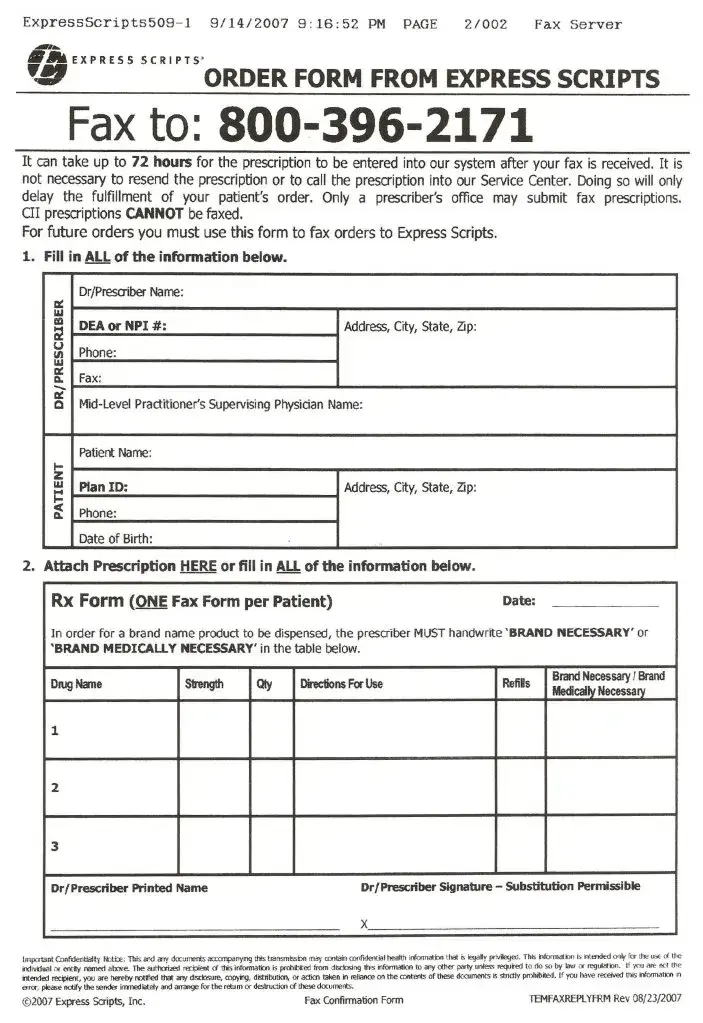
It can take up to 72 hours for the prescription to be entered into our system after your fax is received. It is not necessary to resend the prescription or to call the prescription into our Service Center. Doing so will only delay the fulfillment of your patient's order. Only a prescriber's office may submit fax prescriptions. CII prescriptions CANNOT be faxed.
For future orders you must use this form to fax orders to ExpressScripts.
1. Fill in ALL of the information below.
1:1I::
w m
Q! u
Ul
w
0.
1:1I::
c
Dr/Prescriber Name:
DEAor NPI #: |
Address, City, State, Zip: |
|
|
Phone:
Fax:
•z••
w
l-
ce
0.
Patient Name:
Plan 10:
Phone:
Date of Birth:
Address, City, State, Zip:
Rx Form (ONE Fax Form per Patient) |
Date: |
In order for a brand name product to be dispensed, the prescriber MUST handwrite 'BRAND NECESSARY' or 'BRAND MEDICALLY NECESSARY' in the table below.
DrugNcme
Strength
Qly
Directions For Use
RefiDs
Brand Necessary I Brand Medically Necessary
1
2
3
Dr/Prescriber |
Printed Name |
Dr/Prescriber |
Signature - SUbstitution Permissible |
X
l",pa1ant Confidentially I«:ti::e; This and any docurrents ao:anpanyilg this t",nsmissbn may coolain rooMential health irfumatbn that ~ "'Jilly pr.viege<J. Th~ ilfonnation is nlffid€d 0'!1y fo- tlle US<' D tl;e
iroi\ld""l elf entily named "beNe The ilUtlni2ed re::ipient d this infonmlim is prohibited from disf:.ta;i"'l this nformolioo In ony ctl\er party unless requred to do so by tNl C<reg_ion. If '1<:<1 "'" net It\e intended recipient, you are Ilereby notfied that ony dsclosure, <DP'ling, distributioo, OF adi<:n taken in relance O'! the rontel1ts of these dCOJmenrs ~ stri<lly pro/libited. If you have received !!lis i"lfomlatJon n error, please notify the sender illllled iately and "rr""ge fur the retu", or de>trueticn of these docurrerts.
©2007 Express SCripts, Inc. |
Fax ConfirmationForm |
TEMFAXREPlYFRMRev 08/23/2007 |
| Fact Name | Details |
|---|---|
| Prescription Submission | Only a prescriber's office can submit fax prescriptions to Express Scripts. |
| CII Prescriptions | Controlled Substance Schedule II (CII) prescriptions cannot be faxed. |
| Processing Time | It may take up to 72 hours for the prescription to be entered into the system after the fax is received. |
| Brand Name Requirement | For a brand name product to be dispensed, the prescriber must handwrite 'BRAND NECESSARY' or 'BRAND MEDICALLY NECESSARY'. |
| Patient Information | All patient information must be filled out completely on the order form. |
| Fax Number | Prescribers must fax the completed form to 800-396-2171. |
| Confidentiality Notice | The form contains confidential health information and is intended solely for the recipient named. |
After completing the Express Scripts form, you will need to fax it to the designated number. Ensure all required information is filled out accurately to avoid delays in processing. It is important to remember that only a prescriber's office can submit this fax, and certain restrictions apply to the types of prescriptions that can be faxed.
What is the purpose of the Express Scripts form?
The Express Scripts form is used by prescribers to submit fax prescriptions for medications to Express Scripts. This form ensures that all necessary information is provided for the prescription to be processed efficiently. It is specifically designed to streamline the ordering process for both prescribers and patients.
Who is authorized to submit the Express Scripts form?
Only prescribers' offices are permitted to submit fax prescriptions using the Express Scripts form. This restriction helps maintain the integrity of the prescription process and ensures that only qualified healthcare professionals are making medication requests.
Can controlled substances be faxed using this form?
No, prescriptions for Schedule II controlled substances (CII) cannot be faxed. This is a regulatory requirement aimed at preventing misuse and ensuring that these medications are prescribed and dispensed responsibly. For CII prescriptions, a written prescription must be provided instead.
What information is required to complete the form?
To properly complete the Express Scripts form, prescribers must fill in all requested information, including their name, DEA or NPI number, contact details, and the patient's information such as name, date of birth, and address. Additionally, details about the prescribed medication, including drug name, strength, quantity, and directions for use, must be included.
How long does it take for a prescription to be processed after faxing the form?
It can take up to 72 hours for the prescription to be entered into the Express Scripts system after the fax is received. Patients and prescribers should be aware of this timeline to manage expectations regarding medication availability.
What should I do if I need to submit a prescription for a brand-name medication?
If a brand-name product is necessary, the prescriber must handwrite 'BRAND NECESSARY' or 'BRAND MEDICALLY NECESSARY' on the form. This notation is crucial for ensuring that the pharmacy dispenses the specified brand rather than a generic alternative.
Is it necessary to resend the prescription if I do not receive confirmation?
No, it is not necessary to resend the prescription or call the Service Center if you do not receive immediate confirmation. Doing so may actually delay the fulfillment of the order. It is advisable to wait for the processing period to elapse before taking further action.
What should I do if I receive this form in error?
If you receive the Express Scripts form in error, it is important to notify the sender immediately. You should arrange for the return or destruction of the documents to ensure that confidential health information is not disclosed to unauthorized parties.
How can I ensure patient confidentiality when using this form?
When submitting the Express Scripts form, it is essential to handle all documents with care to protect patient confidentiality. Ensure that the fax is sent to the correct number and that unauthorized individuals do not have access to the information. Following these practices helps maintain compliance with privacy regulations.
Incomplete Information: One of the most common mistakes is not filling in all required fields. Every section, from the prescriber’s name to the patient’s address, is crucial for processing the order.
Incorrect DEA or NPI Number: Providing an incorrect DEA or NPI number can lead to significant delays. Always double-check these numbers for accuracy before submitting the form.
Faxing Controlled Substances: Remember, CII prescriptions cannot be faxed. Attempting to do so will result in rejection of the order.
Not Handwriting Necessary Brand Instructions: If a brand name product is essential, the prescriber must handwrite 'BRAND NECESSARY' or 'BRAND MEDICALLY NECESSARY'. Failing to do this can lead to substitutions that may not be acceptable.
Multiple Patients on One Form: Each patient requires a separate fax form. Submitting multiple patients on one form can cause confusion and delays in processing.
Missing Signature: The prescriber’s signature is mandatory. Without it, the order cannot be processed, and it will be returned for correction.
Not Following Up: While it’s advised not to call or resend the prescription, it’s still important to follow up if there’s no confirmation of receipt after 72 hours. This ensures that the order is being processed as expected.
When submitting a prescription through the Express Scripts form, there are several other documents that may be required to ensure a smooth process. Each of these forms serves a specific purpose and helps facilitate the prescription fulfillment. Understanding these documents can help both prescribers and patients navigate the process more effectively.
By being aware of these forms, prescribers and patients can work together more effectively. Each document plays a crucial role in ensuring that prescriptions are handled correctly and that patients receive the care they need.
The Express Scripts order form is similar to a prescription order form used in many healthcare settings. Both documents serve the same fundamental purpose: to provide necessary information for medications to be dispensed. They require details about the patient, the prescriber, and the medication itself. The layout often includes sections for drug names, dosages, and directions for use, ensuring that pharmacists have all the information needed to fill the prescription accurately.
Another document that shares similarities is the medication refill request form. This form is used by patients or their caregivers to request refills on existing prescriptions. Like the Express Scripts form, it includes patient identification details and specific medication information. It streamlines the process for pharmacies, ensuring that refills can be processed without delays, much like the order form facilitates new prescriptions.
The prior authorization request form is also comparable. Healthcare providers use this document to obtain approval from insurance companies before a specific medication is prescribed. Both forms require detailed patient and prescriber information, and they aim to ensure that the right medications are provided without unnecessary delays. The prior authorization form can help avoid complications that might arise from insurance denials, similar to how the Express Scripts form aims to expedite the fulfillment of prescriptions.
In addition, the medication therapy management (MTM) form bears resemblance to the Express Scripts form. MTM forms are used by pharmacists to document patient medication reviews and recommendations. They require comprehensive patient information and medication details, similar to the order form. The focus on patient safety and effective medication use connects these two documents, as both aim to optimize patient outcomes.
The patient consent form is another document that aligns with the Express Scripts order form. This form is used to obtain permission from patients for their healthcare providers to share their medical information with pharmacies or other entities. Both documents emphasize the importance of patient confidentiality and require specific patient details to ensure compliance with privacy regulations.
The insurance claim form also shares similarities with the Express Scripts order form. This document is submitted to insurance companies to claim reimbursement for medications dispensed. Like the order form, it includes patient and prescriber information and details about the medication. Both documents play crucial roles in ensuring that patients receive their medications without financial barriers.
Furthermore, the medication administration record (MAR) is akin to the Express Scripts form. MARs are used in healthcare settings to track the administration of medications to patients. They require detailed information about the patient and the medications, similar to the order form. The emphasis on accurate documentation helps ensure patient safety and proper medication management in both cases.
Lastly, the discharge medication list is comparable to the Express Scripts order form. This document is provided to patients upon discharge from a healthcare facility, listing all medications prescribed for home use. It includes similar information about the patient and medications, ensuring continuity of care. Both documents aim to facilitate the safe transition of patients from one care setting to another, highlighting the importance of clear communication in healthcare.
When filling out the Express Scripts order form, there are several important steps to keep in mind. Below is a list of things you should and shouldn't do to ensure a smooth process.
By following these guidelines, you can help ensure that the prescription is processed efficiently and correctly. Taking the time to carefully fill out the form can save everyone involved from potential headaches later on.
Misconceptions about the Express Scripts form can lead to confusion and delays in processing prescriptions. Here are five common misunderstandings:
Understanding these points can help streamline the process and ensure that prescriptions are filled correctly and efficiently.
When using the Express Scripts form, it's essential to follow specific guidelines to ensure a smooth process. Here are some key takeaways to keep in mind:
By adhering to these guidelines, you can facilitate a more efficient process for prescription fulfillment through Express Scripts.