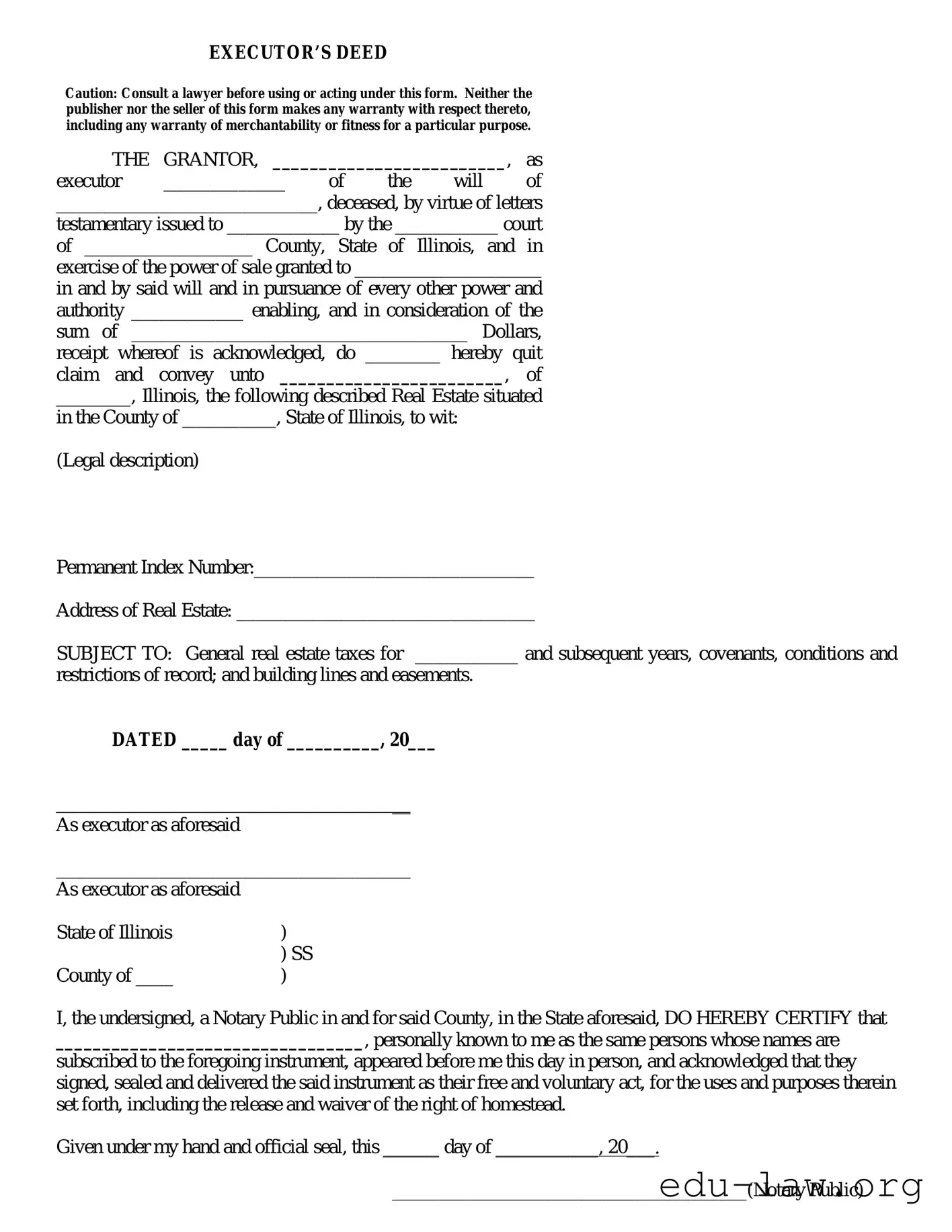
When dealing with the transfer of real estate following someone's passing, an Executor Deed form plays a crucial role. This document is utilized by the executor of an estate, who is appointed to manage the deceased's assets and ensure their wishes are honored as outlined in their will. The form is designed to facilitate the transfer of property from the estate to a designated beneficiary or buyer, thereby providing legal clarity and protection for all parties involved. Key components of the Executor Deed include the identification of the grantor, who is typically the executor, and the acknowledgment of the legal authority granted by the court through letters testamentary. Additionally, the deed outlines the consideration—often a monetary amount—received for the property, along with a detailed description of the real estate being conveyed. It is important to note that the deed is subject to existing taxes, covenants, and restrictions, ensuring that the new owner is aware of any obligations tied to the property. Furthermore, the document must be notarized to validate the signatures and affirm the authenticity of the transaction. Understanding these elements can empower individuals navigating the complexities of estate management and property transfer.

EXECUTOR’S DEED
Caution: Consult a lawyer before using or acting under this form. Neither the publisher nor the seller of this form makes any warranty with respect thereto, including any warranty of merchantability or fitness for a particular purpose.
THE GRANTOR, _________________________, as
executor _____________ of the will of
____________________________, deceased, by virtue of letters
testamentary issued to ____________ by the ___________ court
of __________________ County, State of Illinois, and in
exercise of the power of sale granted to ____________________
in and by said will and in pursuance of every other power and authority ____________ enabling, and in consideration of the
sum of ____________________________________ Dollars,
receipt whereof is acknowledged, do ________ hereby quit
claim and convey unto ________________________, of
________, Illinois, the following described Real Estate situated
in the County of __________, State of Illinois, to wit:
(Legal description)
Permanent Index Number:______________________________
Address of Real Estate: ________________________________
SUBJECT TO: General real estate taxes for ___________ and subsequent years, covenants, conditions and
restrictions of record; and building lines and easements.
DATED _____ day of __________, 20___
__
As executor as aforesaid
______________________________________
As executor as aforesaid
State of Illinois |
) |
|
) SS |
County of ____ |
) |
I, the undersigned, a Notary Public in and for said County, in the State aforesaid, DO HEREBY CERTIFY that
_________________________________, personally known to me as the same persons whose names are
subscribed to the foregoing instrument, appeared before me this day in person, and acknowledged that they signed, sealed and delivered the said instrument as their free and voluntary act, for the uses and purposes therein set forth, including the release and waiver of the right of homestead.
Given under my hand and official seal, this ______ day of ___________, 20___.
______________________________________(Notary Public)
This instrument was prepared by:
MAIL RECORDED INSTRUMENT TO:
SEND SUBSEQUENT TAX BILLS TO:
| Fact Name | Description |
|---|---|
| Definition | An Executor Deed is a legal document used by an executor to transfer property from a deceased person's estate to a beneficiary. |
| Governing Law | In Illinois, the Executor Deed is governed by the Illinois Probate Act (755 ILCS 5). |
| Executor's Role | The executor is responsible for managing the deceased's estate and ensuring that assets are distributed according to the will. |
| Power of Sale | The deed must indicate that the executor has the power of sale granted in the deceased's will. |
| Consideration | The deed must state the amount of money received in exchange for the property transfer. |
| Real Estate Description | A legal description of the property being transferred must be included in the deed. |
| Notary Requirement | The executor's signature must be notarized to validate the deed. |
| Homestead Waiver | The deed may include a waiver of the right of homestead, allowing the property to be sold without the homestead exemption. |
| Tax Responsibilities | The deed should note that the property is subject to general real estate taxes and any existing covenants or easements. |
After completing the Executor Deed form, the next step involves ensuring that all necessary signatures are obtained and that the document is properly notarized. This deed must then be filed with the appropriate county office to finalize the transfer of property. Follow these steps to fill out the form accurately.
What is an Executor Deed?
An Executor Deed is a legal document used to transfer ownership of real estate from a deceased person's estate to a beneficiary or buyer. This deed is executed by the executor of the estate, who is appointed to manage the deceased’s affairs according to the will. The executor must have the authority to sell the property, as granted in the will or by court order.
Who can execute an Executor Deed?
The executor of the estate, appointed through the probate process, is the individual who can execute an Executor Deed. This person is responsible for ensuring that the deceased's wishes are fulfilled, including the transfer of real estate as specified in the will.
What information is required on the Executor Deed?
The Executor Deed must include several key pieces of information. This includes the name of the grantor (the executor), the name of the deceased, the details of the will, the legal description of the property, and the consideration amount (the sale price or value of the property). Additionally, it should specify any conditions or restrictions related to the property.
Is notarization required for an Executor Deed?
Yes, notarization is required for an Executor Deed. The executor must sign the deed in the presence of a notary public, who will then certify the signature. This step is crucial for validating the document and ensuring its acceptance in real estate transactions.
What are the tax implications of using an Executor Deed?
Using an Executor Deed may have tax implications for both the estate and the beneficiary. The property may be subject to estate taxes, and the beneficiary may face capital gains taxes if they sell the property in the future. It is advisable to consult a tax professional to understand the specific tax consequences involved.
Can an Executor Deed be contested?
Yes, an Executor Deed can be contested. Interested parties, such as heirs or beneficiaries who feel wronged, may challenge the validity of the deed or the executor's authority. Grounds for contesting may include claims of improper execution, lack of authority, or disputes over the terms of the will.
What happens if the Executor Deed is not properly executed?
If an Executor Deed is not properly executed, it may not be legally binding. This could lead to complications in the transfer of property ownership, potentially resulting in disputes or delays. It is essential to ensure that all legal requirements are met when preparing and signing the deed.
Where should the Executor Deed be recorded?
The Executor Deed should be recorded in the county where the property is located. Recording the deed provides public notice of the transfer and protects the rights of the new owner. It is advisable to check with the local recorder's office for specific recording procedures and fees.
Incomplete Information: Failing to fill in all required fields can lead to significant delays or even invalidation of the deed.
Incorrect Names: Using the wrong names for the grantor or grantee can create confusion and legal issues.
Missing Legal Description: Omitting the legal description of the property can result in the deed being unenforceable.
Improper Acknowledgment: Not having the signatures properly notarized may render the deed invalid.
Failure to Mention Taxes: Not specifying outstanding taxes or assessments can lead to future disputes.
Incorrect Notary Information: Providing inaccurate information about the notary can lead to complications during the verification process.
Signature Issues: Having the wrong person sign the deed or failing to sign at all can invalidate the document.
Ignoring State Requirements: Each state has specific requirements for executing a deed. Ignoring these can cause legal problems.
Not Consulting a Lawyer: Skipping legal advice can result in mistakes that might have been easily avoided.
The Executor Deed is a crucial document in the process of transferring property from a deceased individual to their beneficiaries. However, several other forms and documents are often used in conjunction with the Executor Deed to ensure that the transfer is legally sound and properly documented. Below is a list of these related documents, each serving a specific purpose in the estate administration process.
Understanding these documents and their roles in the estate administration process can greatly assist executors and beneficiaries alike. Each form contributes to a clearer and more organized transfer of property, ensuring that the deceased's wishes are honored while adhering to legal requirements.
The Executor Deed is similar to a Warranty Deed in that both documents serve to transfer ownership of real property. A Warranty Deed guarantees that the grantor holds clear title to the property and has the right to sell it. The grantor also assures the grantee that the property is free from any encumbrances, except those expressly stated in the deed. This assurance provides a level of security for the buyer, as they can trust that the seller has the legal authority to make the transfer and that the property is not subject to hidden claims.
Another document akin to the Executor Deed is the Quitclaim Deed. This type of deed conveys whatever interest the grantor may have in the property without any warranties. Unlike the Executor Deed, which is executed by an executor of an estate, a Quitclaim Deed can be used by anyone who wishes to transfer their interest in a property. This document is often utilized in situations involving family transfers or divorce settlements, where the parties may not require the assurances that come with a Warranty Deed.
A third document that bears similarities to the Executor Deed is the Personal Representative Deed. This deed is executed by a personal representative of an estate, typically following the same principles as the Executor Deed. The Personal Representative Deed is used to transfer property from a deceased person's estate to a beneficiary or buyer. Both deeds are executed under the authority granted by a probate court, ensuring that the transfer complies with legal requirements and respects the wishes of the deceased as outlined in their will.
The Special Warranty Deed is another document comparable to the Executor Deed. This deed provides a limited warranty, which only covers the period during which the grantor owned the property. The grantor does not guarantee that the property is free from encumbrances prior to their ownership. This is different from the Executor Deed, which does not provide any warranties but is focused on the authority of the executor to convey the property as specified in the will. The Special Warranty Deed is often used in commercial real estate transactions.
Lastly, the Bargain and Sale Deed shares some similarities with the Executor Deed. This type of deed conveys property without any warranties, similar to a Quitclaim Deed. However, it implies that the grantor has title to the property and the right to sell it. The Executor Deed, while also lacking warranties, emphasizes the executor's authority to act on behalf of the estate. Both documents serve to facilitate the transfer of property but differ in their implications regarding the grantor's ownership rights and responsibilities.
When filling out the Executor Deed form, it is essential to proceed with caution and care. Here are six important do's and don'ts to keep in mind:
Understanding the Executor Deed form can be challenging. Here are ten common misconceptions about this form.
Being aware of these misconceptions can help in understanding the Executor Deed form better. It is always wise to seek guidance when dealing with legal documents related to estate matters.
Filling out and using the Executor Deed form requires careful attention to detail. Here are some key takeaways to consider:
By following these guidelines, you can ensure that the Executor Deed form is filled out correctly and used effectively.