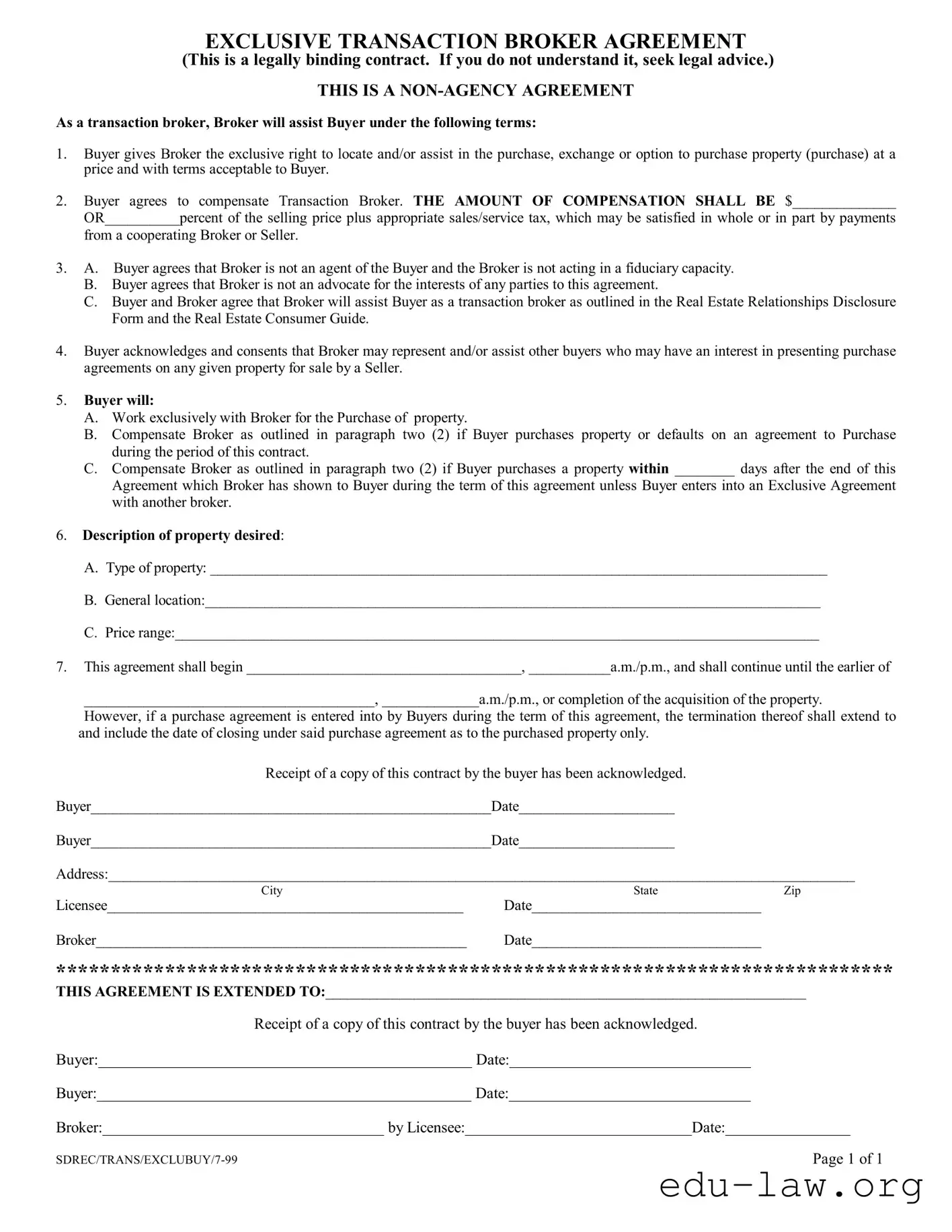
The Exclusive Transaction Broker Agreement is a pivotal document in real estate transactions, designed to clarify the relationship between the buyer and the broker. This agreement establishes that the broker will act as a transaction facilitator rather than as an agent, meaning they do not represent the buyer's interests in a fiduciary capacity. The buyer grants the broker the exclusive right to assist in locating and negotiating the purchase of property, which can include options for exchange or purchase. Compensation for the broker is outlined clearly, specifying either a fixed amount or a percentage of the selling price, potentially supplemented by payments from cooperating brokers or sellers. The agreement also emphasizes that the broker may represent other buyers interested in the same properties, ensuring transparency in the broker's role. Furthermore, it requires the buyer to work exclusively with the broker during the contract's duration and to compensate the broker if a purchase occurs during the contract period or shortly after its conclusion. The document includes sections for detailing the type of property sought, its location, and the desired price range, ensuring that both parties have a clear understanding of expectations. Lastly, the agreement specifies its effective dates and conditions for termination, reinforcing the importance of clarity and mutual consent in the real estate process.
EXCLUSIVE TRANSACTION BROKER AGREEMENT
(This is a legally binding contract. If you do not understand it, seek legal advice.)
THIS IS A
As a transaction broker, Broker will assist Buyer under the following terms:
1.Buyer gives Broker the exclusive right to locate and/or assist in the purchase, exchange or option to purchase property (purchase) at a price and with terms acceptable to Buyer.
2.Buyer agrees to compensate Transaction Broker. THE AMOUNT OF COMPENSATION SHALL BE $______________
OR__________percent of the selling price plus appropriate sales/service tax, which may be satisfied in whole or in part by payments from a cooperating Broker or Seller.
3.A. Buyer agrees that Broker is not an agent of the Buyer and the Broker is not acting in a fiduciary capacity.
B.Buyer agrees that Broker is not an advocate for the interests of any parties to this agreement.
C.Buyer and Broker agree that Broker will assist Buyer as a transaction broker as outlined in the Real Estate Relationships Disclosure Form and the Real Estate Consumer Guide.
4.Buyer acknowledges and consents that Broker may represent and/or assist other buyers who may have an interest in presenting purchase agreements on any given property for sale by a Seller.
5.Buyer will:
A.Work exclusively with Broker for the Purchase of property.
B.Compensate Broker as outlined in paragraph two (2) if Buyer purchases property or defaults on an agreement to Purchase during the period of this contract.
C.Compensate Broker as outlined in paragraph two (2) if Buyer purchases a property within ________ days after the end of this Agreement which Broker has shown to Buyer during the term of this agreement unless Buyer enters into an Exclusive Agreement with another broker.
6.Description of property desired:
A.Type of property: ___________________________________________________________________________________
B.General location:___________________________________________________________________________________
C.Price range:_______________________________________________________________________________________
7.This agreement shall begin _____________________________________, ___________a.m./p.m., and shall continue until the earlier of
_______________________________________, _____________a.m./p.m., or completion of the acquisition of the property.
However, if a purchase agreement is entered into by Buyers during the term of this agreement, the termination thereof shall extend to and include the date of closing under said purchase agreement as to the purchased property only.
Receipt of a copy of this contract by the buyer has been acknowledged.
Buyer______________________________________________________Date_____________________
Buyer______________________________________________________Date_____________________
Address:_____________________________________________________________________________________________________
City |
State |
Zip |
Licensee________________________________________________ |
Date_______________________________ |
|
Broker__________________________________________________ |
Date_______________________________ |
|
*****************************************************************************
THIS AGREEMENT IS EXTENDED TO:_________________________________________________________________
Receipt of a copy of this contract by the buyer has been acknowledged.
Buyer:________________________________________________ Date:_______________________________
Buyer:________________________________________________ Date:_______________________________
Broker:____________________________________ by Licensee:_____________________________Date:________________
Page 1 of 1 |
| Fact Name | Fact Description |
|---|---|
| Contract Type | This is an Exclusive Transaction Broker Agreement, which is a legally binding contract. |
| Non-Agency Agreement | The agreement specifies that the Broker is not acting as an agent or fiduciary for the Buyer. |
| Broker's Role | The Broker assists the Buyer in locating and purchasing property under specified terms. |
| Compensation | The Buyer agrees to compensate the Broker either with a specified amount or a percentage of the selling price. |
| Multiple Representation | The Buyer acknowledges that the Broker may represent other buyers interested in the same property. |
| Exclusivity | The Buyer commits to work exclusively with the Broker for property purchases during the agreement period. |
| Agreement Duration | The agreement begins and ends on specified dates and times, or upon completion of the property acquisition. |
| State Governing Law | This agreement is governed by the laws of the state where the property is located. |
Filling out the Exclusive Transaction Broker Agreement form is an important step in your real estate process. Please follow the steps below to complete the form accurately. Make sure to review your entries before submitting the form.
Once you have completed all the steps, ensure that you keep a copy for your records. This agreement is a crucial part of your real estate transaction process.
What is the Exclusive Transaction Broker Agreement?
The Exclusive Transaction Broker Agreement is a legally binding contract that establishes a relationship between a buyer and a broker. In this agreement, the broker assists the buyer in locating and purchasing property. It is important to note that this is a non-agency agreement, meaning the broker does not act as an agent or advocate for the buyer's interests.
What are the buyer's responsibilities under this agreement?
The buyer agrees to work exclusively with the broker for the purchase of property. Additionally, the buyer must compensate the broker as specified in the agreement, regardless of whether the purchase is completed or if the buyer defaults on the agreement. If the buyer purchases a property shown by the broker within a specified time frame after the agreement ends, the buyer is still responsible for compensation.
How is the broker compensated?
The compensation for the broker is determined in the agreement. It can either be a specific dollar amount or a percentage of the selling price, plus any applicable sales or service tax. This compensation may be partially covered by payments from a cooperating broker or seller.
Can the broker represent other buyers?
Yes, the buyer acknowledges that the broker may represent or assist other buyers who are interested in making offers on the same property. This is an important aspect of the transaction broker relationship, as it ensures that the broker can serve multiple clients without being in a fiduciary role for any single party.
What happens if the buyer purchases a property after the agreement ends?
If the buyer purchases a property that the broker has shown them within a specified number of days after the agreement ends, the buyer is still required to compensate the broker. This obligation remains unless the buyer enters into an exclusive agreement with another broker.
How long does the agreement last?
The agreement specifies a start date and will continue until either a designated end date or the completion of the property acquisition. If a purchase agreement is made during the term of the Exclusive Transaction Broker Agreement, the agreement will extend to cover the closing date of that purchase.
Incomplete Compensation Details: One common mistake is failing to fill in the compensation amount or percentage. This section is crucial as it defines how the broker will be paid for their services. Leaving it blank can lead to misunderstandings later.
Misunderstanding the Broker's Role: Many buyers mistakenly assume that the broker is acting as their agent. The agreement clearly states that the broker is a transaction broker, not an agent. This distinction is important for understanding the level of representation and support provided.
Neglecting to Specify Property Details: Buyers often forget to provide specific details about the property they are interested in. This includes the type of property, general location, and price range. Without this information, the broker may struggle to meet the buyer's needs effectively.
Ignoring the Agreement Duration: Some buyers overlook the importance of specifying the start and end dates of the agreement. Clear timelines help both parties understand the duration of their commitment and avoid potential disputes regarding the agreement's validity.
The Exclusive Transaction Broker Agreement is often accompanied by several other forms and documents that facilitate the real estate transaction process. Each of these documents serves a specific purpose and is essential for ensuring clarity and compliance throughout the transaction. Below is a list of commonly used forms.
Understanding these documents is crucial for both buyers and brokers. Each form plays a vital role in ensuring that the transaction proceeds smoothly and that all parties are informed of their rights and responsibilities. Proper use of these documents can help mitigate misunderstandings and potential disputes.
The Exclusive Buyer Representation Agreement is quite similar to the Exclusive Transaction Broker Agreement. Both documents establish a formal relationship between a buyer and a broker, outlining the expectations and responsibilities of each party. In the Exclusive Buyer Representation Agreement, the broker acts as an advocate for the buyer, providing fiduciary duties and loyalty. This contrasts with the transaction broker role, where the broker does not represent the buyer's interests in a fiduciary capacity. Both agreements, however, emphasize the importance of compensation and the exclusive nature of the relationship, ensuring that the broker is compensated for their efforts in helping the buyer secure a property.
The Listing Agreement shares similarities with the Exclusive Transaction Broker Agreement as both are contracts that define the relationship between a broker and their client. In a Listing Agreement, the seller grants the broker the exclusive right to sell their property, while the Exclusive Transaction Broker Agreement focuses on assisting the buyer in locating a property. Both documents require clear terms regarding compensation and the duration of the agreement. They also specify that the broker may work with multiple clients, but the nature of the relationship differs, as the Listing Agreement involves agency representation for the seller.
The Buyer Agency Agreement is another document akin to the Exclusive Transaction Broker Agreement. While both agreements establish a working relationship between a buyer and a broker, the Buyer Agency Agreement creates an agency relationship, where the broker acts in the best interests of the buyer. This contrasts with the transaction broker's role, which is more neutral and does not advocate for one party over another. Both agreements outline the buyer's obligations, including compensation and the exclusive nature of the relationship, but the level of representation and loyalty varies significantly between the two.
Finally, the Real Estate Consumer Guide complements the Exclusive Transaction Broker Agreement by providing essential information about the roles of various parties involved in real estate transactions. While the Exclusive Transaction Broker Agreement focuses on the specific terms of the relationship between the buyer and the broker, the Real Estate Consumer Guide educates buyers about their rights and the services they can expect. Both documents aim to enhance transparency in real estate transactions, ensuring that buyers understand the nature of their relationship with the broker and the implications of the agreement they are entering into.
When filling out the Exclusive Transaction Broker Agreement form, it is important to follow certain guidelines to ensure accuracy and compliance. Below is a list of things to do and avoid.
There are several misconceptions about the Exclusive Transaction Broker Agreement form that can lead to confusion for buyers. Understanding these misconceptions can help clarify what this agreement entails.
Understanding these points can help buyers navigate the Exclusive Transaction Broker Agreement with greater confidence and clarity.
Understanding the Exclusive Transaction Broker Agreement is crucial for both buyers and brokers. Here are key takeaways to keep in mind: