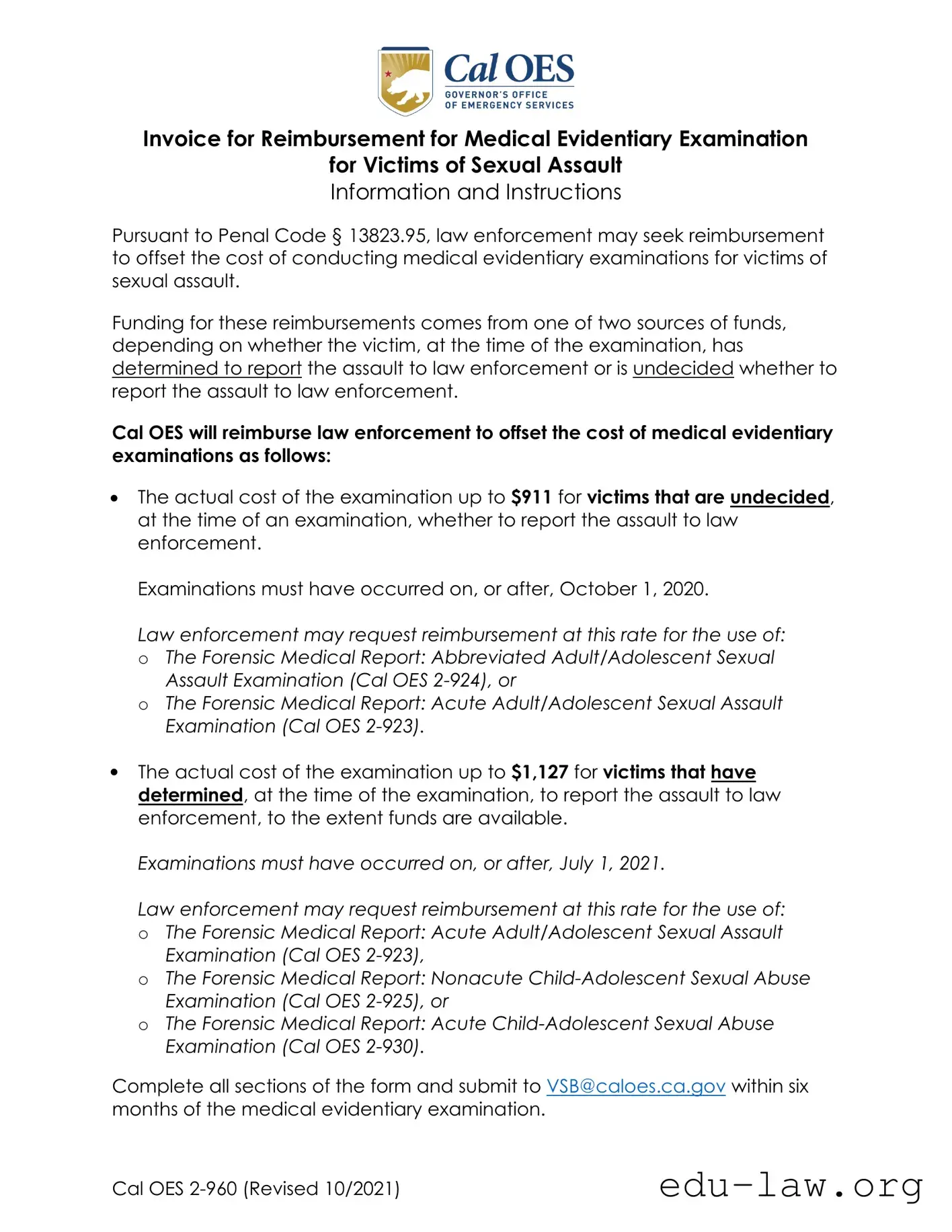
The Examination Invoice form serves a crucial role in the reimbursement process for medical evidentiary examinations conducted for victims of sexual assault. This form is designed to facilitate law enforcement agencies in seeking financial support to cover the costs associated with these sensitive examinations. Under Penal Code § 13823.95, funding is available from two distinct sources, depending on whether the victim has chosen to report the assault or remains undecided at the time of the examination. For those victims who are uncertain about reporting, law enforcement can claim reimbursement for actual examination costs up to $911, provided the examination occurred on or after October 1, 2020. Conversely, if the victim has decided to report the assault, law enforcement may request reimbursement of up to $1,127 for examinations conducted on or after July 1, 2021, contingent upon available funds. The form requires detailed information, including the type of forensic medical report used and the relevant case details. It is imperative that all sections of the form are completed accurately and submitted to the designated email address within six months of the examination date. By signing the form, the submitter certifies the accuracy of the information provided, acknowledging the potential consequences of submitting false claims. This process not only supports victims in their recovery but also reinforces the importance of thorough documentation in the pursuit of justice.

Invoice for Reimbursement for Medical Evidentiary Examination
for Victims of Sexual Assault Information and Instructions
Pursuant to Penal Code § 13823.95, law enforcement may seek reimbursement to offset the cost of conducting medical evidentiary examinations for victims of sexual assault.
Funding for these reimbursements comes from one of two sources of funds, depending on whether the victim, at the time of the examination, has determined to report the assault to law enforcement or is undecided whether to report the assault to law enforcement.
Cal OES will reimburse law enforcement to offset the cost of medical evidentiary examinations as follows:
•The actual cost of the examination up to $911 for victims that are undecided, at the time of an examination, whether to report the assault to law enforcement.
Examinations must have occurred on, or after, October 1, 2020.
Law enforcement may request reimbursement at this rate for the use of: o The Forensic Medical Report: Abbreviated Adult/Adolescent Sexual
Assault Examination (Cal OES
o The Forensic Medical Report: Acute Adult/Adolescent Sexual Assault Examination (Cal OES
•The actual cost of the examination up to $1,127 for victims that have determined, at the time of the examination, to report the assault to law enforcement, to the extent funds are available.
Examinations must have occurred on, or after, July 1, 2021.
Law enforcement may request reimbursement at this rate for the use of: o The Forensic Medical Report: Acute Adult/Adolescent Sexual Assault
Examination (Cal OES
o The Forensic Medical Report: Nonacute
o The Forensic Medical Report: Acute
Complete all sections of the form and submit to [email protected] within six months of the medical evidentiary examination.
Cal OES

Invoice for Reimbursement for Medical Evidentiary Examination
for Victims of Sexual Assault
Law Enforcement Agency: ___________________________________________________
Physical Address: ____________________________________________________________
Payment Mailing Address: ____________________________________________________
Exams for victims that are undecided, at the time of an examination, whether to report the assault to law enforcement.
|
|
|
Reimbursement |
|
Date of |
Case # |
Actual Cost of |
Requested (no |
|
Examination |
Exam |
more than $911 |
||
|
||||
|
|
|
per examination) |
|
|
|
|
|
|
|
|
|
|
|
|
|
|
|
|
|
|
|
|
|
|
|
|
|
|
|
|
Total Requested |
$ 0.00 |
Exams for victims that have determined, at the time of the examination, to report the assault to law enforcement. This includes examinations for all children under the age of 12.
Date of
Examination
Case #
Actual Cost of
Exam
Reimbursement Requested (no more than $1,127 per examination)
Total Requested
$ 0.00
By submitting this form I certify to the best of my knowledge and belief that the information on the invoice is true, complete, and accurate. I am aware that any false, fictious, or fraudulent information, or the omission of any material fact, may subject me to criminal, civil, or administrative penalties for fraud, false statements, false claims, or otherwise.
Submitted By: _______________________________________________________________
Telephone: ________________ Email: _________________________________________
Cal OES
| Fact Name | Description |
|---|---|
| Purpose | The Examination Invoice form is used for reimbursement of medical evidentiary examinations for victims of sexual assault. |
| Governing Law | This form is governed by Penal Code § 13823.95, which outlines the reimbursement process for law enforcement agencies. |
| Reimbursement Amount (Undecided Victims) | Law enforcement can request reimbursement up to $911 for examinations of victims who are undecided about reporting the assault. |
| Reimbursement Amount (Decided Victims) | For victims who have decided to report the assault, the reimbursement can be up to $1,127, subject to fund availability. |
| Submission Deadline | The completed form must be submitted within six months of the medical evidentiary examination to [email protected]. |
After completing the Examination Invoice form, the next step is to submit it to the appropriate email address within the specified timeframe. Ensure all information is accurate and complete before sending to avoid delays in reimbursement.
Once all fields are completed, review the form for accuracy. Submit the finished form to [email protected] within six months of the examination date.
What is the purpose of the Examination Invoice form?
The Examination Invoice form is designed for law enforcement agencies to request reimbursement for the costs associated with medical evidentiary examinations conducted for victims of sexual assault. This form allows agencies to recover expenses incurred during these examinations, which are essential for gathering evidence and providing medical care to victims.
Who is eligible for reimbursement under this program?
Reimbursement is available for examinations of victims of sexual assault based on their decision to report the incident to law enforcement at the time of the examination. If a victim is undecided about reporting, law enforcement can seek reimbursement up to $911. If the victim has decided to report, the reimbursement can be up to $1,127, provided that funds are available.
What types of examinations are covered by this reimbursement?
The reimbursement covers specific forensic medical reports depending on the victim's decision to report the assault. For victims who are undecided, the eligible reports include the Forensic Medical Report: Abbreviated Adult/Adolescent Sexual Assault Examination and the Forensic Medical Report: Acute Adult/Adolescent Sexual Assault Examination. For those who have decided to report, the eligible reports include the Forensic Medical Report: Acute Adult/Adolescent Sexual Assault Examination, the Forensic Medical Report: Nonacute Child-Adolescent Sexual Abuse Examination, and the Forensic Medical Report: Acute Child-Adolescent Sexual Abuse Examination.
What is the time frame for submitting the Examination Invoice form?
Law enforcement agencies must submit the Examination Invoice form within six months of the medical evidentiary examination. Timely submission is crucial to ensure that reimbursement requests are processed efficiently and to avoid any potential delays in funding.
Are there any specific dates when the examinations must have occurred to be eligible for reimbursement?
Yes, the examinations must have occurred on or after October 1, 2020, for victims who are undecided about reporting. For victims who have decided to report, the examinations must have taken place on or after July 1, 2021. These date requirements ensure that only recent examinations are eligible for reimbursement under the current funding guidelines.
What information must be included on the Examination Invoice form?
The form requires several key pieces of information, including the law enforcement agency's name, physical address, and payment mailing address. Additionally, agencies must provide details about each examination, such as the date of the examination, case number, actual cost of the exam, and the total amount requested for reimbursement. All sections of the form must be completed accurately to facilitate processing.
What happens if false information is provided on the form?
Submitting false, fictitious, or fraudulent information on the Examination Invoice form can lead to serious consequences. Individuals may face criminal, civil, or administrative penalties for fraud or false statements. Therefore, it is essential to ensure that all information provided is true, complete, and accurate before submission.
How can law enforcement agencies submit the completed Examination Invoice form?
Once the Examination Invoice form is completed, law enforcement agencies should submit it via email to [email protected]. This electronic submission process helps streamline the reimbursement request and ensures that the necessary documentation is received promptly.
Failing to complete all sections of the form. Each section is crucial for processing the reimbursement.
Not providing accurate dates for the examinations. This information is essential for determining eligibility for reimbursement.
Omitting the case number. This number links the examination to the specific incident and is required for tracking purposes.
Requesting reimbursement amounts that exceed the allowable limits. For victims undecided about reporting, the maximum is $911, while for those who have decided to report, it is $1,127.
Not submitting the form within the six-month deadline. Timeliness is critical for processing the reimbursement.
Using incorrect or outdated forms. Always ensure that the most recent version of the form is used.
Providing an incomplete or incorrect mailing address. This can delay the reimbursement process.
Neglecting to include the name and contact information of the person submitting the form. This information is necessary for follow-up.
Failing to certify the accuracy of the information provided. This certification is a legal requirement and should not be overlooked.
Not keeping a copy of the submitted invoice for personal records. Retaining a copy can be useful for future reference or disputes.
The Examination Invoice form serves as a critical document for law enforcement agencies seeking reimbursement for medical evidentiary examinations conducted on victims of sexual assault. Alongside this form, several other documents are commonly utilized to facilitate the reimbursement process and ensure compliance with legal requirements. Below is a list of these essential forms and documents.
These documents collectively ensure a streamlined process for reimbursement, safeguarding the rights of victims while facilitating the necessary financial support for law enforcement agencies. Proper completion and submission of these forms are essential for compliance with state regulations and the effective handling of sensitive cases.
The Examination Invoice form is similar to a Medical Billing Statement. Both documents serve the purpose of detailing the costs associated with medical services rendered. A Medical Billing Statement provides a breakdown of charges, payments, and any outstanding balances for medical treatments. Like the Examination Invoice, it is essential for reimbursement purposes, ensuring that healthcare providers receive payment for their services. Each document requires accurate information about the patient and the services provided to facilitate timely processing of claims.
Another document that shares similarities is the Insurance Claim Form. This form is used by individuals to request reimbursement from their insurance providers for medical expenses incurred. Like the Examination Invoice, it includes critical details such as the nature of the services provided and the costs associated with them. Both forms require the submission of supporting documentation to substantiate the claim, ensuring that the reimbursement process is transparent and efficient.
The Forensic Medical Report is also comparable to the Examination Invoice form. This report documents the findings from medical examinations conducted on victims of sexual assault. While the Examination Invoice focuses on reimbursement, the Forensic Medical Report provides the necessary medical evidence that may be used in legal proceedings. Both documents are vital in the context of sexual assault cases, as they work together to support victims in obtaining both medical care and financial assistance.
A Patient Receipt is another document that resembles the Examination Invoice. This receipt provides proof of payment for medical services rendered and often includes details such as the date of service, type of service, and total amount paid. Similar to the Examination Invoice, it serves as a record for both the patient and the service provider, facilitating any future reimbursement requests or insurance claims.
Lastly, the Expense Reimbursement Form is akin to the Examination Invoice. This form is used by employees to request reimbursement for expenses incurred while performing work-related duties. Both forms require the submission of detailed information about the costs incurred and the purpose of those expenses. They are essential for ensuring that individuals receive proper compensation for their out-of-pocket costs, whether in a medical context or a business setting.
When filling out the Examination Invoice form, attention to detail is crucial. Below is a list of ten important dos and don’ts to guide you through the process.
Misconceptions about the Examination Invoice form can lead to confusion and errors in the reimbursement process. Below are some common misunderstandings clarified for better comprehension.
When filling out and using the Examination Invoice form for reimbursement of medical evidentiary examinations for victims of sexual assault, keep the following key points in mind: