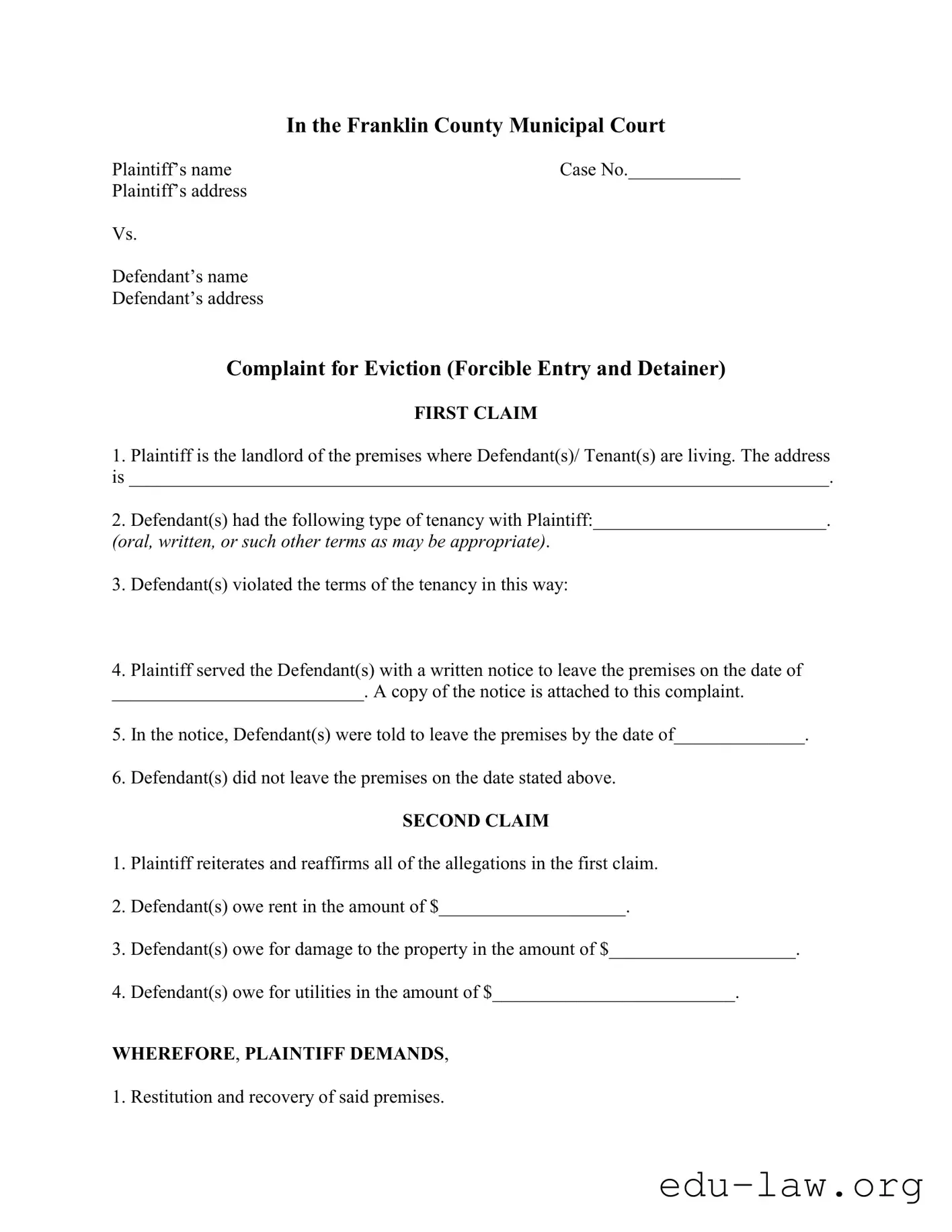
The Eviction Complaint form for Franklin County serves as a crucial legal document for landlords seeking to regain possession of their rental properties. This form is used in the Franklin County Municipal Court and requires the plaintiff, typically the landlord, to provide essential information, including their name, address, and the case number. The form outlines the relationship between the landlord and the tenant, detailing the nature of the tenancy—whether oral, written, or otherwise defined. It specifies how the tenant has violated the terms of the tenancy and includes important dates, such as when the landlord served notice to the tenant to vacate the premises and the deadline by which the tenant was expected to leave. If the tenant fails to comply, the landlord can assert additional claims, including unpaid rent, property damage, and outstanding utility bills. The form concludes with a demand for restitution of the property and a request for judgment covering any owed amounts, such as back rent and damages. Proper completion of this form is essential for landlords to navigate the eviction process effectively.
|
In the Franklin County Municipal Court |
Plaintiff’s name |
Case No.____________ |
Plaintiff’s address |
|
Vs. |
|
Defendant’s name |
|
Defendant’s address |
|
Complaint for Eviction (Forcible Entry and Detainer)
FIRST CLAIM
1.Plaintiff is the landlord of the premises where Defendant(s)/ Tenant(s) are living. The address is ___________________________________________________________________________.
2.Defendant(s) had the following type of tenancy with Plaintiff:_________________________. (oral, written, or such other terms as may be appropriate).
3.Defendant(s) violated the terms of the tenancy in this way:
4.Plaintiff served the Defendant(s) with a written notice to leave the premises on the date of
___________________________. A copy of the notice is attached to this complaint.
5.In the notice, Defendant(s) were told to leave the premises by the date of______________.
6.Defendant(s) did not leave the premises on the date stated above.
SECOND CLAIM
1.Plaintiff reiterates and reaffirms all of the allegations in the first claim.
2.Defendant(s) owe rent in the amount of $____________________.
3.Defendant(s) owe for damage to the property in the amount of $____________________.
4.Defendant(s) owe for utilities in the amount of $__________________________.
WHEREFORE, PLAINTIFF DEMANDS,
1. Restitution and recovery of said premises.
2.Judgment for back rent, damages, late charges, and utilities in the amount of $_______________and costs and interest.
____________________________________________
SIGNATURE
_____________________________________________
NAME (PLEASE PRINT)
__________________________________________________
ADDRESS
__________________________________________________
CITY, STATE, ZIP CODE
__________________________________________________
TELEPHONE NUMBER
| Fact Name | Details |
|---|---|
| Governing Law | The Eviction Complaint in Franklin County is governed by Ohio Revised Code § 1923.01 et seq. |
| Plaintiff Information | The form requires the plaintiff's name and address to be clearly stated at the top. |
| Defendant Information | The defendant's name and address must also be included for proper identification. |
| Type of Tenancy | The form allows for the specification of the type of tenancy, such as oral or written agreement. |
| Notice Requirement | Plaintiffs must provide evidence of a written notice served to the defendant, which is attached to the complaint. |
| Claims for Damages | The form includes a section for detailing any unpaid rent, property damages, and utility costs owed by the defendant. |
| Restitution Request | The plaintiff demands restitution of the premises and may seek judgment for back rent and damages. |
Once you have gathered the necessary information, you can proceed to fill out the Eviction Complaint form for Franklin County. This form is essential for initiating the eviction process and requires accurate details about both the landlord and the tenant.
What is the Eviction Complaint Franklin County form?
The Eviction Complaint form is a legal document used in Franklin County Municipal Court to initiate the eviction process. It allows landlords, known as plaintiffs, to formally complain about a tenant, referred to as the defendant, who has violated the terms of their tenancy. This form outlines the reasons for eviction, such as non-payment of rent or other lease violations, and requests the court's intervention to regain possession of the property.
Who can file an Eviction Complaint?
Only landlords or property owners can file an Eviction Complaint. They must have a legal interest in the property and the right to evict the tenant. If a property is managed by a third party, such as a property management company, that entity may also file on behalf of the landlord, provided they have the necessary authority.
What information is required on the form?
The form requires specific details, including the names and addresses of both the plaintiff and defendant, the address of the rental property, the type of tenancy, and the reasons for eviction. Additionally, it must include the date the tenant was served a notice to leave and any amounts owed for rent, damages, or utilities.
What types of tenancy can be included in the complaint?
Tenancies can be classified as oral or written agreements. The form allows landlords to specify the nature of the tenancy, whether it was established through a formal lease, an informal agreement, or other terms that may apply. This distinction can impact the eviction process and the rights of both parties.
What happens if the tenant does not leave by the specified date?
If the tenant does not vacate the premises by the date indicated in the eviction notice, the landlord can proceed with filing the complaint in court. This step is crucial as it formally begins the legal process for eviction. The court will then schedule a hearing to determine whether the eviction is justified.
What can a landlord request in the complaint?
The landlord can request several remedies in the complaint. This includes restitution of the property, judgment for any unpaid rent, damages to the property, and costs related to the eviction process. The total amount owed, including late charges and utilities, can also be specified in the form.
Is it necessary to attach the notice to leave the premises?
Yes, it is essential to attach a copy of the written notice served to the tenant. This notice serves as evidence that the tenant was informed of the eviction and given a specific timeframe to vacate the property. The inclusion of this document strengthens the landlord's case in court.
What should be done after filing the complaint?
After filing the complaint, the landlord must serve the tenant with a copy of the complaint and a summons to appear in court. This step is crucial to ensure that the tenant is aware of the legal proceedings and has the opportunity to respond. Proper service must be documented as it may affect the outcome of the case.
Can tenants contest an eviction complaint?
Yes, tenants have the right to contest an eviction complaint. They can present their case in court, disputing the claims made by the landlord. Tenants may argue that the eviction is unjustified or that they have rectified the issues cited in the complaint. It is important for tenants to gather evidence and prepare for the hearing to effectively present their defense.
Incomplete Information: One of the most common mistakes is failing to fill in all required fields. Ensure that you provide complete details, including the Plaintiff's and Defendant's names and addresses, as well as the case number.
Incorrect Tenancy Type: People often misunderstand the type of tenancy they have with the Defendant. It’s essential to accurately identify whether it’s oral, written, or another form. Misclassification can lead to delays.
Missing Violation Details: Failing to specify how the Defendant violated the terms of the tenancy can weaken your case. Clearly outline the breach to strengthen your complaint.
Improper Notice Documentation: Some individuals forget to attach the written notice served to the Defendant. This notice is a critical piece of evidence, so ensure it is included with your complaint.
Failure to State Amounts Owed: Not specifying the amounts owed for rent, damages, and utilities can create confusion. Clearly list these amounts to avoid complications in your case.
Signature and Contact Information: Neglecting to sign the form or provide complete contact information can result in rejection of the complaint. Double-check that all details are filled in accurately before submission.
When initiating an eviction process in Franklin County, several additional forms and documents may accompany the Eviction Complaint. Each document serves a specific purpose and helps to streamline the legal proceedings. Below is a list of commonly used documents in conjunction with the Eviction Complaint.
Understanding these documents is vital for landlords navigating the eviction process. Each form plays a role in ensuring that the eviction is conducted legally and fairly, protecting the rights of both landlords and tenants.
The Eviction Complaint form in Franklin County shares similarities with a Residential Lease Agreement. Both documents establish the relationship between a landlord and a tenant, outlining the rights and responsibilities of each party. While the lease agreement details the terms of tenancy, including rental amounts and duration, the eviction complaint addresses violations of those terms. Both documents serve as essential records in a landlord-tenant relationship, with the lease agreement setting the groundwork and the eviction complaint providing a means to enforce the terms when necessary.
Another document comparable to the Eviction Complaint is the Notice to Quit. This notice is often the precursor to filing an eviction complaint. It informs the tenant of their lease violations and demands that they vacate the property by a specified date. Like the eviction complaint, the Notice to Quit must clearly state the reasons for the eviction, such as non-payment of rent or breach of lease terms. The Notice to Quit serves as a formal warning, while the eviction complaint initiates legal proceedings if the tenant fails to comply.
The Summons and Complaint form is also similar, as it is used in various legal proceedings, including eviction cases. This document notifies the defendant that a lawsuit has been filed against them and provides details about the claims being made. In the context of an eviction, the summons informs the tenant of the court date and their obligation to respond. Both the Summons and the Eviction Complaint work together to facilitate the legal process, ensuring that all parties are aware of the proceedings.
A Demand for Rent form can also be likened to the Eviction Complaint. This document is typically issued when a tenant has failed to pay rent. It outlines the amount owed and may include a deadline for payment before further action is taken. While the Demand for Rent focuses solely on unpaid rent, the Eviction Complaint encompasses broader issues, including lease violations and property damage. Both documents aim to resolve disputes between landlords and tenants before escalating to court intervention.
The Answer to Eviction Complaint form is another related document. Once a tenant receives an eviction complaint, they may file an answer to respond to the claims made by the landlord. This document allows tenants to present their side of the story and may include defenses against the eviction. Similar to the eviction complaint, the Answer is a critical part of the legal process, as it helps the court understand both perspectives in the dispute.
Lastly, the Judgment for Possession form is akin to the Eviction Complaint in that it is a result of the eviction process. If the court rules in favor of the landlord, this document officially grants them possession of the property. It outlines the court's decision and may include orders for the tenant to vacate. Both the Eviction Complaint and the Judgment for Possession are integral parts of the legal framework surrounding evictions, marking the beginning and end of the eviction process, respectively.
When filling out the Eviction Complaint Franklin County form, keep the following guidelines in mind:
Understanding the Eviction Complaint form for Franklin County can be challenging. Here are some common misconceptions that people may have:
By clearing up these misconceptions, individuals can better navigate the eviction process and understand their rights and responsibilities.
Filling out the Eviction Complaint form for Franklin County is a crucial step in the eviction process. Here are some key takeaways to keep in mind:
By following these tips, you can navigate the eviction process more smoothly and effectively.