In the realm of persuasive communication, the concepts of Ethos, Pathos, and Logos serve as foundational elements that guide how arguments are constructed and delivered. Ethos appeals to credibility and character, establishing trust between the speaker and the audience. When a speaker shares their qualifications or experiences, they aim to create a sense of authority that enhances the persuasiveness of their message. Pathos, on the other hand, taps into the emotions of the audience, seeking to evoke feelings that can sway opinions and inspire action. Through storytelling or vivid imagery, speakers can connect on a personal level, making their arguments resonate deeply. Finally, Logos relies on logic and reason, presenting facts, statistics, and rational arguments to persuade the audience through intellectual engagement. By combining these three rhetorical strategies, speakers can craft compelling arguments that appeal to the heart, mind, and moral compass of their listeners. Understanding how to identify and utilize Ethos, Pathos, and Logos can empower individuals to communicate more effectively, whether in writing or speaking, and ultimately foster meaningful dialogue on important issues.

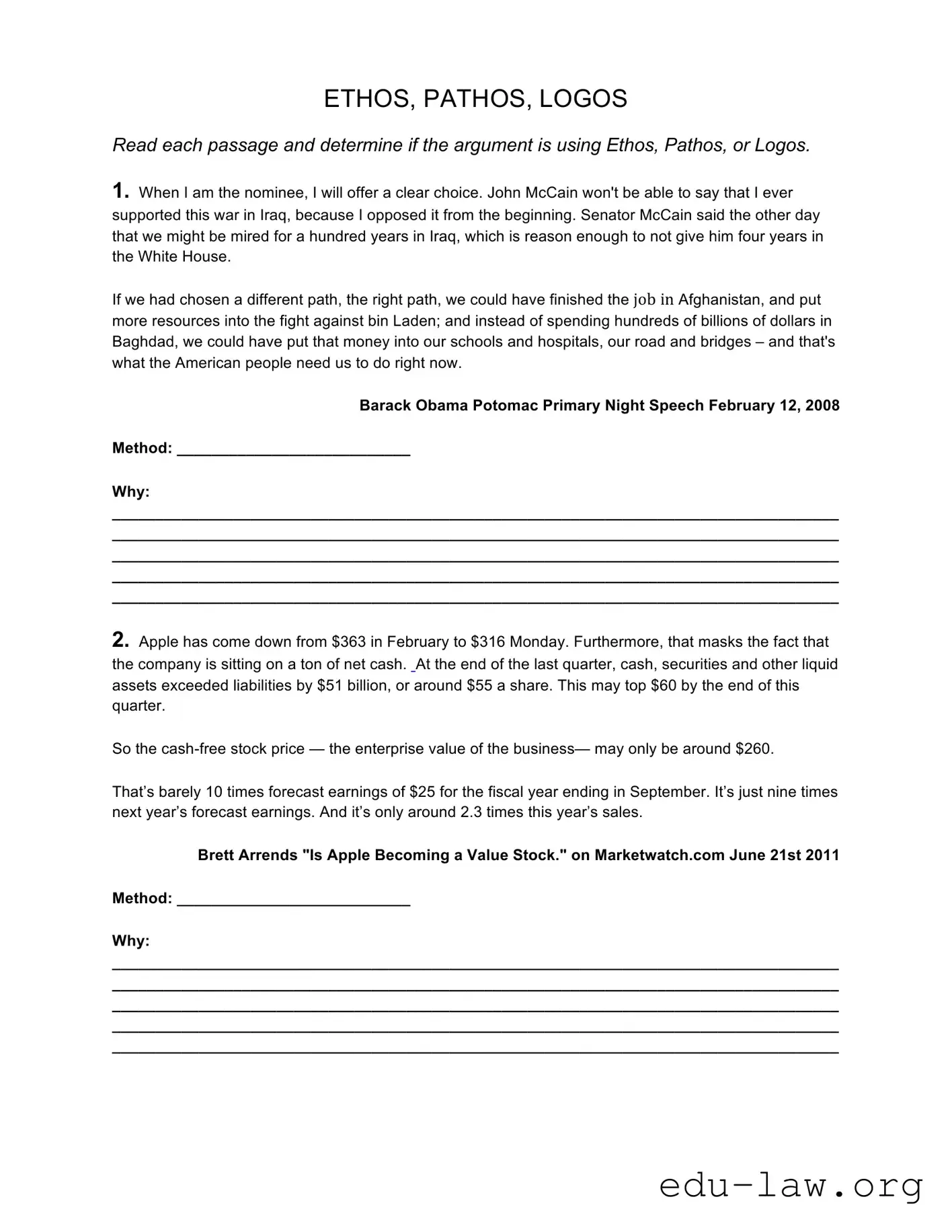
ETHOS, PATHOS, LOGOS
Read each passage and determine if the argument is using Ethos, Pathos, or Logos.
1. When I am the nominee, I will offer a clear choice. John McCain won't be able to say that I ever supported this war in Iraq, because I opposed it from the beginning. Senator McCain said the other day that we might be mired for a hundred years in Iraq, which is reason enough to not give him four years in the White House.
If we had chosen a different path, the right path, we could have finished the job in Afghanistan, and put more resources into the fight against bin Laden; and instead of spending hundreds of billions of dollars in Baghdad, we could have put that money into our schools and hospitals, our road and bridges – and that's what the American people need us to do right now.
Barack Obama Potomac Primary Night Speech February 12, 2008
Method: ___________________________
Why:
____________________________________________________________________________________
____________________________________________________________________________________
____________________________________________________________________________________
____________________________________________________________________________________
____________________________________________________________________________________
2. Apple has come down from $363 in February to $316 Monday. Furthermore, that masks the fact that the company is sitting on a ton of net cash. At the end of the last quarter, cash, securities and other liquid assets exceeded liabilities by $51 billion, or around $55 a share. This may top $60 by the end of this quarter.
So the
That’s barely 10 times forecast earnings of $25 for the fiscal year ending in September. It’s just nine times next year’s forecast earnings. And it’s only around 2.3 times this year’s sales.
Brett Arrends "Is Apple Becoming a Value Stock." on Marketwatch.com June 21st 2011
Method: ___________________________
Why:
____________________________________________________________________________________
____________________________________________________________________________________
____________________________________________________________________________________
____________________________________________________________________________________
____________________________________________________________________________________
3. Kimberly N. had a senior position at a charitable organization when her son was born. She planned for a
An Argument for Parental Leave in the United States, written by: Walsch , Janet. Failing It's
Families New York City, NY: Human Rights Watch, 2011 Online
Method: ___________________________
Why:
____________________________________________________________________________________
____________________________________________________________________________________
____________________________________________________________________________________
____________________________________________________________________________________
____________________________________________________________________________________
4. "I have pledged myself and my colleagues in the cabinet to a continuous encouragement of initiative, responsibility and energy in serving the public interest. Let every public servant know, whether his post is high or low, that a man's rank and reputation in this Administration will be determined by the size of the job he does, and not by the size of his staff, his office or his budget. Let it be clear that this Administration recognizes the value of dissent and daring
John F. Kennedy State of the Union Message, January 30, 1961
Method: ___________________________
Why:
____________________________________________________________________________________
____________________________________________________________________________________
____________________________________________________________________________________
____________________________________________________________________________________
____________________________________________________________________________________
5. Two major studies from military intelligence experts have warned our leaders about the dangerous national security implications of the climate crisis, including the possibility of hundreds of millions of climate refugees destabilizing nations around the world. Just two days ago, 27 senior statesmen and retired military leaders warned of the national security threat from an “energy tsunami” that would be triggered by a loss of our access to foreign oil. Meanwhile, the war in Iraq continues, and now the war in Afghanistan appears to be getting worse.
Al Gore "A Generational Challenge to Repower America" July 17th 2008
Method: ___________________________
Why:
____________________________________________________________________________________
____________________________________________________________________________________
____________________________________________________________________________________
____________________________________________________________________________________
____________________________________________________________________________________
6. The Rangers looked up and saw the enemy soldiers
Behind me is a memorial that symbolizes the Ranger daggers that were thrust into the top of these cliffs. And before me are the men who put them there. These are the boys of Pointe de Hoc. These are the men who took the cliffs. These are the champions who helped free a continent. These are the heroes who helped end a war.
Gentlemen, I look at you and I think of the words of Stephen Spender's poem. You are men who in your "lives fought for life...and left the vivid air
Ronald Reagan "The Boys of Point Du Hoc" Normandy France June 6th 1984
Method: ___________________________
Why:
____________________________________________________________________________________
____________________________________________________________________________________
____________________________________________________________________________________
____________________________________________________________________________________
____________________________________________________________________________________
7. This country is more decent than one where a woman in Ohio, on the brink of retirement finds herself one illness away from disaster after a lifetime of hard work.
This country is more generous than one where a man in Indiana has to pack up the equipment he's worked on for twenty years and watch it shipped off to China, and then chokes up as he explains how he felt like a failure when he went home to tell his family the news.
We are more compassionate than a government that lets veterans sleep on our streets and families slide into poverty; that sits on its hands while a major American city drowns before our eyes.
Barack Obama Night Before the Election Speech Manassas, Prince William County, Virginia November 3, 2008
Method: ___________________________
Why:
____________________________________________________________________________________
____________________________________________________________________________________
____________________________________________________________________________________
____________________________________________________________________________________
____________________________________________________________________________________
8. The little crowd of
When the friends get to the
When you walk through a town like this — two hundred thousand inhabitants, of whom at least twenty thousand own literally nothing except the rags they stand up in — when you see how the people live, and still more how easily they die, it is always difficult to believe that you are walking among human beings.
George Orwell "Marakesh" 1939
Method: ___________________________
Why:
____________________________________________________________________________________
____________________________________________________________________________________
____________________________________________________________________________________
____________________________________________________________________________________
____________________________________________________________________________________
| Fact Name | Description |
|---|---|
| Ethos | Ethos appeals to credibility or character. It relies on the speaker's authority and trustworthiness to persuade the audience. |
| Pathos | Pathos evokes emotions. It aims to connect with the audience's feelings, often stirring empathy or compassion. |
| Logos | Logos uses logical reasoning. It presents facts, statistics, and rational arguments to convince the audience. |
| Governing Laws | For state-specific forms, the governing laws may include local statutes and regulations that guide ethical persuasion practices. |
To complete the Ethos Pathos Logos form, carefully read each passage and analyze the argument's method. Identify whether the argument relies on credibility (Ethos), emotional appeal (Pathos), or logical reasoning (Logos). After determining the method, provide a brief explanation of why you believe that method applies to the passage.
What is Ethos?
Ethos refers to the credibility or ethical appeal of the speaker or writer. It establishes trust and authority. When an argument uses ethos, it often relies on the character, reputation, or expertise of the person making the argument. This can persuade the audience to accept the argument based on who is presenting it.
What is Pathos?
Pathos appeals to the audience's emotions. It seeks to evoke feelings such as sympathy, anger, or joy. Arguments that use pathos often include vivid language, personal stories, or emotional examples to connect with the audience on a deeper level. This connection can lead to a stronger impact and a greater willingness to accept the argument.
What is Logos?
Logos is the logical appeal of an argument. It relies on reason and evidence to persuade the audience. Arguments using logos often include statistics, facts, and logical reasoning. This approach aims to appeal to the audience's rationality, helping them understand the argument through clear and structured information.
How can I identify Ethos in an argument?
To identify ethos, look for elements that establish the speaker's credibility. This could include references to their qualifications, experience, or moral character. If the argument emphasizes the speaker's authority or trustworthiness, it is likely using ethos to persuade the audience.
How can I identify Pathos in an argument?
Pathos can be identified by the emotional language used in the argument. If the speaker shares personal stories, uses vivid imagery, or appeals to the audience's feelings, it is likely employing pathos. Look for moments that aim to evoke an emotional response, such as sadness, anger, or joy.
How can I identify Logos in an argument?
Logos can be recognized through the presence of logical reasoning, facts, and evidence. If the argument includes statistics, data, or logical explanations, it is using logos. Pay attention to how the information is structured and whether it supports the argument in a clear and rational way.
Can an argument use more than one of these appeals?
Yes, an argument can effectively use a combination of ethos, pathos, and logos. Many persuasive pieces blend these appeals to create a more compelling argument. By addressing credibility, emotions, and logic, the speaker can engage the audience on multiple levels, increasing the chances of persuasion.
Why is it important to understand these appeals?
Understanding ethos, pathos, and logos helps individuals critically evaluate arguments. This knowledge allows people to recognize the techniques used to persuade them, whether in speeches, advertisements, or written texts. It empowers individuals to make informed decisions based on a comprehensive understanding of the arguments presented.
How can I use these appeals in my own writing?
To use these appeals in your writing, consider your audience and the message you want to convey. Establish your credibility by sharing relevant experiences (ethos). Use emotional language and stories to connect with your readers (pathos). Finally, back up your claims with facts and logical reasoning (logos). A balanced approach will strengthen your argument and engage your audience effectively.
Neglecting to Identify the Argument Type: Many individuals fail to accurately determine whether the argument employs Ethos, Pathos, or Logos. This oversight can lead to confusion about the overall message and intent of the passage.
Overlooking Contextual Clues: Some people do not pay attention to the context in which the argument is presented. Understanding the background and circumstances surrounding the argument is essential for correctly identifying its method.
Relying on Personal Bias: Individuals often allow their personal beliefs and biases to influence their analysis. This can skew their interpretation and prevent them from objectively assessing the argument's method.
Failing to Provide Sufficient Explanation: When filling out the form, some may not elaborate enough on their reasoning. A thorough explanation is crucial for demonstrating a clear understanding of the argument's method and supporting it with evidence from the text.
The Ethos, Pathos, Logos form is a valuable tool for analyzing arguments based on credibility, emotion, and logic. However, it often works in conjunction with other forms and documents that can enhance your understanding of persuasive communication. Here are four key documents that frequently accompany the Ethos, Pathos, Logos form.
By utilizing these documents alongside the Ethos, Pathos, Logos form, individuals can strengthen their persuasive communication skills. Whether crafting an essay, delivering a speech, or engaging in a debate, these tools provide essential support for making compelling arguments that resonate with audiences.
The Toulmin Model is a framework for analyzing arguments that shares similarities with the Ethos, Pathos, Logos form. Both methods seek to evaluate the strength of an argument. The Toulmin Model breaks down an argument into components such as claim, grounds, warrant, backing, rebuttal, and qualifier. This structured approach allows for a detailed examination of how the argument is constructed and the evidence supporting it. Like Ethos, Pathos, and Logos, the Toulmin Model emphasizes the importance of credibility, emotional appeal, and logical reasoning, making it a useful tool for dissecting persuasive texts.
The Rogerian Argument is another document that aligns with the Ethos, Pathos, Logos form. This approach focuses on finding common ground between opposing viewpoints. While Ethos, Pathos, and Logos analyze the rhetorical strategies used in arguments, the Rogerian method encourages empathy and understanding. It emphasizes the importance of acknowledging differing perspectives before presenting one’s own position. This approach can foster constructive dialogue, making it similar to the Ethos, Pathos, Logos framework, which also aims to persuade through understanding the audience's values and emotions.
The Rhetorical Triangle is a visual representation of the relationship between the speaker, audience, and message. It complements the Ethos, Pathos, Logos form by highlighting how these elements interact in persuasive communication. Ethos refers to the credibility of the speaker, Pathos to emotional appeal, and Logos to logical reasoning. The Rhetorical Triangle encourages speakers to consider all three aspects to effectively reach their audience. This shared focus on audience engagement and message delivery makes the Rhetorical Triangle a relevant counterpart to the Ethos, Pathos, Logos framework.
The Five Canons of Rhetoric also share a connection with the Ethos, Pathos, Logos form. These canons—Invention, Arrangement, Style, Memory, and Delivery—provide a comprehensive guide to crafting effective arguments. Each canon addresses different aspects of communication, much like how Ethos, Pathos, and Logos focus on credibility, emotion, and logic. Understanding these canons can enhance the effectiveness of an argument by ensuring that all rhetorical elements are considered, thereby strengthening the overall persuasive impact.
SWOT Analysis, commonly used in business contexts, can be compared to the Ethos, Pathos, Logos form in its systematic evaluation of strengths, weaknesses, opportunities, and threats. Both frameworks aim to assess and improve decision-making. While Ethos, Pathos, and Logos focus on persuasive communication, SWOT Analysis provides a structured method for understanding the internal and external factors that can influence an argument or strategy. This analytical approach can enhance the effectiveness of persuasive efforts by addressing potential challenges and leveraging strengths.
The Problem-Solution format is similar to the Ethos, Pathos, Logos form in its goal of persuading an audience to take action. This structure presents a problem and then offers a solution, often appealing to emotions and logic. The Problem-Solution format can effectively utilize Ethos by establishing credibility, Pathos by evoking emotional responses, and Logos by providing logical reasoning. This alignment with the persuasive elements of Ethos, Pathos, and Logos makes it a powerful tool for advocacy and persuasion.
Persuasive Essays also share a common ground with the Ethos, Pathos, Logos form. Both aim to convince the audience of a particular viewpoint. In a persuasive essay, the writer employs various rhetorical strategies, including Ethos for credibility, Pathos for emotional engagement, and Logos for logical argumentation. This parallel structure allows for a robust exploration of the topic, ensuring that the argument is well-rounded and compelling. The focus on persuasion in both formats makes them closely related in purpose and execution.
Debate Formats, whether formal or informal, resemble the Ethos, Pathos, Logos form in their emphasis on persuasive argumentation. In debates, participants must present their arguments clearly, utilizing Ethos to establish credibility, Pathos to connect emotionally with the audience, and Logos to provide logical reasoning. This structured approach to presenting arguments mirrors the Ethos, Pathos, Logos framework, highlighting the importance of effective communication in persuading an audience. Both formats require participants to engage critically with their arguments and respond to opposing viewpoints.
Public Speaking Techniques often align with the Ethos, Pathos, Logos form as well. Effective speakers use a combination of credibility (Ethos), emotional appeal (Pathos), and logical reasoning (Logos) to engage their audience. These techniques are essential for delivering persuasive messages. By understanding how to balance these elements, speakers can enhance their effectiveness and impact. This focus on audience engagement and persuasive communication ties public speaking closely to the Ethos, Pathos, Logos framework.
When filling out the Ethos, Pathos, Logos form, there are several strategies to consider. Here’s a guide to help navigate this process effectively:
Understanding how to effectively fill out and utilize the Ethos, Pathos, Logos form can enhance your analytical skills. Here are some key takeaways to consider:
By following these takeaways, you can maximize the utility of the Ethos, Pathos, Logos form in your analyses.