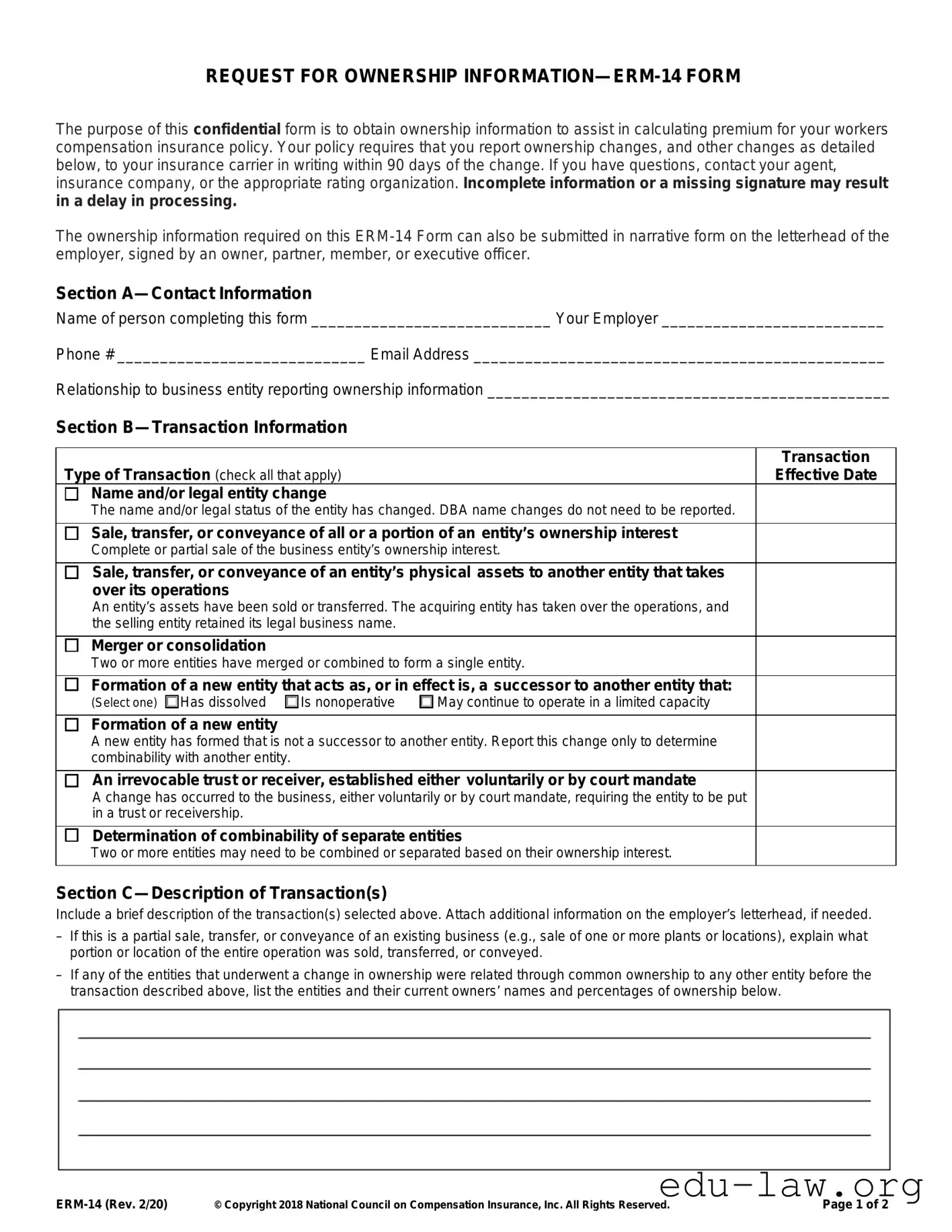
The ERM-14 form, officially known as the Request for Ownership Information, plays a crucial role in the administration of workers' compensation insurance policies. This confidential document is essential for reporting ownership changes and other significant transactions that may affect premium calculations. Timeliness is key; policyholders must submit ownership changes to their insurance carrier in writing within 90 days of any alteration. The form requires specific details, such as the contact information of the person completing it, the type of transaction taking place, and a description of the transaction itself. Various transaction types are covered, including name changes, sales or transfers of ownership interests, mergers, and the formation of new entities. If necessary, the ownership information can also be provided in a narrative format on the employer's letterhead, signed by an authorized individual. Incomplete submissions may lead to processing delays, making accuracy and completeness vital when filling out the form.
REQUEST FOR OWNERSHIP
The purpose of this confidential form is to obtain ownership information to assist in calculating premium for your workers compensation insurance policy. Your policy requires that you report ownership changes, and other changes as detailed below, to your insurance carrier in writing within 90 days of the change. If you have questions, contact your agent, insurance company, or the appropriate rating organization. Incomplete information or a missing signature may result in a delay in processing.
The ownership information required on this
Section
Name of person completing this form ____________________________ Your Employer __________________________
Phone # _____________________________ Email Address ________________________________________________
Relationship to business entity reporting ownership information _______________________________________________
Section
Type of Transaction (check all that apply) |
Transaction |
Effective Date |
Name and/or legal entity change
The name and/or legal status of the entity has changed. DBA name changes do not need to be reported.
Sale, transfer, or conveyance of all or a portion of an entity’s ownership interest
Complete or partial sale of the business entity’s ownership interest.
Sale, transfer, or conveyance of an entity’s physical assets to another entity that takes over its operations
An entity’s assets have been sold or transferred. The acquiring entity has taken over the operations, and the selling entity retained its legal business name.
Merger or consolidation
Two or more entities have merged or combined to form a single entity.
Formation of a new entity that acts as, or in effect is, a successor to another entity that:
(Select one) |
Has dissolved |
Is nonoperative |
May continue to operate in a limited capacity |
Formation of a new entity
A new entity has formed that is not a successor to another entity. Report this change only to determine combinability with another entity.
An irrevocable trust or receiver, established either voluntarily or by court mandate
A change has occurred to the business, either voluntarily or by court mandate, requiring the entity to be put in a trust or receivership.
Determination of combinability of separate entities
Two or more entities may need to be combined or separated based on their ownership interest.
Section
Include a brief description of the transaction(s) selected above. Attach additional information on the employer’s letterhead, if needed.
–If this is a partial sale, transfer, or conveyance of an existing business (e.g., sale of one or more plants or locations), explain what portion or location of the entire operation was sold, transferred, or conveyed.
–If any of the entities that underwent a change in ownership were related through common ownership to any other entity before the transaction described above, list the entities and their current owners’ names and percentages of ownership below.
© Copyright 2018 National Council on Compensation Insurance, Inc. All Rights Reserved. |
Page 1 of 2 |
Section
Copies of this page may be submitted for transactions with more than three entities.
|
|
Entity 1 |
Entity 2 |
Entity 3 |
|
|
Entity before the change or |
Entity after the change or |
Entity after a merger or |
|
Entity Information |
to determine combinability |
to determine combinability |
consolidation or to determine |
|
|
with another entity |
with another entity |
combinability with another entity |
1. |
Name of Business |
|
|
|
|
Provide the legal name of the |
|
|
|
|
business entity. |
|
|
|
|
|
|
|
|
2. |
Primary Address |
|
|
|
|
(Street, City, State, Zip) |
|
|
|
|
|
|
|
|
3. |
Legal Status |
|
|
|
|
(See examples in item 4 below) |
|
|
|
|
|
|
|
|
4. |
Ownership |
|
|
|
|
List names of individual owners, |
|
|
|
|
partners, etc. and percentages of |
|
|
|
|
ownership (if applicable). |
|
|
|
|
Ownership should total 100%. |
|
|
|
– Sole Proprietorship: Owner |
|
|
|
|
– Corporation: Owner(s) and |
|
|
|
|
|
percentages of ownership |
|
|
|
– General Partnership: |
|
|
|
|
|
Partners and percentages of |
|
|
|
|
ownership |
|
|
|
– Limited Partnership: |
|
|
|
|
|
General partners and |
|
|
|
|
percentages of ownership |
|
|
|
– Limited Liability Company: |
|
|
|
|
|
Members and percentages of |
|
|
|
|
ownership |
|
|
|
– Revocable Trust: Grantor(s) |
|
|
|
|
– Irrevocable Trust: Trustee(s) |
|
|
|
|
– Other: If no voting stock, list |
|
|
|
|
|
members of board of directors or |
|
|
|
|
comparable governing body |
|
|
|
|
|
|
|
|
5. |
FEIN |
|
|
|
|
|
|
|
|
6. |
Risk ID Number |
|
|
|
|
|
|
|
|
7. |
Policy Number |
|
|
|
|
|
|
|
|
8. |
Policy Effective Date |
|
|
|
|
|
|
|
|
9. |
Contact Name |
|
|
|
|
|
|
|
|
10. Contact Phone/Email |
|
|
|
|
|
|
|
|
|
Section
This is to certify that the information contained on this form is complete and correct.
_________________________________________________ |
_________________________ |
________________________________ |
Signature of Owner, Partner, Member, or Executive Officer Title |
Business Name |
|
_________________________________________________ |
_________________________ |
|
Print name of above signature |
Date |
|
© Copyright 2018 National Council on Compensation Insurance, Inc. All Rights Reserved. |
Page 2 of 2 |
| Fact Name | Details |
|---|---|
| Purpose of the ERM-14 Form | The ERM-14 form is designed to collect ownership information necessary for calculating premiums on workers' compensation insurance policies. |
| Reporting Requirements | Changes in ownership must be reported to the insurance carrier in writing within 90 days to ensure proper premium calculation. |
| Submission Options | Ownership information can be submitted using the ERM-14 form or in a narrative format on the employer's letterhead, provided it is signed by an authorized individual. |
| Legal Framework | The ERM-14 form is governed by state-specific workers' compensation laws, which may vary by state. Always check local regulations for compliance. |
Filling out the ERM-14 form is a crucial step in ensuring that your workers' compensation insurance policy remains accurate and up to date. This form helps your insurance carrier understand any ownership changes within your business. It's essential to complete it thoroughly to avoid delays in processing your information.
What is the purpose of the ERM-14 form?
The ERM-14 form is used to request ownership information necessary for calculating premiums for workers' compensation insurance policies. It helps ensure that your insurance carrier has accurate and up-to-date ownership details, which is important for your coverage and compliance.
Who needs to fill out the ERM-14 form?
The form should be completed by someone with a significant role in the business, such as an owner, partner, member, or executive officer. This person is responsible for reporting any ownership changes to the insurance carrier within 90 days of the change.
What types of ownership changes must be reported?
Ownership changes that need to be reported include changes in the legal name or status of the entity, sales or transfers of ownership interest, mergers, and the formation of new entities. If a business is put into an irrevocable trust or receivership, that must also be reported.
Can I submit the ownership information in a different format?
Yes, you can provide the required ownership information in a narrative format on your company's letterhead. This document must be signed by an owner, partner, member, or executive officer to be valid.
What happens if I don’t complete the form correctly?
If the ERM-14 form is incomplete or lacks a signature, it may delay processing. It’s crucial to provide accurate and complete information to avoid any issues with your workers' compensation insurance policy.
How long do I have to report ownership changes?
You must report any ownership changes in writing to your insurance carrier within 90 days of the change. Timely reporting helps ensure that your coverage remains valid and that your premiums are calculated correctly.
What should I include in the description of the transaction?
In the transaction description, briefly explain the nature of the ownership change. If it’s a partial sale, specify which part of the business was sold. If related entities were involved, list their names and current ownership percentages.
Do I need to provide additional documentation?
If necessary, you can attach additional information on your employer's letterhead. This is especially useful if the transaction is complex or involves multiple entities.
Is there a specific format for the contact information section?
Yes, the contact information section requires you to provide your name, employer, phone number, email address, and your relationship to the business entity. Make sure all details are accurate to facilitate communication with your insurance carrier.
What is the significance of the certification section?
The certification section is crucial as it confirms that the information provided is complete and correct. The form must be signed by an authorized individual, which holds them accountable for the accuracy of the information submitted.
Failing to provide complete contact information. Ensure that all fields, including name, phone number, and email address, are filled out accurately.
Not reporting ownership changes within the required 90 days. Timely reporting is essential to avoid penalties.
Omitting necessary transaction details. Clearly describe the nature of the transaction in Section C to avoid confusion.
Not checking all applicable transaction types in Section B. Review the list carefully to ensure all relevant changes are marked.
Providing inaccurate ownership percentages. Ensure that the total ownership equals 100% to prevent processing delays.
Neglecting to include additional documentation when necessary. Attach any relevant information on the employer's letterhead if required.
Forgetting to sign the form. The signature of an owner, partner, member, or executive officer is mandatory for validation.
Using outdated version of the form. Always check that you are using the most current version of the ERM-14 form.
Failing to include contact information for follow-up. Providing a contact name and phone/email is crucial for any questions.
Not reviewing the form for errors before submission. Double-check all entries to ensure accuracy and completeness.
The ERM-14 form is essential for providing ownership information related to workers' compensation insurance. Alongside this form, several other documents may be necessary to ensure complete and accurate reporting. Below is a list of these documents, each serving a specific purpose in the ownership reporting process.
Understanding these additional documents can help ensure that all necessary information is reported accurately and promptly. Proper documentation is vital for compliance and can prevent delays in processing your workers' compensation insurance policy.
The ERM-14 form is similar to the IRS Form 1065, which is used by partnerships to report income, deductions, gains, and losses from the operation of a partnership. Both forms require detailed information about ownership and transactions. While the ERM-14 focuses on changes in ownership for workers' compensation insurance, Form 1065 emphasizes the financial aspects of partnership operations. Both documents must be completed accurately to avoid processing delays, ensuring that stakeholders have the necessary information for compliance and decision-making.
Another document akin to the ERM-14 is the IRS Form 1120, which corporations use to report their income and calculate their tax liability. Like the ERM-14, Form 1120 requires comprehensive details about ownership and changes in the corporate structure. Both forms serve as crucial tools for maintaining transparency with regulatory bodies. Timely and accurate submission of either form is vital to prevent penalties and ensure proper insurance coverage or tax compliance.
The ERM-14 also resembles the Change of Ownership Form used in real estate transactions. This form captures ownership changes in property and requires information about the new owners and the nature of the transaction. Similar to the ERM-14, it must be filed within a specific timeframe to ensure that records are updated promptly. Both documents aim to keep relevant parties informed and maintain accurate records for legal and financial purposes.
Additionally, the Business Entity Registration Form shares similarities with the ERM-14. This form is used to register a new business entity or update existing registration details. Both forms require information about ownership, structure, and contact details. The timely submission of each form is crucial for legal compliance and to avoid disruptions in business operations or insurance coverage.
The Membership Change Form for Limited Liability Companies (LLCs) is another document comparable to the ERM-14. This form is used to report changes in membership or ownership within an LLC. Both documents require detailed information about ownership percentages and the nature of the change. Ensuring that these forms are accurately completed and submitted helps maintain proper records and compliance with state regulations.
The Stock Transfer Form is also similar to the ERM-14, as it documents the transfer of shares from one party to another in a corporation. Both forms require detailed information about the parties involved and the nature of the transaction. Accurate completion of these forms is essential to reflect ownership changes correctly in the corporate records, ensuring compliance with both corporate governance and insurance requirements.
Another related document is the Partnership Agreement, which outlines the terms of ownership and management among partners in a business. While the ERM-14 focuses on reporting changes to an insurance provider, the Partnership Agreement serves as a foundational document that governs the relationship between partners. Both documents are critical for ensuring clarity and compliance in ownership matters.
The Certificate of Amendment is akin to the ERM-14 in that it is used to officially document changes to a business entity's structure, such as a name change or change in ownership. Both forms require specific information about the entity and the nature of the change. Proper filing of these documents is essential to maintain legal standing and ensure that all stakeholders are informed of the current status of the entity.
Finally, the Articles of Incorporation can be compared to the ERM-14. This foundational document establishes a corporation's existence and outlines its structure, including ownership details. While the ERM-14 focuses on ongoing changes in ownership, the Articles of Incorporation serve as the initial declaration of ownership and governance. Both documents are vital for maintaining accurate records and ensuring compliance with regulatory requirements.
When filling out the ERM-14 form, there are important steps to take and common mistakes to avoid. Below is a list of things you should and shouldn't do.
Understanding the ERM-14 form is crucial for businesses, especially when it comes to workers' compensation insurance. Here are ten common misconceptions about this form:
Awareness of these misconceptions can help ensure that businesses remain compliant and avoid potential issues with their workers' compensation insurance policies.
The following are key takeaways regarding the completion and use of the ERM-14 form, which is essential for reporting ownership information for workers' compensation insurance policies.