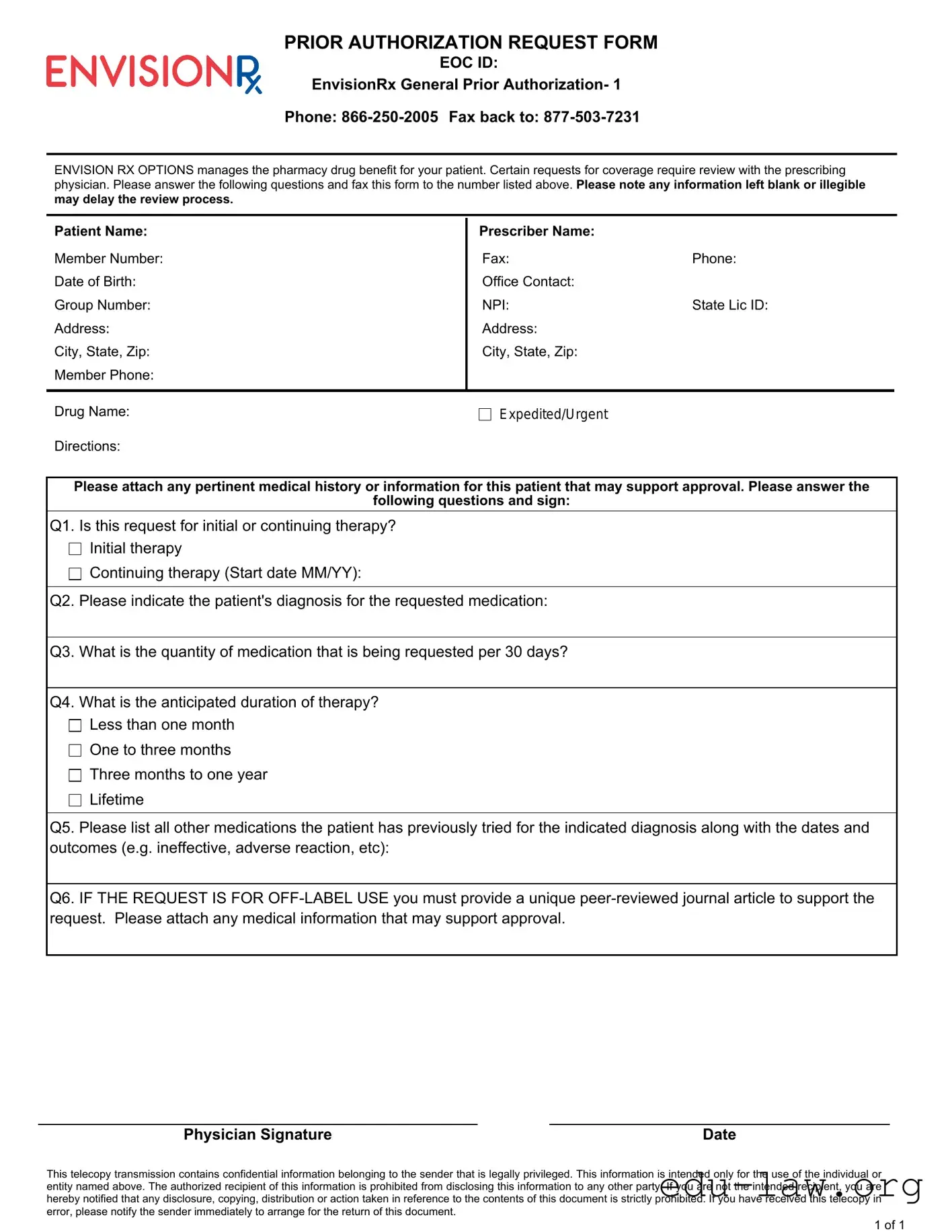
When navigating the complexities of prescription drug coverage, understanding the Envision Rx Prior Authorization form is essential for both healthcare providers and patients. This form plays a critical role in managing pharmacy benefits, ensuring that necessary medications are reviewed for coverage before being dispensed. It requires detailed information about the patient, including their name, member number, and date of birth, as well as specifics about the prescriber, such as their contact details and state license information. The form also prompts the healthcare provider to indicate whether the request is for initial or continuing therapy, the patient's diagnosis, and the quantity of medication needed. Additionally, it asks for a comprehensive history of previous medications tried, which can significantly influence the approval process. For requests involving off-label use, the submission of a peer-reviewed journal article is mandatory to support the case. Completing this form accurately and thoroughly is vital, as any missing or unclear information could delay the review and approval of the medication, impacting patient care.
PRIOR AUTHORIZATION REQUEST FORM
EOC ID:
EnvisionRx General Prior Authorization- 1
Phone:
ENVISION RX OPTIONS manages the pharmacy drug benefit for your patient. Certain requests for coverage require review with the prescribing physician. Please answer the following questions and fax this form to the number listed above. Please note any information left blank or illegible may delay the review process.
Patient Name:
Member Number:
Date of Birth:
Group Number:
Address:
City, State, Zip: Member Phone:
Prescriber Name: |
|
Fax: |
Phone: |
Office Contact: |
|
NPI: |
State Lic ID: |
Address: |
|
City, State, Zip: |
|
Drug Name: |
Expedited/Urgent |
Directions:
Please attach any pertinent medical history or information for this patient that may support approval. Please answer the
following questions and sign:
Q1. Is this request for initial or continuing therapy?
Initial therapy
Continuing therapy (Start date MM/YY):
Q2. Please indicate the patient's diagnosis for the requested medication:
Q3. What is the quantity of medication that is being requested per 30 days?
Q4. What is the anticipated duration of therapy?
Less than one month
One to three months
Three months to one year
Lifetime
Q5. Please list all other medications the patient has previously tried for the indicated diagnosis along with the dates and outcomes (e.g. ineffective, adverse reaction, etc):
Q6. IF THE REQUEST IS FOR
Physician Signature |
Date |
This telecopy transmission contains confidential information belonging to the sender that is legally privileged. This information is intended only for the use of the individual or entity named above. The authorized recipient of this information is prohibited from disclosing this information to any other party. If you are not the intended recipient, you are hereby notified that any disclosure, copying, distribution or action taken in reference to the contents of this document is strictly prohibited. If you have received this telecopy in error, please notify the sender immediately to arrange for the return of this document.
1 of 1
| Fact Name | Details |
|---|---|
| Form Purpose | This form is used to request prior authorization for medications managed by EnvisionRx. |
| Contact Information | For inquiries, call 866-250-2005 or fax completed forms to 877-503-7231. |
| Patient Information | Essential patient details include name, member number, date of birth, and contact information. |
| Prescriber Information | The prescriber must provide their name, contact details, and NPI number on the form. |
| Diagnosis Requirement | A diagnosis for the requested medication must be indicated on the form. |
| Medications History | List all previous medications tried for the diagnosis, including outcomes and dates. |
| Off-Label Use | If requesting off-label use, a peer-reviewed journal article must be attached to support the request. |
| Confidentiality Notice | The form contains confidential information and is intended only for the named recipient. |
| State-Specific Laws | Each state may have specific laws governing prior authorization requests; check local regulations. |
Completing the Envision Rx Prior Authorization form is a straightforward process that requires specific information about the patient and the medication being requested. It’s essential to provide accurate and complete details to avoid delays in the review process. Below are the steps to fill out the form effectively.
After completing the form, fax it to the number provided on the document. Ensure that all sections are filled out clearly and accurately to facilitate a smooth review process. If any information is left blank or is illegible, it may delay the approval of the request.
What is the purpose of the Envision Rx Prior Auth form?
The Envision Rx Prior Auth form is used to request coverage for specific medications that require prior authorization. This form helps ensure that the prescribing physician provides necessary information for the review process, allowing Envision Rx Options to determine if the medication will be covered under the patient's pharmacy benefit plan.
Who needs to fill out the Prior Auth form?
The form must be completed by the prescribing physician. It requires detailed information about the patient, the requested medication, and the medical history relevant to the request. Accurate and complete information is crucial for a timely review.
What information is required on the form?
Key details needed include the patient's name, member number, date of birth, and diagnosis for the requested medication. The prescriber must also provide their contact information, the drug name, and specify whether the request is for initial or continuing therapy. Additional questions about previous medications and the anticipated duration of therapy must also be answered.
What happens if I leave information blank on the form?
Leaving any information blank or providing illegible details can delay the review process. It is essential to fill out all sections of the form completely and clearly to avoid unnecessary delays in obtaining medication coverage.
What should I do if the request is for off-label use?
If the medication is requested for off-label use, a unique peer-reviewed journal article must be provided to support the request. Additionally, any pertinent medical information that may assist in the approval process should be attached to the form.
How do I submit the completed Prior Auth form?
The completed form should be faxed to Envision Rx Options at 877-503-7231. It is important to ensure that all sections are completed before faxing to facilitate a smooth review process.
What should I do if I receive this form in error?
If you receive the Prior Auth form by mistake, you must not disclose, copy, or distribute any information contained within it. Instead, notify the sender immediately to arrange for the return of the document. This ensures compliance with confidentiality and privacy regulations.
When completing the Envision Rx Prior Authorization form, individuals may encounter several common pitfalls. Recognizing these mistakes can facilitate a smoother submission process. Below is a list of eight frequent errors made during this procedure:
By being mindful of these common errors, individuals can improve their chances of a successful prior authorization request. Attention to detail is key.
When submitting a Prior Authorization (PA) request, several additional documents may be necessary to ensure a smooth and efficient approval process. These documents provide critical information that supports the request and can help healthcare providers navigate the complexities of insurance coverage. Below is a list of common forms and documents often used alongside the Envision Rx Prior Auth form.
Gathering these documents can significantly enhance the likelihood of a successful prior authorization request. Each piece of information contributes to a clearer picture of the patient's needs and the medical justification for the requested treatment. By being thorough and organized, healthcare providers can help ensure that their patients receive the medications they require in a timely manner.
The Envision Rx Prior Authorization form shares similarities with the Medicare Part D Prior Authorization form. Both documents require healthcare providers to submit detailed information about a patient's diagnosis and treatment history. They aim to ensure that prescribed medications meet specific criteria for coverage. By collecting similar patient and prescriber information, these forms facilitate communication between healthcare providers and insurance companies, streamlining the approval process for necessary medications.
Another comparable document is the Medicaid Prior Authorization Request form. Like the Envision Rx form, it requires comprehensive details about the patient, including their medical history and current medications. Medicaid often has strict guidelines for medication coverage, necessitating a thorough review process. Both forms aim to protect patients by ensuring that only medically necessary treatments are approved, thereby preventing misuse of prescription medications.
The Commercial Insurance Prior Authorization form is also similar. This document is used by private insurance companies to assess requests for specific medications. Just like the Envision Rx form, it requires detailed patient information, including diagnosis and previous treatments. This ensures that patients receive the most appropriate care while adhering to the insurance provider's coverage policies.
The Workers' Compensation Prior Authorization form has a similar purpose. It is used when a patient needs medication related to a work-related injury. Both forms require the same type of information, including the patient's medical history and the requested medication. This helps ensure that the treatment aligns with the patient's needs and the insurance guidelines, promoting effective recovery from injuries.
The Health Maintenance Organization (HMO) Prior Authorization form is another related document. HMOs often require prior authorization for certain medications to control costs and ensure appropriate use. This form, like the Envision Rx form, collects essential patient and prescriber information to facilitate the review process. The goal is to ensure that the prescribed treatment is medically necessary and aligns with the HMO's policies.
The Pharmacy Benefit Manager (PBM) Prior Authorization form is also comparable. PBMs manage prescription drug benefits for insurance companies and require similar information to assess medication requests. Both forms focus on collecting data about the patient's diagnosis, treatment history, and the requested medication to determine coverage eligibility. This helps ensure that patients receive the necessary medications while managing costs for the insurance provider.
The Specialty Drug Prior Authorization form has similarities as well. Specialty medications often come with higher costs and specific use cases, requiring detailed information about the patient's condition and treatment plan. Like the Envision Rx form, it seeks to gather comprehensive data to justify the need for the medication, ensuring that patients receive appropriate treatments while adhering to insurance requirements.
The Out-of-Network Prior Authorization form is another document that serves a similar function. When patients seek medications from providers outside their insurance network, prior authorization is often required. This form collects information about the patient's medical needs and the requested medication, similar to the Envision Rx form. It helps ensure that patients receive necessary care while navigating insurance policies and potential out-of-pocket costs.
Lastly, the Telehealth Prior Authorization form is comparable in that it addresses the approval process for medications prescribed during telehealth visits. As more patients utilize telehealth services, this form ensures that the medications prescribed during these consultations meet the necessary criteria for coverage. Both forms require similar patient and prescriber information to facilitate the approval process, reflecting the evolving landscape of healthcare delivery.
When filling out the Envision Rx Prior Authorization form, it's important to follow specific guidelines to ensure a smooth process. Here are seven things you should and shouldn't do:
Misconceptions about the Envision Rx Prior Authorization form can lead to confusion and delays in the approval process. Here are four common misunderstandings:
When filling out the Envision Rx Prior Authorization form, keep these key points in mind:
Finally, if the request is for off-label use, attach a peer-reviewed journal article to justify the request. Ensure the form is signed and dated by the physician before faxing it to the designated number.