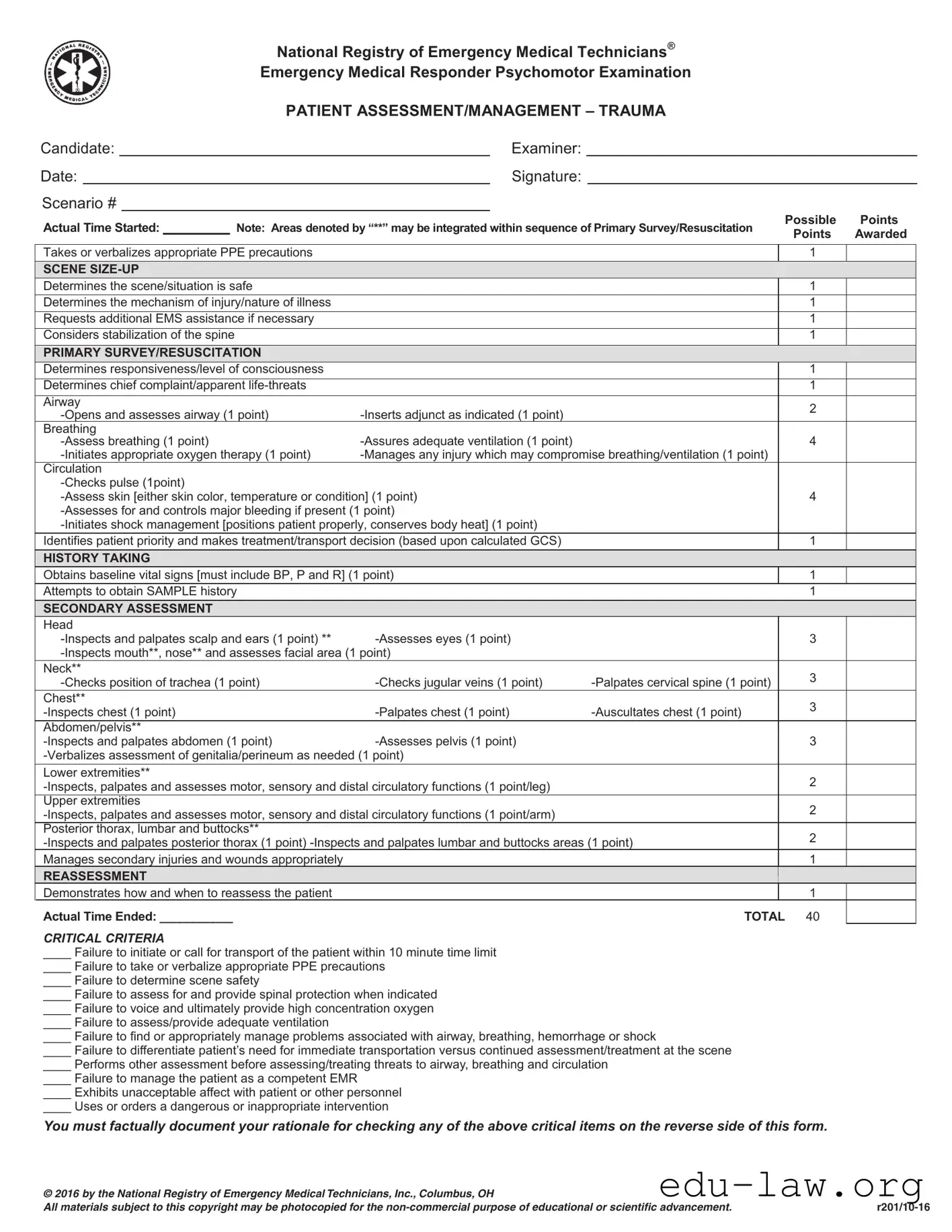
The EMT Trauma Assessment form is a crucial tool designed to guide emergency medical responders through a systematic approach to patient evaluation in trauma situations. This form emphasizes the importance of safety, both for the responder and the patient, starting with a scene size-up to ensure that the environment is secure before any intervention begins. It includes key components such as the primary survey, where responders assess the patient's responsiveness and identify life-threatening conditions. The form outlines specific actions for airway management, breathing assessment, and circulation checks, ensuring that responders can effectively address critical issues like major bleeding and shock. Additionally, the secondary assessment section prompts responders to thoroughly inspect and palpate various body regions, from the head to the extremities, to identify any injuries that may require attention. With an emphasis on obtaining vital signs and a detailed patient history, this form aids in prioritizing treatment and making informed transport decisions. Ultimately, the EMT Trauma Assessment form is not just a checklist; it serves as a comprehensive framework that enhances the quality of care provided to trauma patients, ensuring that every critical aspect is addressed in a timely manner.

National Registry of Emergency Medical Technicians®
Emergency Medical Responder Psychomotor Examination
|
|
|
PATIENT ASSESSMENT/MANAGEMENT – TRAUMA |
|
|
||||
Candidate: |
|
|
Examiner: |
|
|
|
|||
Date: |
|
|
Signature: |
|
|
|
|||
Scenario # |
|
|
|
|
Possible |
Points |
|||
Actual Time Started: __________ Note: Areas denoted by “**” may be integrated within sequence of Primary Survey/Resuscitation |
|||||||||
Points |
Awarded |
||||||||
|
|
|
|
|
|
|
|||
Takes or verbalizes appropriate PPE precautions |
|
|
|
1 |
|
||||
SCENE |
|
|
|
|
|
||||
Determines the scene/situation is safe |
|
|
|
1 |
|
||||
Determines the mechanism of injury/nature of illness |
|
|
|
1 |
|
||||
Requests additional EMS assistance if necessary |
|
|
|
1 |
|
||||
Considers stabilization of the spine |
|
|
|
1 |
|
||||
PRIMARY SURVEY/RESUSCITATION |
|
|
|
|
|
||||
Determines responsiveness/level of consciousness |
|
|
|
1 |
|
||||
Determines chief complaint/apparent |
|
|
|
1 |
|
||||
Airway |
|
|
|
2 |
|
||||
|
|
||||||||
|
|
|
|||||||
Breathing |
|
4 |
|
||||||
|
|
||||||||
|
|
||||||||
Circulation |
|
|
|
|
|
||||
|
|
|
|
|
|||||
|
4 |
|
|||||||
|
|
|
|||||||
|
|
|
|||||||
Identifies patient priority and makes treatment/transport decision (based upon calculated GCS) |
|
1 |
|
||||||
HISTORY TAKING |
|
|
|
|
|
||||
Obtains baseline vital signs [must include BP, P and R] (1 point) |
|
1 |
|
||||||
Attempts to obtain SAMPLE history |
|
|
|
1 |
|
||||
SECONDARY ASSESSMENT |
|
|
|
|
|
||||
Head |
|
|
|
|
|
||||
|
3 |
|
|||||||
|
|
|
|||||||
Neck** |
|
|
|
3 |
|
||||
|
|||||||||
|
|
||||||||
Chest** |
|
|
|
3 |
|
||||
|
|||||||||
|
|
||||||||
Abdomen/pelvis** |
|
|
|
|
|
||||
|
3 |
|
|||||||
|
|
|
|||||||
Lower extremities** |
|
|
|
2 |
|
||||
|
|
||||||||
Upper extremities |
|
|
|
2 |
|
||||
|
|
||||||||
Posterior thorax, lumbar and buttocks** |
|
|
|
2 |
|
||||
|
|||||||||
|
|
||||||||
Manages secondary injuries and wounds appropriately |
|
|
|
1 |
|
||||
REASSESSMENT |
|
|
|
|
|
||||
Demonstrates how and when to reassess the patient |
|
|
|
1 |
|
||||
Actual Time Ended: ___________ |
|
|
TOTAL 40 |
|
|||||
CRITICAL CRITERIA |
|
|
|
|
|
||||
____ Failure to initiate or call for transport of the patient within 10 minute time limit |
|
|
|
||||||
____ Failure to take or verbalize appropriate PPE precautions |
|
|
|
||||||
____ Failure to determine scene safety |
|
|
|
|
|
||||
____ Failure to assess for and provide spinal protection when indicated |
|
|
|
||||||
____ Failure to voice and ultimately provide high concentration oxygen |
|
|
|
||||||
____ Failure to assess/provide adequate ventilation |
|
|
|
|
|
||||
____ Failure to find or appropriately manage problems associated with airway, breathing, hemorrhage or shock
____ Failure to differentiate patient’s need for immediate transportation versus continued assessment/treatment at the scene
____ Performs other assessment before assessing/treating threats to airway, breathing and circulation
____ Failure to manage the patient as a competent EMR
____ Exhibits unacceptable affect with patient or other personnel
____ Uses or orders a dangerous or inappropriate intervention
You must factually document your rationale for checking any of the above critical items on the reverse side of this form.
© 2016 by the National Registry of Emergency Medical Technicians, Inc., Columbus, OH |
|
All materials subject to this copyright may be photocopied for the |
| Fact Name | Description |
|---|---|
| Purpose | The Emt Trauma Assessment form is designed to evaluate the skills of emergency medical responders during trauma scenarios. |
| Governing Body | This form is governed by the National Registry of Emergency Medical Technicians (NREMT). |
| Assessment Areas | It includes sections for scene size-up, primary survey, history taking, secondary assessment, and reassessment. |
| Total Points | The maximum score achievable on the form is 40 points. |
| Critical Criteria | Specific critical criteria must be met to ensure patient safety and effective assessment. |
| PPE Precautions | Responders must take or verbalize appropriate personal protective equipment (PPE) precautions. |
| Time Limit | There is a 10-minute time limit for initiating or calling for patient transport. |
| Documentation | Rationale for any critical criteria failures must be documented on the reverse side of the form. |
| Copyright | The form is copyrighted by the NREMT and can be photocopied for educational purposes. |
Completing the EMT Trauma Assessment form is essential for documenting patient assessments and ensuring that all necessary steps are taken during a trauma situation. Follow these steps carefully to fill out the form accurately.
What is the purpose of the EMT Trauma Assessment form?
The EMT Trauma Assessment form is designed to guide emergency medical responders in conducting a thorough assessment of trauma patients. It ensures that responders follow a systematic approach to evaluate the patient's condition, prioritize treatment, and document vital information during emergencies.
How is the form structured?
The form is divided into several sections, including Scene Size-Up, Primary Survey/Resuscitation, History Taking, Secondary Assessment, and Reassessment. Each section contains specific tasks that responders must complete, allowing for a comprehensive evaluation of the patient’s condition.
What is the significance of the scoring system?
The scoring system, which assigns points for each task completed, helps assess the responder's performance during the evaluation. A total of 40 points can be awarded, with critical criteria identified to ensure that essential aspects of patient care are not overlooked.
What should be included in the Primary Survey/Resuscitation section?
This section focuses on assessing the patient's responsiveness, airway, breathing, and circulation. Responders must open and assess the airway, ensure adequate ventilation, check the pulse, and manage any major bleeding. These steps are crucial for stabilizing the patient before further assessment.
How important is the Scene Size-Up?
The Scene Size-Up is critical as it ensures the safety of both the responder and the patient. It involves evaluating the scene for hazards, determining the mechanism of injury, and considering the need for additional assistance. Proper scene assessment can prevent further injuries and facilitate a more effective response.
What does the History Taking section entail?
This section requires responders to obtain baseline vital signs and gather a SAMPLE history, which includes Signs and Symptoms, Allergies, Medications, Past medical history, Last oral intake, and Events leading to the present illness or injury. This information is vital for understanding the patient's condition and guiding treatment decisions.
What is the purpose of the Secondary Assessment?
The Secondary Assessment allows responders to conduct a more detailed examination of the patient. This includes inspecting and palpating various body parts, assessing for injuries, and managing any secondary injuries that may have been overlooked during the Primary Survey. It helps ensure that all potential injuries are identified and treated appropriately.
What should be done during Reassessment?
Reassessment involves monitoring the patient’s condition after initial treatment has been provided. Responders should demonstrate how and when to reassess the patient to identify any changes in their status. This ongoing evaluation is essential for ensuring the effectiveness of the treatment provided and for making necessary adjustments.
What happens if critical criteria are not met?
If critical criteria are not met, the responder must document the rationale for any deficiencies on the reverse side of the form. This documentation is important for quality assurance and can provide insights into areas for improvement in future assessments.
Neglecting PPE Precautions: Failing to take or verbalize appropriate personal protective equipment (PPE) precautions can put both the responder and the patient at risk. Always prioritize safety by using the necessary gear.
Ignoring Scene Safety: Not determining if the scene is safe can lead to further injury. Always assess the environment before approaching the patient.
Overlooking Mechanism of Injury: Failing to determine the mechanism of injury or nature of illness can result in missing critical information needed for effective treatment.
Inadequate Airway Management: Not properly opening and assessing the airway, or neglecting to insert an adjunct when necessary, can compromise patient safety. Airway management is a top priority.
Insufficient Breathing Assessment: Not assuring adequate ventilation or managing injuries that may compromise breathing can have dire consequences. Always assess and intervene as needed.
Failing to Control Bleeding: Not assessing for and controlling major bleeding can lead to shock and other complications. Be vigilant in identifying and managing any bleeding.
Inaccurate Vital Signs: Failing to obtain baseline vital signs, including blood pressure, pulse, and respiration, can hinder effective treatment and transport decisions.
Neglecting Secondary Assessment: Skipping the secondary assessment of areas like the head, neck, chest, abdomen, and extremities can result in missed injuries. Thoroughly inspect and palpate all relevant areas.
Improper Reassessment: Not demonstrating how and when to reassess the patient can lead to overlooking changes in their condition. Regular reassessment is essential for ongoing care.
The EMT Trauma Assessment form is a crucial document used in emergency medical situations. It provides a structured approach to evaluating trauma patients and ensures that all necessary assessments and interventions are performed. Along with this form, several other documents are often utilized to support the assessment and treatment process. Below is a list of five additional forms and documents commonly used in conjunction with the EMT Trauma Assessment form.
Each of these documents plays a vital role in ensuring comprehensive patient care and maintaining accurate records during emergency medical situations. Proper documentation not only facilitates effective treatment but also protects the rights of the patient and the healthcare providers involved.
The EMT Trauma Assessment form shares similarities with the Patient Assessment form used in Advanced Cardiac Life Support (ACLS) training. Both documents emphasize the importance of a systematic approach to evaluating a patient’s condition. In ACLS, healthcare providers must assess the patient's responsiveness, airway, breathing, and circulation, mirroring the primary survey elements found in the EMT Trauma Assessment. Both forms require providers to take vital signs and identify any immediate life threats, ensuring that critical interventions are prioritized in emergency situations.
Another document that aligns closely with the EMT Trauma Assessment form is the National Institute for Occupational Safety and Health (NIOSH) Emergency Responder Health Monitoring and Surveillance (ERHMS) form. This form focuses on health monitoring during emergency responses, similar to how the EMT Trauma Assessment evaluates a patient's physical condition. Both documents stress the importance of thorough assessments and documentation, enabling responders to make informed decisions about patient care and safety. Each form aims to enhance the effectiveness of emergency responses through structured evaluation protocols.
The Comprehensive Trauma Assessment form used in hospital settings also bears resemblance to the EMT Trauma Assessment form. This hospital-based document includes detailed sections for history taking, physical examination, and diagnostic considerations. Like the EMT form, it guides medical professionals through a systematic evaluation of trauma patients. Both forms prioritize identifying life-threatening conditions and outline specific assessment techniques, ensuring that critical information is gathered efficiently to inform treatment decisions.
Finally, the Pediatric Assessment Triangle (PAT) used in pediatric emergencies offers another point of comparison. The PAT is a quick assessment tool that helps healthcare providers evaluate the severity of a child's condition. Similar to the EMT Trauma Assessment, it focuses on three key areas: appearance, work of breathing, and circulation to the skin. Both documents aim to facilitate rapid and effective assessments in high-pressure situations, ensuring that responders can quickly identify and address any immediate threats to life.
When filling out the EMT Trauma Assessment form, it's essential to approach the task with care and attention to detail. Here’s a helpful list of things to do and avoid:
By following these guidelines, you can ensure a thorough and effective assessment while maintaining the safety and well-being of everyone involved.
This form is designed for Emergency Medical Technicians (EMTs) and Emergency Medical Responders (EMRs). It serves as a structured guide for assessing trauma patients, ensuring that all necessary steps are followed regardless of the responder's level of training.
While the form is a valuable tool, it does not guarantee success in every situation. Patient outcomes depend on various factors, including the nature of the injury, the responder's skill level, and the availability of resources.
The assessment is designed to be flexible. While it provides a sequence, responders can adapt their approach based on the specific circumstances and patient needs. Prioritizing airway, breathing, and circulation is crucial, but the order of other assessments may vary.
The Emt Trauma Assessment form includes components for obtaining a patient history and assessing responsiveness. These elements are vital for understanding the patient's condition and determining appropriate interventions.
Immediate threats to airway, breathing, and circulation should be addressed as they are identified. Treatment can and should occur simultaneously with the assessment, especially in life-threatening situations.
The Emt Trauma Assessment form is applicable in all environments, whether urban or rural. EMTs and EMRs may encounter trauma patients in diverse situations, and the form provides a consistent framework for assessment in any location.
Reassessment is a critical part of patient care. The form emphasizes the importance of monitoring the patient’s condition over time, allowing responders to adjust their treatment as necessary based on any changes.
Here are key takeaways for effectively filling out and using the EMT Trauma Assessment form: