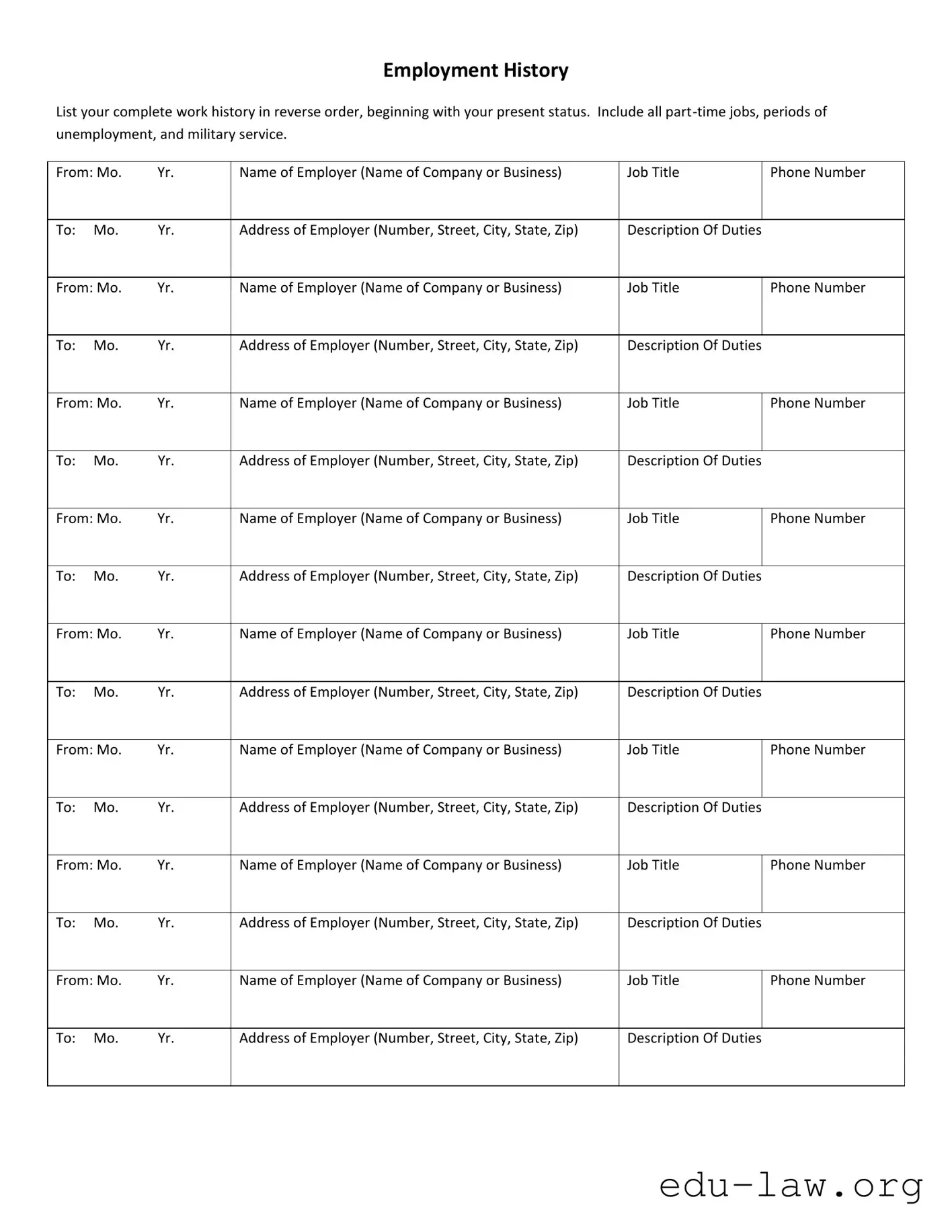
The Employment History form is a crucial document for job seekers, providing potential employers with a comprehensive view of a candidate's professional background. This form requires individuals to list their work history in reverse chronological order, starting with their current or most recent position. It's important to include all relevant experiences, such as part-time jobs, gaps in employment, and any military service. Each entry should detail the name of the employer, job title, phone number, and the address of the workplace, along with the dates of employment. Additionally, a brief description of duties performed in each role is necessary to give employers insight into the candidate's skills and responsibilities. By accurately completing this form, applicants can present a clear and organized summary of their career journey, which can significantly impact their job search success.
Employment History
List your complete work history in reverse order, beginning with your present status. Include all
From: Mo. |
Yr. |
Name of Employer (Name of Company or Business) |
Job Title |
Phone Number |
|
|
|
|
|
|
|
To: |
Mo. |
Yr. |
Address of Employer (Number, Street, City, State, Zip) |
Description Of Duties |
|
|
|
|
|
|
|
From: Mo. |
Yr. |
Name of Employer (Name of Company or Business) |
Job Title |
Phone Number |
|
|
|
|
|
|
|
To: |
Mo. |
Yr. |
Address of Employer (Number, Street, City, State, Zip) |
Description Of Duties |
|
|
|
|
|
|
|
From: Mo. |
Yr. |
Name of Employer (Name of Company or Business) |
Job Title |
Phone Number |
|
|
|
|
|
|
|
To: |
Mo. |
Yr. |
Address of Employer (Number, Street, City, State, Zip) |
Description Of Duties |
|
|
|
|
|
|
|
From: Mo. |
Yr. |
Name of Employer (Name of Company or Business) |
Job Title |
Phone Number |
|
|
|
|
|
|
|
To: |
Mo. |
Yr. |
Address of Employer (Number, Street, City, State, Zip) |
Description Of Duties |
|
|
|
|
|
|
|
From: Mo. |
Yr. |
Name of Employer (Name of Company or Business) |
Job Title |
Phone Number |
|
|
|
|
|
|
|
To: |
Mo. |
Yr. |
Address of Employer (Number, Street, City, State, Zip) |
Description Of Duties |
|
|
|
|
|
|
|
From: Mo. |
Yr. |
Name of Employer (Name of Company or Business) |
Job Title |
Phone Number |
|
|
|
|
|
|
|
To: |
Mo. |
Yr. |
Address of Employer (Number, Street, City, State, Zip) |
Description Of Duties |
|
|
|
|
|
|
|
From: Mo. |
Yr. |
Name of Employer (Name of Company or Business) |
Job Title |
Phone Number |
|
|
|
|
|
|
|
To: |
Mo. |
Yr. |
Address of Employer (Number, Street, City, State, Zip) |
Description Of Duties |
|
|
|
|
|
|
|
From: Mo. |
Yr. |
Name of Employer (Name of Company or Business) |
Job Title |
Phone Number |
|
|
|
|
|
|
|
To: |
Mo. |
Yr. |
Address of Employer (Number, Street, City, State, Zip) |
Description Of Duties |
|
|
|
|
|
|
|
| Fact Name | Description |
|---|---|
| Purpose | The Employment History form collects a detailed account of an individual's work experience. |
| Order of Information | Applicants must list their work history in reverse chronological order, starting with the most recent job. |
| Required Entries | All part-time jobs, periods of unemployment, and military service must be included. |
| Employer Details | Each entry requires the name, address, and phone number of the employer, along with job title and description of duties. |
| State-Specific Laws | In states like California, the Fair Employment and Housing Act governs the collection and use of employment history information. |
| Confidentiality | Employers must handle the information provided in this form with confidentiality and comply with applicable privacy laws. |
Completing the Employment History form is an important step in providing a comprehensive overview of your work background. This information helps potential employers understand your experience and qualifications. Below are the steps to accurately fill out the form.
What is the purpose of the Employment History form?
The Employment History form collects detailed information about your work experience. It helps employers understand your background, skills, and qualifications. By providing a complete history, you give potential employers a clearer picture of your professional journey.
How should I list my work history?
You should list your work history in reverse chronological order. Start with your current or most recent job and work backward. Include all relevant positions, even part-time jobs and any gaps in employment. This gives a comprehensive view of your experience.
What details do I need to include for each job?
For each position, include the following information: the name of the employer, your job title, the phone number of the employer, the dates you worked there (from and to), the employer's address, and a brief description of your duties. This information helps employers verify your work history and understand your responsibilities.
What if I have gaps in my employment history?
It’s important to be honest about any gaps. You should still list the periods of unemployment. If you were pursuing education, volunteering, or caring for family members during that time, consider mentioning those activities briefly. Transparency is key, and many employers appreciate a straightforward approach.
Do I need to include military service?
Yes, you should include any military service in your employment history. This experience can highlight valuable skills and qualities such as leadership, teamwork, and discipline. Make sure to provide the same details as you would for civilian jobs.
What if I can’t remember specific dates for my previous jobs?
If you can’t recall exact dates, try to provide approximate months and years. It’s better to give a rough estimate than to leave that information blank. If you remember the year but not the month, you can indicate just the year.
Can I use a resume instead of the Employment History form?
Not listing jobs in reverse chronological order: Many people forget to start with their most recent job. This can confuse potential employers and make it harder for them to follow your work history.
Omitting part-time jobs or gaps in employment: It's important to include all work experiences, even part-time positions or periods of unemployment. This gives a complete picture of your work history.
Failing to provide accurate contact information: Ensure that the phone number and address of each employer are correct. Incorrect details can lead to missed opportunities for follow-up.
Not including detailed job descriptions: Simply listing job titles is not enough. Provide a brief description of your duties and responsibilities to showcase your skills and experience.
Using vague or generic language: Avoid phrases like "responsible for" without specifics. Be clear and concise about what you accomplished in each role.
Neglecting to update the form: If you've had recent jobs or changes in your work history, make sure to update the form before submission. Outdated information can reflect poorly on you.
When applying for a job, several documents may accompany the Employment History form to provide a comprehensive view of a candidate's qualifications and experiences. Each of these documents plays a crucial role in the hiring process, helping employers make informed decisions. Below is a list of commonly used forms and documents that often accompany the Employment History form.
These documents collectively present a well-rounded picture of an applicant's professional journey. By including them alongside the Employment History form, candidates can enhance their chances of making a positive impression on potential employers.
The Employment Application is similar to the Employment History form because it also collects detailed information about a candidate's work experience. Like the Employment History form, it typically asks for previous employers, job titles, and dates of employment. The application may require additional personal details, such as education and references, but both documents aim to present a comprehensive view of a person's professional background.
The Resume serves a similar purpose as the Employment History form, providing a summary of a person's work experience. While the Employment History form usually lists jobs in chronological order, a resume may highlight skills and accomplishments. Both documents require accurate details about previous employment, including job titles and descriptions, making them essential tools in job applications.
The Curriculum Vitae (CV) is another document that resembles the Employment History form. While a CV is often more detailed and used in academic or professional settings, it includes work history, education, and relevant experiences. Both the CV and the Employment History form require a clear presentation of past jobs and responsibilities, making them useful for potential employers to assess qualifications.
The Job Application Checklist can be seen as similar to the Employment History form in that it outlines necessary documents and information needed for job applications. This checklist helps ensure candidates gather all relevant work history, contact details, and descriptions of duties. Both documents play a crucial role in organizing information for job seekers.
The Reference List is akin to the Employment History form, as it often includes past employers who can vouch for a candidate's work experience. While the Employment History form details the jobs held, the Reference List provides contacts who can confirm the candidate's skills and work ethic. Both are essential for building credibility during the hiring process.
The Background Check Authorization form is similar to the Employment History form because it often requires verification of employment history. When candidates fill out this form, they provide consent for employers to check their past jobs and confirm details. Both documents work together to ensure that the information provided is accurate and trustworthy.
The Skills Inventory is comparable to the Employment History form, as it highlights a candidate's relevant skills gained through previous jobs. While the Employment History form focuses on job titles and duties, the Skills Inventory emphasizes specific abilities and competencies. Together, they give a fuller picture of a candidate's qualifications.
The Cover Letter often accompanies the Employment History form and serves to introduce the applicant to potential employers. While the Employment History form lists jobs and duties, the cover letter allows candidates to explain their experiences and express their interest in the position. Both documents work together to create a compelling application package.
The Interview Preparation Guide can also be viewed as similar to the Employment History form. This guide helps candidates prepare for interviews by encouraging them to reflect on their work history and articulate their experiences. Both documents emphasize the importance of understanding one's employment background and being ready to discuss it with potential employers.
When completing the Employment History form, it is important to follow certain guidelines to ensure accuracy and clarity. Here is a list of things you should and shouldn't do:
Understanding the Employment History form is essential for job seekers. However, several misconceptions can lead to confusion. Here are six common misunderstandings:
When filling out the Employment History form, keep the following key points in mind: