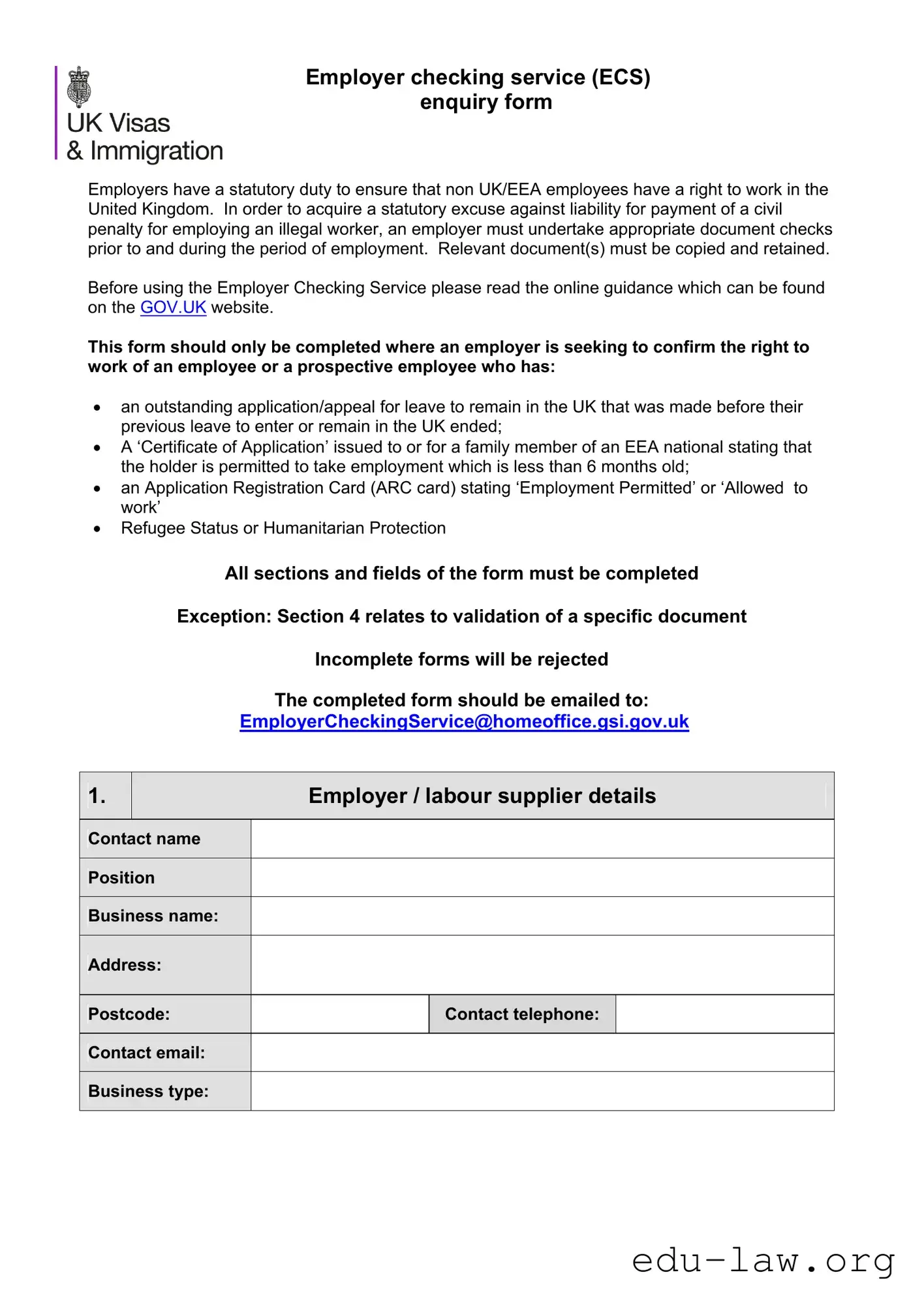
The Employment Checking Service (ECS) form is an essential tool for employers in the UK, designed to help them fulfill their legal obligations regarding the employment of non-UK and non-EEA individuals. Employers must ensure that these employees possess the right to work in the UK to avoid potential civil penalties for employing someone illegally. To establish this statutory excuse, employers are required to conduct thorough document checks both prior to and during employment. The form itself is straightforward but demands careful attention; it must be fully completed to avoid rejection. It includes sections for employer details, employee information, and specific documentation related to the employee's right to work status, such as outstanding applications or specific permits. Notably, all relevant documents must be copied and retained as part of the employer's records. Before submitting the form, employers should consult the online guidance available on the GOV.UK website to ensure compliance with current regulations. The completed form must be emailed to the designated address, and a mandatory data protection statement must be acknowledged, confirming that the individual has consented to the sharing of their personal information with UK Visas and Immigration (UKVI). Understanding the nuances of this form is crucial for employers to navigate the complexities of employment law effectively.

Employer checking service (ECS) enquiry form
Employers have a statutory duty to ensure that non UK/EEA employees have a right to work in the United Kingdom. In order to acquire a statutory excuse against liability for payment of a civil penalty for employing an illegal worker, an employer must undertake appropriate document checks prior to and during the period of employment. Relevant document(s) must be copied and retained.
Before using the Employer Checking Service please read the online guidance which can be found on the GOV.UK website.
This form should only be completed where an employer is seeking to confirm the right to work of an employee or a prospective employee who has:
an outstanding application/appeal for leave to remain in the UK that was made before their previous leave to enter or remain in the UK ended;
A ‘Certificate of Application’ issued to or for a family member of an EEA national stating that the holder is permitted to take employment which is less than 6 months old;
an Application Registration Card (ARC card) stating ‘Employment Permitted’ or ‘Allowed to work’
Refugee Status or Humanitarian Protection
All sections and fields of the form must be completed
Exception: Section 4 relates to validation of a specific document
Incomplete forms will be rejected
The completed form should be emailed to:
1.
Employer / labour supplier details
|
Contact name |
|
|
|
|
|
|
|
|
|
|
|
|
|
|
|
|
|
Position |
|
|
|
|
|
|
|
|
|
|
|
|
|
|
|
|
|
|
|
|
|
|
|
Business name: |
|
|
|
|
|
|
|
|
|
|
|
|
|
|
|
|
|
|
|
|
|
|
|
Address: |
|
|
|
|
|
|
|
|
|
|
|
|
|
|
|
|
|
|
|
|
|
|
|
|
|
|
|
|
|
Postcode: |
|
|
Contact telephone: |
|
|
|
|
|
|
|
|
|
|
|
|
|
|
|
|
|
|
|
|
Contact email: |
|
|
|
|
|
|
|
|
|
|
|
|
|
|
|
|
|
|
|
|
|
|
|
Business type: |
|
|
|
|
|
|
|
|
|
|

|
|
|
|
|
Employer checking service (ECS) |
|
|
|||||
|
|
|
|
|
|
|
enquiry form |
|
|
|||
|
|
|
|
|
|
|
|
|
|
|
|
|
|
|
|
|
|
|
|
|
|
|
|
|
|
|
2. |
|
|
|
|
|
Employee details |
|
|
|||
|
|
|
|
|
|
|
|
|
|
|
|
|
|
|
|
|
|
|
|
|
|
|
|
||
|
Full name (including middle |
|
|
|
|
|
|
|
||||
|
|
|
|
|
names): |
|
|
|
|
|
|
|
|
|
|
|
|
|
|
|
|
|
|
|
|
|
|
|
|
|
|
|
|
|
|
|
|
|
|
|
|
|
|
Date of birth: |
|
|
|
|
|
|
|
|
|
|
|
|
|
|
|
|
|
|
|
|
|
|
|
|
|
Nationality: |
|
|
|
|
|
|
|
|
|
|
|
|
|
|
|
|
|
|
|
|
|
|
|
|
|
|
|
|
|
|
|
|
|
|
|
|
|
|
|
|
|
|
|
|
|
|
|
|
|
|
|
Personal address |
|
|
|
|
|
|
|
|
|
|
|
|
|
|
|
|
|
|
|
|
|
|
|
|
|
Job title |
|
|
|
|
|
|
|
|
|
|
|
|
|
|
|
|
|
|
||
|
|
|
|
|
|
|
|
|
|
|
|
|
|
|
|
|
|
Hours per week |
|
|
|
|
|
|
|
|
|
|
|
|
|
|
|
|
|
|
||
|
|
|
|
|
|
|
|
|
||||
|
|
|
|
|
|
|
YES / NO |
|
||||
|
Start date of existing employee |
|
|
|
Potential employee? |
|
|
|||||
|
|
|
|
|
|
|
|
|
||||
|
Employee acquired as a result |
|
|
|
|
|
|
|
||||
|
|
|
|
|
|
|
|
|||||
|
|
|
|
|
of a TUPE transfer? |
|
YES / NO |
|
|
|
|
|
|
|
|
|
|
|
|
Date of TUPE transfer: |
|
|
|
||
|
|
|
Transfer of Undertakings |
|
|
|
|
|
||||
|
|
|
|
|
|
|
|
|
|
|||
|
|
(Protection of Employment) |
|
|
|
|
|
|
|
|||
|
|
|
|
|
|
|
|
|
||||
|
|
|
|
|
|
|
||||||
|
3. |
|
|
|
Reference Number of ongoing application |
|
|
|||||
|
|
|
|
|
|
|||||||
|
|
|
|
|
|
|
|
|
|
|
|
|
|
|
|
|
|
|
|
|
|
|
|
|
|
|
|
|
|
|
|
|
|
|
|
|
|
|
4.
When presented with an Application Registration Card (ARC) stating ‘Employment Permitted’ or ‘Allowed to work’ we will only
validate it when both of these boxes have been completed.
IFB Reference
(top left corner on reverse of card)
ARC Serial Number
(top left corner on reverse of card)
Mandatory - Data Protection statement
I confirm that the individual named above has been informed that a work status check may be carried out and has given permission for their personal information to be shared with UKVI for these purposes. I understand that these details may be held by the UKVI.
(The response from UKVI will also contain personal data and should be treated accordingly.)
Please confirm that you have read, understood and complied with the Data Protection statement above:
(Double click the box and select
‘Checked’ as the default value )
| Fact Name | Description |
|---|---|
| Statutory Duty | Employers are legally required to ensure that non-UK/EEA employees have the right to work in the UK. |
| Document Checks | To avoid penalties for hiring illegal workers, employers must conduct proper document checks before and during employment. |
| Retention of Documents | Employers must copy and retain relevant documents as proof of the right to work. |
| Eligibility Criteria | The form is used for employees with pending applications, ARC cards, or those with refugee status. |
| Form Completion | All sections of the form must be filled out completely; incomplete forms will be rejected. |
| Email Submission | The completed form should be emailed to [email protected]. |
| Data Protection Compliance | Employers must confirm that the individual has been informed about the work status check and consented to share their personal information. |
| Governing Law | The Employment Checking Service is governed by UK immigration laws, including the Immigration, Asylum and Nationality Act 2006. |
Completing the Employment Checking Service form is an essential step for employers to confirm the right to work of their employees or prospective employees. This process ensures compliance with legal requirements and helps avoid penalties associated with employing individuals without the right to work in the UK. Follow the steps below carefully to fill out the form accurately.
What is the purpose of the Employment Checking Service form?
The Employment Checking Service (ECS) form is designed for employers to confirm the right to work of their employees or potential employees who may have specific immigration statuses. It helps employers ensure they comply with legal requirements and avoid penalties for employing individuals without the right to work in the UK.
Who should use the Employment Checking Service form?
This form should be used by employers seeking to verify the right to work for individuals who have pending applications for leave to remain, those with a Certificate of Application, holders of an Application Registration Card (ARC) stating ‘Employment Permitted’, or individuals with Refugee Status or Humanitarian Protection.
What happens if the form is incomplete?
If any sections or fields of the ECS form are left incomplete, the form will be rejected. It is crucial to ensure all required information is filled out accurately to avoid delays in processing your enquiry.
How should the completed form be submitted?
Once the form is fully completed, it should be emailed to [email protected]. Make sure to double-check that all information is correct before sending to prevent any issues.
What is the significance of the Data Protection statement?
The Data Protection statement is essential as it confirms that the individual whose information is being submitted has been informed about the work status check and has consented to their personal information being shared with UK Visas and Immigration (UKVI). This ensures compliance with data protection laws.
Are there any specific documents that need to be validated?
Yes, if you are presenting an Application Registration Card (ARC) that states ‘Employment Permitted’ or ‘Allowed to work’, both the IFB Reference and the ARC Serial Number must be completed on the form for validation to occur.
Leaving Sections Incomplete: Every section of the form must be filled out. If any part is left blank, the form will be rejected.
Incorrect Contact Information: Ensure that the contact name, telephone number, and email address are accurate. Mistakes can lead to delays in processing.
Failure to Provide Required Documents: It’s essential to include all relevant documents. Missing documents can result in a denial of the request.
Not Following Data Protection Guidelines: The individual must be informed about the work status check. Failing to confirm this can lead to compliance issues.
Incorrectly Completing the ARC Section: When submitting an Application Registration Card, both required boxes must be checked. If either is left unchecked, the validation will not proceed.
Ignoring the Online Guidance: Before filling out the form, it’s crucial to read the guidance on the GOV.UK website. Ignoring this step can lead to common mistakes.
When utilizing the Employment Checking Service form, several other forms and documents may also be required to ensure compliance with employment regulations. Below is a list of these documents, along with a brief description of each.
These documents work together with the Employment Checking Service form to ensure employers comply with their legal obligations regarding the employment of non-UK/EEA workers. Proper documentation not only protects the employer from penalties but also safeguards the rights of employees.
The Employment Checking Service (ECS) form shares similarities with the I-9 Employment Eligibility Verification form used in the United States. Both documents serve to confirm an employee's eligibility to work. The I-9 form requires employers to verify the identity and employment authorization of individuals hired for employment in the U.S. Just as the ECS form mandates that employers retain copies of relevant documents, the I-9 form also requires employers to keep copies of the documents presented by employees as proof of their right to work.
Another comparable document is the Form W-4, which is used for tax withholding purposes. While the W-4 does not directly verify work eligibility, it collects essential information about an employee's tax status. Employers must ensure that the W-4 is accurately completed to comply with tax laws. Similarly, the ECS form requires complete and accurate information to fulfill the legal obligations surrounding employment verification.
The Social Security Administration’s Form SS-5, used to apply for a Social Security number, also bears resemblance to the ECS form. Both documents require personal information from the individual to establish identity and eligibility for work. Employers may need to verify that an employee has a valid Social Security number, paralleling the need for the ECS form to confirm an employee's right to work in the UK.
The U.S. Citizenship and Immigration Services (USCIS) Form N-400, Application for Naturalization, is another document that shares similarities. While the N-400 is focused on obtaining U.S. citizenship, it requires applicants to provide detailed personal information and proof of residency and employment history. This is akin to the ECS form, which necessitates comprehensive details about the employee’s work status and history in the UK.
Additionally, the Employment Authorization Document (EAD) is a crucial document that parallels the ECS form. The EAD serves as proof that an individual is authorized to work in the U.S. Employers often request a copy of the EAD to confirm an employee's eligibility. Similarly, the ECS form is utilized to verify the right to work for individuals in the UK, emphasizing the importance of having valid documentation.
The Affidavit of Support, used in immigration processes, also has similarities with the ECS form. This document is a promise from a sponsor to support an immigrant financially, ensuring they will not become a public charge. Both documents require significant personal information and verification of status, highlighting the need for thorough documentation in employment and immigration matters.
The California Employment Development Department’s DE 1 form, which is an employer’s registration form, is another document that serves a similar purpose. This form collects information about employers and their employees, including details necessary for tax and employment verification. Like the ECS form, the DE 1 ensures that employers comply with state regulations regarding employment.
Lastly, the Labor Condition Application (LCA) is used by employers seeking to hire foreign workers under the H-1B visa program. The LCA requires employers to attest to the wages and working conditions offered to foreign employees. This is similar to the ECS form, which also requires employers to ensure that they are hiring individuals who are legally permitted to work, thereby protecting both the employer and the employee.
When filling out the Employment Checking Service form, it's important to follow certain guidelines to ensure a smooth process. Here are six things you should and shouldn't do:
Following these guidelines can help avoid delays and ensure compliance with legal requirements. Make sure to pay attention to detail and keep all relevant documentation handy.
Here are four common misconceptions about the Employment Checking Service (ECS) form:
When filling out and using the Employment Checking Service (ECS) form, there are several important points to keep in mind. Here are key takeaways to ensure a smooth process:
By following these key takeaways, employers can navigate the ECS form effectively and ensure compliance with UK employment laws.