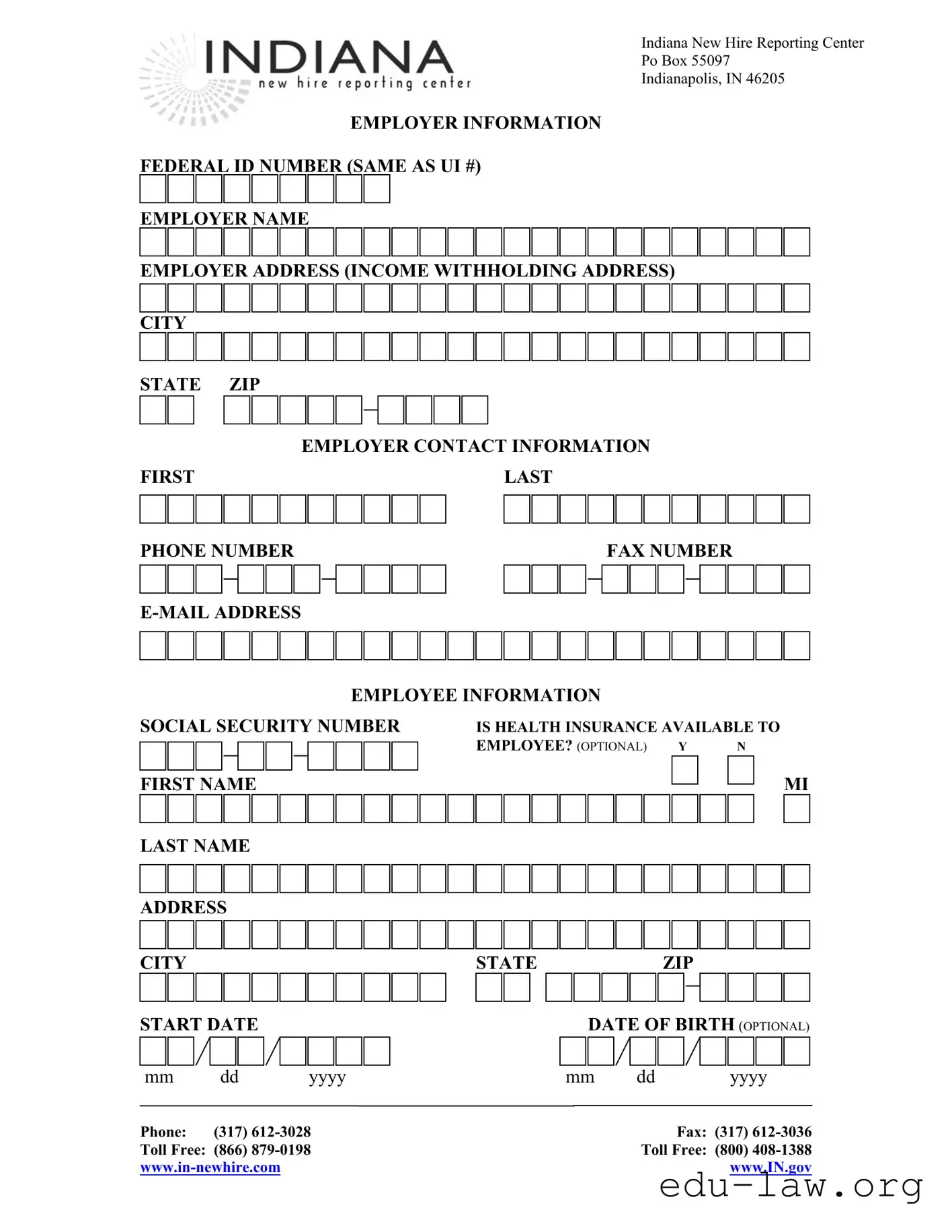
The Employer Information form is a critical document for employers in Indiana, designed to streamline the process of reporting new hires. It requires essential details such as the employer's Federal ID number, name, and address, ensuring that the state has accurate records for income withholding purposes. Additionally, the form collects contact information for the employer, including phone numbers and email addresses, which facilitate communication. For each new employee, the form captures vital information, including the employee's Social Security number, health insurance availability, and personal details like their name, address, start date, and date of birth. This comprehensive approach not only helps in maintaining compliance with state regulations but also supports the efficient management of employee records. Employers can access further assistance through dedicated phone lines and websites, ensuring they have the resources needed to complete the form accurately.

Indiana New Hire Reporting Center
Po Box 55097
Indianapolis, IN 46205
EMPLOYER INFORMATION
FEDERAL ID NUMBER (SAME AS UI #)
EMPLOYER NAME
EMPLOYER ADDRESS (INCOME WITHHOLDING ADDRESS)
CITY
STATE ZIP
|
EMPLOYER CONTACT INFORMATION |
FIRST |
LAST |
PHONE NUMBER |
FAX NUMBER |
|
EMPLOYEE INFORMATION
SOCIAL SECURITY NUMBER |
IS HEALTH INSURANCE AVAILABLE TO |
|
|
EMPLOYEE? (OPTIONAL) Y |
N |
FIRST NAME
MI
LAST NAME |
|
|
|
|
ADDRESS |
|
|
|
|
CITY |
|
|
STATE |
ZIP |
START DATE |
|
DATE OF BIRTH (OPTIONAL) |
||
mm |
dd |
yyyy |
mm dd |
yyyy |
Phone: |
(317) |
Fax: |
(317) |
|
Toll Free: (866) |
Toll Free: |
(800) |
||
|
www.IN.gov |
|||
| Fact Name | Description |
|---|---|
| Purpose | The Employer Information form is used for reporting new hires to the state of Indiana. |
| Governing Law | This form is governed by Indiana Code § 22-4-18.2. |
| Federal ID Number | The form requires the employer's Federal ID Number, which is the same as the Unemployment Insurance number. |
| Employer Contact | Employers must provide contact information, including a phone number, fax number, and email address. |
| Employee Information | Details about the employee, such as Social Security Number and start date, must be included. |
| Health Insurance | The form includes an optional question regarding the availability of health insurance for the employee. |
| Submission Address | Forms should be mailed to the Indiana New Hire Reporting Center at P.O. Box 55097, Indianapolis, IN 46205. |
| Contact Information | For inquiries, employers can call (317) 612-3028 or toll-free at (866) 879-0198. |
| Online Resources | Employers can access more information at www.in-newhire.com and www.IN.gov. |
Filling out the Employer Information form is an important step in the new hire reporting process. It ensures that all necessary details are submitted accurately. Follow these steps carefully to complete the form correctly.
After completing the form, review all entries for accuracy. Make sure everything is filled out clearly to avoid any delays in processing. Once verified, submit the form as instructed.
What is the purpose of the Employer Information form?
The Employer Information form is used to report new hires to the Indiana New Hire Reporting Center. This information helps ensure compliance with state and federal laws regarding child support enforcement and other employment-related regulations. By submitting this form, employers contribute to a system that supports families and promotes responsible employment practices.
What information is required on the form?
The form requires several key details. Employers must provide their Federal ID number, name, and address. Additionally, contact information such as a phone number, fax number, and email address is necessary. For each new employee, the form asks for their Social Security number, name, address, start date, and optional health insurance availability. This comprehensive data collection helps streamline the reporting process.
How do I submit the Employer Information form?
You can submit the form by mailing it to the Indiana New Hire Reporting Center at the address provided: P.O. Box 55097, Indianapolis, IN 46205. Alternatively, you may also submit the information electronically through the Indiana New Hire website. Ensure all required fields are completed to avoid delays in processing.
What happens if I do not submit the form?
Failure to submit the Employer Information form can lead to penalties and fines. Additionally, it may hinder the enforcement of child support orders and other legal obligations. It's essential to comply with reporting requirements to avoid potential legal issues and to support the welfare of employees and their families.
Who can I contact for assistance with the form?
If you have questions or need assistance, you can reach out to the Indiana New Hire Reporting Center by phone at (317) 612-3028 or toll-free at (866) 879-0198. You can also send a fax to (317) 612-3036. For further information, visit their website at www.in-newhire.com or www.IN.gov.
Incorrect Federal ID Number: Many people mistakenly enter an incorrect Federal ID number. This number is crucial as it identifies your business for tax purposes. Double-check to ensure it matches your records.
Missing Employer Name: Failing to include the employer's name can lead to confusion. Ensure the name is spelled correctly and matches official documentation.
Incomplete Employer Address: Omitting parts of the employer's address, such as the street number or suite number, can cause delays in processing. Every detail matters.
Incorrect Contact Information: Providing wrong contact details can hinder communication. Verify that the phone number, fax number, and email address are accurate.
Omitting Employee Social Security Number: Some forget to include the employee's Social Security number. This information is necessary for tax reporting and should be entered carefully.
Health Insurance Availability Not Specified: Indicating whether health insurance is available is optional, but leaving it blank can lead to misunderstandings. If applicable, be clear about the options.
Incorrect Date Format: Dates should be entered in the specified format (mm dd yyyy). Misplacing or misformatting these can cause errors in record-keeping.
Inaccurate Start Date: Entering the wrong start date for the employee can lead to issues with benefits and payroll. Always confirm the date before submission.
Neglecting to Review Before Submission: Failing to review the entire form before submitting can result in overlooked mistakes. Take a moment to check all entries for accuracy.
When managing employee records, especially in the context of new hires, several forms and documents complement the Employer Information form. Each document plays a critical role in ensuring compliance with state and federal regulations, as well as facilitating smooth onboarding processes. Below is a list of commonly used forms that work in tandem with the Employer Information form.
Understanding these documents and their purposes can streamline the hiring process and help maintain compliance with various regulations. Each form serves a unique function, contributing to a comprehensive employee record that supports both the employer and the employee.
The W-4 form is similar to the Employer Information form in that both documents collect essential information about employees for tax purposes. The W-4 is used by employees to indicate their tax withholding preferences, while the Employer Information form gathers details about the employer and the employee's basic information. Both forms play a crucial role in ensuring compliance with federal and state regulations regarding employment and taxation.
The I-9 form, which verifies an employee's eligibility to work in the United States, shares similarities with the Employer Information form. Both documents require personal information from the employee, such as name and address. While the I-9 focuses on immigration status, the Employer Information form centers on employer details and basic employee information, making them both vital for employment verification processes.
The state-specific New Hire Reporting forms are also akin to the Employer Information form. These forms are designed to report newly hired employees to the state for child support enforcement and other purposes. Like the Employer Information form, they require employer details and employee information, ensuring that both documents serve the goal of maintaining accurate records for state compliance.
The 1099 form, used for reporting income paid to independent contractors, has similarities with the Employer Information form in terms of information gathering. Both documents collect identifying information such as names and addresses, although the 1099 focuses on payments made to individuals who are not classified as employees. This distinction highlights the different employment relationships while still emphasizing the importance of accurate reporting.
The payroll records maintained by employers are comparable to the Employer Information form as they both track employee information. Payroll records document hours worked, wages paid, and other compensation-related data. Similarly, the Employer Information form collects basic employee details that are essential for payroll processing and compliance with tax obligations.
The Employee Handbook serves a similar purpose to the Employer Information form by providing essential information about employment policies and benefits. While the Employer Information form collects basic personal data, the Employee Handbook outlines the rights and responsibilities of employees, including details about health insurance availability, which is also mentioned in the Employer Information form.
The benefits enrollment form, which employees fill out to choose their health insurance and other benefits, is akin to the Employer Information form. Both documents require personal information and details about the employer. The benefits enrollment form goes further by allowing employees to select their preferred benefits, while the Employer Information form primarily collects basic identifying details.
The job application form also shares similarities with the Employer Information form. Both documents gather personal information about potential employees, such as names and contact details. While the job application form focuses on the applicant's qualifications and experience, the Employer Information form centers on the employer's details and basic employee information, both of which are essential for the hiring process.
The state tax withholding form, used to determine how much state tax should be withheld from an employee's paycheck, is similar to the Employer Information form. Both documents require personal information from employees, including their names and addresses. The state tax withholding form specifically addresses state tax obligations, while the Employer Information form focuses on employer and employee data necessary for compliance with various regulations.
Finally, the termination form, which documents the end of an employee's employment, is similar to the Employer Information form in that it contains essential employee details. Both forms require identifying information such as names and addresses. The termination form focuses on the circumstances surrounding the end of employment, while the Employer Information form is concerned with the initial hiring details, illustrating the full cycle of employment documentation.
When filling out the Employer Information form, it is important to follow certain guidelines to ensure accuracy and compliance. Below is a list of things to do and avoid.
Misconceptions about the Employer Information form can lead to confusion and errors. Here are seven common misunderstandings:
When filling out the Employer Information form, there are several important points to keep in mind. This form is essential for new hire reporting in Indiana and must be completed accurately to ensure compliance with state regulations.
By following these guidelines, employers can ensure that the form is filled out correctly, which helps streamline the hiring process and maintain compliance with state laws.