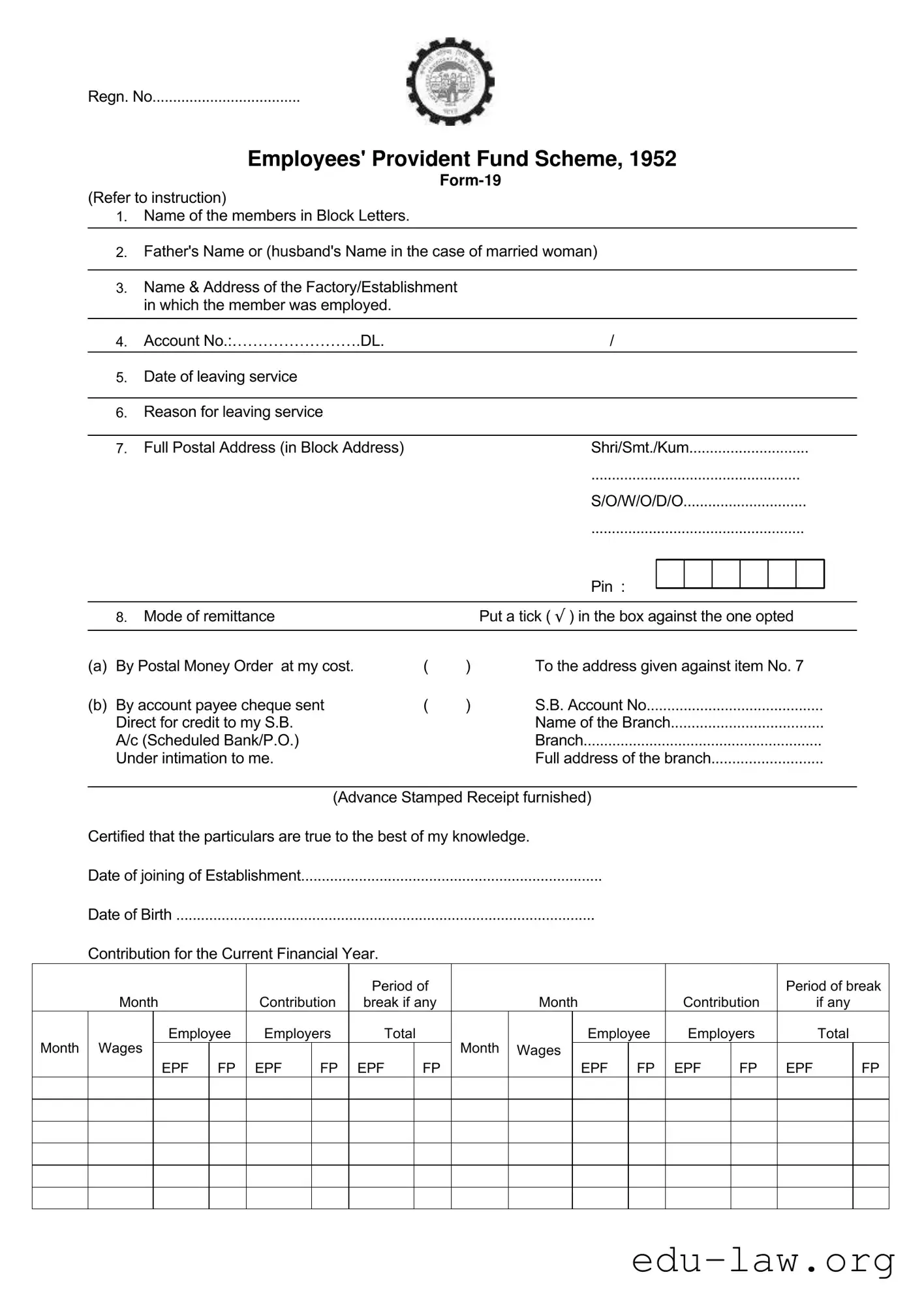
The Employees Provident Fund (EPF) form is a crucial document for individuals who have been employed in establishments covered under the EPF Scheme, 1952. This form serves multiple purposes, primarily facilitating the withdrawal of provident fund contributions upon leaving a job. It requires essential information, including the member's name, father's or husband's name for married women, and the address of the factory or establishment where the individual was employed. Additionally, the form asks for the account number and the date of leaving service, along with the reason for departure. Members must provide their full postal address and select a preferred mode of remittance for their funds, such as a postal money order or a direct credit to their bank account. To ensure accuracy, the form includes sections for contributions made during the current financial year, detailing both employee and employer contributions. Furthermore, it requires certification from the employer, confirming that the contributions have been included in regular monthly remittances. Members must also include a declaration of non-employment if applicable, indicating that they have remained unemployed for a specified period. Overall, the EPF form is designed to streamline the process of accessing retirement savings, providing a structured approach to managing contributions and ensuring that members receive their entitlements efficiently.

Regn. No....................................
Employees' Provident Fund Scheme, 1952
(Refer to instruction)
1.Name of the members in Block Letters.
2.Father's Name or (husband's Name in the case of married woman)
3.Name & Address of the Factory/Establishment in which the member was employed.
4. Account No.:…………………….DL. |
/ |
5.Date of leaving service
6.Reason for leaving service
7. |
Full Postal Address (in Block Address) |
Shri/Smt./Kum |
|||||||
|
|
................................................... |
|
||||||
|
|
S/O/W/O/D/O |
|||||||
|
|
.................................................... |
|
||||||
|
|
Pin : |
|
|
|
|
|
|
|
|
|
|
|
|
|
|
|
|
|
|
|
|
|
|
|
|
|
|
|
|
|
|
|
||||||
8. |
Mode of remittance |
Put a tick ( Ö ) in the box against the one opted |
|
||||||
|
|
|
|
|
|
|
|
|
|
(a)By Postal Money Order at my cost.
(b)By account payee cheque sent Direct for credit to my S.B. A/c (Scheduled Bank/P.O.) Under intimation to me.
( |
) |
To the address given against item No. 7 |
( |
) |
S.B. Account No |
|
|
Name of the Branch |
|
|
Branch |
|
|
Full address of the branch |
(Advance Stamped Receipt furnished)
Certified that the particulars are true to the best of my knowledge.
Date of joining of Establishment.........................................................................
Date of Birth ......................................................................................................
Contribution for the Current Financial Year.
|
|
|
|
|
|
Period of |
|
|
|
|
|
|
Period of break |
||||
|
Month |
|
Contribution |
break if any |
|
Month |
|
Contribution |
|
if any |
|||||||
|
|
Employee |
Employers |
Total |
|
|
|
Employee |
Employers |
|
Total |
||||||
Month |
Wages |
|
|
|
|
|
|
|
Month |
Wages |
|
|
|
|
|
|
|
|
|
EPF |
FP |
EPF |
FP |
EPF |
|
FP |
|
|
EPF |
FP |
EPF |
FP |
EPF |
|
FP |
|
|
|
|
|
|
|
|
|
|
|
|
|
|
|
|
|
|
|
|
|
|
|
|
|
|
|
|
|
|
|
|
|
|
|
|
|
|
|
|
|
|
|
|
|
|
|
|
|
|
|
|
|
|
|
|
|
|
|
|
|
|
|
|
|
|
|
|
|
|
|
|
|
|
|
|
|
|
|
|
|
|
|
|
|
|
|
|
|
|
|
|
|
|
|
|
|
|
|
|
|
|
|
|
|
|
|
|

( information to be furnished by the Employer if the Claim Form is Attested by the Employer)
Certified that the above contributions have been included in the regular monthly remittances.
The Applicant has signed/Thumb impressed before me.
............ .....................................................
Signature of Left/Right hand thumb impression of the member
Date......................................
Designation & Seal
Encl.
Declaration of
Note:- In the case of submission of application for settlement under clause (s) of
Date |
Signature or Left / Right hand thumb impression of the member |
|
|
ADVANCE STAMPED RECEIPT (To be furnished only in case of 8 (b) above)
Received a sum of Rs. ....................(Rupees .......................................................... .......................... from
Regional Provident Fund Commissioner /
by deposit in my Savings Bank account towards the settlement of my Provident Fund Account.
The space should be left blank which shall be filled in by Regional Provident Fund Commissioner/Officer
Affix 1/- Rupee
Revenue
Stamp
Signature orLeft / Right hand thumb impression of the member
(For the use of Commissioner's Office)
A/C Settled in part/Full Entered in F.
|
Clerk |
Section Supervisor |
M.O./Cheque |
||
Account No. |
Section |
|
¼in
M.O. Commission (if any)
Net Amount to be paid by M.0……………………………Date………………..
|
(For use in Cash Section) |
|
Paid by inclusion in Cheque No |
............................ |
date |
vide Cash Book (Bank) Account No.3 Debit Item No |
||
HC |
|
AC / RC |
|
|
|
|
Remarks |
|
| Fact Name | Description |
|---|---|
| Form Title | This is the Employees' Provident Fund Scheme, 1952 Form-19. |
| Governing Law | The form is governed by the Employees' Provident Funds and Miscellaneous Provisions Act, 1952. |
| Member's Name | The member must provide their name in block letters. |
| Father's or Husband's Name | Members need to include their father's name or husband's name if married. |
| Employer Details | The name and address of the factory or establishment where the member was employed must be provided. |
| Account Number | Members should fill in their Provident Fund Account Number. |
| Date of Leaving | The form requires the date when the member left the service. |
| Remittance Mode | Members can choose how to receive their funds, either by Postal Money Order or through a bank account. |
| Declaration | A declaration confirming the accuracy of the details provided must be signed by the member. |
Filling out the Employees Provident Fund form is an important step in managing your retirement savings. Once you have completed the form, you will need to submit it to the appropriate authority for processing. Below are the steps to guide you through the completion of the form.
What is the Employees Provident Fund Form?
The Employees Provident Fund Form is a document used by employees in India to claim their provident fund contributions upon leaving a job. This form is part of the Employees' Provident Fund Scheme, 1952, and helps facilitate the transfer or withdrawal of accumulated savings from the provident fund account.
Who needs to fill out this form?
Any employee who has contributed to the Employees' Provident Fund and is leaving their job can fill out this form. This includes individuals who are retiring, resigning, or being terminated from their employment. It is essential for those who wish to access their provident fund savings.
What information is required on the form?
The form requires several details, including the member's name, father's or husband's name (if applicable), the name and address of the employer, the account number, the date of leaving service, and the reason for leaving. Additionally, the member must provide their full postal address and choose a mode of remittance for the funds.
How do I choose a mode of remittance?
On the form, you will see options for remittance. You can choose between receiving your funds via postal money order or through an account payee cheque. If you select the cheque option, you must provide your bank account details, including the account number and branch information.
What is the significance of the employer's certification?
The employer's certification is crucial as it verifies that the contributions mentioned in the form have been included in the regular monthly remittances. This certification helps ensure that the claim is processed smoothly and that all contributions are accounted for accurately.
When can I submit the claim form?
You should submit the claim form after two months from your date of leaving the service, provided you remain unemployed. This waiting period allows for proper processing and ensures compliance with the regulations of the Employees' Provident Fund Scheme.
What happens if I have a break in service?
If you have a break in service, you will need to provide details of the break in the form. This includes the period of the break and the contributions made during that time. Accurate reporting helps in the correct calculation of your total provident fund amount.
Is there a need for a declaration of non-employment?
Yes, when submitting the claim, you may be required to include a declaration of non-employment. This declaration confirms that you are not currently employed in any establishment covered under the Employees' Provident Fund Act, which is necessary for processing your claim.
What should I do if I need assistance with the form?
If you require help with filling out the Employees Provident Fund Form, you can seek assistance from your employer's HR department or consult with a legal expert. They can guide you through the process and ensure that you complete the form accurately to avoid delays in your claim.
What if I make a mistake on the form?
If you make a mistake on the form, it is advisable to correct it before submission. You can cross out the incorrect information and write the correct details next to it. However, ensure that any changes are initialed to maintain clarity. If the errors are significant, it may be best to fill out a new form.
Inaccurate Personal Information: Many individuals fail to provide their name in block letters, leading to confusion and potential delays in processing.
Missing Father's or Husband's Name: Applicants often overlook this requirement, which is crucial for verifying identity, especially for married women.
Incorrect Factory/Establishment Details: Providing an inaccurate name or address of the place of employment can hinder the verification process.
Account Number Errors: Mistakes in the account number section can result in funds being sent to the wrong account, causing significant delays.
Not Specifying the Date of Leaving Service: Some applicants forget to include this date, which is essential for processing the claim.
Omitting the Reason for Leaving: Failing to provide a reason can lead to questions from the authorities, slowing down the approval process.
Incomplete Postal Address: Providing an incomplete or unclear address can result in misdelivery of funds or important documents.
Neglecting the Mode of Remittance: Not indicating the preferred method of receiving funds can lead to delays, as the authorities may not know how to proceed.
The Employees Provident Fund (EPF) form is just one part of the documentation needed for managing your retirement savings. Alongside this form, several other documents may be required to ensure a smooth process. Here’s a brief overview of some commonly used forms and documents related to the EPF.
Each of these documents plays a vital role in managing your EPF account and ensuring that your retirement savings are secure and accessible when needed. Being familiar with these forms can make the process smoother and help you make informed decisions about your financial future.
The Employees' Provident Fund (EPF) form shares similarities with the Social Security Administration (SSA) application form. Both documents serve as official requests for benefits, requiring personal information and employment history. The SSA application necessitates details such as the applicant's name, Social Security number, and work history, paralleling the EPF form's requirement for the member's name, father's name, and employment details. Each form aims to ensure that the individual receives the appropriate benefits based on their contributions and employment status.
Another document comparable to the EPF form is the Unemployment Insurance (UI) claim form. This form is used to apply for unemployment benefits and also requires personal and employment information. Just like the EPF form, the UI claim form requests the reason for leaving employment and the dates of employment. Both documents emphasize the need for accuracy in reporting to facilitate timely processing of claims and benefits.
The 401(k) withdrawal form is another document that resembles the EPF form. Individuals use this form to request the disbursement of retirement savings from their 401(k) plans. Similar to the EPF form, it requires personal identification details, employment history, and the reason for withdrawal. Both forms are designed to manage retirement funds and ensure that individuals can access their savings under specific circumstances.
The Disability Benefits application form aligns closely with the EPF form as well. Individuals seeking disability benefits must provide personal information, medical history, and employment details. Like the EPF form, it requires the applicant to certify that the information provided is accurate and complete. Both documents aim to assess eligibility for benefits based on the individual's work history and current status.
Lastly, the Health Insurance Portability and Accountability Act (HIPAA) authorization form is similar in that it requires personal information and consent for the release of health-related information. While the purpose differs, both forms necessitate precise details to ensure that the intended benefits or services are accurately delivered. Each document underscores the importance of protecting personal information while facilitating access to necessary resources.
Filling out the Employees Provident Fund (EPF) form can seem daunting, but it doesn’t have to be. Here’s a list of things you should and shouldn’t do to ensure a smooth process.
By following these guidelines, you can help ensure that your EPF claim is processed efficiently. Remember, attention to detail can make all the difference in navigating this process smoothly.
Misconceptions about the Employees Provident Fund (EPF) form can lead to confusion and delays in processing claims. Here are six common misconceptions:
This is not true. The EPF form can also be used for employees who are still working but want to withdraw their funds for specific reasons, such as purchasing a home or medical emergencies.
While it's important to act promptly, the form can be submitted after a two-month waiting period if you remain unemployed. This allows for better processing of your claim.
The key is to ensure that all required fields are completed accurately. As long as the necessary information is provided, minor formatting issues typically won't affect your claim.
This is incorrect. While employers need to verify certain details, employees can and should fill out their personal information and reasons for withdrawal.
You can update your bank account information if you notify the relevant authorities before your claim is processed. Ensure you provide the correct details to avoid delays.
Even if you have a digital account, you may still need to submit the EPF form for certain transactions or withdrawals. Always check the requirements based on your situation.
When it comes to filling out and using the Employees Provident Fund (EPF) form, there are several important points to keep in mind. Below are key takeaways to help ensure a smooth process:
By following these guidelines, you can help ensure that your EPF claim is processed efficiently and accurately. Always double-check your entries for completeness before submission.