In today's visually-driven world, the use of images for marketing and promotional purposes has become increasingly common among businesses. An Employee Photo Release form serves as an essential tool for organizations that wish to utilize photographs of their employees in various media, including websites, brochures, and social media platforms. This form provides clarity and protection for both the employer and the employee, ensuring that consent is obtained before any images are published. It typically outlines the rights granted by the employee regarding the use of their likeness, specifying how and where the images may be used. Additionally, the form often includes information about the duration of the consent and any compensation involved, if applicable. By having a clear and signed release, companies can avoid potential legal disputes while fostering a respectful and transparent relationship with their staff.
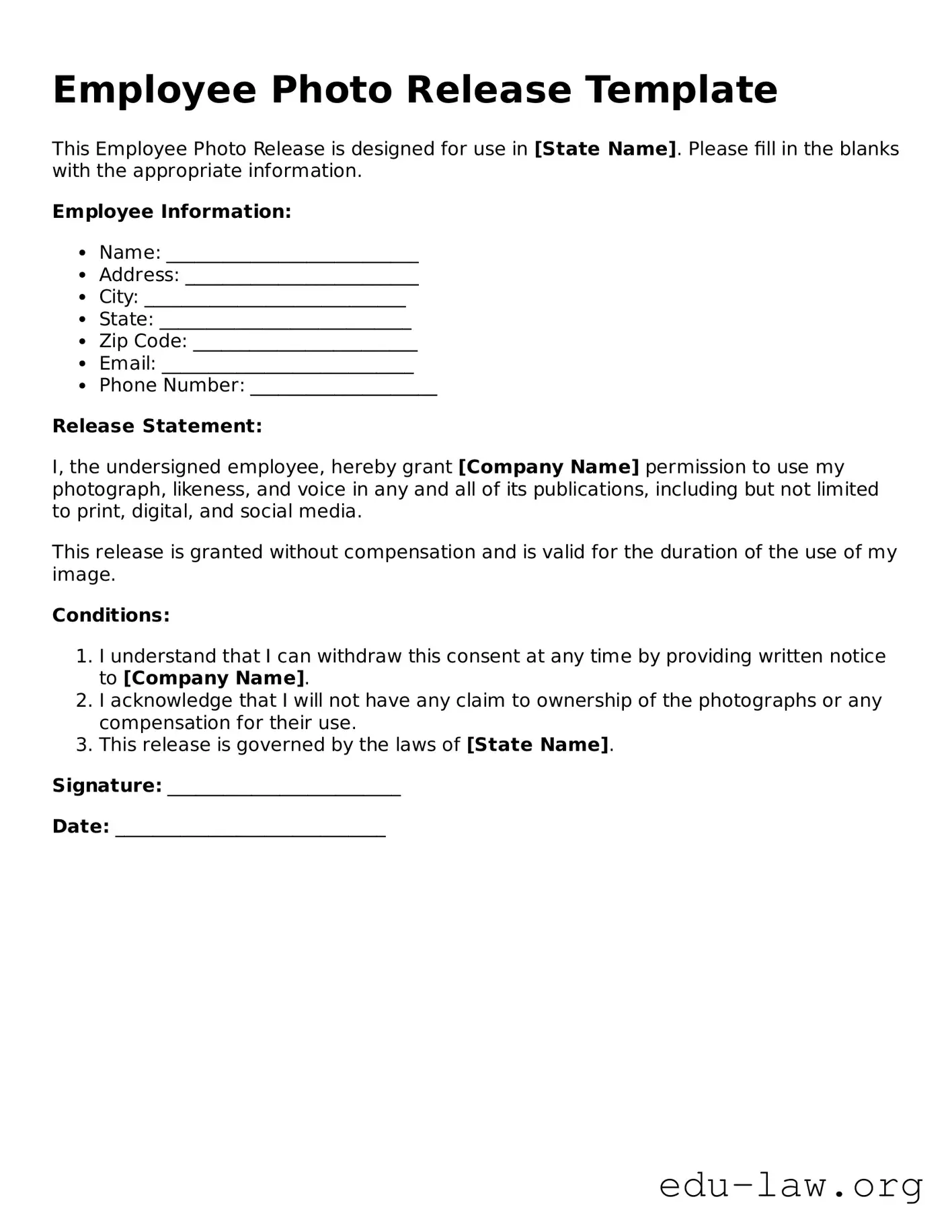
Employee Photo Release Template
This Employee Photo Release is designed for use in [State Name]. Please fill in the blanks with the appropriate information.
Employee Information:
Release Statement:
I, the undersigned employee, hereby grant [Company Name] permission to use my photograph, likeness, and voice in any and all of its publications, including but not limited to print, digital, and social media.
This release is granted without compensation and is valid for the duration of the use of my image.
Conditions:
Signature: _________________________
Date: _____________________________
| Fact Name | Description |
|---|---|
| Purpose | The Employee Photo Release form allows employers to obtain permission from employees to use their photographs for various purposes, such as marketing or promotional materials. |
| Consent | By signing the form, employees give their explicit consent for their images to be used, which protects both the employer and the employee legally. |
| State-Specific Laws | Different states may have specific laws governing the use of employee images. For example, California requires clear consent under the California Civil Code. |
| Revocation | Employees typically have the right to revoke their consent at any time, which should be clearly stated in the form to ensure transparency. |
Completing the Employee Photo Release form is an important step in ensuring that your organization has the necessary permissions to use employee images for various purposes. Follow these steps carefully to fill out the form accurately and ensure that it is processed without delay.
Once you have filled out the form, review it for accuracy. Ensure all required fields are complete before submitting it to the appropriate department. Timely submission will help facilitate the process of using your images as intended.
What is an Employee Photo Release form?
An Employee Photo Release form is a document that allows an employer to obtain permission from an employee to use their photograph or likeness for specific purposes. This may include promotional materials, company websites, social media, or other marketing efforts. The form ensures that the employee understands how their image will be used and agrees to it, protecting both the employee's rights and the employer's interests.
Why is it important to have an Employee Photo Release form?
Having an Employee Photo Release form is crucial for several reasons. First, it provides legal protection for the employer by ensuring that they have the employee's consent to use their image. This can help avoid potential disputes or claims of unauthorized use. Second, it allows employees to understand how their image will be used, giving them control over their likeness. Clear communication about usage can foster trust between employees and the employer.
What should be included in an Employee Photo Release form?
An effective Employee Photo Release form should include several key components. It should clearly state the purpose of the photo usage, specify the types of media in which the images may appear, and outline any limitations on the use of the images. Additionally, it should provide space for the employee to sign and date the form, indicating their consent. Including a section that explains the employee's rights regarding withdrawal of consent may also be beneficial.
Can an employee revoke their consent after signing the form?
Not reading the entire form carefully before signing. Understanding all sections is crucial.
Failing to provide a clear and recent photo. Ensure the image meets the specified guidelines.
Overlooking the date of signature. This can lead to confusion about the validity of the release.
Not including contact information. This is essential for follow-up and clarification if needed.
Ignoring the purpose of the photo release. Be aware of how the photo will be used.
Not checking the box for consent. This is a crucial step in granting permission.
Providing incomplete or inaccurate personal information. Double-check for accuracy.
Failing to ask questions if unsure about any part of the form. Clarification is important.
Not keeping a copy of the signed form for personal records. This can be helpful for future reference.
Submitting the form late. Timeliness is essential to ensure that your photo is included as intended.
The Employee Photo Release form is an essential document for organizations that wish to use employees' images for promotional or informational purposes. However, it often accompanies several other forms and documents to ensure comprehensive compliance and clarity in the use of images. Below is a list of commonly used documents that work in conjunction with the Employee Photo Release form.
Utilizing these documents alongside the Employee Photo Release form ensures that both the organization and its employees are protected and informed. Proper documentation fosters a transparent relationship and safeguards everyone’s interests in the use of images.
The Employee Photo Release form shares similarities with the Media Release form. Both documents grant permission for the use of an individual's likeness in various media formats. The Media Release form is often used by photographers, filmmakers, and organizations to ensure they have the right to publish or distribute images or videos featuring individuals. This similarity highlights the importance of consent in both personal and professional settings.
Another document akin to the Employee Photo Release form is the Model Release form. This form is specifically utilized in the modeling industry and serves a similar purpose: it allows photographers and companies to use the images of models for promotional purposes. Like the Employee Photo Release, the Model Release outlines the rights of both the model and the photographer, emphasizing the need for clear communication regarding image usage.
The Talent Release form is also comparable. This document is commonly used in film and television production. It ensures that actors and performers consent to the use of their performances in various media. Both the Talent Release and the Employee Photo Release protect the rights of individuals while providing legal coverage for organizations that wish to use their likenesses.
The Consent to Use Image form is another related document. This form is often used by educational institutions and non-profits to obtain permission from individuals before using their images in promotional materials. Similar to the Employee Photo Release, it emphasizes the need for consent and outlines how the images will be used, fostering transparency between the parties involved.
The Video Release form is also similar in nature. This document is used when filming individuals for video projects, ensuring that the subjects agree to the use of their image and voice. Like the Employee Photo Release, the Video Release protects both the rights of the individual and the interests of the organization producing the video.
The Waiver of Liability form bears some resemblance as well. While its primary focus is on limiting liability for organizations, it often includes clauses regarding the use of images taken during events. This document may not be solely about image rights, but it often intersects with the themes of consent and usage rights found in the Employee Photo Release.
The Release of Liability and Consent form is another relevant document. This form is typically used in recreational or sporting events, where participants agree to allow their images to be used for promotional purposes. Similar to the Employee Photo Release, it aims to protect organizations while ensuring that participants understand how their images may be utilized.
The Publicity Release form is also worth mentioning. This document is often used in advertising campaigns, granting permission for the use of an individual’s image in marketing materials. Like the Employee Photo Release, it highlights the importance of obtaining consent and clearly outlines how the individual’s likeness will be used, thus safeguarding both parties.
Lastly, the Social Media Release form is increasingly relevant in today’s digital landscape. This document is used to obtain permission from individuals before sharing their images or content on social media platforms. Similar to the Employee Photo Release, it emphasizes the importance of consent in the context of online sharing and ensures that individuals are aware of how their images may be disseminated in the digital space.
When filling out the Employee Photo Release form, it’s important to be careful and thorough. Here are some guidelines to follow:
Following these steps will help ensure that your rights and preferences are respected.
The Employee Photo Release form is often misunderstood, leading to confusion among employees and employers alike. Below are four common misconceptions about this form.
Understanding these misconceptions can help foster a more informed workplace environment where both employees and employers are aware of their rights and responsibilities regarding image use.
When dealing with the Employee Photo Release form, it’s important to understand its significance and how to properly fill it out. Here are some key takeaways: