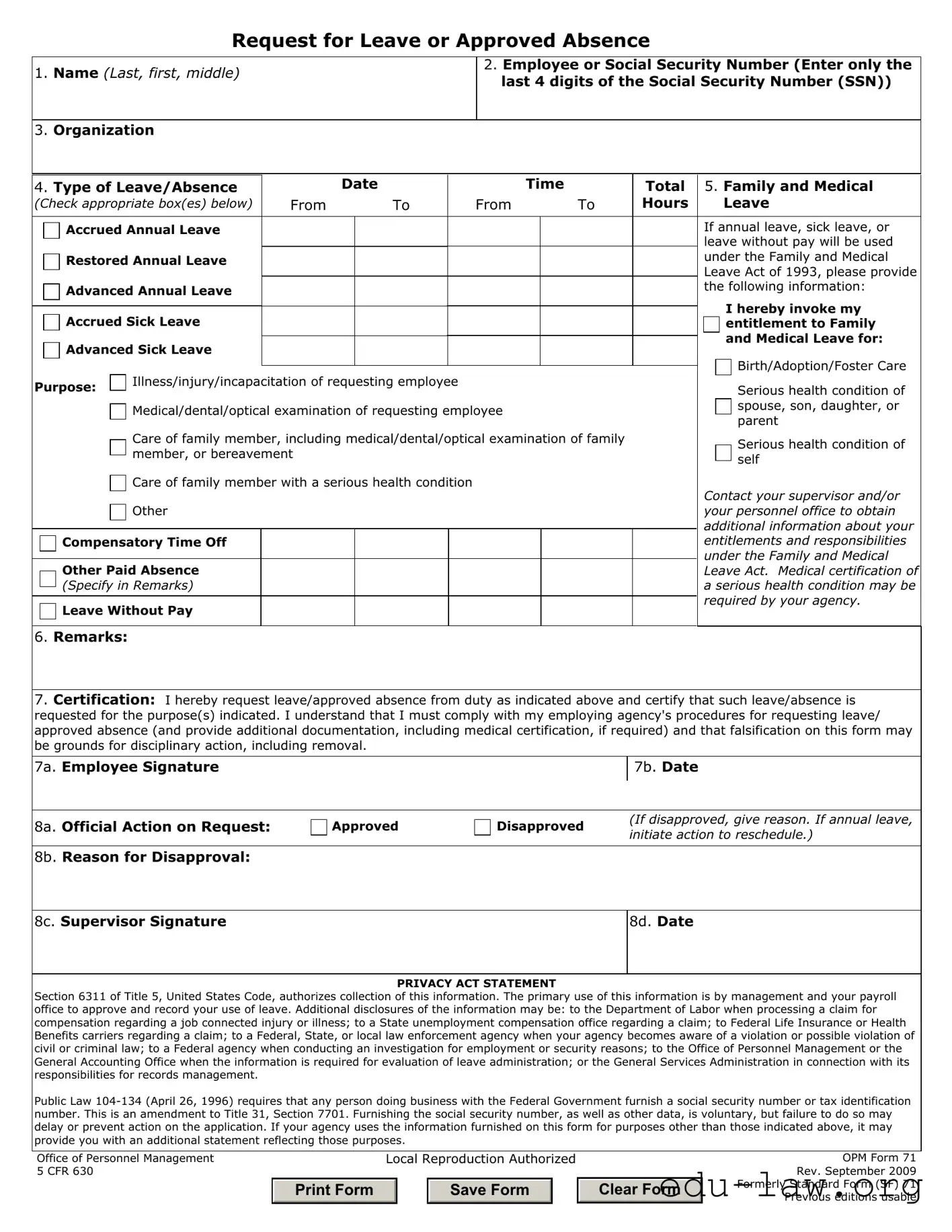
The Employee Leave Request form serves as a crucial tool for employees navigating their time away from work, ensuring that both their needs and the organization’s protocols are respected. This form requires essential information such as the employee’s name, the last four digits of their Social Security Number, and their organization. It details the type of leave being requested, whether it be for family and medical reasons, annual leave, or sick leave, along with specific dates and times. Employees must indicate the purpose of their leave, which can range from personal illness to caring for a family member or even bereavement. The form also includes a certification section where employees affirm the accuracy of their request and acknowledge their obligation to follow agency procedures. Additionally, the privacy of the information provided is protected under the Privacy Act, ensuring that the data is used appropriately for payroll and leave management. Understanding how to complete this form accurately can significantly impact an employee's ability to take necessary time off while maintaining compliance with workplace policies.
Request for Leave or Approved Absence
1.Name (Last, first, middle)
2.Employee or Social Security Number (Enter only the last 4 digits of the Social Security Number (SSN))
3.Organization
4. Type of Leave/Absence |
|
Date |
|
|
Time |
Total |
5. Family and Medical |
|||||
(Check appropriate box(es) below) |
From |
|
To |
|
From |
|
To |
Hours |
Leave |
|||
|
|
Accrued Annual Leave |
|
|
|
|
|
|
|
|
If annual leave, sick leave, or |
|
|
|
|
|
|
|
|
|
|
|
|
|
leave without pay will be used |
|
|
Restored Annual Leave |
|
|
|
|
|
|
|
|
under the Family and Medical |
|
|
|
|
|
|
|
|
|
|
|
|
|
Leave Act of 1993, please provide |
|
|
Advanced Annual Leave |
|
|
|
|
|
|
|
|
the following information: |
|
|
|
|
|
|
|
|
|
|
|
|
|
I hereby invoke my |
|
|
Accrued Sick Leave |
|
|
|
|
|
|
|
|
||
|
|
|
|
|
|
|
|
|
|
entitlement to Family |
||
|
|
Advanced Sick Leave |
|
|
|
|
|
|
|
|
and Medical Leave for: |
|
|
|
|
|
|
|
|
|
|
|
|||
|
|
|
|
|
|
|
|
|
|
Birth/Adoption/Foster Care |
||
|
|
|
|
|
|
|
|
|
|
|
|
|
Purpose: |
Illness/injury/incapacitation of requesting employee |
|
|
|
|
|||||||
|
|
|
|
Serious health condition of |
||||||||
|
|
|
|
|
|
|
|
|
||||
|
|
|
Medical/dental/optical examination of requesting employee |
|
|
|
spouse, son, daughter, or |
|||||
|
|
|
|
|
|
parent |
||||||
|
|
|
|
|
|
|
|
|
|
|
|
|
|
|
|
Care of family member, including medical/dental/optical examination of family |
|
Serious health condition of |
|||||||
|
|
|
member, or bereavement |
|
|
|
|
|
|
|
||
|
|
|
|
|
|
|
|
|
|
self |
||
|
|
|
|
|
|
|
|
|
|
|
|
|
|
|
|
Care of family member with a serious health condition |
|
|
|
|
Contact your supervisor and/or |
||||
|
|
|
|
|
|
|
|
|
|
|
|
|
|
|
|
Other |
|
|
|
|
|
|
|
|
your personnel office to obtain |
|
|
|
|
|
|
|
|
|
|
|
|
additional information about your |
|
|
Compensatory Time Off |
|
|
|
|
|
|
|
|
entitlements and responsibilities |
|
|
|
|
|
|
|
|
|
|
|
|
|
under the Family and Medical |
|
|
|
|
|
|
|
|
|
|
|
|
|
|
|
Other Paid Absence |
|
|
|
|
|
|
|
|
||
|
|
|
|
|
|
|
|
|
|
Leave Act. Medical certification of |
||
|
|
(Specify in Remarks) |
|
|
|
|
|
|
|
|
a serious health condition may be |
|
|
|
|
|
|
|
|
|
|
|
|
|
required by your agency. |
|
|
Leave Without Pay |
|
|
|
|
|
|
|
|
||
|
|
|
|
|
|
|
|
|
|
|
||
|
|
|
|
|
|
|
|
|
|
|
|
|
6.Remarks:
7.Certification: I hereby request leave/approved absence from duty as indicated above and certify that such leave/absence is requested for the purpose(s) indicated. I understand that I must comply with my employing agency's procedures for requesting leave/ approved absence (and provide additional documentation, including medical certification, if required) and that falsification on this form may be grounds for disciplinary action, including removal.
7a. Employee Signature
7b. Date
8a. Official Action on Request: |
Approved |
Disapproved |
(If disapproved, give reason. If annual leave, |
|
initiate action to reschedule.) |
||||
|
|
|
||
|
|
|
|
|
8b. Reason for Disapproval: |
|
|
|
8c. Supervisor Signature
8d. Date
PRIVACY ACT STATEMENT
Section 6311 of Title 5, United States Code, authorizes collection of this information. The primary use of this information is by management and your payroll office to approve and record your use of leave. Additional disclosures of the information may be: to the Department of Labor when processing a claim for compensation regarding a job connected injury or illness; to a State unemployment compensation office regarding a claim; to Federal Life Insurance or Health Benefits carriers regarding a claim; to a Federal, State, or local law enforcement agency when your agency becomes aware of a violation or possible violation of civil or criminal law; to a Federal agency when conducting an investigation for employment or security reasons; to the Office of Personnel Management or the General Accounting Office when the information is required for evaluation of leave administration; or the General Services Administration in connection with its responsibilities for records management.
Public Law
Office of Personnel Management |
Local Reproduction Authorized |
||||
5 CFR 630 |
|
|
|
|
|
|
Print Form |
|
|
Save Form |
|
|
|
|
|
|
|
Clear Form
OPM Form 71
Rev. September 2009
Formerly Standard Form (SF) 71
Previous editions usable
| Fact Name | Details |
|---|---|
| Purpose of the Form | The Employee Leave Request form is used to formally request time off from work for various reasons, including personal health issues, family needs, or other approved absences. |
| Required Information | Employees must provide their name, last four digits of their Social Security Number, organization, and specific details about the type of leave requested. |
| Types of Leave | The form accommodates various leave types, including annual leave, sick leave, Family and Medical Leave, and leave without pay. |
| Certification Requirement | Employees must certify that their request is valid and understand the consequences of falsifying information on the form. |
| Medical Certification | For certain types of leave, especially those related to health conditions, a medical certification may be required by the employer. |
| Supervisor's Role | The supervisor must review and approve or disapprove the leave request, providing reasons for any disapproval. |
| Privacy Act Compliance | The collection of information is authorized under Section 6311 of Title 5, U.S. Code, ensuring confidentiality and proper use of data. |
| State-Specific Forms | Some states may have specific forms or additional requirements based on local labor laws. Always check state regulations for compliance. |
| Legal References | Federal laws, such as the Family and Medical Leave Act (FMLA) and Public Law 104-134, govern the use and administration of leave requests. |
After completing the Employee Leave Request form, submit it to your supervisor or personnel office for review. They will process your request and inform you of the outcome. Follow the steps below to ensure accurate completion of the form.
What information do I need to provide on the Employee Leave Request form?
When completing the Employee Leave Request form, you must provide several key pieces of information. Start with your name, including your last, first, and middle names. Next, include the last four digits of your Social Security Number. You will also need to specify your organization and the type of leave or absence you are requesting. Be sure to indicate the dates and times of your leave, as well as the total hours. If applicable, check the appropriate boxes for Family and Medical Leave and detail the purpose of your request. Lastly, include any remarks and sign the form to certify your request.
What types of leave can I request using this form?
This form allows you to request various types of leave, including annual leave, sick leave, leave without pay, and Family and Medical Leave. You can also request leave for specific reasons such as birth, adoption, illness, or caring for a family member with a serious health condition. If you plan to use accrued leave or request advanced leave, ensure you indicate this clearly on the form. Each type of leave has specific guidelines, so be sure to review your agency's policies for any additional requirements.
What happens if my leave request is disapproved?
If your leave request is disapproved, your supervisor will provide a reason for the denial. This information is crucial as it helps you understand any potential issues or misunderstandings regarding your request. In the case of annual leave, your supervisor may initiate action to reschedule your leave. It is advisable to communicate with your supervisor to address any concerns and explore alternative options if your request is not approved.
Do I need to provide medical certification for my leave request?
In certain circumstances, you may be required to provide medical certification to support your leave request, especially if you are invoking Family and Medical Leave. Your agency will inform you if this documentation is necessary. It is essential to comply with this requirement to ensure your leave is properly authorized. Failure to provide required documentation could result in delays or denial of your leave request.
Incomplete Name Information: Many people forget to include their full name, including last, first, and middle names. This can lead to confusion and delays in processing the request.
Incorrect Social Security Number: Entering the wrong last four digits of the Social Security Number can cause issues with identification and payroll.
Missing Dates: Failing to provide the start and end dates of the leave can result in the request being denied. Always double-check that these fields are filled out completely.
Not Specifying Type of Leave: It’s crucial to check the appropriate box for the type of leave requested. Omitting this detail can lead to misunderstandings about the nature of the leave.
Inadequate Remarks: Some individuals neglect to provide enough information in the remarks section. This can be especially important for medical leave, where additional context may be required.
Failure to Sign: Forgetting to sign and date the form can halt the entire process. Always remember to complete this final step before submission.
Ignoring Agency Procedures: Each agency may have specific rules for submitting leave requests. Not following these can lead to disapproval or delays.
When submitting an Employee Leave Request form, several other documents may also be required or helpful for processing the request. These documents provide additional information and support for the leave being requested. Below is a list of common forms and documents that are often used alongside the Employee Leave Request form.
Having these documents ready can streamline the leave request process and ensure that all necessary information is provided. Employees should consult their HR department if they have questions about any of these forms or need assistance completing them.
The Sick Leave Request form is similar to the Employee Leave Request form in that both documents require employees to specify the type of leave they are requesting. Each form captures essential information such as the employee's name and identification number, which helps to maintain accurate records. Additionally, both forms may necessitate a medical certification if the leave is due to health-related issues, ensuring that the request is valid and documented appropriately.
The Family Leave Request form also shares similarities with the Employee Leave Request form. This document is specifically designed for employees needing time off to care for a family member with a serious health condition. Like the Employee Leave Request form, it requires details about the employee and the nature of the leave. Furthermore, both forms emphasize compliance with agency procedures and may require supporting documentation.
The Vacation Request form is another document that parallels the Employee Leave Request form. Both forms allow employees to request time away from work for personal reasons, whether for leisure or family matters. Each form includes sections for the employee's name and the specific dates of the requested leave, ensuring that supervisors can manage scheduling effectively.
The Bereavement Leave Request form is similar to the Employee Leave Request form as it provides a structured way for employees to request time off following the death of a loved one. Both forms require the employee's information and outline the type of leave being requested. In both cases, the documentation helps employers understand the reasons behind the absence and manage workloads accordingly.
The Leave of Absence Request form shares key features with the Employee Leave Request form. This document is used when an employee needs to take an extended period away from work for various reasons, such as personal issues or health concerns. Both forms require detailed information about the employee and the duration of the leave, facilitating proper planning and communication within the organization.
The Compensatory Time Off Request form is another document that aligns with the Employee Leave Request form. Employees use this form to request time off in exchange for extra hours worked. Similar to the Employee Leave Request form, it requires the employee's name and the specific dates for the time off, helping supervisors track and approve requests efficiently.
The Medical Leave Request form is akin to the Employee Leave Request form in that it specifically addresses absences due to medical reasons. Both forms require the employee to provide personal information and may necessitate medical documentation to validate the request. This ensures that the leave is appropriately categorized and that the employee’s rights are protected under relevant laws.
The Personal Leave Request form is similar to the Employee Leave Request form, as it allows employees to take time off for personal reasons not covered by other leave types. Each form requires similar information about the employee and the reason for the absence. This helps maintain transparency and ensures that all requests are handled consistently.
The Maternity Leave Request form is another document that mirrors the Employee Leave Request form. It is specifically designed for employees expecting a child and outlines the time off needed for maternity purposes. Both forms require the employee's identification and the dates of the requested leave, ensuring that the organization can plan for the employee's absence effectively.
The Flexible Work Arrangement Request form also shares similarities with the Employee Leave Request form. While this document is used to request changes to work schedules rather than leave, it still requires the employee to provide personal information and details about the requested arrangement. Both forms aim to accommodate employees' needs while ensuring that business operations continue smoothly.
When filling out the Employee Leave Request form, consider the following guidelines:
Misconception 1: The Employee Leave Request form is only for sick leave.
This is not true. While the form does allow for sick leave requests, it covers various types of leave, including annual leave, family and medical leave, and leave without pay. Employees can use this form to request time off for a range of personal and family-related reasons.
Misconception 2: Submitting the form guarantees approval of leave.
Approval is not automatic upon submission. The request is subject to review by a supervisor or personnel office. They will evaluate the request based on agency policies and the reasons provided. Disapproval can occur, and the employee will be informed of the reasons.
Misconception 3: Only full-time employees can use the Employee Leave Request form.
This form is available to all employees, regardless of their work schedule. Part-time employees and those on temporary assignments can also request leave using this form, as long as they follow the appropriate procedures.
Misconception 4: Medical certification is always required for leave requests.
While medical certification may be required for certain types of leave, such as family and medical leave, it is not necessary for all requests. The need for documentation depends on the specific type of leave being requested and the agency's policies.
Filling out and using the Employee Leave Request form is an important process for managing your time away from work. Here are some key takeaways to keep in mind:
By keeping these points in mind, you can navigate the leave request process more smoothly and ensure that your time away from work is managed effectively.