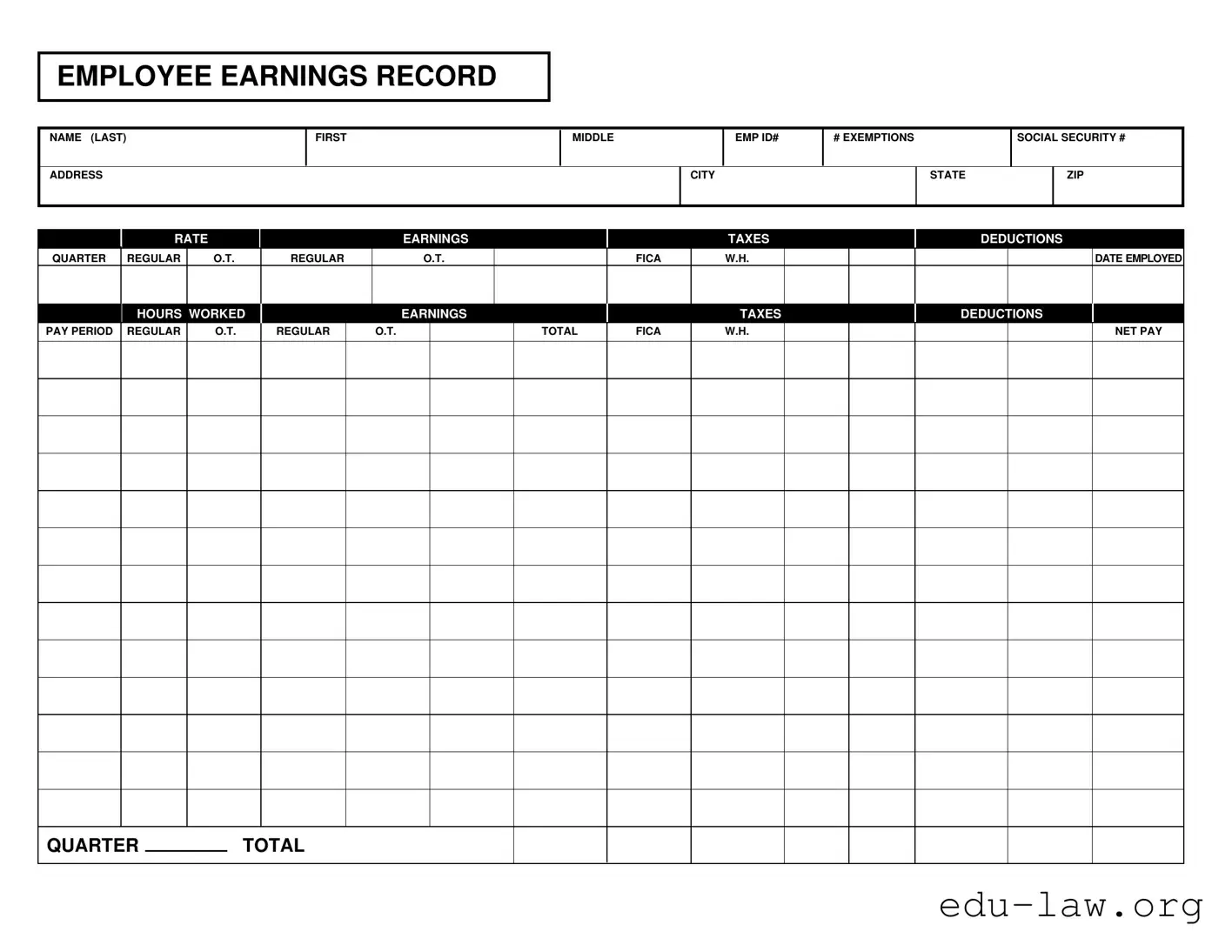
The Employee Earnings Record form serves as a vital tool for both employers and employees, encapsulating essential information about an individual's earnings and deductions over a specific pay period. This form typically includes the employee's name, address, and unique identification number, ensuring that all records are accurately linked to the right person. It also captures critical details such as the employee's Social Security number, exemptions, and the various rates of pay, including regular and overtime earnings. Notably, the form breaks down taxes and deductions, providing transparency regarding FICA (Federal Insurance Contributions Act) contributions and withholding taxes. By summarizing hours worked and net pay, the Employee Earnings Record offers a comprehensive snapshot of an employee's financial standing within a given quarter. This document not only facilitates payroll processing but also serves as a reference for employees to understand their earnings and obligations, fostering a clearer relationship between them and their employers.
EMPLOYEE EARNINGS RECORD
NAME (LAST)
ADDRESS
FIRST |
|
MIDDLE |
EMP ID# |
# EXEMPTIONS |
SOCIAL SECURITY # |
|||
|
||||||||
|
|
|
CITY |
|
|
STATE |
|
ZIP |
|
|
|
|
|
|
|||
|
|
|
|
|
|
|
|
|
|
RATE |
|
|
|
EARNINGS |
|
|
TAXES |
DEDUCTIONS |
|
QUARTER |
REGULAR |
|
O.T. |
REGULAR |
O.T. |
|
FICA |
W.H. |
DATE EMPLOYED |
|
|
|
|
|
|
|
|
|
|
|
|
|
HOURS |
WORKED |
|
|
EARNINGS |
|
|
TAXES |
DEDUCTIONS |
|
PAY PERIOD |
REGULAR |
|
O.T. |
REGULAR |
|
O.T. |
TOTAL |
FICA |
W.H. |
NET PAY |
|
|
|
|
|
|
|
|
|
|
|
|
|
|
|
|
|
|
|
|
|
|
|
|
|
|
|
|
|
|
|
|
|
|
|
|
|
|
|
|
|
|
|
|
|
|
|
|
|
|
|
|
|
|
|
|
|
|
|
|
|
|
|
|
|
|
|
|
|
|
|
|
|
|
|
|
|
|
|
|
|
|
|
|
|
|
|
|
|
|
|
|
|
|
|
|
|
|
|
|
|
|
|
|
|
|
|
|
|
|
|
|
|
|
|
|
|
|
|
|
|
|
|
|
|
|
|
|
|
|
|
|
|
|
|
|
|
|
|
|
|
|
|
|
|
|
|
|
|
|
|
|
|
|
QUARTERTOTAL
| Fact Name | Details |
|---|---|
| Form Purpose | The Employee Earnings Record form tracks an employee's earnings, taxes, and deductions over a specific period. |
| Required Information | Essential details include the employee's name, address, Social Security number, and employment ID. |
| Exemptions | The form includes a section for listing exemptions, which can affect tax withholding. |
| Tax Reporting | Employers use the information to report earnings and taxes to the IRS and state agencies. |
| FICA Taxes | FICA taxes are calculated and reported, which fund Social Security and Medicare. |
| Pay Period | The form specifies the pay period, detailing when the employee worked and earned wages. |
| Regular and Overtime Hours | It distinguishes between regular hours and overtime hours worked, which may have different pay rates. |
| Net Pay Calculation | Net pay is calculated after deducting taxes and other deductions from gross earnings. |
| State-Specific Forms | Some states may have specific requirements for the Employee Earnings Record under state labor laws. |
| Retention Period | Employers must retain these records for a specified period, often up to three years, for compliance purposes. |
After gathering the necessary information, you can begin filling out the Employee Earnings Record form. This form helps keep track of an employee's earnings, taxes, and deductions over a specific period. Follow these steps to complete it accurately.
What is the purpose of the Employee Earnings Record form?
The Employee Earnings Record form serves as a detailed record of an employee's earnings, taxes, and deductions over a specific pay period. It tracks essential information such as regular and overtime hours worked, earnings, and the taxes withheld. This form helps both employers and employees keep accurate financial records, which can be useful for tax reporting and payroll management.
What information is included on the Employee Earnings Record form?
This form includes various fields that capture critical data. You'll find sections for the employee's name, address, employee ID number, Social Security number, and exemptions. Additionally, it records the rate of pay, total earnings (both regular and overtime), taxes withheld (like FICA and federal withholding), and deductions. It also notes the pay period and hours worked, providing a comprehensive overview of an employee's earnings for that time frame.
How often should the Employee Earnings Record be updated?
The Employee Earnings Record should be updated with each pay period. This ensures that all earnings, taxes, and deductions are accurately reflected and can be easily accessed for payroll processing and tax reporting. Keeping this record current helps prevent discrepancies and ensures compliance with tax regulations.
Who is responsible for maintaining the Employee Earnings Record?
Failing to provide complete name information. Ensure that the last name, first name, and middle name (if applicable) are all included.
Incorrectly entering the Employee ID number. This number is crucial for accurate record-keeping and payroll processing.
Omitting or miscalculating exemptions. It's important to accurately report the number of exemptions claimed to ensure proper tax withholding.
Not double-checking the Social Security number. A single digit error can lead to significant issues with tax reporting.
Inaccurate reporting of hours worked. Ensure that both regular and overtime hours are recorded correctly to avoid payroll discrepancies.
Failing to calculate net pay accurately. All earnings, taxes, and deductions must be totaled correctly to reflect the true amount due.
By avoiding these common mistakes, employees can help ensure that their earnings are accurately recorded and processed. Attention to detail is essential in this process.
The Employee Earnings Record form is essential for tracking an employee's earnings and deductions throughout their employment. Several other documents complement this form, providing a comprehensive overview of an employee's financial records and tax obligations. Below are four commonly used forms that work alongside the Employee Earnings Record.
These documents collectively ensure accurate record-keeping and compliance with tax regulations. Keeping them organized and accessible is crucial for both employees and employers.
The Employee Earnings Record form shares similarities with the Pay Stub, which provides a summary of an employee's earnings and deductions for a specific pay period. Like the Employee Earnings Record, a pay stub includes details such as gross pay, taxes withheld, and net pay. Both documents serve as a record for employees to understand their compensation and track deductions, making them essential for personal financial management.
Another document akin to the Employee Earnings Record is the W-2 form. The W-2 summarizes an employee’s annual earnings and tax withholdings, providing a comprehensive overview of income for tax reporting purposes. Similar to the Employee Earnings Record, it includes information such as total earnings and taxes withheld, allowing employees to accurately file their tax returns. Both documents are vital for ensuring compliance with tax regulations.
The Payroll Register also resembles the Employee Earnings Record, as it contains detailed information about all employees’ earnings and deductions for a specific pay period. This document is typically used by employers to manage payroll efficiently. Like the Employee Earnings Record, the Payroll Register includes data on hours worked, regular and overtime earnings, and total deductions, making it a crucial tool for payroll administration.
Lastly, the Time Card is another document that aligns with the Employee Earnings Record. A Time Card tracks the hours an employee has worked during a specific period, including regular and overtime hours. While the Employee Earnings Record focuses on earnings and deductions, the Time Card provides the foundational data needed to calculate those figures. Both documents are essential for accurate payroll processing and ensuring employees are compensated correctly for their work.
When filling out the Employee Earnings Record form, there are important steps to follow. Here’s a list of what to do and what to avoid:
Understanding the Employee Earnings Record form is crucial for both employers and employees. However, several misconceptions can lead to confusion. Here are six common misunderstandings:
This is incorrect. While payroll departments primarily use the form, employees should also review it to ensure accuracy in their earnings and deductions.
In reality, the Employee Earnings Record contains essential information that can affect your tax filings. It provides a detailed account of earnings and taxes withheld.
This is misleading. The form should be reviewed regularly, especially during each pay period, to catch any discrepancies early.
It is advisable to keep a personal copy of your Employee Earnings Record. This can serve as a reference for future employment or tax-related inquiries.
Errors can occur, whether due to data entry mistakes or miscalculations. Employees should verify their information to ensure it reflects their actual earnings and deductions.
This is not true. Part-time employees also receive an Employee Earnings Record, as it tracks their earnings and tax withholdings just like it does for full-time staff.
Filling out the Employee Earnings Record form accurately is crucial for both employers and employees. Here are some key takeaways to consider: