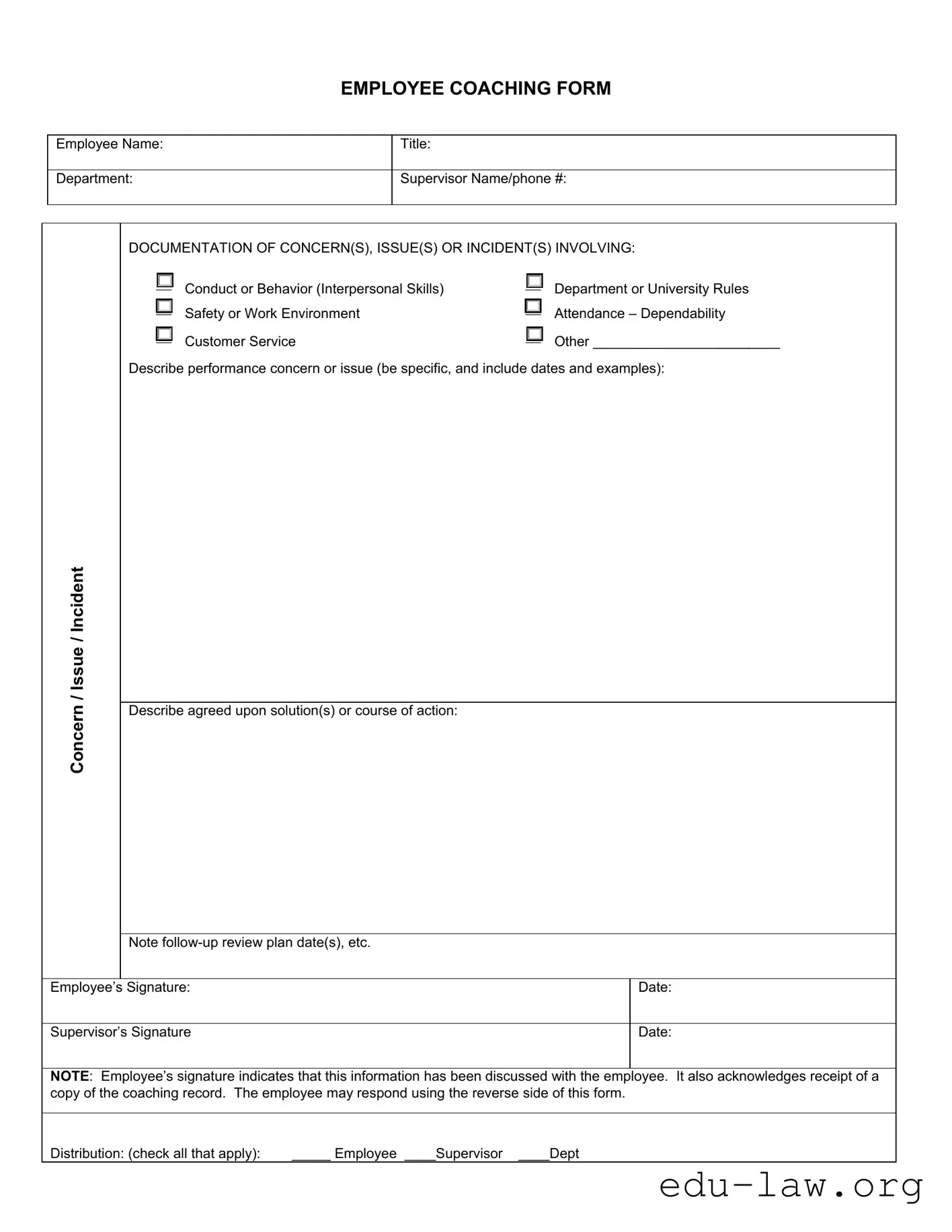
Effective employee coaching is a vital component of workplace development, fostering a culture of growth and accountability. The Employee Coaching Form serves as a structured tool to address various performance concerns, ensuring that both supervisors and employees are on the same page. This form captures essential information, including the employee's name, department, and title, as well as the supervisor's contact details. It allows for the documentation of specific issues, ranging from conduct and behavior to attendance and customer service. By detailing the concerns, supervisors can provide clear examples and dates, making it easier to understand the context of the situation. The form also outlines agreed-upon solutions and action plans, ensuring that both parties are committed to improvement. Additionally, it includes a follow-up review plan, reinforcing the importance of ongoing communication. Signatures from both the employee and supervisor indicate that the discussion has taken place and that the employee has received a copy of the coaching record. This collaborative approach not only enhances accountability but also encourages employees to engage in the process, as they have the option to respond to the feedback provided.

EMPLOYEE COACHING FORM
Employee Name:
Department:
Title:
Supervisor Name/phone #:
CONCERN / ISSUE / INCIDENT
DOCUMENTATION OF CONCERN(S), ISSUE(S) OR INCIDENT(S) INVOLVING:
⎯ Conduct or Behavior (Interpersonal Skills) |
⎯ Department or University Rules |
||
⎯ |
Safety or Work Environment |
⎯ |
Attendance – Dependability |
⎯ |
Customer Service |
⎯ |
Other ________________________ |
Describe performance concern or issue (be specific, and include dates and examples):
Describe agreed upon solution(s) or course of action:
Note
Employee’s Signature:
Supervisor’s Signature
Date:
Date:
NOTE: Employee’s signature indicates that this information has been discussed with the employee. It also acknowledges receipt of a copy of the coaching record. The employee may respond using the reverse side of this form.
Distribution: (check all that apply): |
_____ Employee ____Supervisor ____Dept |
| Fact Name | Details |
|---|---|
| Purpose | The Employee Coaching Form is designed to document performance issues and outline agreed-upon solutions. |
| Employee Information | The form requires the employee's name, department, title, and supervisor's contact information. |
| Documentation of Concerns | Specific areas of concern include conduct, departmental rules, safety, attendance, and customer service. |
| Performance Description | It is essential to describe the performance concern clearly, including dates and specific examples. |
| Agreed Solutions | The form includes a section to outline the solutions or actions agreed upon to address the concerns. |
| Follow-up Plan | A follow-up review plan is necessary to ensure that the agreed solutions are being implemented effectively. |
| Signatures | Both the employee and supervisor must sign the form, indicating that the discussion took place. |
| Distribution | The form must be distributed to the employee, supervisor, and department as indicated by checkboxes. |
| State-Specific Laws | For state-specific forms, it’s important to refer to local employment laws that govern performance documentation. |
Completing the Employee Coaching form is a straightforward process that requires specific information about the employee and the concerns being addressed. After filling out the form, it will be discussed with the employee and a copy will be provided for their records. Follow these steps to ensure the form is filled out correctly.
What is the purpose of the Employee Coaching form?
The Employee Coaching form is designed to document performance concerns, issues, or incidents related to an employee's conduct, behavior, or work performance. It serves as a tool for supervisors to communicate specific areas of concern and to outline agreed-upon solutions or actions to help the employee improve. This process fosters open dialogue between the employee and supervisor, aiming for constructive feedback and development.
Who needs to fill out the Employee Coaching form?
The form is typically filled out by the supervisor or manager who has observed the performance concern. However, the employee also has the opportunity to provide input or feedback on the issues discussed. It is a collaborative process aimed at addressing and resolving workplace challenges.
What types of concerns can be documented using this form?
The form allows for a wide range of concerns to be documented, including issues related to conduct or behavior, adherence to department or university rules, safety in the work environment, attendance and dependability, customer service, and any other specific issues that may arise. This flexibility ensures that all relevant concerns can be addressed appropriately.
What should I include when describing a performance concern?
When detailing a performance concern, it is important to be specific. Include clear examples, relevant dates, and any incidents that illustrate the issue. The more detailed the description, the better the understanding of the concern. This specificity helps in creating a constructive dialogue and a clear path toward improvement.
What happens after the form is filled out?
Once the form is completed, both the employee and supervisor will review it together. The supervisor will outline the agreed-upon solutions or actions. A follow-up plan will also be established, including dates for future reviews to assess progress. This ensures accountability and provides opportunities for ongoing support.
What does the employee's signature indicate?
The employee's signature on the form indicates that the information has been discussed with them and that they have received a copy of the coaching record. It does not imply agreement with the content but acknowledges that the conversation took place. The employee can also use the reverse side of the form to provide their own comments or responses.
Who receives copies of the Employee Coaching form?
Copies of the completed form are distributed to the employee, the supervisor, and the department. This distribution ensures that all relevant parties are informed and can reference the coaching record as needed. Keeping everyone in the loop promotes transparency and accountability.
Can the employee respond to the concerns raised in the form?
Yes, the employee has the opportunity to respond to the concerns raised. They can use the reverse side of the form to share their thoughts, provide additional context, or address any misunderstandings. This response is an important part of the process, as it allows for a two-way conversation about performance and expectations.
Neglecting to Provide Specific Examples: One common mistake is failing to include detailed examples of the performance concern. It's crucial to describe the issue clearly, along with dates and specific incidents. This helps everyone understand the context and seriousness of the situation.
Omitting the Follow-Up Plan: Another frequent error is not outlining a follow-up review plan. Without a clear timeline for revisiting the issue, it can be easy to overlook the progress made or necessary adjustments needed in the employee's performance.
Inadequate Signature Documentation: Some individuals forget to ensure that both the employee and supervisor sign the form. This step is essential as it indicates that the discussion took place and that the employee has received a copy of the coaching record.
Failing to Check Distribution Boxes: Lastly, neglecting to check the appropriate distribution boxes can lead to confusion about who should receive copies of the form. It's important to ensure that all relevant parties, including the employee and supervisor, are informed.
The Employee Coaching form is a vital tool in addressing performance issues and facilitating constructive dialogue between employees and supervisors. To ensure a comprehensive approach to employee development and management, several other forms and documents may be used in conjunction with the Employee Coaching form. Below is a list of these documents, each serving a specific purpose in the process.
Utilizing these documents in conjunction with the Employee Coaching form can enhance the effectiveness of performance management efforts. Each document contributes to a structured and transparent process, fostering an environment of accountability and continuous improvement.
The Employee Coaching Form shares similarities with a Performance Improvement Plan (PIP). Both documents aim to address performance issues and set clear expectations for improvement. While the Employee Coaching Form focuses on specific incidents or behaviors, a PIP provides a more structured approach, outlining measurable goals and timelines for the employee to meet. The PIP often includes a formal review process, which can help ensure accountability and track progress over time.
Another document akin to the Employee Coaching Form is the Incident Report. This form is typically used to document specific occurrences that may affect workplace safety or employee conduct. Like the coaching form, an Incident Report requires detailed descriptions of the events, including dates and involved parties. However, the primary purpose of an Incident Report is to record factual information for future reference, while the Employee Coaching Form emphasizes corrective actions and performance improvement.
The Performance Appraisal is also similar to the Employee Coaching Form. Both documents assess employee performance, but they serve different functions. The Performance Appraisal is usually conducted annually and provides a comprehensive evaluation of an employee's work over the year. In contrast, the Employee Coaching Form focuses on immediate concerns and outlines specific actions to address them. Both documents can facilitate discussions between employees and supervisors, fostering a culture of feedback and growth.
A disciplinary action notice is another related document. This notice is used when an employee's behavior or performance requires formal reprimand. Similar to the Employee Coaching Form, it documents the issue and often includes a plan for improvement. However, a disciplinary action notice typically indicates a more serious situation and may lead to further consequences if the employee does not improve. The coaching form, on the other hand, is more about guidance and support.
The Exit Interview Form bears resemblance to the Employee Coaching Form in that both documents facilitate open communication. While the coaching form addresses current performance issues, the Exit Interview Form gathers feedback from departing employees about their experiences. Both forms emphasize the importance of dialogue between employees and management, aiming to improve workplace conditions and employee satisfaction.
Lastly, the Employee Feedback Form is similar in its goal of fostering communication between employees and supervisors. Both forms allow employees to express concerns or suggestions regarding their work environment. However, the Employee Feedback Form is generally more open-ended and less focused on specific performance issues. It encourages a two-way conversation, which can lead to improvements in workplace culture and employee engagement.
When filling out the Employee Coaching form, it is important to follow certain guidelines to ensure clarity and effectiveness. Below are seven things you should and shouldn't do:
Misconceptions about the Employee Coaching form can lead to misunderstandings regarding its purpose and use. Here are four common misconceptions:
When filling out and using the Employee Coaching form, consider the following key takeaways: