The Emotional Support Animal (ESA) Letter is a vital document that plays an important role in the lives of individuals who benefit from the companionship and support that an emotional support animal provides. This letter serves as evidence that a specific individual has a mental health condition that is alleviated by the presence of their animal. It is written by a licensed mental health professional, ensuring its credibility and the authenticity of the claims made within. The form typically includes the patient's name, the date, and the professional's contact information and license details. Importantly, it outlines the specific mental health diagnosis and explains how the emotional support animal helps in managing that condition. For those navigating the complexities of housing regulations or travel accommodations, this letter can significantly ease their circumstances. Having the right ESA letter can enhance quality of life, allowing individuals to forge a deeper bond with their pets while ensuring their well-being is prioritized. Understanding the contents and purpose of this form unlocks opportunities for many seeking comfort and healing through their beloved animals.

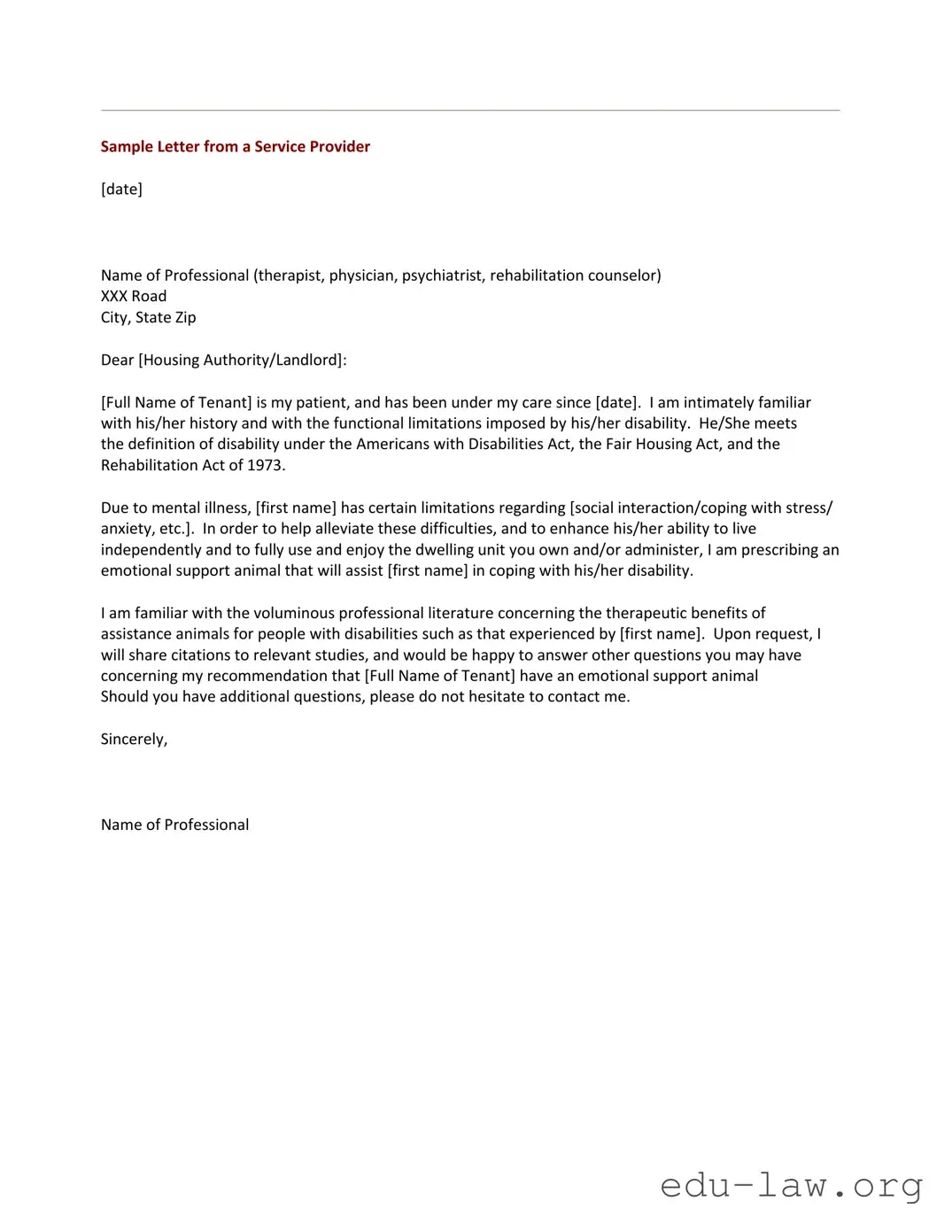
Sample Letter from a Service Provider
[date]
Name of Professional (therapist, physician, psychiatrist, rehabilitation counselor)
XXXRoad
City, State Zip
Dear [Housing Authority/Landlord]:
[Full Name of Tenant] is my patient, and has been under my care since [date]. I am intimately familiar with his/her history and with the functional limitations imposed by his/her disability. He/She meets the definition of disability under the Americans with Disabilities Act, the Fair Housing Act, and the Rehabilitation Act of 1973.
Due to mental illness, [first name] has certain limitations regarding [social interaction/coping with stress/ anxiety, etc.]. In order to help alleviate these difficulties, and to enhance his/her ability to live independently and to fully use and enjoy the dwelling unit you own and/or administer, I am prescribing an emotional support animal that will assist [first name] in coping with his/her disability.
I am familiar with the voluminous professional literature concerning the therapeutic benefits of assistance animals for people with disabilities such as that experienced by [first name]. Upon request, I will share citations to relevant studies, and would be happy to answer other questions you may have concerning my recommendation that [Full Name of Tenant] have an emotional support animal Should you have additional questions, please do not hesitate to contact me.
Sincerely,
Name of Professional
| Fact Name | Details |
|---|---|
| Definition | An Emotional Support Animal (ESA) Letter is a document provided by a licensed mental health professional, affirming that an individual requires an ESA for emotional support. |
| Legal Recognition | ESAs are recognized under the Fair Housing Act (FHA) which allows individuals with disabilities to live with their animals in housing that otherwise prohibits pets. |
| State-Specific Forms | Some states have specific laws regarding ESAs. For example, in California, the California Civil Code Section 54.2 provides guidelines for ESAs. |
| Verification Requirements | The ESA letter must typically include the mental health professional’s license number, date of issue, and should be on official letterhead. |
| Duration of Validity | ESA letters usually have a validity period of one year, after which a new assessment may be required to renew the letter. |
| Emotional Support vs. Service Animals | It is important to note that ESAs differ from service animals, which are specifically trained to perform tasks for individuals with disabilities. |
| Housing vs. Travel | While ESAs can reside with their owners in housing that prohibits pets, they do not have the same access rights on airplanes as service animals after recent regulatory changes. |
Completing the Emotional Support Animal Letter form is crucial for individuals seeking the necessary documentation to support their need for an emotional support animal. Follow the steps below to ensure you fill out the form correctly and thoroughly.
What is an Emotional Support Animal (ESA) Letter?
An Emotional Support Animal Letter is a document provided by a licensed mental health professional. It states that a person requires an emotional support animal for their mental health. This letter helps to legitimize the need for emotional support animals in various situations, such as housing and travel.
Who can issue an ESA letter?
Only licensed mental health professionals can issue Emotional Support Animal Letters. This includes psychologists, therapists, and psychiatrists. They must assess the individual to determine if an emotional support animal is necessary for their mental well-being.
What information should be included in the ESA letter?
An ESA letter should typically include the mental health professional's name, license number, and contact information. It should clearly state that the individual has a mental or emotional disability and that an emotional support animal is part of their treatment plan.
Is an ESA letter the same as a service animal certification?
No, an ESA letter is not equivalent to a service animal certification. Service animals are specifically trained to perform tasks for individuals with disabilities. In contrast, emotional support animals provide comfort and support, but they do not require specialized training.
Do I need an ESA letter for my emotional support animal?
Yes, to legally qualify for housing or travel accommodations that require documentation, you need an ESA letter. This letter proves that your emotional support animal is necessary for your mental health.
Can an ESA letter be used to avoid pet fees?
Generally, an ESA letter may exempt you from pet fees or breed restrictions in housing situations, as they are not considered pets. However, it is important to check the specific policies of your landlord or housing provider.
How long is an ESA letter valid?
The validity of an ESA letter varies depending on the issuing professional. Many recommend renewing the letter every year to ensure it remains up to date and meets any necessary requirements.
Can someone have more than one emotional support animal?
Yes, an individual can have multiple emotional support animals. However, it is essential that each animal is documented with separate ESA letters if required by the housing provider or travel company.
What should I do if my ESA letter is questioned?
If your ESA letter is questioned, politely provide a copy of the document and offer to contact the issuing mental health professional for confirmation. It can help to be prepared for any inquiries regarding your letter and the necessity of your emotional support animal.
How can I ensure my ESA letter is recognized?
To ensure your ESA letter is recognized, always get it from a licensed mental health professional. Keep the letter updated and maintain open communication with your landlord or travel providers about your rights and the need for your emotional support animal.
Not including necessary information: Some individuals forget to provide important details, such as their full name, address, or the type of animal. This information is crucial for establishing the relationship between the owner and the emotional support animal.
Using incorrect terminology: Using vague or incorrect terms can lead to confusion. Make sure to refer to the animal as an emotional support animal and not as a service animal, as they serve different purposes.
Omitting the therapist's credentials: It’s essential to include the qualifications and credentials of the mental health professional who has recommended the emotional support animal. This adds legitimacy to the letter.
Failing to sign the document: It may seem simple, but forgetting to sign the letter can invalidate it. A personal signature confirms the authenticity of the document.
Not keeping a copy: After submitting the form, it’s easy to overlook retaining a copy for personal records. This can create challenges if verification is needed later.
Neglecting to update the letter: Individuals often forget to update their emotional support animal letter when renewing their lease or if there are changes in their situation. Keeping the letter current is vital to ensure ongoing support.
When obtaining an Emotional Support Animal (ESA) Letter, there are several other forms and documents that may be necessary. These documents can help establish the need for an emotional support animal and ensure compliance with housing or travel regulations. Below is a list of commonly used forms along with brief descriptions of each.
Each of these documents can be crucial in supporting the case for an emotional support animal. Review what is necessary based on individual circumstances, as requirements can vary depending on laws and regulations.
One document similar to the Emotional Support Animal Letter is the Service Animal Certificate. While an Emotional Support Animal (ESA) provides comfort through companionship, a Service Animal is trained to perform specific tasks for individuals with disabilities. Both documents serve to establish a legitimate need for the animal, though the certificates address different types of support. They can help facilitate access to housing or public areas, ensuring individuals can benefit from the presence of their animals in various situations.
Another comparable document is the Psychiatric Service Animal Letter. Like the ESA letter, this document verifies the necessity of an animal in aiding individuals with mental health conditions. However, the key distinction lies in training and tasks. Psychiatric Service Animals are specifically trained to perform actions that alleviate symptoms, while ESAs primarily offer emotional support. Both letters provide validation for the use of these animals, allowing their handlers to access comfort and assistance where it is needed.
The Therapy Animal Letter is also similar, as it acknowledges the role of animals in promoting emotional well-being and therapeutic benefits. Therapy animals, unlike ESAs and service animals, are typically trained to provide support to multiple people, often in settings like hospitals or nursing homes. While all these documents share the common goal of highlighting the significance of animal companionship, the Therapy Animal Letter focuses more on the animal's role in therapeutic environments rather than individual support needs.
Finally, the Physician’s Recommendation for Animal Companionship can closely relate to the ESA letter. This document typically comes from a healthcare professional who recommends the inclusion of an animal for emotional support. It often serves as validation for the necessity of animal companionship from a medical standpoint. Similar to the ESA letter, it aims to provide the recipient with assistance or accommodations in various situations based on their mental health needs.
When filling out an Emotional Support Animal (ESA) Letter form, there are specific actions that can lead to a successful application. Here’s a list of dos and don’ts to keep in mind.
Understanding the world of Emotional Support Animals (ESAs) and their associated documentation can be quite confusing. Many people hold misconceptions about the Emotional Support Animal Letter, which can affect their rights and ability to have an ESA. Below are four common misconceptions, explained for clarity.
This is not accurate. While both emotional support animals and service animals assist individuals with disabilities, they serve different purposes. A service animal, such as a guide dog for the visually impaired, is trained to perform specific tasks. In contrast, an emotional support animal provides comfort and companionship but is not trained for specific tasks. Thus, the documentation required for ESAs is different from that of service animals.
This is partially true. While licensed mental health professionals can write an ESA letter, not every doctor is qualified to do so. The professional must assess the individual's mental health needs and determine if an emotional support animal is appropriate for their situation. This process often includes a thorough evaluation.
This is misleading. An ESA letter typically has an expiration date that can range from a few months to a year, depending on the policies of the issuing professional. It is essential for individuals to renew their letters as necessary to ensure that they continue to meet the requirements set forth by housing authorities or airlines.
This misconception can lead to significant misunderstanding. While an ESA letter provides evidence of a need for an emotional support animal, it does not automatically guarantee housing rights. Landlords and housing providers may have specific policies in place. It's crucial for tenants to review these policies and communicate with their landlords proactively.
Understanding the process of acquiring and utilizing an Emotional Support Animal (ESA) letter is crucial for those who may benefit from the companionship of an animal for mental health support. Here are some key takeaways to keep in mind:
By keeping these takeaways in mind, you can navigate the world of Emotional Support Animals confidently and ensure you receive the support you need.
How to Count Money Cashier - The sheet is a practical solution for ensuring cash drawer compliance.
Dd 214 - This document can be critical in obtaining any necessary military-related documentation.