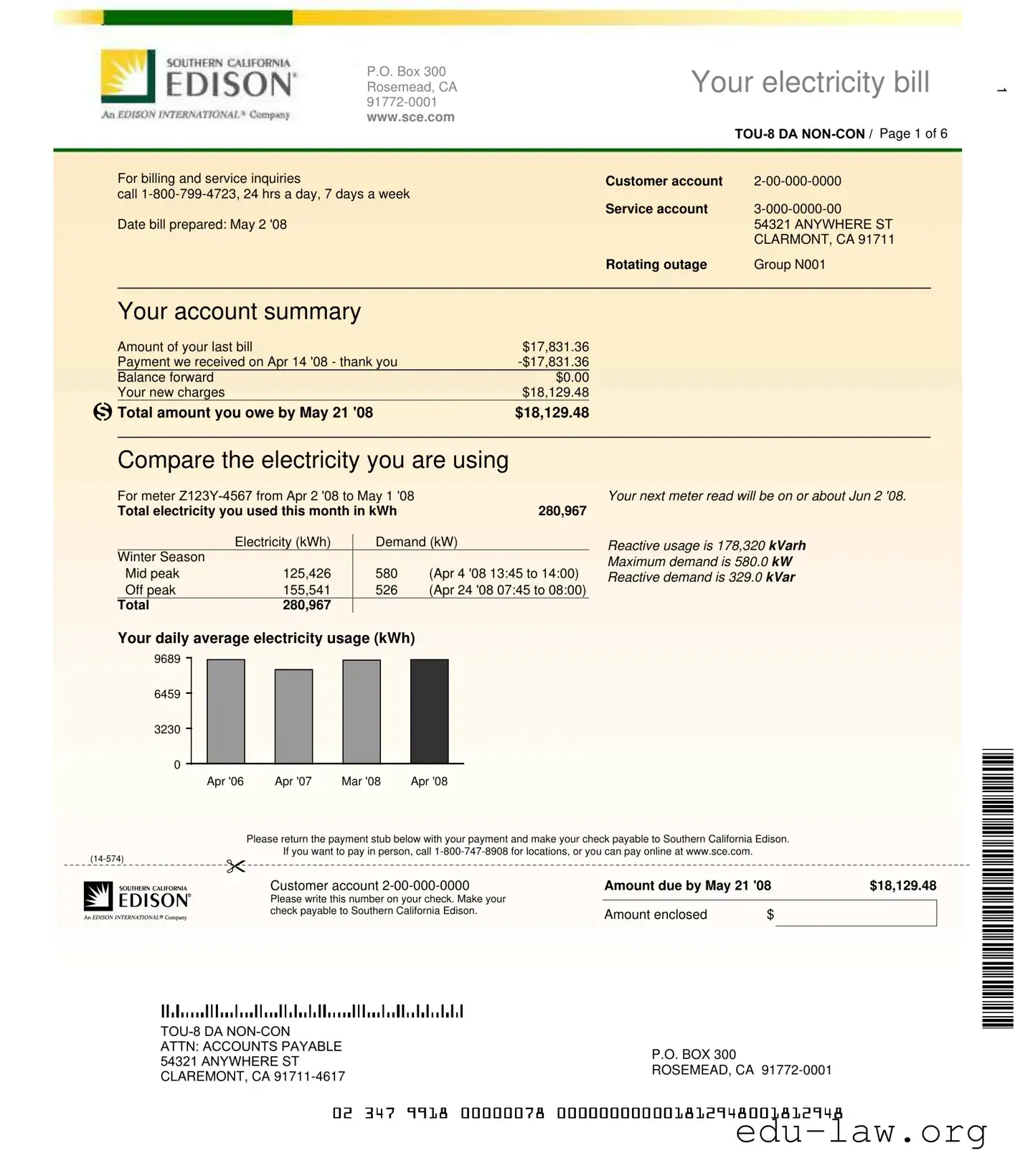
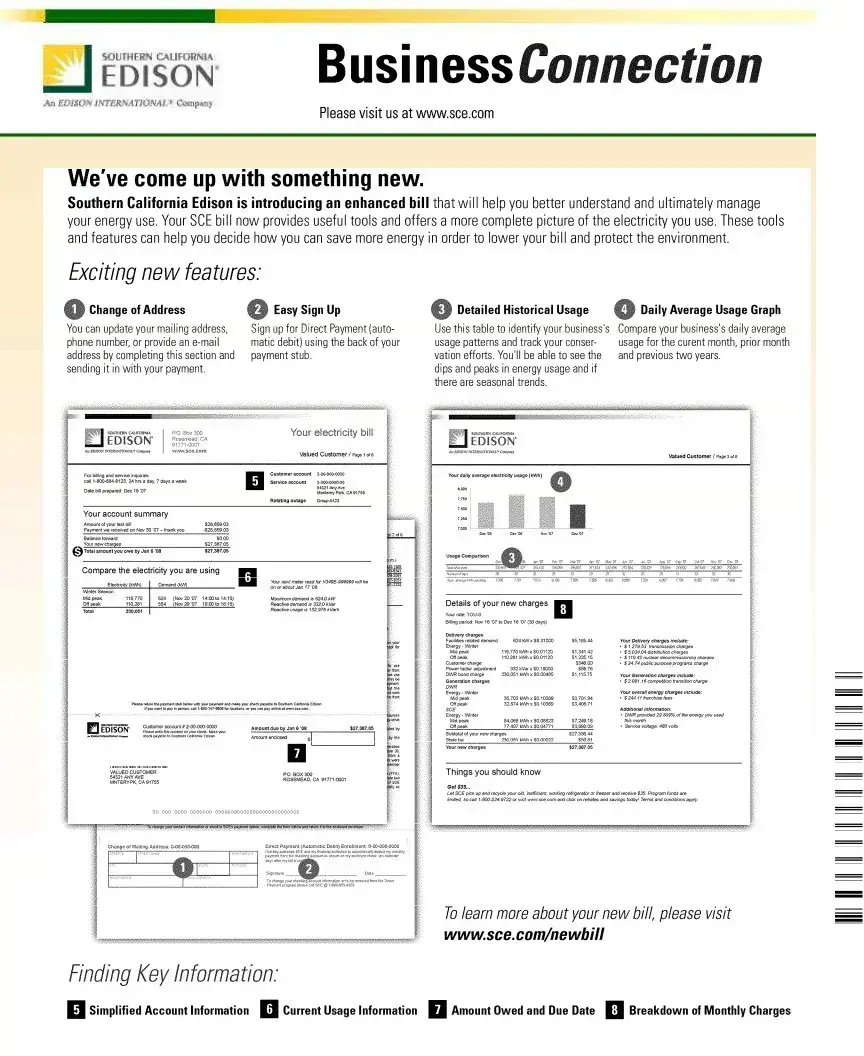
The Edison Electricity Bill form provides essential information for customers of Southern California Edison (SCE) regarding their electricity usage and charges. It includes a summary of the account, detailing the total amount due, which in this case is $18,129.48, and the due date of May 21, 2008. Customers can find their previous balance, payments received, and new charges clearly outlined. The form also presents a comparison of electricity usage over time, allowing customers to track their consumption patterns. For those on a time-of-use plan, the bill breaks down energy usage into peak and off-peak periods, helping customers understand their charges better. Additionally, the form addresses important topics such as rotating outages, payment options, and procedures for disputing bills. Customers are encouraged to utilize various payment methods, including online payments and direct debit options. Clear instructions for contacting customer service and resources for assistance are provided, ensuring that customers have the support they need to manage their accounts effectively.
|
P.O. Box 300 |
Your electricity bill |
|
|
Rosemead, CA |
||
|
|
|
|
|
www.sce.com |
|
|
|
|
|
|
For billing and service inquiries |
Customer account |
||
call |
|
|
|
|
|
Service account |
|
Date bill prepared: May 2 '08 |
|
54321 ANYWHERE ST |
|
|
|
|
CLARMONT, CA 91711 |
|
|
Rotating outage |
Group N001 |
Your account summary
Amount of your last bill |
$17,831.36 |
Payment we received on Apr 14 '08 - thank you |
|
Balance forward |
$0.00 |
Your new charges |
$18,129.48 |
Total amount you owe by May 21 '08 |
$18,129.48 |
1
Compare the electricity you are using
For meter |
|
|||
Total electricity you used this month in kWh |
280,967 |
|||
|
Electricity (kWh) |
|
Demand (kW) |
|
|
|
|||
Winter Season |
|
|
|
|
Mid peak |
125,426 |
|
580 |
(Apr 4 '08 13:45 to 14:00) |
Off peak |
155,541 |
|
526 |
(Apr 24 '08 07:45 to 08:00) |
Total |
280,967 |
|
|
|
Your daily average electricity usage (kWh)
9689
6459
3230
0
Apr '06 |
Apr '07 |
Mar '08 |
Apr '08 |
Your next meter read will be on or about Jun 2 '08.
Reactive usage is 178,320 kVarh
Maximum demand is 580.0 kW
Reactive demand is 329.0 kVar
Please return the payment stub below with your payment and make your check payable to Southern California Edison.
If you want to pay in person, call
Customer account
Please write this number on your check. Make your check payable to Southern California Edison.
ATTN: ACCOUNTS PAYABLE 54321 ANYWHERE ST CLAREMONT, CA
Amount due by May 21 '08 |
$18,129.48 |
|
|
|
|
Amount enclosed |
$ |
|
|
|
|
P.O. BOX 300
ROSEMEAD, CA
Important information
Rotating Outages
A rotating outage is a controlled electric outage that lasts approximately one hour for a group of circuits, which is used during electric system emergency conditions to avoid widespread or uncontrolled blackouts. Each SCE customer is assigned a rotating outage group, shown on the upper part of the SCE bill. If your rotating outage group begins with the letters A, M, R, S, or X, you are subject to rotating outages. If it begins with N or Exempt, you are not. Your rotating outage group may change at any time. For more information, and to see which rotating outage groups are likely to be called in the event of a system emergency, visit www.sce.com or call (800)
Options for Paying Your Bill
You can pay your bill by:
·In person at an authorized payment location
·By telephone
·Online at www.sce.com
You may call us for electronic payment options, to make payment arrangements, or for information on agencies to assist you in bill payment.
Your bill was prepared on May 2, 2008. Your bill is due when you receive it and becomes past due 19 days after the date the bill was prepared. You will have 15 days at your new address to pay a bill from a prior address before your service will be terminated. SCE does not terminate residential service for non- payment of bills for other classes of service. Termination of electric service requires a reconnection charge. A field assignment charge may appear on your next bill if SCE visits your premises because of non- payment. If you are a residential customer, and claim an inability to pay and payment arrangements have not been extended to you by SCE pursuant to SCE's filed tariffs, you may contact the California Public Utilities Commission (CPUC).
Disputed Bills
If you think your bill is incorrect, call us and speak with a customer service representative, or if necessary, with a manager. If you feel unsatisfied with the result of such discussion(s), contact the CPUC, Consumer Affairs Branch by mail at: 505 Van Ness, Room 2003, San Francisco, CA 94102; or at: WWW.CPUC.CA.GOV, (800)
Rules and Rates
SCE's rules and rates are available in full at www.sce.com or upon request.
Late Payment Charge (LPC)
A late payment charge of .9% will be applied to the total unpaid balance on your account if full payment is not received by the due date on this bill (except for CARE rate and state agency accounts).
Electronic Fund Transfers (EFT)
When you provide a check as payment, you authorize us either to use information from your check to make a
To change your contact information or enroll in SCE's payment option, complete the form below and return it in the enclosed envelope.
Change of Mailing Address:
STREET # |
STREET NAME |
|
|
APARTMENT # |
|
|
|
|
|
CITY |
|
|
STATE |
ZIP CODE |
|
|
|
|
|
TELEPHONE # |
|
|
||
|
|
|
|
|
Direct Payment (Automatic Debit) Enrollment:
I hereby authorize SCE and my financial institution to automatically deduct my monthly payment from the checking account as shown on my enclosed check, ten calendar days after my bill is mailed.
Signature _____________________________ Date _______________
To change your checking account information or to be removed from the Direct Payment program please call SCE @
3
Usage comparison
|
Apr '06 |
Apr '07 |
May '07 |
Jun '07 |
Jul '07 |
Aug '07 |
Sep '07 |
Oct '07 |
Nov '07 |
Dec '07 |
Jan '08 |
Feb '08 |
Mar '08 |
Apr '08 |
|
|
|
|
|
|
|
|
|
|
|
|
|
|
|
Total kWh used |
280,051 |
253,570 |
296,684 |
301,623 |
291,224 |
299,149 |
319,281 |
326,623 |
307,974 |
291,764 |
284,592 |
310,392 |
287,883 |
280,967 |
Number of days |
29 |
29 |
30 |
29 |
32 |
29 |
30 |
32 |
31 |
33 |
29 |
32 |
30 |
29 |
Appx. average kWh |
9,656 |
8,743 |
9,889 |
10,400 |
9,100 |
10,315 |
10,642 |
10,206 |
9,934 |
8,841 |
9,813 |
9,699 |
9,596 |
9,688 |
used/day |
|
|
|
|
|
|
|
|
|
|
|
|
|
|
Details of your new charges
Your rate:
Billing period: Apr 2 '08 to May 1 '08 (29 days)
Delivery charges |
Your Delivery charges include: |
Facilities rel demand |
580 kW x $9.90000 x 5/29 days |
$990.00 |
Facilities rel demand |
580 kW x $10.77000 x 24/29 days |
$5,169.60 |
|
|
|
Mid peak |
21,625 kWh x $0.00903 |
$195.27 |
Mid peak |
103,801 kWh x $0.01009 |
$1,047.35 |
Off peak |
26,817 kWh x $0.00903 |
$242.16 |
Off peak |
128,724 kWh x $0.01009 |
$1,298.83 |
Customer charge |
|
$71.55 |
Customer charge |
|
$379.07 |
Power factor adj |
329 kVar x $0.18000 |
$59.22 |
Direct Access cost responsibility surcharge |
|
|
DA CRS DWR bond |
280,967 kWh x $0.00477 |
$1,340.21 |
PCIA |
232,524 kWh x $0.00107 |
$248.80 |
PCIA |
48,443 kWh x |
|
DA CRS UC |
48,443 kWh x $0.02001 |
$969.34 |
DA CRS UC |
232,524 kWh x $0.01780 |
$4,138.93 |
CTC |
48,443 kWh x $0.00613 |
$296.96 |
CTC |
232,524 kWh x $0.00336 |
$781.28 |
Other charges or credits |
|
|
Revenue cycle services credit |
|
|
Generation Municipal Surcharge |
|
$160.64 |
|
|
|
Subtotal of SCE charges |
|
$17,184.34 |
Claremont UUT |
$17,184.34 x 5.50000 % |
$945.1 |
Your new charges |
|
$18,129.48 |
·$1,209.91 transmission charges
·$6,404.84 distribution charges
·$165.29 nuclear decommissioning charges
·$1,605.58 public purpose programs charge
Your overall energy charges include:
·$152.02 franchise fees
Additional information:
·Percentage of energy provided by DWR used to calculate GMS factor this month: 26.513%
·Service voltage: 480 volts
·Generation Municipal Surcharge (GMS) factor: 0.008930

Page 4 of 6
May 2008
3
Page 5 of 6
Page 6 of 6
| Fact Name | Description |
|---|---|
| Billing Period | The Edison Electricity Bill covers a billing period from April 2, 2008, to May 1, 2008, lasting 29 days. |
| Payment Due Date | The total amount due, $18,129.48, must be paid by May 21, 2008, to avoid late fees. |
| Rotating Outage Group | Customers are assigned to a rotating outage group, indicated on the bill. Groups starting with A, M, R, S, or X are subject to outages, while those starting with N or Exempt are not. |
| Late Payment Charge | A late payment charge of 0.9% will apply to any unpaid balance if payment is not received by the due date. |
| Governing Law | This bill is governed by California Public Utilities Commission regulations, which oversee utility service and billing practices in the state. |
Filling out the Edison Electricity Bill form is a straightforward process. You'll need to provide specific information regarding your payment and any changes you wish to make. Follow these steps to ensure your form is completed accurately.
After submitting your payment, you can expect to receive confirmation from Edison. Keep an eye on your account for updates and ensure timely payments to avoid any late fees.
What should I do if I believe my Edison electricity bill is incorrect?
If you think your bill is incorrect, contact customer service. Speak with a representative or, if necessary, a manager. If you are not satisfied with the outcome, you can reach out to the California Public Utilities Commission (CPUC). Provide a copy of your bill, explain why you believe there was an error, and include a check or money order for the disputed amount. Pay the disputed amount or send it to the CPUC before the past-due date to avoid disconnection.
How can I pay my Edison electricity bill?
You have several options for paying your bill. You can pay by mail, in person at an authorized payment location, by telephone, or online at www.sce.com. If you need assistance with electronic payment options or want to make payment arrangements, you can call customer service for help.
What happens if I do not pay my bill on time?
Your bill is due upon receipt and becomes past due 19 days after the bill preparation date. If you fail to pay, SCE may terminate your service, but residential customers have protections. A reconnection charge will apply if service is terminated. Additionally, a field assignment charge may appear on your next bill if SCE visits your premises due to non-payment.
What is a rotating outage and how does it affect me?
A rotating outage is a controlled electric outage lasting about one hour, used to prevent widespread blackouts during emergencies. Each customer is assigned a rotating outage group, indicated on the bill. If your group starts with A, M, R, S, or X, you may experience outages. If it begins with N or is marked as Exempt, you will not be affected. For more information, visit www.sce.com or call 1-800-655-4555.
What should I do if I change my mailing address?
If you need to change your mailing address, complete the designated form included with your bill. Return the form in the enclosed envelope. You can also call customer service to update your information. Keeping your address current ensures you receive your bills and important notifications without delay.
What is the late payment charge on my bill?
A late payment charge of 0.9% will be applied to any unpaid balance if full payment is not received by the due date. This charge applies to most accounts, except for CARE rate and state agency accounts. To avoid this fee, ensure your payment is made on time.
Leaving the customer account number blank. This number is essential for processing your bill accurately.
Incorrectly entering the amount enclosed. Double-check your payment amount to avoid delays in processing.
Failing to sign the payment stub. A missing signature may lead to payment rejection.
Not including the payment stub with your check. Ensure that you send the correct documents together.
Using an incorrect address for mailing your payment. Always verify the address listed on the bill.
Neglecting to check the due date. Payments made after the due date may incur late fees.
Overlooking the rotating outage group information. Knowing your group can help you prepare for potential outages.
Not reading the important information section. This section contains crucial details about your service and payment options.
Assuming that past-due bills will not affect service. Ignoring this can lead to disconnection of service.
Forgetting to update contact information when moving. This can lead to missed bills and service interruptions.
The Edison Electricity Bill form is a crucial document for customers of Southern California Edison (SCE). Along with this bill, several other forms and documents may be used to manage accounts, address billing issues, or make payments. Below is a list of commonly associated documents that can help customers navigate their electricity service and billing processes.
Understanding these documents can enhance a customer's experience with their electricity service. Each form serves a specific purpose, making it easier to manage accounts and address any concerns that may arise.
The Edison Electricity Bill form shares similarities with a water utility bill. Both documents provide a summary of services rendered, detailing the amount of usage during a specific billing period. Customers can find their total charges, previous payments, and any outstanding balances. Additionally, just like an electricity bill, a water bill may include information on payment options, due dates, and potential penalties for late payments, ensuring customers are informed about their financial responsibilities.
A gas utility bill is another document comparable to the Edison Electricity Bill. Both bills outline the customer's account information, including the service address and account number. They also present a breakdown of charges, such as delivery fees and usage costs, allowing customers to understand their consumption patterns. Similar to electricity bills, gas bills typically offer various payment methods and provide information about late fees for overdue payments, making it easy for customers to manage their accounts.
The credit card statement is yet another document that resembles the Edison Electricity Bill. Both documents list transactions over a specific period, showing the total amount due and the minimum payment required. They also provide details about previous payments and any interest charges that may apply. Just as with utility bills, credit card statements include payment options and deadlines, helping consumers stay on top of their financial obligations.
An insurance premium statement is also similar to the Edison Electricity Bill. Both documents summarize the account holder's current balance and outline any changes in charges from the previous period. They often include information about payment options and deadlines, ensuring that customers are aware of when payments are due. Additionally, both statements may offer insights into the services provided, such as coverage details for insurance or usage statistics for utilities, allowing customers to make informed decisions.
Finally, a bank statement can be compared to the Edison Electricity Bill. Both documents provide an overview of account activity over a given timeframe, detailing deposits, withdrawals, and the current balance. They typically include transaction dates and descriptions, which help customers track their financial activities. Like utility bills, bank statements emphasize the importance of timely payments to avoid fees or penalties, reinforcing the need for customers to stay vigilant about their finances.
When filling out the Edison Electricity Bill form, it’s crucial to follow certain guidelines to ensure a smooth process. Here’s a list of what to do and what to avoid:
Following these steps will help you avoid complications and ensure your payment is processed efficiently.
Here are some common misconceptions about the Edison Electricity Bill form:
Understanding these misconceptions can help you manage your electricity bill more effectively. Stay informed and proactive about your account.
Understanding your Edison Electricity Bill form can help you manage your electricity usage and payments effectively. Here are some key takeaways: