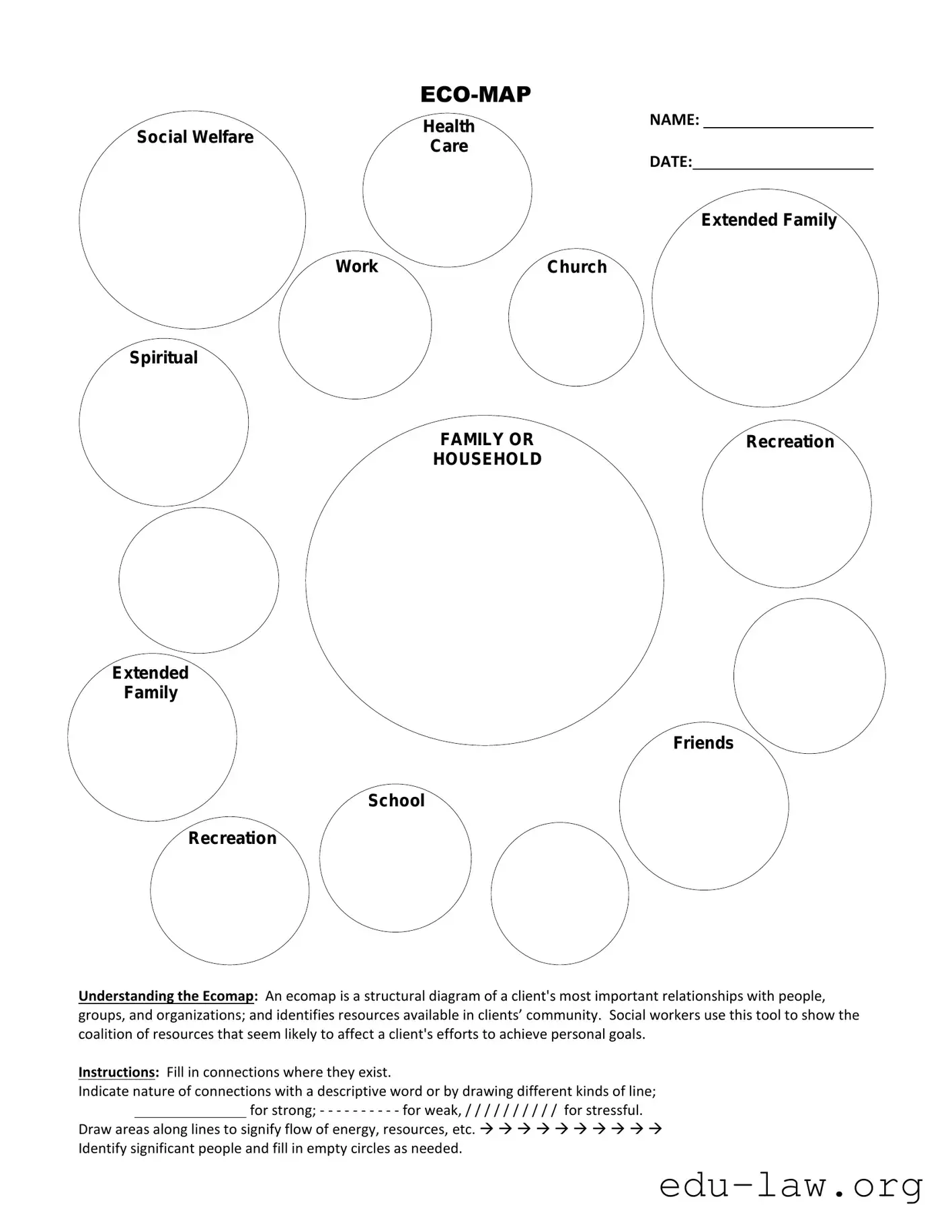
The Eco Map form serves as a vital tool for individuals and professionals seeking to understand and visualize the complex relationships and resources surrounding a person or family. This form highlights the various systems that influence a person's life, including family dynamics, social networks, and community resources. By mapping out these connections, users can identify strengths and areas of support, as well as pinpoint challenges and barriers that may exist. The Eco Map encourages a holistic view, allowing for a comprehensive assessment of an individual’s environment. It is particularly useful in fields such as social work, counseling, and education, where understanding the broader context of a person's life can lead to more effective interventions and support strategies. The urgency of utilizing such a tool lies in its ability to foster awareness and facilitate discussions that can ultimately enhance the well-being of individuals and families.

Social Welfare
Spiritual
Extended
Family
Recreation
Health
Care
WorkChurch
FAMILY OR
HOUSEHOLD
School
NAME:
DATE:
Extended Family
Recreation
Friends
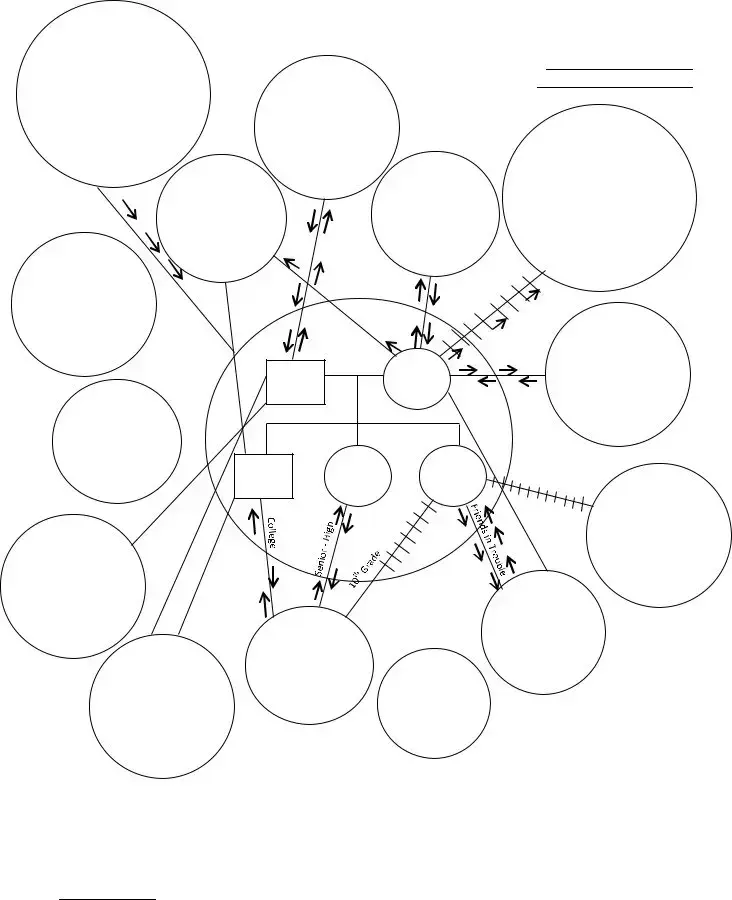
Understanding the Ecomap: An ecomap is a structural diagram of a client's most important relationships with people, groups, and organizations; and identifies resources available in clients’ community. Social workers use this tool to show the coalition of resources that seem likely to affect a client's efforts to achieve personal goals.
Instructions: Fill in connections where they exist.
Indicate nature of connections with a descriptive word or by drawing different kinds of line; for strong; - - - - - - - - - - for weak, / / / / / / / / / / for stressful.
Draw areas along lines to signify flow of energy, resources, etc.
Identify significant people and fill in empty circles as needed.
Social Welfare
Family has been referred to counseling around Joan.
Medicare and A Disabled
SAMPLE
Health
Care
City Hospital Clinic John – MS for 10 years
NAME:
DATE:
Extended Family
Work |
Church |
Birth’s mother |
|
|
demanding – I’ll |
Both – part time |
|
need financial & |
|
emotional support |
|
|
|
Spiritual
|
|
FAMILY OR |
Recreation |
|
|
HOUSEHOLD |
|||
|
|
|||
|
|
BETH |
Beth involved in |
|
JOHN |
gardening & |
|||
40 |
||||
42 |
|
garden club. |
||
|
|
|||
JOHN |
GWEN |
JOAN |
19 |
17 |
15 |
|
|
Court & |
Extended |
|
Probation Officer |
Family |
|
(Mia Thompson) |
Father’s in |
|
Friends |
Arkansas very |
|
|
|
|
|
little contact |
School |
Joan popular with |
|
|
|
Recreation |
|
“rough crowd” |
|
|
|
John very |
|
|
involved in |
|
|
sports. |
|
|
Father used to be |
|
|
Understanding the Ecomap: An ecomap is a structural diagram of a client's most important relationships with people, groups, and organizations; and identifies resources available in clients’ community. Social workers use this tool to show the coalition of resources that seem likely to affect a client's efforts to achieve personal goals.
Instructions: Fill in connections where they exist.
Indicate nature of connections with a descriptive word or by drawing different kinds of line; for strong; - - - - - - - - - - for weak, / / / / / / / / / / for stressful.
Draw areas along lines to signify flow of energy, resources, etc.
Identify significant people and fill in empty circles as needed.
| Fact Name | Description |
|---|---|
| Definition | An Eco Map form is a visual representation used to illustrate the relationships and connections between individuals and their environment. |
| Purpose | The form helps identify resources, support systems, and potential stressors in a person's life. |
| Usage | Professionals, such as social workers and therapists, often utilize Eco Maps to assess and plan interventions. |
| Components | Typically includes circles representing individuals and lines indicating the nature of relationships. |
| State-Specific Forms | Some states may have specific versions of the Eco Map that adhere to local guidelines. |
| Governing Laws | In California, for example, the use of Eco Maps in social work is guided by the California Business and Professions Code. |
| Benefits | Provides a clear overview of social connections, aiding in effective communication and planning. |
| Limitations | Eco Maps may not capture the full complexity of relationships and can be subjective in interpretation. |
| Confidentiality | When used in practice, confidentiality of the information represented must be maintained according to HIPAA regulations. |
Filling out the Eco Map form is a straightforward process that helps you visualize the connections and relationships in your environment. Once you have completed the form, you will have a clearer understanding of your social networks and resources. This can be beneficial for personal reflection or for sharing with a professional who can assist you further.
What is an Eco Map?
An Eco Map is a visual tool that helps individuals or families map out their relationships and connections with various systems in their lives. It illustrates how these systems interact and support or hinder personal well-being. This can include family, friends, work, community services, and other important influences.
Who can use an Eco Map?
Anyone can use an Eco Map! It's particularly helpful for social workers, therapists, educators, and individuals looking to understand their social support networks better. Families and individuals facing challenges can also benefit from this tool to identify strengths and areas needing attention.
How do I create an Eco Map?
To create an Eco Map, start by drawing a circle in the center for the individual or family. Then, draw lines to represent connections with various systems, placing them around the central circle. Use different types of lines to indicate the strength of these relationships. For example, solid lines can show strong connections, while dotted lines can indicate weaker ties.
What should I include in my Eco Map?
Include all relevant relationships and systems that impact your life. This can encompass family members, friends, schools, workplaces, healthcare providers, and community organizations. Consider both positive and negative influences to get a complete picture.
Can I use colors in my Eco Map?
Absolutely! Using colors can help differentiate between various types of relationships or levels of support. For instance, you might use green for positive influences and red for negative ones. This visual aspect can make it easier to understand your connections at a glance.
How often should I update my Eco Map?
It’s a good idea to update your Eco Map regularly. Life changes, and so do relationships. Reassess your connections every few months or whenever you experience significant changes in your life. This keeps the map relevant and useful.
What if I feel overwhelmed by my Eco Map?
If you feel overwhelmed, take a step back. Focus on one area at a time. You can also seek help from a trusted friend or professional who can guide you through the process. Remember, the goal is to clarify your support network, not to add stress.
How can an Eco Map benefit me?
An Eco Map can provide clarity about your relationships and support systems. It can help you identify who you can rely on and where you might need to seek additional support. This understanding can empower you to make informed decisions about your well-being.
Is there a digital version of the Eco Map?
Yes, there are several digital tools and apps available that allow you to create Eco Maps online. These platforms often provide templates and features that make it easy to visualize your connections. However, a simple hand-drawn map can be just as effective!
Can I share my Eco Map with others?
Yes, sharing your Eco Map can be beneficial, especially with professionals who are helping you. It can foster discussions about your support system and highlight areas that need attention. Just be mindful of your privacy and only share it with trusted individuals.
Inaccurate Information: Many individuals provide incorrect details about their support systems. This can include wrong names, addresses, or contact information for friends and family. Always double-check your entries.
Omitting Important Relationships: Some people forget to include significant relationships that impact their lives. This could mean leaving out close friends, mentors, or community resources. Make sure to think broadly about your connections.
Not Using the Right Symbols: The Eco Map uses specific symbols to represent different types of relationships and support. Misusing these symbols can lead to confusion. Familiarize yourself with the key before filling out the form.
Failing to Update: Relationships change over time. Some people fill out the Eco Map and never look back. Regularly updating the form ensures it reflects your current support system.
Rushing the Process: Filling out the Eco Map should not be a hurried task. Taking your time to think through your connections will yield a more accurate representation. A thoughtful approach can make a significant difference.
The Eco Map form is a valuable tool for visualizing relationships and interactions within a person's environment. It helps individuals and professionals understand how various systems, such as family, community, and resources, interact with one another. Alongside the Eco Map, several other forms and documents can enhance understanding and provide additional context. Here are some commonly used documents:
Each of these documents complements the Eco Map form by providing additional insights into an individual’s life and environment. Together, they create a more comprehensive picture that can inform decision-making and support planning.
The Genogram is a visual representation of family relationships and medical history. Similar to the Eco Map, it provides insight into social connections and dynamics. While the Eco Map focuses on environmental relationships and resources, the Genogram highlights familial ties, emotional connections, and hereditary patterns. Both tools serve to illustrate complex interpersonal relationships, making them useful in fields such as social work and counseling.
The Family Assessment Form is another document that shares similarities with the Eco Map. It collects information about family structure, functioning, and relationships. Like the Eco Map, it emphasizes the importance of understanding a family’s environment and support systems. This form often includes questions about family dynamics and individual roles, providing a comprehensive view of the family unit's strengths and challenges.
The Social Network Map offers a visual depiction of an individual’s social connections, akin to the Eco Map's focus on resources and relationships. Both tools help identify support systems and community ties. However, the Social Network Map is typically more focused on friends, acquaintances, and community members, while the Eco Map includes broader environmental influences, such as schools and healthcare services.
The Strengths and Needs Assessment is a document that evaluates an individual’s strengths and areas requiring support. This assessment aligns with the Eco Map by identifying resources available to the individual. Both documents aim to create a comprehensive understanding of an individual’s situation, helping professionals tailor interventions and support strategies effectively.
The Life Space Interview is a method used to gather information about an individual’s experiences and relationships. Similar to the Eco Map, it focuses on understanding the context of a person’s life. This interview technique captures the nuances of daily interactions and environmental influences, providing a deeper insight into how these factors affect an individual’s well-being.
The Community Resource Directory lists available services and support within a community. Like the Eco Map, it emphasizes the importance of access to resources. While the Eco Map visually represents relationships and connections, the Community Resource Directory serves as a practical guide for individuals seeking assistance, making it a complementary tool for identifying support systems.
The Assessment of Functional Abilities document evaluates an individual's capacity to perform daily tasks and engage with their environment. This assessment parallels the Eco Map in its focus on understanding the individual’s interactions with their surroundings. Both documents aim to identify barriers to functioning and highlight areas where support may be needed to enhance the individual’s quality of life.
The Individualized Service Plan outlines specific goals and services tailored to meet an individual’s needs. Similar to the Eco Map, it takes into account the person’s environment and available resources. Both documents work together to ensure that interventions are relevant and effective, fostering a collaborative approach to support and care.
When filling out the Eco Map form, it’s important to keep a few key points in mind. Here’s a list of things you should and shouldn’t do:
Following these guidelines will help you complete the Eco Map form effectively and efficiently.
Understanding the Eco Map form can be challenging due to some common misconceptions. Here are four prevalent misunderstandings about this important tool.
Many people believe that only social workers use the Eco Map form. In reality, it can be beneficial for various professionals, including educators, therapists, and healthcare providers, to understand a person’s support system and environment.
Some think that only trained professionals can fill out the Eco Map form accurately. However, with a basic understanding of the individual's relationships and resources, anyone can complete it effectively.
Another misconception is that the Eco Map only highlights problematic or negative relationships. In fact, it also emphasizes positive connections and support systems that contribute to an individual’s well-being.
Some believe that the Eco Map is a static tool that only needs to be completed once. On the contrary, it should be updated regularly to reflect changes in relationships and support systems over time.
By clarifying these misconceptions, individuals can better utilize the Eco Map form to enhance their understanding of personal and community resources.
Filling out the Eco Map form can be an important step in understanding and visualizing the relationships and resources surrounding an individual or family. Here are some key takeaways to consider: