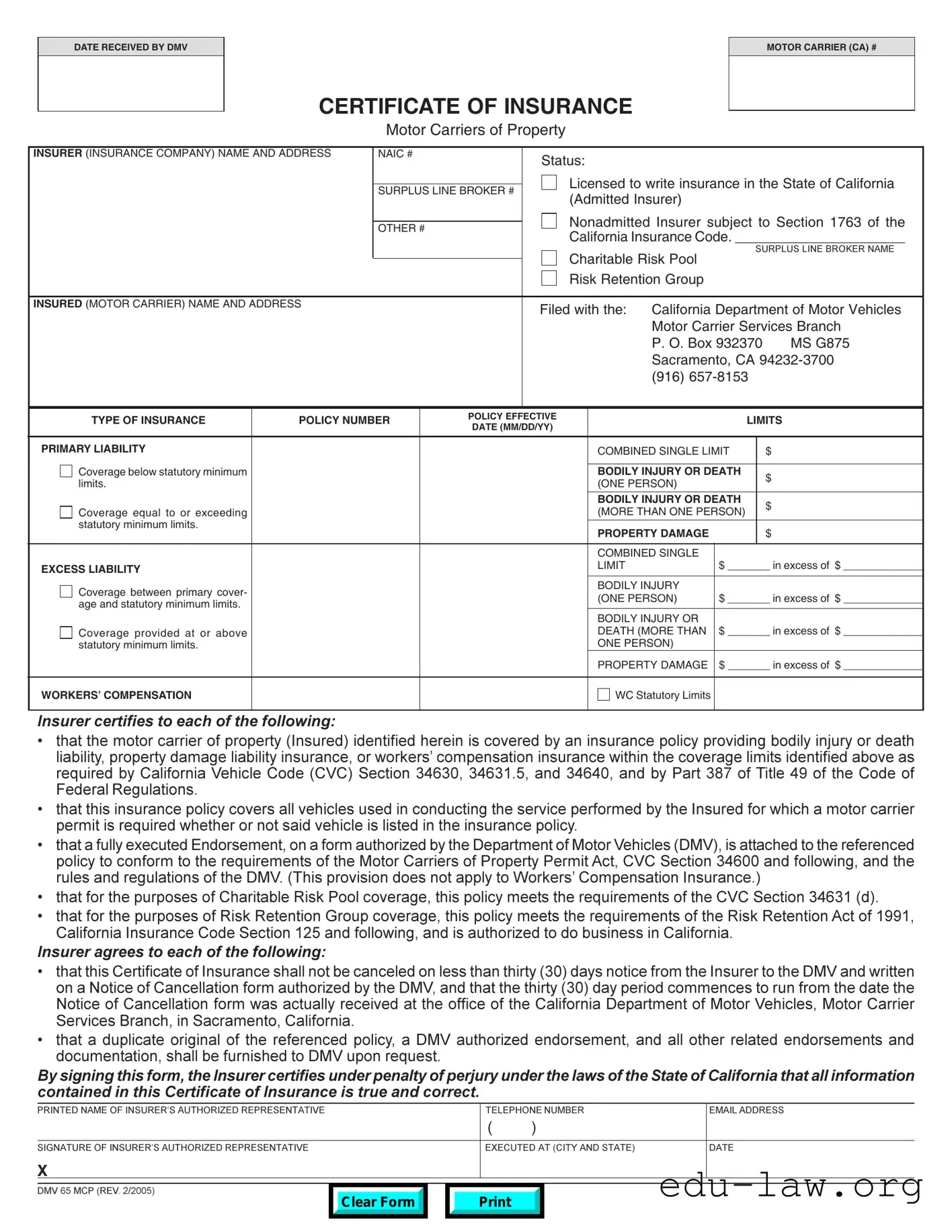
The DMV 65 MCP form is a crucial document for motor carriers of property operating in California. This form serves as a Certificate of Insurance, ensuring that motor carriers meet the state's insurance requirements. It includes essential information such as the motor carrier's name, the insurance company details, and the specific coverage limits for bodily injury, property damage, and workers' compensation. The form also stipulates that the insurance policy must cover all vehicles used in the carrier's operations, regardless of whether those vehicles are explicitly listed in the policy. Additionally, it outlines the obligations of the insurer, including the requirement for a thirty-day notice before cancellation and the provision for submitting necessary documentation to the DMV upon request. By signing the form, the insurer certifies that the information provided is accurate, reinforcing the legal responsibilities involved in maintaining compliance with California's Vehicle Code and federal regulations. Understanding the intricacies of the DMV 65 MCP form is vital for motor carriers to ensure their operations are legally protected and insured.

DATE RECEIVED BY DMV
CERTIFICATE OF INSURANCE
Motor Carriers of Property
MOTOR CARRIER (CA) #
INSURER (INSURANCE COMPANY) NAME AND ADDRESS |
NAIC # |
|
Status: |
|
|
|
|
|||
|
|
|
|
|
|
|
|
|
||
|
|
|
|
|
Licensed to write insurance in the State of California |
|||||
|
|
SURPLUS LINE BROKER # |
||||||||
|
|
(Admitted Insurer) |
|
|
|
|||||
|
|
|
|
|
|
|
|
|||
|
|
|
|
|
Nonadmitted Insurer subject to Section 1763 of the |
|||||
|
|
OTHER # |
|
|||||||
|
|
|
California Insurance Code. ______________________ |
|||||||
|
|
|
|
|
||||||
|
|
|
|
|
Charitable Risk Pool |
SURPLUS LINE BROKER NAME |
||||
|
|
|
|
|
|
|
|
|||
|
|
|
|
|
|
|
|
|||
|
|
|
|
|
Risk Retention Group |
|
|
|
||
|
|
|
|
|
|
|
|
|
|
|
INSURED (MOTOR CARRIER) NAME AND ADDRESS |
|
|
|
Filed with the: |
California Department of Motor Vehicles |
|||||
|
|
|
|
|
||||||
|
|
|
|
|
|
|
Motor Carrier Services Branch |
|||
|
|
|
|
|
|
|
P. O. Box 932370 |
MS G875 |
||
|
|
|
|
|
|
|
Sacramento, CA |
|||
|
|
|
|
|
|
|
(916) |
|
|
|
|
|
|
|
|
|
|
|
|
|
|
TYPE OF INSURANCE |
POLICY NUMBER |
|
POLICY EFFECTIVE |
|
|
LIMITS |
||||
|
DATE (MM/DD/YY) |
|
|
|||||||
|
|
|
|
|
|
|
|
|
||
|
|
|
|
|
|
|
|
|
|
|
PRIMARY LIABILITY |
|
|
|
|
|
COMBINED SINGLE LIMIT |
|
$ |
||
|
|
|
|
|
|
|
|
|
|
|
Coverage below statutory minimum |
|
|
|
|
|
BODILY INJURY OR DEATH |
|
$ |
||
limits. |
|
|
|
|
|
(ONE PERSON) |
|
|
||
|
|
|
|
|
|
|
|
|||
|
|
|
|
|
|
BODILY INJURY OR DEATH |
|
$ |
||
Coverage equal to or exceeding |
|
|
|
|
|
(MORE THAN ONE PERSON) |
|
|||
|
|
|
|
|
|
|
||||
statutory minimum limits. |
|
|
|
|
|
PROPERTY DAMAGE |
|
|
$ |
|
|
|
|
|
|
|
|
|
|||
|
|
|
|
|
|
|
|
|
|
|
|
|
|
|
|
|
COMBINED SINGLE |
|
|
|
|
EXCESS LIABILITY |
|
|
|
|
|
LIMIT |
|
$ _______ in excess of $ _____________ |
||
|
|
|
|
|
|
|
|
|
|
|
Coverage between primary cover- |
|
|
|
|
|
BODILY INJURY |
|
|
|
|
|
|
|
|
|
(ONE PERSON) |
$ _______ in excess of $ _____________ |
||||
age and statutory minimum limits. |
|
|
|
|
|
|||||
|
|
|
|
|
|
|
|
|
|
|
|
|
|
|
|
|
BODILY INJURY OR |
|
|
|
|
Coverage provided at or above |
|
|
|
|
|
DEATH (MORE THAN |
$ _______ in excess of $ _____________ |
|||
statutory minimum limits. |
|
|
|
|
|
ONE PERSON) |
|
|
|
|
|
|
|
|
|
|
PROPERTY DAMAGE |
$ _______ in excess of $ _____________ |
|||
|
|
|
|
|
|
|
|
|
|
|
WORKERS’ COMPENSATION |
|
|
|
|
|
WC Statutory Limits |
|
|
|
|
|
|
|
|
|
|
|
|
|
|
|
Insurer certifies to each of the following:
•that the motor carrier of property (Insured) identified herein is covered by an insurance policy providing bodily injury or death liability, property damage liability insurance, or workers’ compensation insurance within the coverage limits identified above as required by California Vehicle Code (CVC) Section 34630, 34631.5, and 34640, and by Part 387 of Title 49 of the Code of Federal Regulations.
•that this insurance policy covers all vehicles used in conducting the service performed by the Insured for which a motor carrier permit is required whether or not said vehicle is listed in the insurance policy.
•that a fully executed Endorsement, on a form authorized by the Department of Motor Vehicles (DMV), is attached to the referenced policy to conform to the requirements of the Motor Carriers of Property Permit Act, CVC Section 34600 and following, and the rules and regulations of the DMV. (This provision does not apply to Workers’ Compensation Insurance.)
•that for the purposes of Charitable Risk Pool coverage, this policy meets the requirements of the CVC Section 34631 (d).
•that for the purposes of Risk Retention Group coverage, this policy meets the requirements of the Risk Retention Act of 1991, California Insurance Code Section 125 and following, and is authorized to do business in California.
Insurer agrees to each of the following:
•that this Certificate of Insurance shall not be canceled on less than thirty (30) days notice from the Insurer to the DMV and written on a Notice of Cancellation form authorized by the DMV, and that the thirty (30) day period commences to run from the date the Notice of Cancellation form was actually received at the office of the California Department of Motor Vehicles, Motor Carrier Services Branch, in Sacramento, California.
•that a duplicate original of the referenced policy, a DMV authorized endorsement, and all other related endorsements and documentation, shall be furnished to DMV upon request.
By signing this form, the Insurer certifies under penalty of perjury under the laws of the State of California that all information contained in this Certificate of Insurance is true and correct.
PRINTED NAME OF INSURER’S AUTHORIZED REPRESENTATIVE |
|
|
|
TELEPHONE NUMBER |
EMAIL ADDRESS |
||
|
|
( |
) |
|
|
||
|
|
|
|
|
|
|
|
SIGNATURE OF INSURER’S AUTHORIZED REPRESENTATIVE |
|
|
|
EXECUTED AT (CITY AND STATE) |
DATE |
||
X |
|
|
|
|
|
|
|
|
|
|
|
|
|
|
|
DMV 65 MCP (REV. 2/2005) |
|
|
|
|
|
|
|
Clear Form
| Fact Name | Details |
|---|---|
| Date Received | This form records the date it was received by the DMV, which is essential for tracking compliance. |
| Certificate of Insurance | The DMV 65 MCP serves as a certificate of insurance specifically for motor carriers of property operating in California. |
| Governing Laws | The form is governed by California Vehicle Code (CVC) Sections 34630, 34631.5, 34640, and federal regulations under Part 387 of Title 49. |
| Insurance Coverage | The insurer certifies that the motor carrier is covered for bodily injury, property damage, and workers' compensation as required by law. |
| Endorsement Requirement | An authorized endorsement must be attached to the insurance policy to comply with the Motor Carriers of Property Permit Act. |
| Cancellation Notice | The insurer must provide a minimum of 30 days' notice to the DMV before canceling the insurance policy. |
| Duplicate Policy Requirement | Upon request, the insurer must furnish a duplicate original of the insurance policy and all related endorsements to the DMV. |
| Penalties for False Information | The insurer certifies that all information provided is true and correct under penalty of perjury, emphasizing the importance of accuracy. |
Completing the DMV 65 MCP form is a straightforward process that requires accurate information about the motor carrier, insurance details, and the insurer. After filling out the form, it should be submitted to the California Department of Motor Vehicles to ensure compliance with state regulations.
What is the DMV 65 MCP form?
The DMV 65 MCP form is a Certificate of Insurance for motor carriers of property in California. It verifies that a motor carrier has the necessary insurance coverage as required by state law. This form is essential for obtaining and maintaining a motor carrier permit.
Who needs to submit the DMV 65 MCP form?
Motor carriers of property operating in California must submit the DMV 65 MCP form. This includes businesses that transport goods for hire. If you are a motor carrier, ensure that you have this form completed and filed with the DMV.
What information is required on the form?
The form requires details such as the motor carrier's name and address, the insurance company's name and address, policy number, coverage limits, and effective dates. It also includes declarations from the insurer regarding the coverage provided.
How does the insurance coverage work?
The insurance must cover bodily injury, property damage, and workers' compensation as specified by California law. Coverage limits must meet or exceed the statutory minimums. This ensures that the motor carrier is adequately protected while operating.
What happens if my insurance policy is canceled?
If your insurance policy is canceled, the insurer must provide a 30-day notice to the DMV. This notice must be submitted using a specific form authorized by the DMV. The 30-day period begins when the DMV receives the cancellation notice.
Can I use a non-admitted insurer for my coverage?
Yes, you can use a non-admitted insurer, but it must comply with California Insurance Code Section 1763. The insurer must be authorized to do business in California and meet the requirements for motor carrier coverage.
What is the role of the insurer in this process?
The insurer certifies that the motor carrier has the required coverage and agrees to notify the DMV of any cancellations. They also must provide documentation upon request, ensuring that all information is accurate and complete.
Is there a specific format for submitting this form?
The DMV 65 MCP form must be completed accurately and submitted to the California Department of Motor Vehicles, Motor Carrier Services Branch. It is important to follow any specific instructions provided by the DMV to avoid delays in processing.
Where can I find assistance with completing the DMV 65 MCP form?
For assistance, you can contact the California Department of Motor Vehicles directly. They can provide guidance on completing the form and answer any specific questions you may have about the process.
Failing to provide the correct motor carrier number. This number is essential for identifying your business with the DMV.
Not including the insurance company’s NAIC number. This number helps verify that the insurer is licensed to operate in California.
Leaving out the policy effective date. This date is crucial as it indicates when your coverage begins.
Incorrectly filling in the coverage limits. Ensure that these amounts meet or exceed the statutory minimums required by law.
Neglecting to attach the required endorsements. These documents are necessary to comply with DMV regulations and should be included with the form.
Not signing the form. The signature of the authorized representative is a legal requirement for the document to be valid.
Forgetting to provide contact information. Include a telephone number and email address to ensure the DMV can reach you if needed.
Using an outdated version of the form. Always check that you are using the most recent version of the DMV 65 MCP form.
Failing to notify the DMV of any policy cancellations. The insurer must provide a 30-day notice to the DMV if the insurance policy is canceled.
Not reviewing the form for accuracy before submission. Double-check all entries to avoid mistakes that could delay processing.
When dealing with the DMV 65 MCP form, several other documents and forms may be necessary to ensure compliance with California regulations for motor carriers. Each of these documents serves a specific purpose and helps to facilitate the proper processing of motor carrier permits and insurance requirements.
Understanding these documents can simplify the process of obtaining and maintaining a motor carrier permit. Each form plays a vital role in demonstrating compliance with both state and federal regulations, ensuring the safe and legal operation of motor carrier services.
The DMV 65 MCP form is similar to the Certificate of Insurance (COI) that many businesses use to prove they have the necessary insurance coverage. Both documents serve as proof that a party has met specific insurance requirements. A COI typically includes details such as the type of coverage, policy number, and effective dates. Just like the DMV 65 MCP form, a COI is often requested by third parties to ensure that adequate coverage is in place before entering into contracts or agreements.
Another document that shares similarities with the DMV 65 MCP form is the Commercial Auto Insurance Policy. This policy outlines coverage for vehicles used for business purposes. Both documents require details about the insured party, including name and address, and specify the types of coverage provided. The Commercial Auto Insurance Policy often serves as the basis for the information included in the DMV 65 MCP form, ensuring that the motor carrier complies with state regulations.
The Motor Carrier Permit (MCP) application form also parallels the DMV 65 MCP form. The MCP application is necessary for businesses that transport goods for hire. Both documents require proof of insurance and compliance with state laws. The MCP application includes information about the business and its operations, while the DMV 65 MCP form focuses on the insurance coverage necessary to operate legally.
The Certificate of Liability Insurance (CLI) is another document akin to the DMV 65 MCP form. A CLI is often required by clients or regulatory bodies to demonstrate that a business holds liability coverage. Similar to the DMV 65 MCP form, the CLI provides essential information about the insurer, the insured, and the types of coverage in place. Both documents help ensure that businesses are protected against potential liabilities.
The Workers' Compensation Insurance Policy is also comparable to the DMV 65 MCP form, especially since the latter requires confirmation of workers' compensation coverage. This policy provides benefits to employees injured on the job. Both documents ensure that businesses comply with state regulations regarding employee safety and insurance coverage. The DMV 65 MCP form explicitly mentions the need for workers' compensation, reflecting its importance in the motor carrier industry.
The Endorsement form is another document that aligns with the DMV 65 MCP form. Endorsements modify the terms of an insurance policy and are often required to meet specific regulatory requirements. The DMV 65 MCP form states that an authorized endorsement must be attached to the insurance policy, ensuring that the policy meets the necessary conditions set forth by the DMV. Both documents emphasize the importance of proper documentation in maintaining compliance.
The Proof of Insurance form is similar to the DMV 65 MCP form in that it serves as verification of coverage. This form is often required when registering a vehicle or applying for permits. Both documents must include details about the insured party, the insurer, and the coverage limits. The Proof of Insurance form, like the DMV 65 MCP form, ensures that parties have the required insurance in place before proceeding with their operations.
The Certificate of Freight Insurance is another relevant document. This certificate provides evidence of insurance coverage for goods being transported. Similar to the DMV 65 MCP form, it outlines the types of coverage and limits applicable to the insured. Both documents play a crucial role in the transportation industry, ensuring that businesses are protected against potential losses during transit.
The Commercial General Liability (CGL) Policy is also comparable to the DMV 65 MCP form. A CGL policy protects businesses from various liability claims, including bodily injury and property damage. Both documents require detailed information about the insured and the types of coverage provided. The DMV 65 MCP form references liability coverage specifically required for motor carriers, highlighting the importance of having comprehensive insurance in place.
Lastly, the Application for a Business License may be considered similar to the DMV 65 MCP form. Both documents are essential for legal compliance in operating a business. The business license application often requires proof of insurance, just as the DMV 65 MCP form does. Both ensure that businesses meet local and state regulations before they can legally operate and provide services.
When filling out the DMV 65 MCP form, it is essential to follow specific guidelines to ensure the process goes smoothly. Here are six things to do and not do:
Following these guidelines will help avoid common pitfalls and ensure compliance with DMV requirements.
Here are seven common misconceptions about the DMV 65 MCP form, along with clarifications to help you understand its purpose and requirements.
Understanding these misconceptions can help ensure compliance with California regulations and avoid potential issues with your motor carrier permit.
Filling out the DMV 65 MCP form is a crucial step for motor carriers in California. Here are some key takeaways to keep in mind:
By following these guidelines, you can navigate the DMV 65 MCP form process more smoothly and ensure compliance with state regulations.