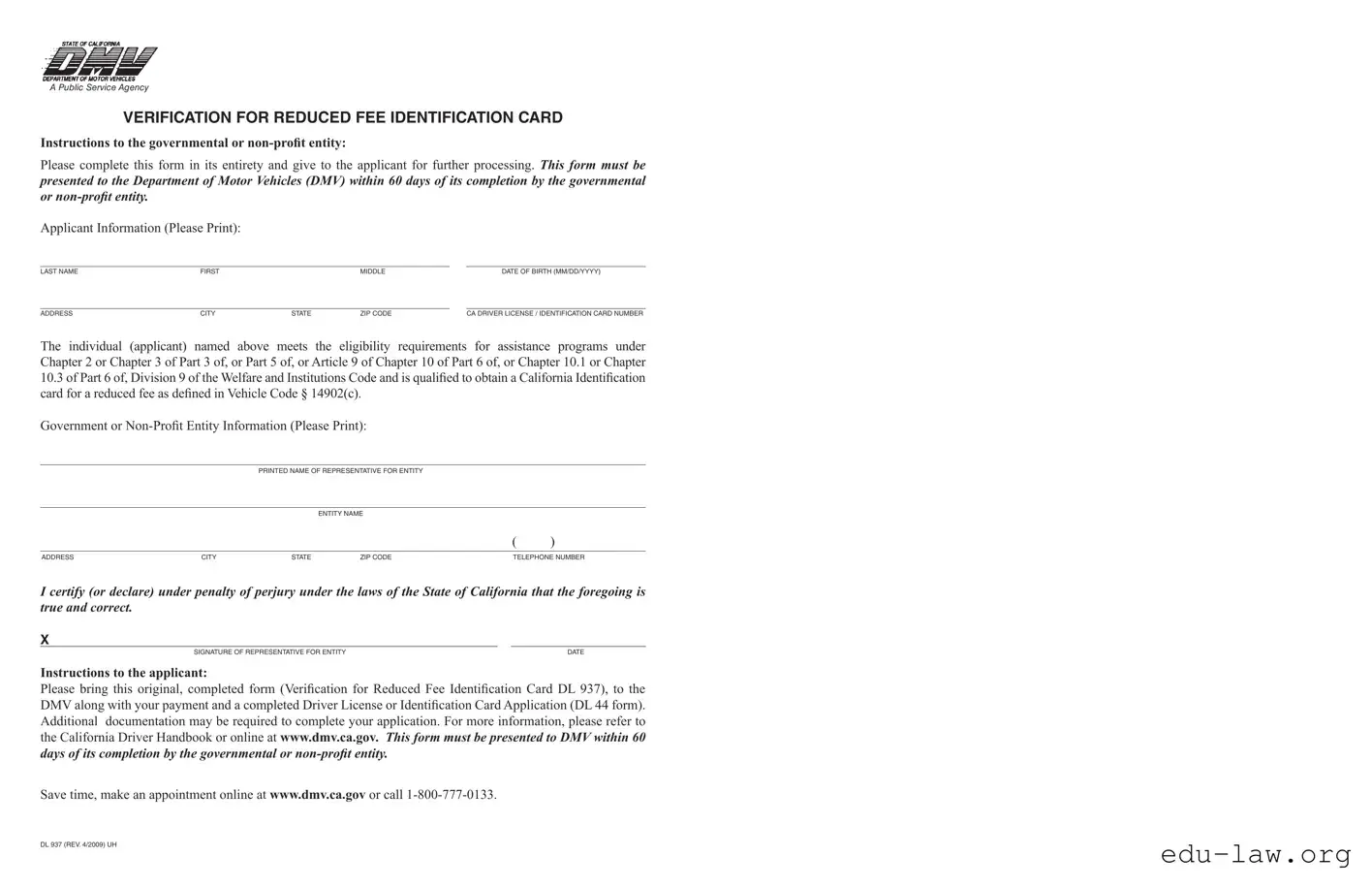
The DL 937 form serves as a crucial tool for individuals seeking a reduced fee identification card in California. Designed for applicants who qualify for assistance programs, this form must be completed by a governmental or non-profit entity. It captures essential information such as the applicant's name, date of birth, and address, along with the entity's details. The completed form must be submitted to the Department of Motor Vehicles (DMV) within 60 days to ensure eligibility. Along with the DL 937, applicants are required to present a completed Driver License or Identification Card Application (DL 44 form) and may need to provide additional documentation. Clear instructions guide both the entity and the applicant through the process, ensuring that the necessary steps are followed for a smooth application experience. For those seeking more information, resources are available online or through DMV customer service. Understanding the requirements and following the instructions carefully can help streamline the process of obtaining a reduced fee identification card.

A Public Service Agency
VERIFICATION FOR REDUCED FEE IDENTIFICATION CARD
Instructions to the governmental or
Please complete this form in its entirety and give to the applicant for further processing. This form must be
presented to the Department of Motor Vehicles (DMV) within 60 days of its completion by the governmental or
Applicant Information (Please Print):
_________________________________________________________________________ |
________________________________ |
|||
LAST NAME |
FIRST |
|
MIDDLE |
DATE OF BIRTH (MM/DD/YYYY) |
_________________________________________________________________________ |
________________________________ |
|||
ADDRESS |
CITY |
STATE |
ZIP CODE |
CA DRIVER LICENSE / IDENTIFICATION CARD NUMBER |
The individual (applicant) named above meets the eligibility requirements for assistance programs under Chapter 2 or Chapter 3 of Part 3 of, or Part 5 of, or Article 9 of Chapter 10 of Part 6 of, or Chapter 10.1 or Chapter
10.3of Part 6 of, Division 9 of the Welfare and Institutions Code and is qualiied to obtain a California Identiication card for a reduced fee as deined in Vehicle Code § 14902(c).
Government or
____________________________________________________________________________________________________________
PRINTED NAME OF REPRESENTATIVE FOR ENTITY
____________________________________________________________________________________________________________
ENTITY NAME
|
|
|
|
( |
) |
____________________________________________________________________________________________________________ |
|||||
ADDRESS |
CITY |
STATE |
ZIP CODE |
TELEPHONE NUMBER |
|
I certify (or declare) under penalty of perjury under the laws of the State of California that the foregoing is true and correct.
X |
____________________ |
SIGNATURE OF REPRESENTATIVE FOR ENTITY |
DATE |
Instructions to the applicant:
Please bring this original, completed form (Veriication for Reduced Fee Identiication Card DL 937), to the DMV along with your payment and a completed Driver License or Identiication Card Application (DL 44 form). Additional documentation may be required to complete your application. For more information, please refer to
the California Driver Handbook or online at www.dmv.ca.gov. This form must be presented to DMV within 60 days of its completion by the governmental or
Save time, make an appointment online at www.dmv.ca.gov or call
DL 937 (REV. 4/2009) UH
| Fact Name | Description |
|---|---|
| Purpose | The DL 937 form serves as a verification document for individuals seeking a reduced fee identification card in California. |
| Eligibility | Applicants must meet the eligibility requirements outlined in various chapters of the Welfare and Institutions Code. |
| Submission Deadline | The completed form must be submitted to the DMV within 60 days of its completion by the governmental or non-profit entity. |
| Governing Laws | The form is governed by California Vehicle Code § 14902(c) and specific chapters of the Welfare and Institutions Code. |
| Required Documentation | Applicants must bring the original completed DL 937 form along with a completed DL 44 form and payment to the DMV. |
| Entity Requirement | The form must be completed by a governmental or non-profit entity authorized to verify eligibility. |
| Signature Requirement | The representative of the entity must sign the form, certifying the information is true and correct under penalty of perjury. |
| Contact Information | Applicants can contact the DMV at 1-800-777-0133 or visit www.dmv.ca.gov for more information. |
| Form Revision | The current version of the DL 937 form was last revised in April 2009. |
After you fill out the DL 937 form, you will need to take it to the Department of Motor Vehicles (DMV) along with some additional documents. Make sure to do this within 60 days of the form being completed. You may also need to fill out another application form, so be prepared with everything you need.
Once completed, ensure that the form is original and bring it to the DMV along with your payment and the completed DL 44 form. Additional documentation may be needed, so check ahead to avoid any delays.
What is the DL 937 form used for?
The DL 937 form, also known as the Verification for Reduced Fee Identification Card, is used to confirm that an individual qualifies for a reduced fee identification card in California. This form must be completed by a governmental or non-profit entity and is necessary for applicants who are eligible for certain assistance programs as outlined in California's Welfare and Institutions Code.
Who needs to complete the DL 937 form?
A representative from a governmental or non-profit entity must complete the DL 937 form. This representative certifies that the applicant meets the eligibility requirements for assistance programs. The applicant will then take this completed form to the Department of Motor Vehicles (DMV) as part of their application for a reduced fee identification card.
How long is the DL 937 form valid?
The DL 937 form must be presented to the DMV within 60 days of its completion by the governmental or non-profit entity. After this period, the form will no longer be valid, and the applicant will need to obtain a new verification form to proceed with their application.
What should applicants bring to the DMV along with the DL 937 form?
Applicants must bring the original, completed DL 937 form to the DMV, along with their payment and a completed Driver License or Identification Card Application (DL 44 form). Additional documentation may also be required, so it's advisable to check the California Driver Handbook or the DMV website for specific requirements before visiting.
Incomplete Information: Failing to fill out all required fields can lead to delays. Ensure every section of the form is complete, including the applicant's full name, date of birth, and address.
Incorrect Date Format: The date of birth must be entered in the specified format (MM/DD/YYYY). Using a different format will cause confusion and may result in rejection.
Missing Signature: The representative from the governmental or non-profit entity must sign the form. An unsigned form cannot be processed.
Incorrect Entity Information: Providing inaccurate details about the governmental or non-profit entity can lead to complications. Double-check the entity name, address, and phone number.
Failure to Submit on Time: The completed form must be presented to the DMV within 60 days. Missing this deadline will require starting the process over.
Omitting Additional Documentation: Not including necessary supporting documents can delay the application. Review the requirements carefully and attach all needed papers.
Not Following Up: After submission, applicants should follow up with the DMV to confirm receipt and processing of their application. Ignoring this step can lead to unexpected issues.
Ignoring Appointment Recommendations: The DMV encourages making an appointment online. Neglecting this advice can result in long wait times and frustration.
The DL 937 form is essential for individuals seeking a reduced fee identification card in California. Alongside this form, several other documents are often required to ensure a smooth application process at the Department of Motor Vehicles (DMV). Below is a list of common forms and documents that may accompany the DL 937 form.
Gathering these documents in advance can streamline the application process for a reduced fee identification card. Ensuring that all forms are completed accurately and submitted on time will help avoid any complications when visiting the DMV.
The DL 44 form, known as the Application for a Driver License or Identification Card, is similar to the DL 937 form in that both are essential for obtaining identification in California. The DL 44 form serves as the primary application for individuals seeking either a driver’s license or an identification card. Applicants must provide personal information, such as their name, address, and date of birth. Like the DL 937, it requires the applicant to submit additional documentation to verify identity and residency. Both forms must be presented to the DMV for processing, making them crucial steps in the identification card application process.
The DL 205 form, or the Application for a Disabled Person Parking Placard, shares similarities with the DL 937 in that it also requires verification of eligibility for a specific program. This form is intended for individuals who have disabilities and need a parking placard to access designated parking spaces. Just as the DL 937 must be completed by a governmental or nonprofit entity, the DL 205 requires a medical professional’s signature to confirm the applicant’s disability status. Both forms involve a verification process and are submitted to the DMV for approval.
The DL 964 form, known as the Application for a California Identification Card for Minors, is another document that parallels the DL 937. This form is specifically designed for minors under the age of 18 who wish to obtain an identification card. Similar to the DL 937, it requires parental or guardian consent and includes sections for personal information. The verification process is also critical, as it ensures that the minor meets the necessary requirements for obtaining an ID. Both forms ultimately aim to provide individuals with legal identification.
The DL 44C form, which is the Application for a California Driver License or Identification Card for a Child, is akin to the DL 937 as it also caters to younger applicants. This form is used when a child is applying for a driver’s license or ID card, requiring consent from a parent or guardian. Like the DL 937, it necessitates the submission of supporting documents to verify the child’s identity and residency. Both forms highlight the importance of parental involvement in the application process for minors.
The DL 100 form, known as the Notice of Change of Address, is another document that complements the DL 937. While it does not serve as an application for identification, it is essential for maintaining accurate records with the DMV. Individuals who have recently moved must submit this form to update their address on their identification card or driver’s license. This form, like the DL 937, plays a crucial role in ensuring that the DMV has up-to-date information for all applicants and cardholders.
The DL 56 form, or the Application for a Duplicate Driver License or Identification Card, is similar to the DL 937 in that it is used to obtain a form of identification. This document is necessary for individuals who have lost their ID and need a replacement. Just like the DL 937, it requires the applicant to provide personal information and may necessitate additional documentation to verify identity. Both forms are integral to maintaining valid identification in California.
The DL 801 form, which is the Application for a California Identification Card for a Person with a Disability, aligns with the DL 937 by focusing on a specific group of applicants. This form is specifically for individuals with disabilities who are applying for an identification card. Similar to the DL 937, it requires verification of eligibility and may involve documentation from a healthcare provider. Both forms aim to ensure that individuals with disabilities have access to identification that meets their needs.
When filling out the DL 937 form, it's important to ensure accuracy and completeness. Here’s a list of things you should and shouldn’t do:
Following these guidelines can help ensure a smoother process when applying for your reduced fee identification card.
Understanding the DL 937 form can be tricky, and there are several misconceptions surrounding it. Here’s a list of common misunderstandings to clarify the purpose and process of this important document.
This form is designed for individuals who qualify for various assistance programs, not just those with low income. Eligibility criteria can vary.
It's crucial to submit the form to the DMV within 60 days of its completion. Delaying this may result in having to fill it out again.
Only governmental or non-profit entities are authorized to fill out and sign this form. Make sure the representative is from an approved organization.
Completing the form does not automatically guarantee that you will receive the reduced fee card. Eligibility must be verified by the DMV.
The applicant does not need to be present for the form to be filled out. However, they must bring the completed form to the DMV.
While the DL 937 form is important, additional documentation may still be required by the DMV to complete your application.
This form is specifically for California identification cards, so it is applicable only to residents of California.
The form must be completed by a governmental or non-profit entity. It cannot be filled out independently by the applicant.
The form must be submitted within 60 days of completion. After that period, it becomes invalid, and you will need a new one.
The DL 937 form is essential for obtaining the reduced fee. Without it, you will not be eligible for the discount.
Being informed about these misconceptions can help streamline the process of obtaining a reduced fee identification card. Always refer to official resources or contact the DMV for the most accurate and up-to-date information.
When filling out and using the DL 937 form, there are several important points to keep in mind. Here are four key takeaways:
By keeping these takeaways in mind, applicants can navigate the process more smoothly and increase their chances of obtaining a reduced fee identification card successfully.