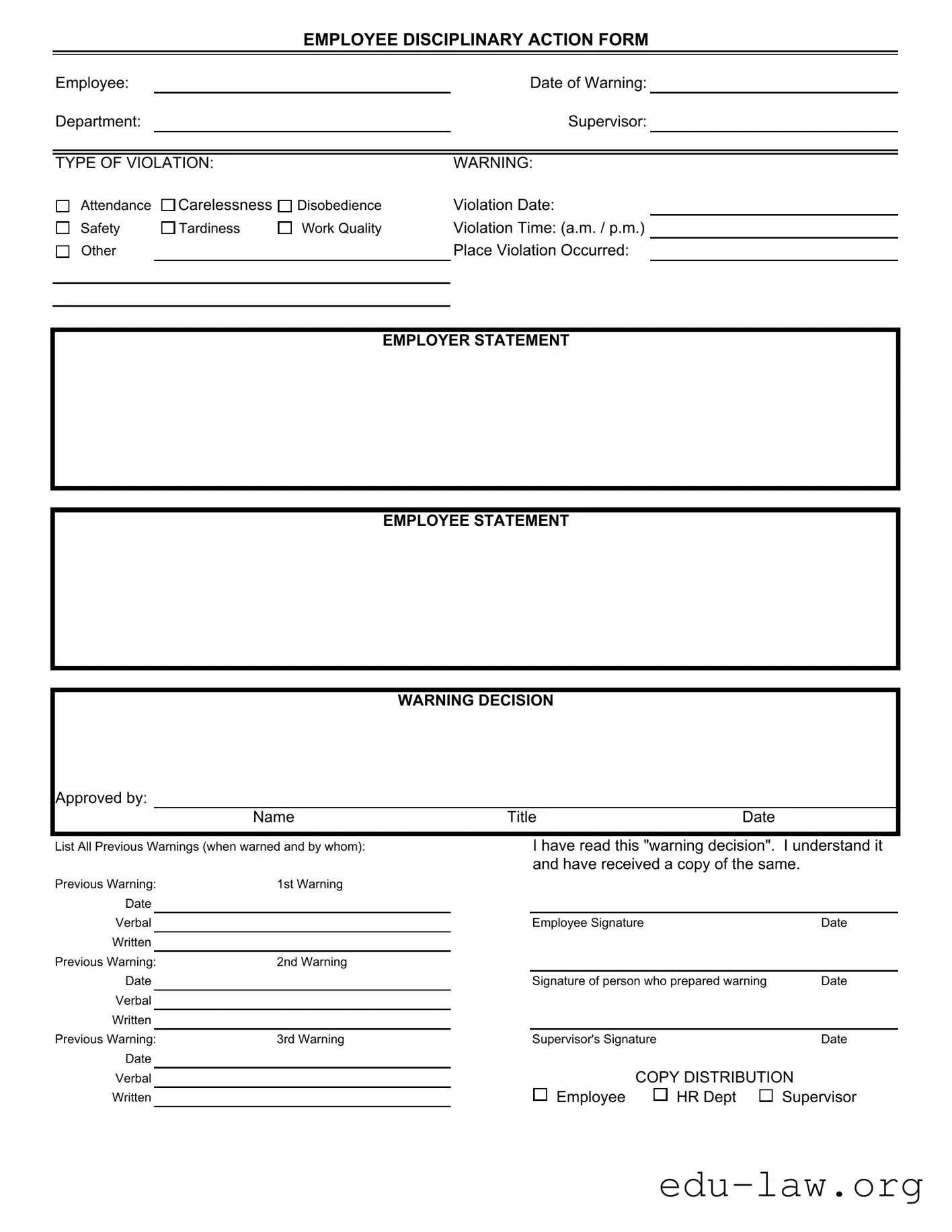
The Disciplinary Action form serves as a crucial tool for maintaining workplace standards and ensuring accountability among employees. This form outlines essential details, including the employee's name, the date of the warning, and the department they work in, along with the supervisor's name. It categorizes the type of violation, which may range from attendance issues to safety concerns, allowing for a clear understanding of the reason behind the disciplinary action. The form also records the specific date and time of the violation, as well as the location where it occurred. Both the employer and employee have the opportunity to provide their statements, ensuring that all perspectives are documented. Additionally, the form tracks previous warnings, creating a comprehensive history of the employee's conduct. Upon completion, it requires signatures from the employee and the supervisor, affirming that the employee has received and understood the warning decision. Copies are then distributed to the employee, the HR department, and the supervisor, ensuring transparency and proper record-keeping.
EMPLOYEE DISCIPLINARY ACTION FORM
Employee: |
|
Date of Warning: |
Department:Supervisor:
TYPE OF VIOLATION:
Attendance Carelessness
Safety |
Tardiness |
Other
|
WARNING: |
Disobedience |
Violation Date: |
Work Quality |
Violation Time: (a.m. / p.m.) |
|
Place Violation Occurred: |
EMPLOYER STATEMENT
EMPLOYEE STATEMENT
WARNING DECISION
Approved by:
|
|
Name |
Title |
Date |
|
|
||
|
|
|
|
|
||||
List All Previous Warnings (when warned and by whom): |
|
I have read this "warning decision". I understand it |
||||||
|
|
|
|
and have received a copy of the same. |
||||
Previous Warning: |
1st Warning |
|
|
|
|
|
|
|
Date |
|
|
|
|
|
|
|
|
Verbal |
|
|
|
Employee Signature |
|
Date |
||
Written |
|
|
|
|
|
|
|
|
Previous Warning: |
2nd Warning |
|
|
|
|
|
|
|
Date |
|
|
|
Signature of person who prepared warning |
Date |
|||
Verbal |
|
|
|
|
|
|
|
|
Written |
|
|
|
|
|
|
|
|
Previous Warning: |
3rd Warning |
|
Supervisor's Signature |
|
Date |
|||
Date |
|
|
|
|
|
|
|
|
Verbal |
|
|
COPY DISTRIBUTION |
|||||
Written |
|
|
|
Employee |
|
HR Dept |
Supervisor |
|
|
|
|
||||||
| Fact Name | Details |
|---|---|
| Purpose | The Disciplinary Action Form is used to document employee violations and the corresponding disciplinary measures taken by an employer. |
| Employee Information | The form requires essential employee details, including the employee's name, the date of the warning, and their department. |
| Type of Violation | Common categories of violations include attendance issues, carelessness, safety violations, tardiness, and other specified infractions. |
| Warning Details | The form captures the date and time of the violation, along with the specific place where it occurred. |
| Employer Statement | Employers provide a statement detailing the reasoning behind the warning and any relevant context regarding the violation. |
| Employee Acknowledgment | Employees must sign the form to acknowledge that they have read and understood the warning decision. |
| Previous Warnings | The form includes a section to list all previous warnings, including the dates and the names of the individuals who issued them. |
| Approval Process | Each warning must be approved by a supervisor, who also signs and dates the form to validate the action taken. |
| Distribution | After completion, copies of the form are distributed to the employee, the HR department, and the supervisor for record-keeping. |
| State-Specific Laws | Disciplinary actions must comply with state-specific employment laws, such as the Fair Labor Standards Act (FLSA) and state labor codes. |
Once you have gathered all necessary information, it’s time to fill out the Disciplinary Action form. This form will help document the situation and the actions taken. Ensure that you complete each section carefully and accurately to maintain clarity and transparency.
What is the purpose of the Disciplinary Action form?
The Disciplinary Action form is used to document any violations of company policies or standards by an employee. It serves as a formal record of the issue, the actions taken by the employer, and the employee's acknowledgment of the warning. This documentation is essential for ensuring fair treatment and providing a clear history of disciplinary actions if further issues arise.
Who fills out the Disciplinary Action form?
The supervisor or manager of the employee typically fills out the Disciplinary Action form. They are responsible for documenting the violation, explaining the circumstances surrounding it, and detailing any previous warnings. This process helps maintain transparency and accountability within the workplace.
What types of violations can be reported on this form?
The form allows for various types of violations to be documented, including attendance issues, carelessness, safety violations, tardiness, and any other specific infractions. Each type of violation is categorized to ensure clarity and proper handling of the situation.
How is the employee informed about the disciplinary action?
What should an employee do if they disagree with the warning?
If an employee disagrees with the warning, they should discuss their concerns with their supervisor or HR department. It is important for the employee to express their perspective and seek clarification. This open communication can help resolve misunderstandings and ensure that all parties are on the same page.
Are previous warnings included on the form?
Yes, the Disciplinary Action form includes a section to list all previous warnings. This section allows for a comprehensive view of the employee's disciplinary history, which can be crucial in determining the appropriate course of action for repeated violations.
What happens after the form is completed?
Once the Disciplinary Action form is completed and signed, it is distributed to the employee, the HR department, and the supervisor. This ensures that all relevant parties have access to the documentation and can follow up as necessary. The employee is expected to retain their copy for their records.
Is the Disciplinary Action form confidential?
While the information on the Disciplinary Action form is considered sensitive, it is not strictly confidential. However, it should be handled with care and only shared with individuals who need to be informed, such as HR personnel and relevant supervisors. This helps maintain the integrity of the disciplinary process.
What is the significance of the employee's signature on the form?
The employee's signature on the Disciplinary Action form indicates that they have read and understood the warning decision. It does not necessarily mean that they agree with the warning, but it confirms that they have been informed of the situation and have received a copy of the documentation.
Can the Disciplinary Action form be used in legal proceedings?
Yes, the Disciplinary Action form can be used as evidence in legal proceedings if necessary. Its detailed documentation of the violation, the employer's response, and the employee's acknowledgment can support the employer's position in cases of disputes or claims related to employment practices.
Inaccurate Information: One common mistake is providing incorrect details about the employee or the incident. Always double-check names, dates, and times to ensure accuracy.
Vague Descriptions: Failing to clearly describe the violation can lead to misunderstandings. Specificity is key; describe the actions that led to the disciplinary action in detail.
Not Documenting Previous Warnings: Neglecting to list prior warnings can undermine the current disciplinary action. It's important to provide a complete history to show a pattern of behavior.
Ignoring Employee Input: Skipping the section for the employee's statement may lead to a perception of bias. Always allow the employee to share their side of the story.
Inconsistent Signatures: Failing to obtain the necessary signatures can invalidate the form. Ensure that both the supervisor and the employee sign the document to confirm acknowledgment.
Missing Distribution: Not distributing copies of the form to all relevant parties can create confusion later. Make sure copies are provided to the employee, HR, and the supervisor.
Rushing the Process: Hurrying through the completion of the form can lead to oversights. Take the time needed to fill out each section thoughtfully and carefully.
When managing employee behavior, it’s essential to have a clear understanding of the various forms and documents that complement the Disciplinary Action form. These documents help ensure a consistent approach to discipline and provide necessary context for any actions taken. Below is a list of forms commonly used alongside the Disciplinary Action form.
Utilizing these forms in conjunction with the Disciplinary Action form can create a more comprehensive approach to employee management. By documenting each step in the process, employers can ensure clarity, fairness, and consistency in their disciplinary procedures.
The Performance Improvement Plan (PIP) is a document designed to help employees enhance their work performance. Similar to the Disciplinary Action form, it identifies specific areas of concern and outlines expectations for improvement. The PIP typically includes measurable goals and a timeline for reassessment, ensuring that employees are aware of the steps they need to take to meet performance standards. Both documents serve as a formal record of issues and provide a structured approach to addressing employee behavior and performance, fostering accountability and transparency.
The Incident Report is another document that shares similarities with the Disciplinary Action form. This report captures details of a specific event or behavior that may have violated company policies or standards. Like the Disciplinary Action form, it typically includes information about the individuals involved, the nature of the incident, and any witnesses present. Both documents aim to provide a clear account of events, which can be referenced later if further action is necessary, ensuring that all parties have a shared understanding of the situation.
The Employee Grievance Form allows employees to formally express concerns or complaints regarding workplace issues. This document, much like the Disciplinary Action form, requires detailed information about the issue at hand, including dates, times, and specific incidents. Both forms are critical for maintaining open communication within the workplace. They provide a structured process for addressing problems, whether they stem from employee behavior or workplace conditions, fostering a culture of accountability and resolution.
The Termination Notice is a document that formally communicates the end of an employee's tenure with a company. It often outlines the reasons for termination, similar to how the Disciplinary Action form details the violations leading to disciplinary measures. Both documents serve as official records that can be referenced in the future, ensuring that the employer has documented the rationale behind their decisions. This clarity is vital for both legal protection and the employee's understanding of their situation.
The Corrective Action Plan (CAP) is used to address and rectify employee performance issues. Like the Disciplinary Action form, it outlines specific problems and provides a framework for improvement. The CAP typically includes timelines and measurable objectives, ensuring that employees know what is expected of them moving forward. Both documents emphasize the importance of addressing issues constructively, aiming to support employee development while also protecting the organization’s interests.
The Counseling Form is used to document discussions between supervisors and employees regarding performance or behavioral issues. This document shares similarities with the Disciplinary Action form in that it records the nature of the discussion, the employee's responses, and any agreed-upon actions. Both forms serve as a means of communication and documentation, ensuring that there is a clear record of expectations and any commitments made by the employee.
The Policy Violation Notice is issued when an employee breaches company policies. It functions similarly to the Disciplinary Action form by detailing the specific violation and the consequences that may follow. Both documents aim to inform the employee of the seriousness of their actions and provide a formal record of the incident. This ensures that the organization can enforce its policies consistently and fairly, while also giving employees the opportunity to understand and rectify their behavior.
The Exit Interview Form is completed when an employee leaves a company, capturing insights about their experiences. While it may seem different from the Disciplinary Action form, both documents serve to gather information that can improve workplace practices. The Exit Interview Form often addresses issues that may have contributed to an employee's departure, similar to how the Disciplinary Action form highlights behavioral concerns. Both forms are valuable for organizations seeking to enhance their work environment and employee satisfaction.
The Employee Handbook Acknowledgment Form is signed by employees to confirm that they have received and understood the company’s policies. This document shares a connection with the Disciplinary Action form, as both emphasize the importance of adherence to company standards. The acknowledgment serves as a reminder to employees of their responsibilities, while the Disciplinary Action form documents when those responsibilities have not been met. Together, they help create a culture of compliance and accountability within the workplace.
The Attendance Record is a document that tracks employee attendance patterns, including absences and tardiness. Similar to the Disciplinary Action form, it is used to monitor compliance with company policies. Both documents can highlight problematic behaviors, such as frequent tardiness or absenteeism, and may lead to further action if patterns emerge. By documenting attendance, organizations can address issues proactively, ensuring that employees understand the importance of reliability in the workplace.
When filling out the Disciplinary Action form, it is essential to approach the task with care and attention to detail. Below is a list of ten guidelines to help ensure the form is completed correctly.
Following these guidelines will help maintain professionalism and clarity in documenting disciplinary actions. Proper completion of the form is crucial for both the employee and employer's understanding of the situation.
Here are six common misconceptions about the Disciplinary Action form:
When utilizing the Disciplinary Action form, it is essential to follow specific guidelines to ensure clarity and effectiveness. Here are key takeaways to consider: