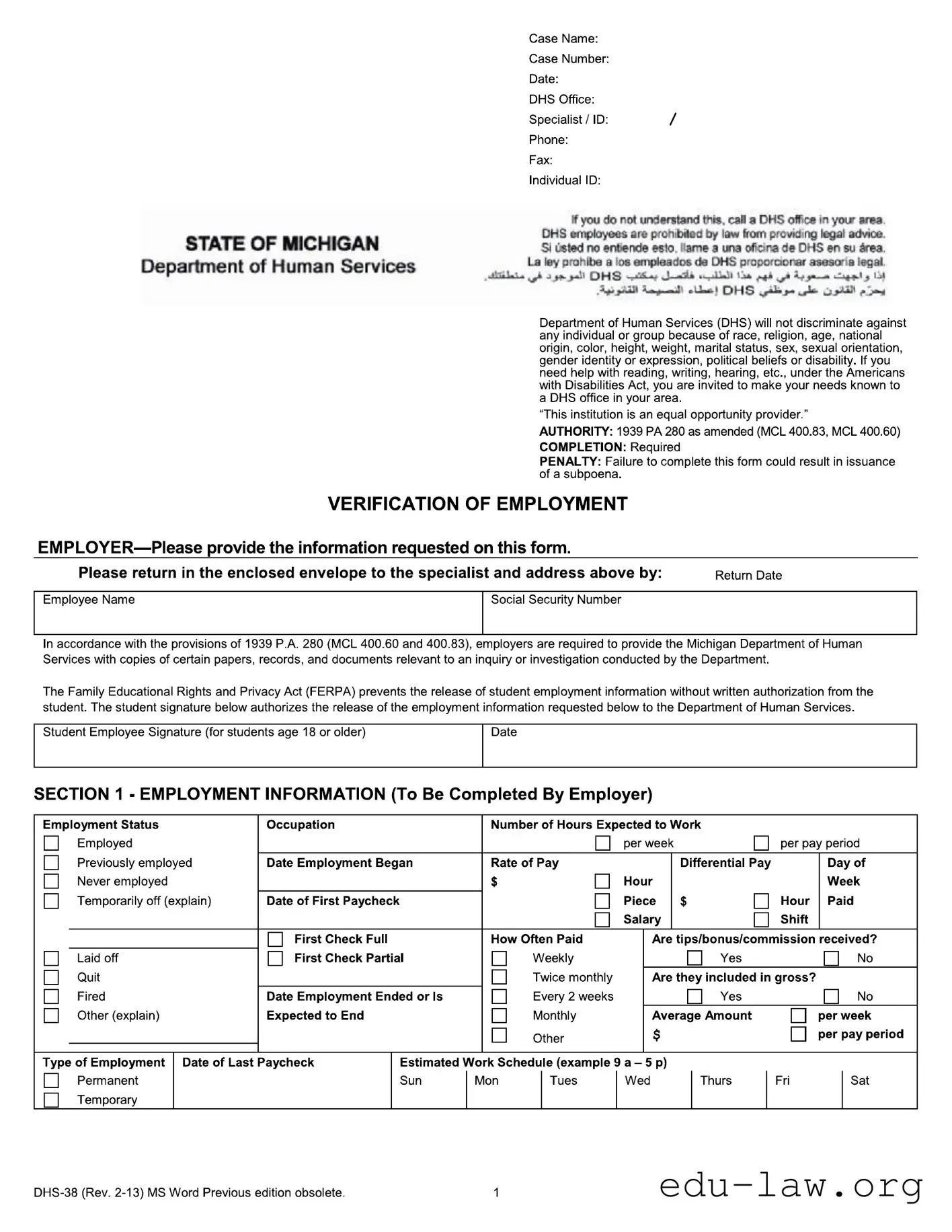
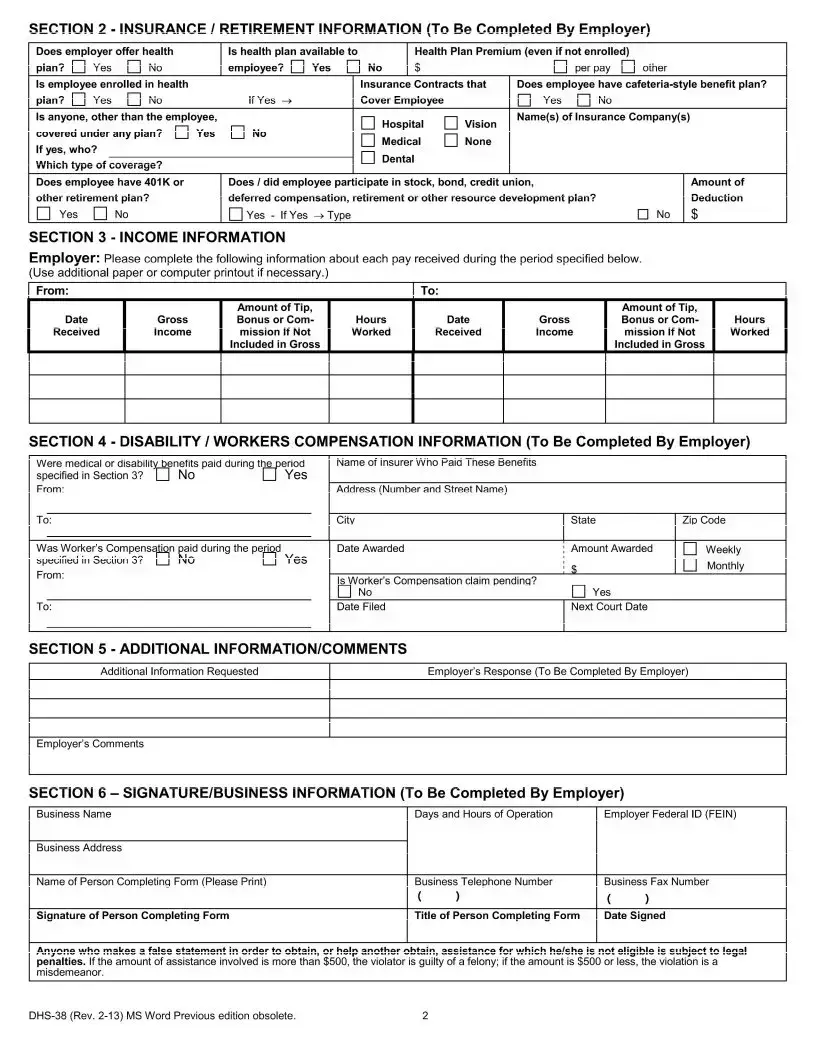
The DHS 38 form is a crucial document utilized by the Michigan Department of Human Services (DHS) to gather essential employment and income information. This form plays a significant role in various investigations and inquiries conducted by the department. It requires employers to provide detailed information about their employees, including employment status, rate of pay, and hours worked. Additionally, the form includes sections for verifying health insurance and retirement plan details, ensuring that all relevant aspects of an employee's financial situation are considered. The DHS emphasizes its commitment to nondiscrimination, stating that it will not treat individuals unfairly based on race, religion, age, or other characteristics. For those with disabilities, the DHS encourages individuals to express their needs for assistance in completing the form. It is important to note that failure to complete the DHS 38 form may result in legal consequences, such as the issuance of a subpoena. Therefore, employers must take care to fill out the form accurately and return it by the specified deadline. By understanding the significance of the DHS 38 form, both employers and employees can navigate the complexities of the assistance process more effectively.
| Fact Name | Description |
|---|---|
| Governing Law | The DHS-38 form is governed by the Michigan Public Act 280 of 1939, specifically MCL 400.60 and MCL 400.83. |
| Completion Requirement | Completing the DHS-38 form is mandatory. Failure to do so may lead to legal consequences, including the issuance of a subpoena. |
| Equal Opportunity Statement | The Department of Human Services ensures that it does not discriminate against individuals based on various factors, including race, gender, and disability. |
| Privacy Considerations | The Family Educational Rights and Privacy Act (FERPA) protects student employment information, requiring written consent for its release. |
After gathering the necessary information, individuals can proceed to fill out the DHS 38 form. This form requires specific details about employment, insurance, and other relevant financial information. Completing it accurately is essential for the processing of inquiries or investigations conducted by the Department of Human Services.
What is the DHS 38 form?
The DHS 38 form is a verification of employment document required by the Michigan Department of Human Services. It collects essential information about an employee's work status, income, and benefits. This form is crucial for the department's inquiries or investigations related to assistance programs.
Who needs to complete the DHS 38 form?
The form must be completed by employers for their employees when requested by the Michigan Department of Human Services. Specifically, it is used for individuals who are applying for or receiving public assistance and whose employment details need verification.
What information is required on the DHS 38 form?
The form requires various details, including the employee's name, Social Security number, employment status, occupation, rate of pay, work schedule, and information about health insurance or retirement plans. Employers must provide accurate and complete information to avoid penalties.
What happens if the DHS 38 form is not completed?
Failure to complete the DHS 38 form can lead to serious consequences, including the issuance of a subpoena. This emphasizes the importance of timely and accurate submission of the form to the Michigan Department of Human Services.
Can the DHS provide legal advice regarding the DHS 38 form?
No, DHS employees are prohibited by law from providing legal advice. If you have questions about the form or its implications, it is advisable to consult a legal professional or seek assistance from a qualified source.
Is there a deadline for submitting the DHS 38 form?
Yes, the form must be returned to the designated DHS specialist by a specified return date indicated on the form. It is essential to adhere to this deadline to ensure compliance and avoid delays in assistance processing.
What should an employer do if they need help completing the DHS 38 form?
If an employer needs assistance with the DHS 38 form, they should contact their local DHS office. The staff can provide guidance on how to fill out the form correctly. Additionally, employers can seek help from resources available under the Americans with Disabilities Act if they require accommodations.
Are there penalties for providing false information on the DHS 38 form?
Yes, providing false information on the DHS 38 form can lead to legal penalties. If the amount of assistance involved exceeds $500, the individual may face felony charges. If the amount is $500 or less, it may be classified as a misdemeanor. Honesty and accuracy are critical when completing this form.
What should be done if an employee's information changes after submitting the DHS 38 form?
If there are any changes to an employee's information after submitting the DHS 38 form, the employer should promptly notify the Michigan Department of Human Services. This ensures that the department has the most current and accurate information for their records.
Incomplete Information: Many people forget to fill in all required fields. Missing details can lead to delays or rejection of the form.
Incorrect Employer Details: Providing inaccurate information about the employer, such as the name or address, can cause confusion and complications.
Not Signing the Form: Failing to sign the form is a common mistake. Without a signature, the form is not valid.
Missing Deadlines: Submitting the form after the deadline can result in penalties or denial of assistance. It's important to be aware of submission dates.
Ignoring Additional Documentation: Some applicants overlook the need to attach supporting documents. This can lead to processing delays or further requests for information.
The DHS-38 form is an essential document used by the Michigan Department of Human Services (DHS) to gather employment and income information. However, there are several other forms and documents that often accompany the DHS-38 to provide a comprehensive view of an individual's situation. Below is a list of these forms, each serving a specific purpose.
Each of these forms plays a vital role in the assistance process, ensuring that the Michigan DHS has the necessary information to make informed decisions about eligibility and benefits. Understanding these documents can help individuals navigate the system more effectively.
The DHS-38 form is similar to the W-2 form, which employers use to report wages paid to employees and the taxes withheld from those wages. Both documents require detailed employment information, including the employee's name, Social Security number, and earnings. While the W-2 is primarily focused on tax reporting, the DHS-38 is used by the Department of Human Services to assess eligibility for assistance programs, making both forms essential for verifying employment status and income.
Another document that shares similarities with the DHS-38 is the 1099 form. This form is used to report income received by independent contractors and freelancers. Like the DHS-38, it captures information about earnings, but it does not require the same level of detail regarding employment status or benefits. Both forms aim to provide a clear picture of an individual’s income, but the context in which they are used differs significantly.
The Employment Verification Form is also comparable to the DHS-38. This document is often used by lenders and landlords to confirm an individual's employment status and income. Similar to the DHS-38, it includes sections for employer details, employee information, and income verification. However, the Employment Verification Form is typically used in private transactions rather than for government assistance programs.
The I-9 form, which is used to verify an employee's identity and eligibility to work in the United States, shares some features with the DHS-38. Both forms require personal information and employment details. However, while the DHS-38 focuses on income verification for assistance eligibility, the I-9 is primarily concerned with legal work status and compliance with immigration laws.
The Pay Stub is another document that bears resemblance to the DHS-38. Pay stubs provide detailed information about an employee's earnings, deductions, and net pay for a specific pay period. Both the pay stub and the DHS-38 are used to verify income, but the pay stub is generated regularly by employers, while the DHS-38 is a request for information from the Department of Human Services.
Similarly, the Social Security Administration’s Earnings Record is akin to the DHS-38 in that it tracks an individual's earnings over time. This document is used to determine benefits eligibility and calculate Social Security payments. While both forms aim to document income, the Earnings Record is more focused on long-term contributions to Social Security rather than immediate assistance eligibility.
Lastly, the Child Support Income Verification form is comparable to the DHS-38. This form is used to determine a parent’s income for child support calculations. Like the DHS-38, it collects detailed employment and income information to ensure accurate assessments. Both forms are essential for ensuring that financial support obligations are met, although they serve different purposes in the context of family law and public assistance.
When filling out the DHS 38 form, it’s important to follow some guidelines to ensure accuracy and compliance. Here’s a list of things you should and shouldn’t do:
Misconceptions about the DHS 38 form can lead to confusion and incorrect assumptions. Here are nine common misconceptions along with clarifications.
Understanding these misconceptions can help individuals navigate the DHS 38 form more effectively and ensure they meet all necessary requirements.
When filling out and using the DHS 38 form, keep these key points in mind:
By following these takeaways, you can ensure a smoother experience when dealing with the DHS 38 form.