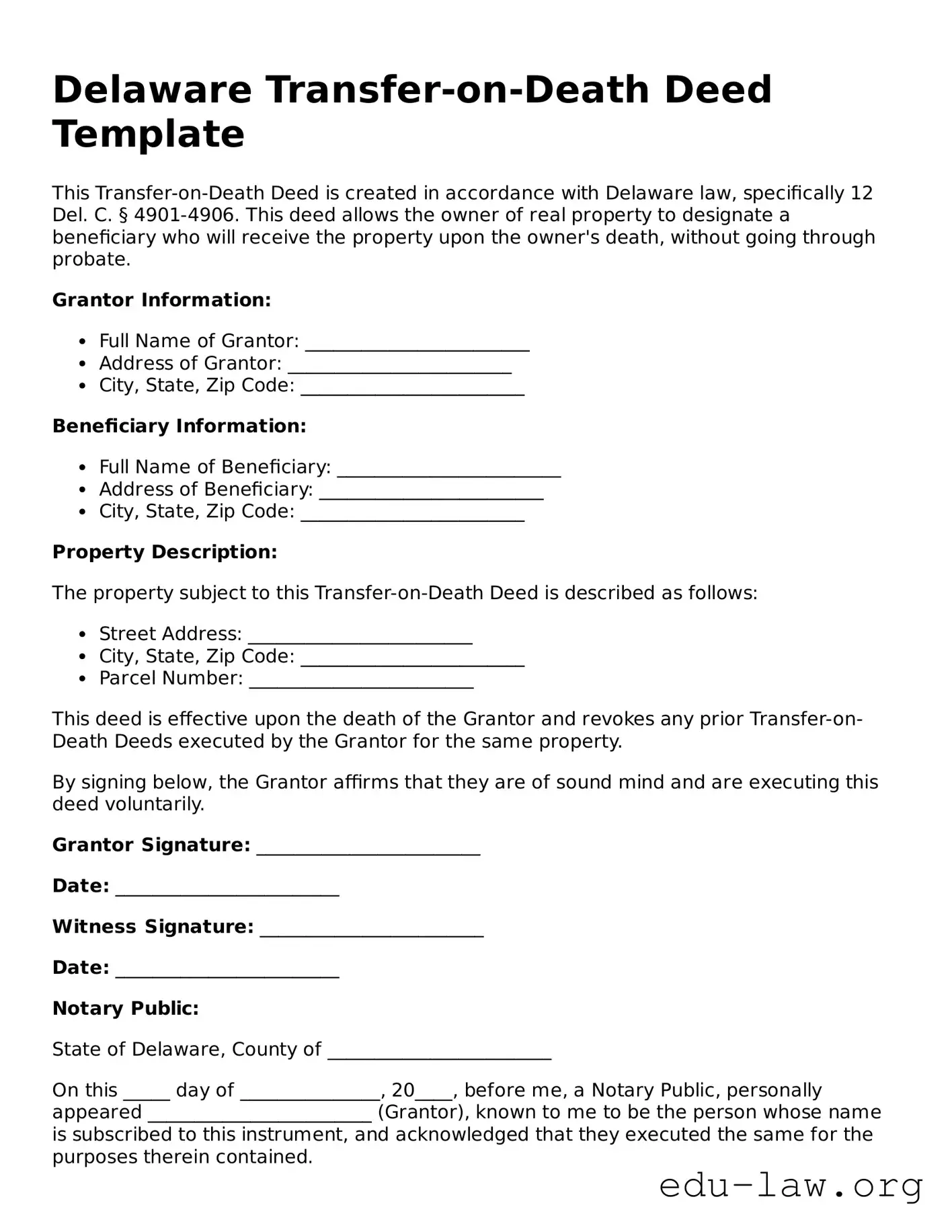
In the state of Delaware, the Transfer-on-Death (TOD) Deed form serves as a valuable tool for individuals looking to streamline the transfer of real estate upon their passing. This legal document allows property owners to designate a beneficiary who will automatically receive the property without the need for probate. By completing a TOD Deed, you can ensure that your loved ones inherit your property quickly and efficiently, minimizing potential disputes and delays. The form requires specific information, including the property description and the names of the beneficiaries. Once executed and recorded, the deed becomes effective upon the owner's death, making it a straightforward option for estate planning. Understanding the nuances of this form can empower you to make informed decisions about your property and how it will be handled after you are gone.
Delaware Transfer-on-Death Deed Template
This Transfer-on-Death Deed is created in accordance with Delaware law, specifically 12 Del. C. § 4901-4906. This deed allows the owner of real property to designate a beneficiary who will receive the property upon the owner's death, without going through probate.
Grantor Information:
Beneficiary Information:
Property Description:
The property subject to this Transfer-on-Death Deed is described as follows:
This deed is effective upon the death of the Grantor and revokes any prior Transfer-on-Death Deeds executed by the Grantor for the same property.
By signing below, the Grantor affirms that they are of sound mind and are executing this deed voluntarily.
Grantor Signature: ________________________
Date: ________________________
Witness Signature: ________________________
Date: ________________________
Notary Public:
State of Delaware, County of ________________________
On this _____ day of _______________, 20____, before me, a Notary Public, personally appeared ________________________ (Grantor), known to me to be the person whose name is subscribed to this instrument, and acknowledged that they executed the same for the purposes therein contained.
Notary Signature: ________________________
My Commission Expires: ________________________
| Fact Name | Details |
|---|---|
| Definition | A Transfer-on-Death Deed allows an individual to transfer real property to a beneficiary upon death without going through probate. |
| Governing Law | The Delaware Transfer-on-Death Deed is governed by Title 12, Chapter 6102 of the Delaware Code. |
| Eligibility | Only individuals, not entities, can execute a Transfer-on-Death Deed in Delaware. |
| Revocation | The deed can be revoked at any time before the death of the grantor by executing a new deed or a formal revocation. |
| Beneficiary Requirements | Beneficiaries must be identified clearly in the deed to ensure proper transfer of property. |
| Filing Requirements | The deed must be recorded with the county recorder's office where the property is located to be effective. |
| Tax Implications | Property transferred via a Transfer-on-Death Deed may still be subject to estate taxes, depending on the overall estate value. |
Once you have the Delaware Transfer-on-Death Deed form, it's important to fill it out accurately. After completing the form, you will need to have it signed and notarized before filing it with the appropriate county recorder's office. This ensures that your intentions regarding the transfer of property are legally recognized.
What is a Transfer-on-Death Deed in Delaware?
A Transfer-on-Death Deed (TOD Deed) allows property owners in Delaware to transfer real estate to beneficiaries upon their death without going through probate. This means that when the property owner passes away, the designated beneficiaries automatically receive ownership of the property. This deed is a straightforward way to ensure that your property goes to the people you choose, simplifying the process for your loved ones.
Who can create a Transfer-on-Death Deed?
Any individual who is the owner of real estate in Delaware can create a Transfer-on-Death Deed. This includes single owners, joint owners, and those who hold property in a trust. However, it’s essential that the person creating the deed has the legal capacity to do so. This means they must be of sound mind and at least 18 years old. It’s advisable to consult with a professional if there are any questions about capacity or ownership rights.
How do I complete a Transfer-on-Death Deed?
To complete a Transfer-on-Death Deed, you must fill out the required form, which includes details such as the property description and the names of the beneficiaries. The deed must then be signed by the property owner in the presence of a notary public. After signing, the deed must be recorded with the county recorder's office where the property is located. This recording is crucial as it makes the deed effective and publicly known.
Can I change or revoke a Transfer-on-Death Deed after it is created?
Yes, you can change or revoke a Transfer-on-Death Deed at any time before your death. To do this, you can create a new TOD Deed that supersedes the previous one or file a revocation form with the county recorder's office. It’s important to ensure that any changes are properly documented and recorded to avoid confusion later on. Always keep your beneficiaries informed about any changes you make.
Are there any tax implications associated with a Transfer-on-Death Deed?
Generally, there are no immediate tax implications when you create a Transfer-on-Death Deed. The property remains part of your estate until your death, so you retain all rights and responsibilities associated with it during your lifetime. However, once the property transfers to the beneficiaries, they may be responsible for property taxes and other obligations. It’s wise to consult a tax professional for specific advice related to your situation and to understand any potential estate tax implications.
Incorrect Property Description: Failing to accurately describe the property can lead to confusion. Ensure the address and legal description match public records.
Missing Signatures: All required parties must sign the deed. Omitting a signature can invalidate the document.
Not Notarizing the Document: A Transfer-on-Death Deed must be notarized to be legally binding. Skipping this step can render the deed ineffective.
Improper Witness Requirements: Some states require witnesses for the signing. Check local regulations to ensure compliance.
Filing in the Wrong Office: Submit the deed to the appropriate office. Filing it in the wrong location can delay or complicate the transfer process.
Not Updating the Deed: If circumstances change, such as the sale of the property, the deed must be updated or revoked to reflect the current situation.
Failing to Inform Beneficiaries: Beneficiaries should be aware of the deed. Not informing them can lead to misunderstandings or disputes later on.
Ignoring State-Specific Requirements: Each state has its own rules regarding Transfer-on-Death Deeds. Familiarize yourself with Delaware's specific requirements to avoid errors.
When preparing a Delaware Transfer-on-Death Deed, it is essential to consider other related documents that may be necessary for a smooth property transfer. Each of these forms serves a specific purpose and can help ensure that your wishes are honored. Below is a list of commonly used documents that complement the Transfer-on-Death Deed.
Understanding these documents can significantly impact the efficiency of your estate planning. Be sure to consult with a qualified professional to ensure everything is in order and reflects your intentions accurately.
The Delaware Transfer-on-Death Deed (TOD) allows individuals to transfer real estate to beneficiaries upon their death without going through probate. This document is similar to a will in that both dictate how a person's assets will be distributed after their death. However, unlike a will, which takes effect only after probate, a TOD deed allows for a smoother transition of property ownership directly to the named beneficiaries, bypassing the often lengthy and costly probate process.
A revocable living trust shares similarities with the TOD deed in that it also facilitates the transfer of property outside of probate. With a living trust, individuals can place their assets into the trust during their lifetime. Upon their death, the assets are distributed according to the terms of the trust, allowing for privacy and a quicker transfer process. Both documents serve to simplify the transfer of property but differ in their setup and management during the grantor's lifetime.
An irrevocable trust is another document that resembles the TOD deed. Once established, an irrevocable trust cannot be altered or revoked, which means the assets are permanently removed from the grantor's estate. This can provide tax benefits and protect assets from creditors. Like the TOD deed, it allows for a clear plan for asset distribution, but it requires more commitment and has different implications for control over the assets.
When filling out the Delaware Transfer-on-Death Deed form, there are some important dos and don'ts to keep in mind. Following these guidelines can help ensure that your form is completed correctly and efficiently.
Understanding the Delaware Transfer-on-Death Deed can be challenging. Here are some common misconceptions about this legal document:
These points clarify some common misunderstandings about the Delaware Transfer-on-Death Deed. Proper knowledge can help in making informed decisions regarding property transfer.
Filling out and using the Delaware Transfer-on-Death Deed form can be a straightforward process if you keep a few key points in mind. Here are some essential takeaways to guide you: