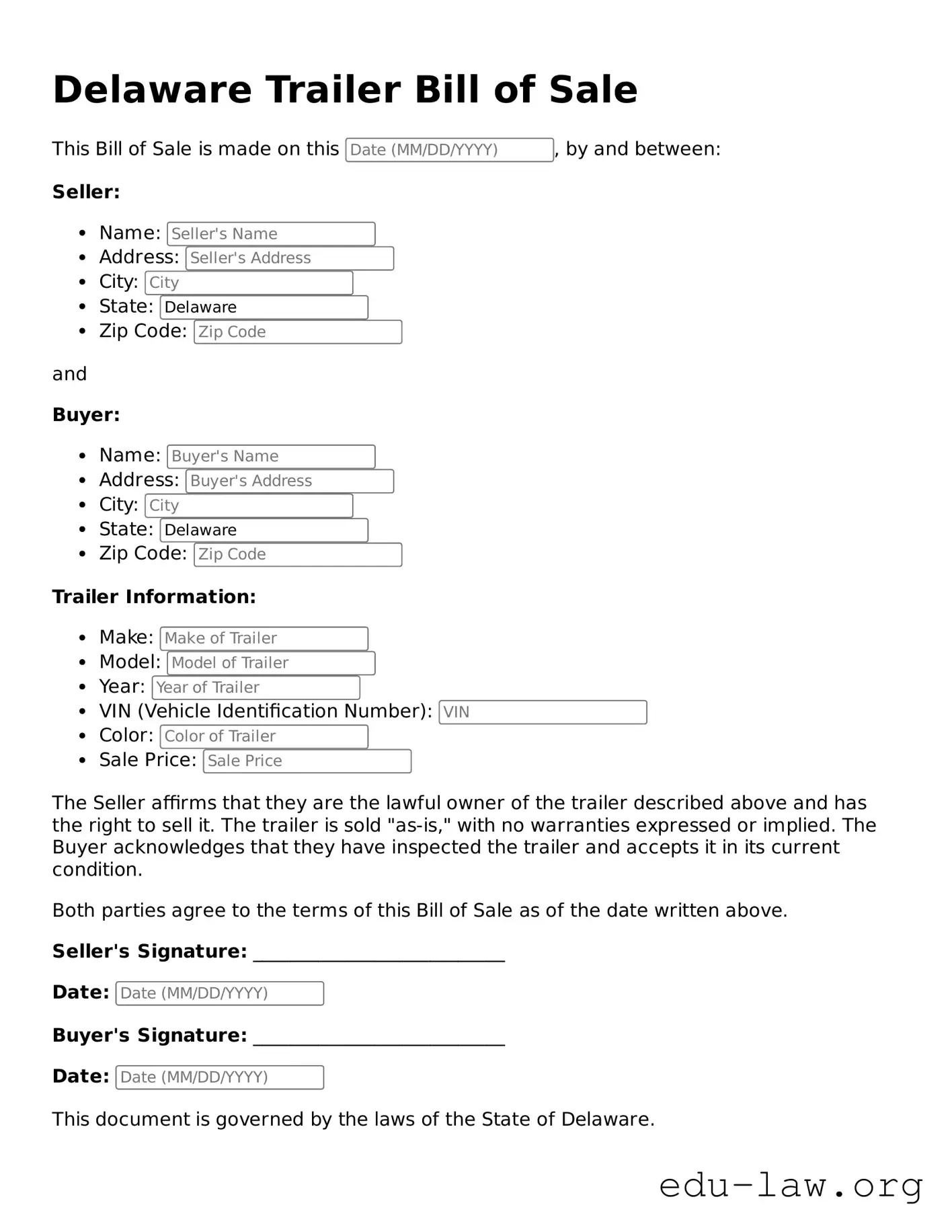
When it comes to buying or selling a trailer in Delaware, having the right documentation is crucial to ensure a smooth transaction. The Delaware Trailer Bill of Sale form serves as a vital record that outlines the details of the sale, protecting both the buyer and the seller. This form typically includes essential information such as the names and addresses of both parties, a description of the trailer including its make, model, and Vehicle Identification Number (VIN), as well as the sale price. Additionally, it may contain details regarding any warranties or conditions of the sale. By completing this form, both parties can establish clear ownership and transfer rights, which is especially important for registering the trailer with the state. Whether you are a seasoned trailer owner or a first-time buyer, understanding the importance of this document can help you navigate the process with confidence.
Delaware Trailer Bill of Sale
This Bill of Sale is made on this , by and between:
Seller:
and
Buyer:
Trailer Information:
The Seller affirms that they are the lawful owner of the trailer described above and has the right to sell it. The trailer is sold "as-is," with no warranties expressed or implied. The Buyer acknowledges that they have inspected the trailer and accepts it in its current condition.
Both parties agree to the terms of this Bill of Sale as of the date written above.
Seller's Signature: ___________________________
Date:
Buyer's Signature: ___________________________
Date:
This document is governed by the laws of the State of Delaware.
| Fact Name | Description |
|---|---|
| Purpose | The Delaware Trailer Bill of Sale form is used to document the sale of a trailer between a buyer and a seller. |
| Governing Law | This form is governed by Delaware state law, specifically the Delaware Code Title 21. |
| Parties Involved | The form includes sections for both the seller and the buyer to provide their information. |
| Vehicle Information | Details about the trailer, including make, model, year, and Vehicle Identification Number (VIN), must be included. |
| Sale Price | The agreed sale price must be clearly stated on the form to ensure clarity in the transaction. |
| Date of Sale | The date on which the sale occurs should be recorded to establish the timeline of the transaction. |
| Signatures | Both the buyer and seller must sign the form to validate the sale and acknowledge the agreement. |
| Notarization | While notarization is not always required, it can provide an extra layer of security for the transaction. |
| Record Keeping | It is advisable for both parties to keep a copy of the completed Bill of Sale for their records. |
Once you have the Delaware Trailer Bill of Sale form, you'll need to fill it out carefully to ensure all necessary information is included. This document will help facilitate the transfer of ownership for a trailer, making it easier for both the seller and the buyer to complete the transaction smoothly.
What is a Delaware Trailer Bill of Sale form?
The Delaware Trailer Bill of Sale form is a legal document used to transfer ownership of a trailer from one party to another within the state of Delaware. This form provides a written record of the transaction, detailing the trailer's specifications, the buyer and seller's information, and the sale price. It serves as proof of ownership for the buyer and can be essential for registration purposes with the state authorities.
Why is a Bill of Sale important when buying or selling a trailer?
A Bill of Sale is crucial for several reasons. First, it protects both the buyer and the seller by documenting the transaction. This record can help prevent disputes regarding ownership or payment in the future. Additionally, it provides the buyer with proof of purchase, which may be required for registering the trailer with the Department of Motor Vehicles (DMV). Without this document, you may face difficulties in proving ownership or selling the trailer again later on.
What information is typically included in the Delaware Trailer Bill of Sale form?
The form generally includes key details such as the names and addresses of both the buyer and seller, a description of the trailer (including make, model, year, and Vehicle Identification Number or VIN), the sale price, and the date of the transaction. Both parties usually sign the document to confirm their agreement and understanding of the sale.
Do I need to have the Bill of Sale notarized?
In Delaware, notarization is not typically required for a Bill of Sale to be valid. However, having the document notarized can add an extra layer of security and credibility to the transaction. It ensures that the identities of both parties are verified, which can be particularly useful if any disputes arise later. Always check with local regulations to confirm if notarization is necessary for your specific situation.
Can I use a generic Bill of Sale form for my trailer sale?
While you can technically use a generic Bill of Sale form, it is advisable to use the specific Delaware Trailer Bill of Sale form. This ensures that all necessary information is included and that the form complies with state requirements. Using a state-specific form can help streamline the registration process and reduce the risk of errors that could complicate ownership transfer.
What should I do after completing the Bill of Sale?
Once the Bill of Sale is completed and signed by both parties, the buyer should keep a copy for their records. The seller may also want to retain a copy for their own documentation. After that, the buyer should take the Bill of Sale to the DMV to register the trailer in their name. It's important to do this promptly to avoid any potential issues with ownership or legality in the future.
Failing to include all required information. It's essential to provide complete details about both the buyer and the seller, including names, addresses, and contact information.
Not accurately describing the trailer. A clear and precise description of the trailer, including make, model, year, and Vehicle Identification Number (VIN), is crucial.
Omitting the sale price. The total amount paid for the trailer should be clearly stated to avoid any confusion later.
Neglecting to date the document. Including the date of the transaction is important for record-keeping and legal purposes.
Not signing the form. Both the buyer and the seller must sign the Bill of Sale to validate the transaction.
Using incorrect or outdated forms. Always ensure that you are using the most current version of the Delaware Trailer Bill of Sale form.
Forgetting to provide any necessary disclosures. If there are any issues with the trailer, such as damages or liens, these should be disclosed in the document.
Not keeping a copy for personal records. After completing the form, it is advisable for both parties to retain a copy for their records.
Overlooking state-specific requirements. Each state may have its own rules regarding the sale of trailers, so it's important to be aware of any additional requirements in Delaware.
The Delaware Trailer Bill of Sale form is an essential document for transferring ownership of a trailer. However, several other forms and documents may accompany it to ensure a smooth transaction. Below is a list of these commonly used documents.
Having these documents prepared can facilitate a smoother transaction process when buying or selling a trailer in Delaware. Ensuring that all necessary paperwork is in order protects both parties involved in the sale.
The Vehicle Bill of Sale is a document similar to the Delaware Trailer Bill of Sale. It serves as a record of the transfer of ownership for a motor vehicle. Like the trailer bill of sale, it includes essential details such as the buyer and seller's names, the vehicle's identification number, and the sale price. This document protects both parties by providing proof of the transaction and can be used for registration purposes with the state.
The Boat Bill of Sale functions in much the same way as the Trailer Bill of Sale. This document is specifically designed for the sale of watercraft. It captures vital information, including the boat's hull identification number, the names of the buyer and seller, and the agreed-upon price. Both forms serve as legal proof of ownership transfer, ensuring that the new owner can register the boat without complications.
A Motorcycle Bill of Sale is another document that shares similarities with the Delaware Trailer Bill of Sale. This form outlines the transfer of ownership for a motorcycle. It contains information such as the motorcycle's VIN, the names of both parties, and the sale amount. Just like the trailer bill of sale, it acts as a safeguard for the buyer and seller, providing necessary documentation for registration and future ownership disputes.
The RV Bill of Sale is comparable to the Trailer Bill of Sale in that it documents the sale of a recreational vehicle. This form includes specific details about the RV, such as its make, model, and VIN, along with the buyer and seller's information. Both documents facilitate a smooth transfer of ownership and can be essential for registering the RV in the new owner's name.
The Mobile Home Bill of Sale is another relevant document. It is used for the sale of mobile or manufactured homes. Like the trailer bill of sale, it includes important details about the property being sold, such as the home’s identification number and the names of the buyer and seller. This document also serves as proof of ownership transfer, ensuring that the new owner can claim their rights to the property.
Lastly, the Personal Property Bill of Sale is akin to the Delaware Trailer Bill of Sale in that it can be used for various types of personal property transactions, including trailers. This document provides a record of the sale, detailing the item being sold, the sale price, and the parties involved. It serves a similar purpose by protecting both the buyer and seller, making it easier to resolve any potential disputes that may arise after the transaction.
When filling out the Delaware Trailer Bill of Sale form, it is crucial to approach the task with care. The accuracy and completeness of this document can significantly affect the transfer of ownership. Below are some essential dos and don’ts to consider.
By following these guidelines, you can navigate the process more smoothly and ensure that the transaction is legally sound. Take the time to review your work, and do not hesitate to seek assistance if needed. This diligence can save you from potential headaches down the road.
Understanding the Delaware Trailer Bill of Sale form is essential for anyone involved in buying or selling a trailer in the state. However, several misconceptions can lead to confusion. Here are seven common misunderstandings:
By addressing these misconceptions, individuals can navigate the trailer buying and selling process more effectively and ensure compliance with Delaware regulations.
Filling out the Delaware Trailer Bill of Sale form is an important step in the process of buying or selling a trailer. Here are key takeaways to consider: