When a loved one passes away, dealing with their estate can be an overwhelming experience, especially during a time of grief. In Delaware, if the estate is small enough, the process can be simplified through the use of the Small Estate Affidavit form. This form is a legal document that allows heirs or beneficiaries to claim the deceased’s assets without going through the lengthy probate process. Typically, the Small Estate Affidavit can be used when the total value of the estate is under a specific threshold, which makes it a more accessible option for many families. By completing this affidavit, individuals can assert their rights to the estate's assets, such as bank accounts, personal property, and other belongings, while also providing necessary information about the deceased. It serves not only as a tool for transferring assets but also as a means to acknowledge the relationship between the affiant and the deceased, ensuring that the rightful heirs receive what they are entitled to. Understanding how to properly fill out and submit this form is crucial for a smooth transition during a challenging time.
Delaware Small Estate Affidavit Template
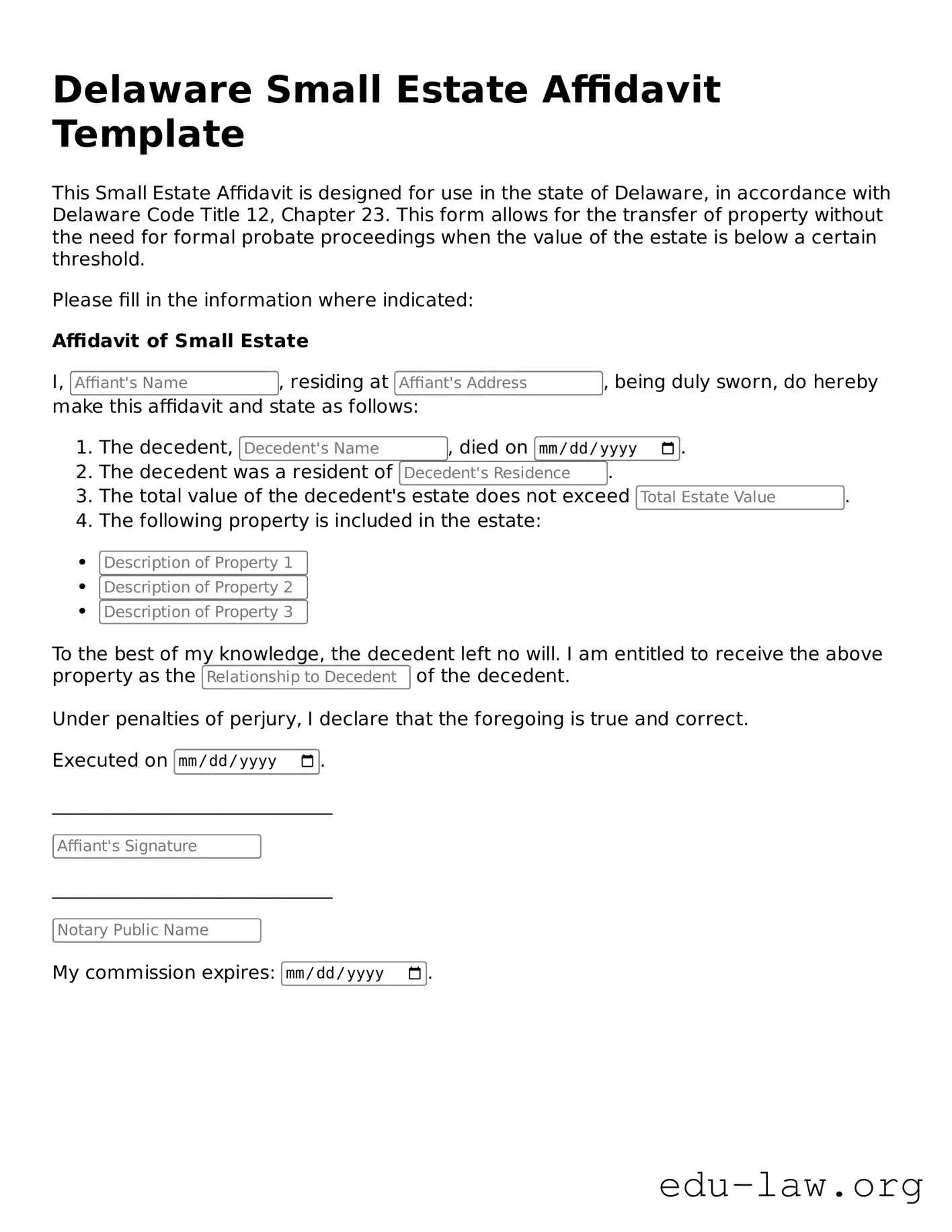
This Small Estate Affidavit is designed for use in the state of Delaware, in accordance with Delaware Code Title 12, Chapter 23. This form allows for the transfer of property without the need for formal probate proceedings when the value of the estate is below a certain threshold.
Please fill in the information where indicated:
Affidavit of Small Estate
I, , residing at , being duly sworn, do hereby make this affidavit and state as follows:
To the best of my knowledge, the decedent left no will. I am entitled to receive the above property as the of the decedent.
Under penalties of perjury, I declare that the foregoing is true and correct.
Executed on .
______________________________
______________________________
My commission expires: .
| Fact Name | Details |
|---|---|
| Eligibility | The Delaware Small Estate Affidavit can be used when the total value of the estate is $50,000 or less, excluding real estate. |
| Governing Law | This form is governed by Delaware Code Title 12, Chapter 39. |
| Purpose | The affidavit allows heirs to claim assets without going through formal probate proceedings. |
| Filing Requirements | The affidavit must be filed with the Register of Wills in the county where the deceased resided. |
| Signature Requirement | The affidavit must be signed by all heirs who are entitled to inherit from the estate. |
| Assets Included | It can be used for various types of assets, including bank accounts and personal property. |
| Time Limit | There is no specific time limit to file the affidavit, but it is advisable to do so promptly after the death. |
Once you have gathered the necessary information, you can proceed to fill out the Delaware Small Estate Affidavit form. This form is essential for claiming assets of a deceased person without going through the full probate process. Follow these steps carefully to ensure accuracy and compliance.
After submitting the form, keep a copy for your records. You may need to follow up with the court to confirm that the affidavit has been processed and to obtain any necessary documentation regarding the assets claimed.
What is a Delaware Small Estate Affidavit?
The Delaware Small Estate Affidavit is a legal document that allows individuals to settle the estate of a deceased person without going through the lengthy probate process. This form is applicable when the total value of the estate is below a certain threshold, which simplifies the distribution of assets to heirs or beneficiaries. By using this affidavit, heirs can claim property and assets directly, streamlining the process and reducing costs associated with probate court.
Who is eligible to use the Small Estate Affidavit in Delaware?
To qualify for the Small Estate Affidavit, the estate must meet specific criteria. The total value of the estate, excluding certain exempt assets, must be below $50,000 for individuals or $100,000 for married couples. Additionally, the affiant, or the person filing the affidavit, must be an heir or a beneficiary named in the will. If there is no will, the affiant should be a legal heir according to Delaware law. It’s important to ensure that all criteria are met to avoid complications in the process.
How do I complete and file the Small Estate Affidavit?
Completing the Small Estate Affidavit involves gathering necessary information about the deceased's assets and liabilities. The form requires details such as the deceased's name, date of death, and a list of assets. Once the affidavit is filled out, it must be signed in front of a notary public. After notarization, the affidavit can be filed with the appropriate county office, typically the Register of Wills. It’s advisable to keep copies of the filed affidavit for your records and to present to financial institutions or other entities holding the deceased’s assets.
What happens after I file the Small Estate Affidavit?
After filing the Small Estate Affidavit, the affiant can begin the process of collecting and distributing the deceased's assets. Financial institutions and other entities will typically require a copy of the affidavit to release funds or property to the affiant. It’s crucial to communicate with these institutions to ensure a smooth transfer. Additionally, any debts or obligations of the deceased should be addressed, as the affiant may be responsible for settling these before distributing assets to heirs. Following these steps will help ensure compliance with Delaware laws regarding small estates.
Failing to meet the eligibility requirements for using the Small Estate Affidavit. In Delaware, the total value of the estate must be less than $50,000 for personal property or $100,000 for real property.
Not providing accurate information about the deceased. This includes the full name, date of death, and last known address.
Omitting required signatures. The affidavit must be signed by the individual claiming the estate and may require additional signatures from other heirs or beneficiaries.
Neglecting to list all assets. All assets owned by the deceased must be accounted for, including bank accounts, vehicles, and real estate.
Incorrectly calculating the total value of the estate. Individuals should ensure that they accurately assess the value of each asset to avoid exceeding the limits.
Not including necessary supporting documentation. This may include a copy of the death certificate or any relevant legal documents that support the claim.
Failing to notify all interested parties. All heirs and beneficiaries must be informed of the filing of the affidavit, as required by Delaware law.
Submitting the form without reviewing it for errors. Mistakes in the affidavit can lead to delays or complications in the estate settlement process.
When dealing with the Delaware Small Estate Affidavit, there are several other forms and documents that may be necessary to ensure a smooth process. Each of these documents serves a specific purpose in managing the estate and fulfilling legal requirements. Below is a list of commonly used forms that accompany the Small Estate Affidavit.
Having these documents ready can streamline the process of settling an estate in Delaware. Each form plays a vital role in ensuring that the estate is managed according to legal standards and the wishes of the deceased.
The Delaware Small Estate Affidavit is similar to the Affidavit of Heirship, which is often used in probate cases. An Affidavit of Heirship serves to establish the rightful heirs of a deceased person's estate when there is no will. Like the Small Estate Affidavit, it simplifies the process of transferring assets by allowing heirs to assert their claim without going through lengthy probate proceedings. Both documents are sworn statements that require the signer to affirm the truth of the information provided, helping to expedite the distribution of assets to heirs.
Another document that shares similarities is the Will. A Will outlines how a person wishes their assets to be distributed after death. While the Small Estate Affidavit is used when the estate is below a certain value, a Will can be used for larger estates. However, both documents ultimately serve the same purpose of transferring ownership of assets. The key difference lies in the process: a Will typically requires probate, while the Small Estate Affidavit can facilitate a quicker transfer without court intervention.
The Letter of Administration is also comparable to the Small Estate Affidavit. This document is issued by the court to appoint an administrator to manage the estate of a deceased person when there is no Will. While the Small Estate Affidavit allows heirs to bypass the court process for small estates, a Letter of Administration is necessary for larger estates or when there are disputes among heirs. Both documents aim to provide a clear path for asset distribution, albeit through different legal mechanisms.
The Release of Estate Claim is another document that functions similarly. This release is often signed by heirs to relinquish their claim to certain assets in favor of another heir or beneficiary. Like the Small Estate Affidavit, it simplifies the process of asset transfer by formalizing the agreement among heirs. Both documents require the parties involved to affirm their understanding and agreement, thus helping to avoid future disputes over the estate.
The Affidavit of Support can also be likened to the Small Estate Affidavit, though it serves a different purpose. This document is commonly used in immigration cases to demonstrate that a sponsor can financially support an immigrant. However, both affidavits require a sworn statement and can expedite processes—one for asset distribution and the other for immigration. In both cases, the affiant must provide truthful information to avoid legal complications.
Lastly, the Power of Attorney (POA) can be compared to the Small Estate Affidavit, particularly in its function of allowing individuals to act on behalf of another. A POA grants someone the authority to manage financial or legal matters for another person, often used when that person is unable to do so themselves. Both documents empower individuals to make decisions regarding assets, though the Small Estate Affidavit specifically pertains to the distribution of an estate after death, while a POA is typically effective during a person’s lifetime.
When filling out the Delaware Small Estate Affidavit form, it's essential to follow specific guidelines to ensure accuracy and compliance. Below is a list of dos and don'ts to keep in mind:
Here are four common misconceptions about the Delaware Small Estate Affidavit form:
Many people believe that only estates below a certain value can use the Small Estate Affidavit. While there is a threshold, it is essential to understand that the limit may change. Always check the current laws to confirm eligibility.
Some think the Small Estate Affidavit applies solely to personal property. In reality, it can also address real estate, depending on the situation. Review the requirements carefully to determine what can be included.
People often confuse the Small Estate Affidavit process with probate. While both deal with transferring assets, the affidavit is a simpler, faster alternative that avoids the full probate process.
It’s a common misconception that anyone can submit a Small Estate Affidavit. Only certain individuals, typically the heirs or beneficiaries, have the legal right to file this form. Ensure you meet the criteria before proceeding.
Filling out the Delaware Small Estate Affidavit form can be a straightforward process if you understand the key elements involved. Here are some important takeaways to keep in mind:
Understanding these points can help ensure a smoother experience when dealing with a small estate in Delaware.