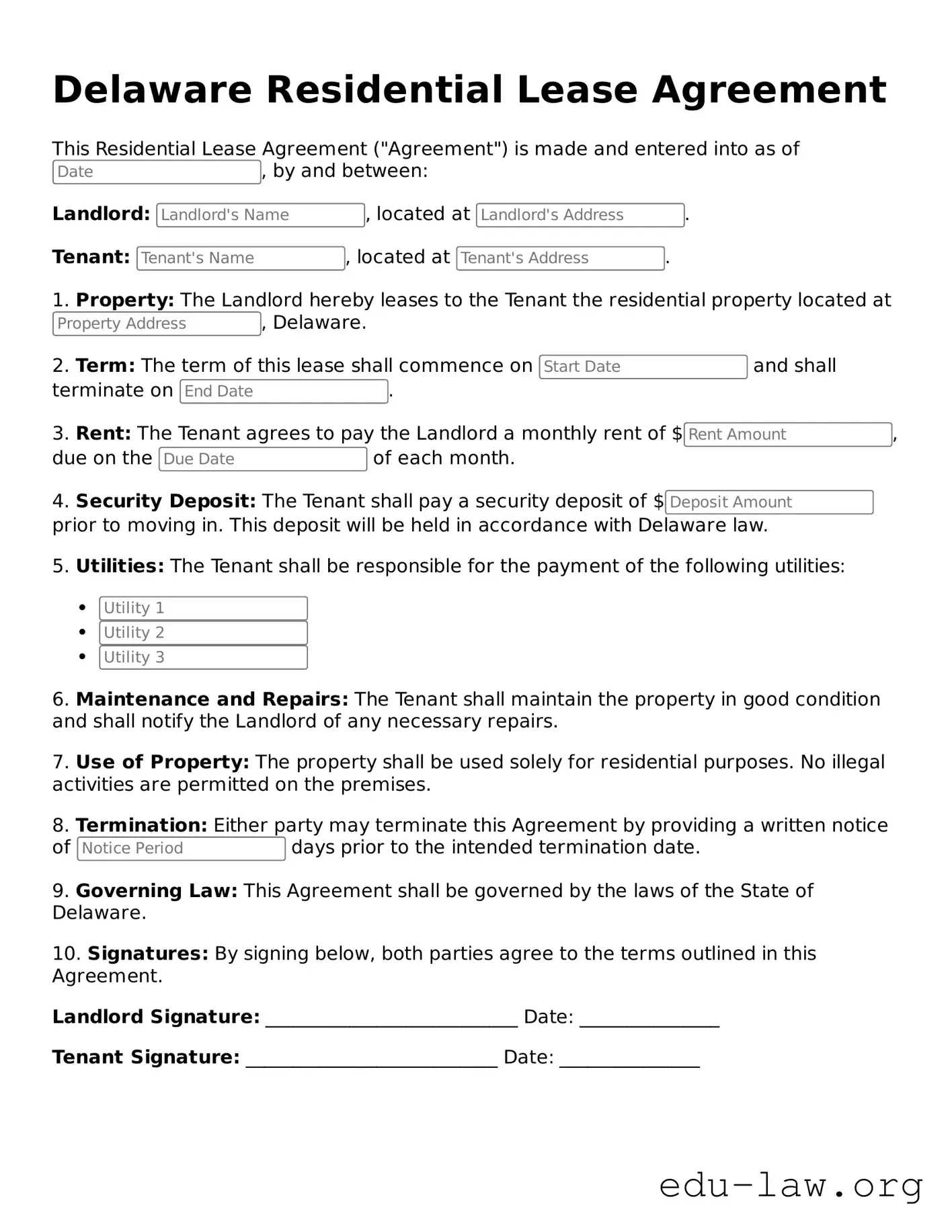
The Delaware Residential Lease Agreement is a crucial document that outlines the terms and conditions governing the rental of residential properties in the state. This form serves as a binding contract between landlords and tenants, detailing essential elements such as the duration of the lease, rental payment schedules, and security deposit requirements. It also specifies the responsibilities of both parties, including maintenance obligations and rules regarding property use. Additionally, the agreement addresses potential issues like late payment penalties and procedures for terminating the lease, ensuring that both landlords and tenants have a clear understanding of their rights and obligations. By utilizing this standardized form, individuals can foster transparency and mitigate disputes throughout the rental process, ultimately promoting a more harmonious landlord-tenant relationship.
Delaware Residential Lease Agreement
This Residential Lease Agreement ("Agreement") is made and entered into as of , by and between:
Landlord: , located at .
Tenant: , located at .
1. Property: The Landlord hereby leases to the Tenant the residential property located at , Delaware.
2. Term: The term of this lease shall commence on and shall terminate on .
3. Rent: The Tenant agrees to pay the Landlord a monthly rent of $, due on the of each month.
4. Security Deposit: The Tenant shall pay a security deposit of $ prior to moving in. This deposit will be held in accordance with Delaware law.
5. Utilities: The Tenant shall be responsible for the payment of the following utilities:
6. Maintenance and Repairs: The Tenant shall maintain the property in good condition and shall notify the Landlord of any necessary repairs.
7. Use of Property: The property shall be used solely for residential purposes. No illegal activities are permitted on the premises.
8. Termination: Either party may terminate this Agreement by providing a written notice of days prior to the intended termination date.
9. Governing Law: This Agreement shall be governed by the laws of the State of Delaware.
10. Signatures: By signing below, both parties agree to the terms outlined in this Agreement.
Landlord Signature: ___________________________ Date: _______________
Tenant Signature: ___________________________ Date: _______________
| Fact Name | Description |
|---|---|
| Governing Law | The Delaware Residential Lease Agreement is governed by the Delaware Code, Title 25, Chapter 5101 et seq. |
| Parties Involved | The agreement is between a landlord and a tenant, outlining their rights and responsibilities. |
| Lease Duration | The lease can be for a fixed term or a month-to-month arrangement, depending on the agreement between the parties. |
| Security Deposit | Delaware law allows landlords to collect a security deposit, typically not exceeding one month's rent. |
| Notice Requirements | Both parties must provide written notice for termination or renewal of the lease, as specified in the agreement. |
| Disclosures | Landlords must disclose certain information, such as lead paint hazards, to tenants before signing the lease. |
Filling out the Delaware Residential Lease Agreement form requires attention to detail and clarity. Each section of the form must be completed accurately to ensure that both the landlord and tenant understand their rights and responsibilities. Below are the steps to guide you through the process of filling out the form.
What is a Delaware Residential Lease Agreement?
A Delaware Residential Lease Agreement is a legally binding contract between a landlord and a tenant. It outlines the terms and conditions for renting residential property in Delaware. This agreement typically includes details such as the rental amount, duration of the lease, security deposit requirements, and responsibilities of both parties.
What should be included in the lease agreement?
The lease agreement should include essential information such as the names of the landlord and tenant, the address of the rental property, the lease term, the monthly rent amount, and the due date for rent payments. Additionally, it should specify any rules regarding pets, maintenance responsibilities, and procedures for terminating the lease.
How long does a typical lease last?
Residential leases in Delaware can vary in length. Common lease terms are one year, six months, or month-to-month. The duration should be clearly stated in the lease agreement. A longer lease often provides stability for both the tenant and the landlord, while a shorter lease may offer more flexibility.
Can a lease be terminated early?
Yes, a lease can be terminated early, but the process depends on the terms outlined in the agreement. Both parties must agree to the termination, or the tenant may need to provide a valid reason, such as a breach of contract by the landlord. It's important to review the lease for specific conditions related to early termination.
What is a security deposit, and how much can be charged?
A security deposit is a sum of money that the tenant pays to the landlord before moving in. It serves as protection for the landlord against potential damages or unpaid rent. In Delaware, the maximum security deposit cannot exceed one month's rent unless otherwise agreed upon. The lease should specify the amount and the conditions for its return.
What happens if the tenant fails to pay rent?
If a tenant fails to pay rent, the landlord has the right to take action as specified in the lease agreement. This may include charging late fees, issuing a notice to pay rent or quit, or starting eviction proceedings. It is crucial for both parties to understand their rights and obligations regarding rent payments.
Is the lease agreement legally binding?
Yes, once both the landlord and tenant sign the lease agreement, it becomes legally binding. This means that both parties are obligated to follow the terms outlined in the document. If either party fails to comply, the other party may seek legal remedies to enforce the agreement.
Not including all tenant names: It’s essential to list all tenants who will reside in the property. Omitting names can lead to confusion about who is responsible for the lease terms.
Incorrect rental amount: Ensure the monthly rent is accurately stated. Double-check the figures to avoid disputes later on.
Missing lease term: Clearly specify the duration of the lease. This includes the start and end dates. Leaving this blank can create uncertainty for both parties.
Ignoring maintenance responsibilities: Clearly outline who is responsible for maintenance and repairs. Not addressing this can lead to misunderstandings about obligations.
Not including security deposit details: State the amount of the security deposit and the conditions for its return. This helps avoid disputes when the lease ends.
Failure to comply with local laws: Ensure the lease agreement adheres to Delaware laws. Ignoring legal requirements can render the lease unenforceable.
When entering into a rental agreement in Delaware, several additional forms and documents may be necessary to ensure clarity and compliance. These documents help both landlords and tenants understand their rights and responsibilities, and they can facilitate a smoother rental experience.
Understanding these documents can enhance the rental process for both landlords and tenants. Each form serves a specific purpose, contributing to a more organized and transparent leasing experience.
The Commercial Lease Agreement is similar to the Delaware Residential Lease Agreement in that both documents outline the terms under which a property is rented. While the Residential Lease focuses on housing, the Commercial Lease pertains to business premises. Both agreements detail the responsibilities of the landlord and tenant, including rent payment, maintenance obligations, and the duration of the lease. The structure and purpose of these agreements are fundamentally alike, catering to the needs of both residential and commercial tenants.
The Rental Application form is another document related to the Delaware Residential Lease Agreement. This form is typically completed by potential tenants before signing a lease. It gathers essential information such as employment history, credit history, and references. Like the Residential Lease Agreement, the Rental Application aims to protect the landlord's interests by ensuring that tenants are reliable and financially capable of meeting their rental obligations.
The Lease Renewal Agreement is closely associated with the Residential Lease Agreement as it serves to extend the terms of an existing lease. When the original lease term expires, this document allows both parties to agree to new terms or continue under the same conditions. It ensures continuity for tenants while providing landlords with a straightforward method to retain good tenants without having to draft a new lease from scratch.
The Sublease Agreement is similar to the Residential Lease Agreement in that it governs the rental of a property, but it is specific to situations where a tenant rents out their leased property to another party. This document must align with the original lease terms and often requires the landlord’s consent. Both agreements include terms about rent, duration, and responsibilities, ensuring that all parties are clear about their rights and obligations.
The Month-to-Month Rental Agreement is another document that parallels the Residential Lease Agreement. This type of lease allows tenants to occupy a property on a monthly basis, rather than committing to a long-term lease. While it provides flexibility for tenants, it also includes terms regarding notice periods for termination, rent payments, and property maintenance, similar to those found in a standard Residential Lease Agreement.
The Move-In/Move-Out Checklist is a practical document related to the Residential Lease Agreement. It outlines the condition of the property at the time of the tenant's move-in and move-out. Both landlords and tenants use this checklist to document any existing damages or issues. This helps prevent disputes over security deposits and ensures that the property is returned in an acceptable condition, reflecting the responsibilities outlined in the Residential Lease Agreement.
The Security Deposit Agreement is another document that complements the Residential Lease Agreement. This agreement specifies the amount of the security deposit, the conditions under which it can be withheld, and the timeline for its return. Like the Residential Lease Agreement, it protects both the landlord’s and tenant’s interests by clearly defining the financial obligations related to the property.
The Eviction Notice is a legal document that relates to the Residential Lease Agreement by outlining the process for terminating a lease due to tenant violations. If a tenant fails to pay rent or breaches lease terms, the landlord can issue this notice. It serves as a formal communication that initiates the legal process, ensuring that both parties are aware of their rights and responsibilities under the lease.
The Tenant Rights and Responsibilities document is also similar to the Residential Lease Agreement. This document outlines the legal rights and obligations of tenants within a rental agreement. It provides essential information on what tenants can expect from their landlords and what is expected of them in return. Understanding these rights is crucial for tenants to navigate their lease agreements effectively.
Finally, the Property Management Agreement is akin to the Residential Lease Agreement in that it defines the relationship between property owners and management companies. This document details the responsibilities of the property manager in relation to the rental property, including tenant relations, maintenance, and rent collection. Both agreements serve to clarify roles and expectations, ensuring smooth operations for rental properties.
When filling out the Delaware Residential Lease Agreement form, it’s important to ensure accuracy and clarity. Here are some key points to keep in mind:
Following these guidelines can help ensure that your lease agreement is properly completed and legally sound. Always consider consulting a professional if you have questions or concerns.
Understanding the Delaware Residential Lease Agreement form is crucial for both landlords and tenants. However, several misconceptions often arise. Here’s a list of common misunderstandings:
Being aware of these misconceptions can help both landlords and tenants navigate their agreements more effectively and avoid potential disputes.
When filling out and using the Delaware Residential Lease Agreement form, there are several important points to keep in mind. Understanding these key aspects can help ensure a smooth rental experience for both landlords and tenants.
By paying attention to these elements, both landlords and tenants can create a comprehensive and effective lease agreement that protects their rights and responsibilities.