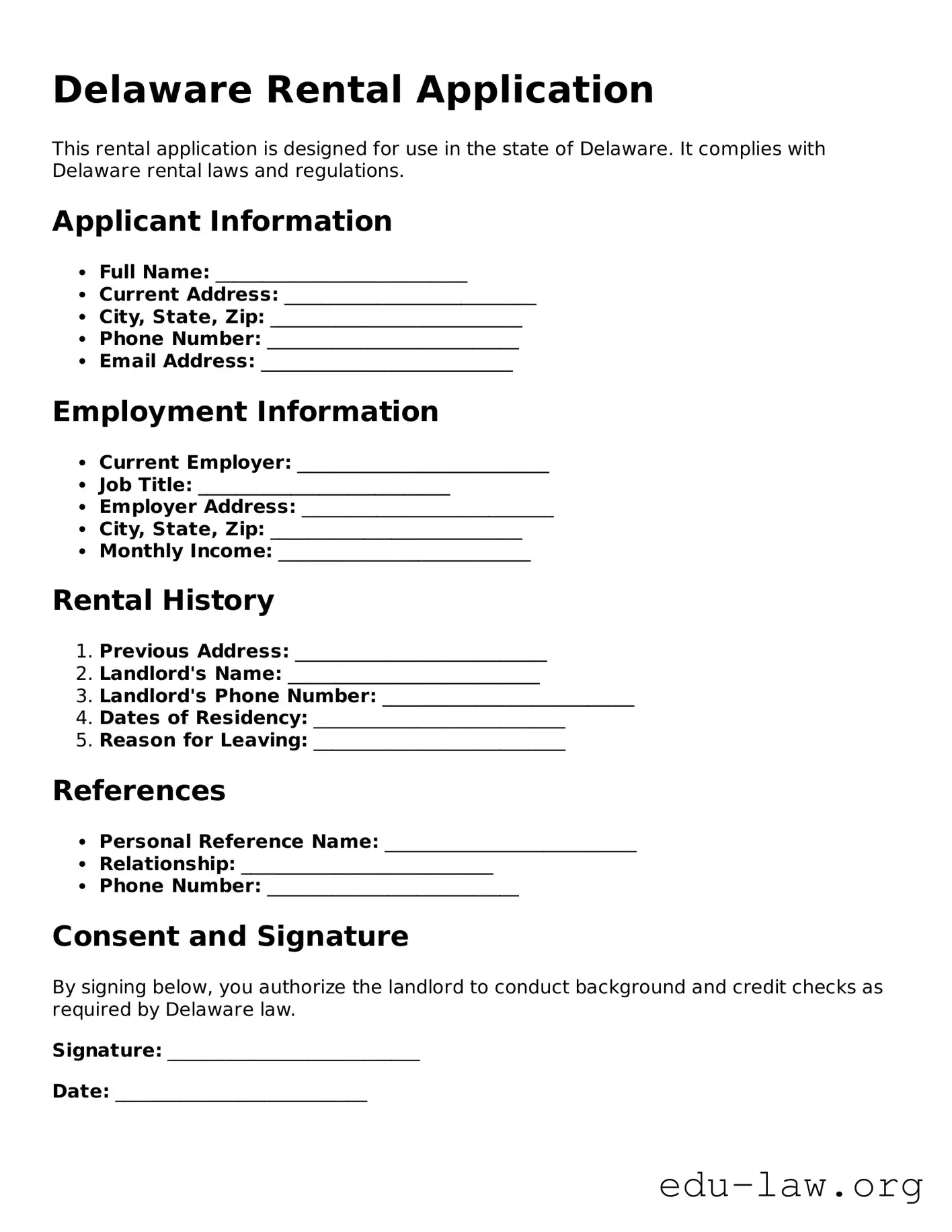
The Delaware Rental Application form serves as a crucial document in the rental process, facilitating the relationship between landlords and prospective tenants. This form typically collects essential information such as the applicant's personal details, employment history, and rental history. It may also require consent for background and credit checks, ensuring that landlords can make informed decisions. Additionally, the application often includes questions regarding income verification and references, which help assess the applicant's reliability and suitability as a tenant. By standardizing this information gathering, the form promotes transparency and fairness in the rental market. Understanding the nuances of the Delaware Rental Application is vital for both landlords and tenants, as it lays the groundwork for a successful rental agreement and fosters a positive living environment.
Delaware Rental Application
This rental application is designed for use in the state of Delaware. It complies with Delaware rental laws and regulations.
Applicant Information
Employment Information
Rental History
References
Consent and Signature
By signing below, you authorize the landlord to conduct background and credit checks as required by Delaware law.
Signature: ___________________________
Date: ___________________________
| Fact Name | Description |
|---|---|
| State-Specific Requirement | The Delaware Rental Application form is governed by Delaware law, specifically Title 25 of the Delaware Code, which outlines landlord-tenant relationships. |
| Application Fee | Landlords in Delaware may charge an application fee, but it must be reasonable and disclosed upfront to the applicant. |
| Disclosure of Information | Applicants are typically required to provide personal information, including employment history and references, to assist landlords in their decision-making process. |
| Fair Housing Compliance | The application process must comply with federal and state fair housing laws, ensuring that all applicants are treated fairly and without discrimination. |
| Right to Privacy | Delaware law protects the privacy of applicants; landlords must handle personal information with care and confidentiality. |
After obtaining the Delaware Rental Application form, you will need to provide specific information to complete it. This information is essential for the rental process. Follow these steps to fill out the form accurately.
What is the purpose of the Delaware Rental Application form?
The Delaware Rental Application form is designed to collect essential information from potential tenants. Landlords use this form to assess the suitability of applicants for renting their properties. It typically includes personal details, rental history, employment information, and references.
Who needs to fill out the Rental Application?
Anyone interested in renting a property in Delaware must complete the Rental Application. This includes individuals, couples, or groups applying for a rental unit. Each adult applicant usually needs to submit a separate application.
What information is typically required on the Rental Application?
The application generally requires personal information such as your full name, contact details, Social Security number, and date of birth. Additionally, you will need to provide your current address, rental history, employment details, and references. Some applications may also ask for financial information to evaluate your ability to pay rent.
Is there a fee associated with the Rental Application?
Many landlords charge an application fee to cover the cost of background checks and processing. This fee can vary, so it’s important to confirm the amount with the landlord or property management before submitting your application.
How long does it take to process a Rental Application?
The processing time for a Rental Application can vary widely. Typically, it may take anywhere from a few hours to several days. Factors influencing this timeline include the landlord's policies, the completeness of the application, and how quickly references can be contacted.
What happens if my Rental Application is denied?
If your application is denied, the landlord is generally required to provide a reason. This could be due to insufficient income, negative rental history, or poor credit. You have the right to request a copy of your credit report if it was a factor in the denial.
Can I appeal a Rental Application denial?
While there is no formal appeal process for a Rental Application denial, you can communicate with the landlord to discuss the decision. Providing additional documentation or clarifying misunderstandings may improve your chances if you wish to reapply in the future.
What should I do if my information changes after I submit the application?
If any information changes after you submit your application, it’s important to notify the landlord or property manager immediately. Changes in employment, income, or contact information can affect your application status and should be updated to ensure accuracy.
Is the information I provide on the Rental Application confidential?
Generally, the information you provide on the Rental Application is considered confidential and is used solely for the purpose of evaluating your application. However, it is advisable to confirm the landlord's privacy policy regarding how your information will be handled and stored.
Incomplete Personal Information: Many applicants forget to fill in all required fields, such as their full name, phone number, and email address. Missing this information can delay the process.
Incorrect Social Security Number: Some people accidentally enter the wrong Social Security Number. Double-checking this detail is crucial since it’s often used for background checks.
Failure to Disclose Income: Applicants sometimes neglect to provide accurate income details. It’s important to list all sources of income to give a complete picture of financial stability.
Omitting Rental History: Forgetting to include previous rental addresses can raise red flags. Providing a complete rental history helps landlords assess reliability.
Not Providing References: Some applicants skip the reference section. Including personal and professional references can strengthen an application.
Ignoring Background Check Consent: Failing to sign the consent for background checks can halt the application process. Always read and sign this section.
Inaccurate Employment Information: Listing outdated or incorrect employment details can lead to misunderstandings. Make sure to provide the most current job information.
Not Checking for Errors: Typos and mistakes can make a bad impression. Take a moment to review the application before submitting it.
Missing Application Fee: Some applicants forget to include the required application fee. Ensure this payment is made to avoid delays in processing.
When applying for a rental property in Delaware, several other forms and documents are commonly used alongside the Delaware Rental Application. These documents help landlords assess potential tenants and streamline the rental process.
Having these documents prepared can facilitate a smoother application process. It demonstrates readiness and transparency, which can be beneficial in a competitive rental market.
The Delaware Rental Application form shares similarities with the standard Lease Agreement. Both documents serve to establish a legal relationship between landlords and tenants. While the rental application focuses on gathering information about potential tenants, the lease agreement outlines the terms and conditions of the tenancy. Both require personal details, rental history, and financial information to ensure that the landlord can make informed decisions about who to rent to.
Another document that resembles the Delaware Rental Application is the Tenant Background Check Authorization form. This form is often used in conjunction with the rental application. It allows landlords to conduct background checks on applicants, ensuring they meet specific criteria. Both documents prioritize the landlord's need to assess the suitability of potential tenants, emphasizing the importance of trust and safety in rental agreements.
The Employment Verification form is similar to the rental application in that it seeks to confirm the applicant's financial stability. This document is often requested by landlords to verify income sources and employment status. Just like the rental application, it helps landlords assess whether a tenant can afford the rent, providing peace of mind for both parties involved.
The Credit Report Authorization form also parallels the Delaware Rental Application. This document allows landlords to obtain a credit report, which offers insights into an applicant's financial history. Both forms are crucial for evaluating a tenant's reliability and ability to pay rent on time, helping landlords make informed decisions based on financial responsibility.
The Rental History Verification form is another document that aligns with the rental application. This form seeks to confirm an applicant's previous rental experiences, including payment history and behavior as a tenant. Both documents aim to provide landlords with a comprehensive view of a potential tenant's past, ensuring they choose someone who is likely to be responsible and trustworthy.
Similar to the rental application is the Pet Application form, which is often required when a tenant has pets. This document collects information about the pet's breed, size, and behavior. Like the rental application, it helps landlords assess potential risks and determine if the applicant meets their pet policies, ensuring a harmonious living environment for all tenants.
The Guarantor Application form is another document that resembles the rental application. This form is used when a tenant requires a guarantor to co-sign the lease, often due to insufficient income or credit history. Both applications collect personal and financial information to evaluate the guarantor's ability to support the tenant, ensuring that rent will be paid even if the tenant faces financial difficulties.
The Move-In Checklist is similar to the rental application in that it documents the condition of the property before a tenant moves in. While the rental application focuses on the tenant's qualifications, the checklist ensures that both parties agree on the property's state. This helps prevent disputes over security deposits and property damage when the lease ends.
The Eviction Notice, while different in purpose, can also be seen as related to the rental application. If a tenant fails to meet the obligations outlined in the rental application, such as paying rent, the landlord may need to issue an eviction notice. Both documents are part of the rental process, highlighting the importance of fulfilling agreed-upon terms and responsibilities.
Lastly, the Move-Out Notice is similar to the rental application in that it signifies the end of the rental relationship. While the rental application initiates the process, the move-out notice formally concludes it. Both documents are essential for maintaining clear communication between landlords and tenants, ensuring that expectations are set and met throughout the rental period.
When filling out a rental application in Delaware, it’s essential to approach the process with care. Here are some important dos and don'ts to keep in mind:
By following these guidelines, you can enhance your chances of securing a rental property while also ensuring a smooth application process.
Many people have misconceptions about the Delaware Rental Application form. Understanding these can help potential renters navigate the process more smoothly. Here are six common misconceptions:
Being aware of these misconceptions can help you approach the rental application process with confidence. Always ask questions if you are unsure about any part of the application.
When filling out and using the Delaware Rental Application form, there are several important points to keep in mind. Here are some key takeaways:
By keeping these takeaways in mind, you can improve your chances of securing a rental in Delaware.