When navigating the complexities of real estate transactions in Delaware, understanding the Quitclaim Deed form becomes essential. This particular document serves as a legal instrument that allows one party, known as the grantor, to transfer their interest in a property to another party, referred to as the grantee, without making any guarantees about the title's validity. Unlike other types of deeds, such as warranty deeds, a Quitclaim Deed offers no assurances regarding the presence of liens or other encumbrances on the property. This form is often utilized in various situations, including transferring property between family members, settling estates, or clarifying ownership interests. It is crucial for individuals to recognize that while the Quitclaim Deed is a straightforward way to convey property rights, it does not provide the same level of protection as other deed types. As a result, understanding the implications of using this form can help parties make informed decisions about their real estate dealings.
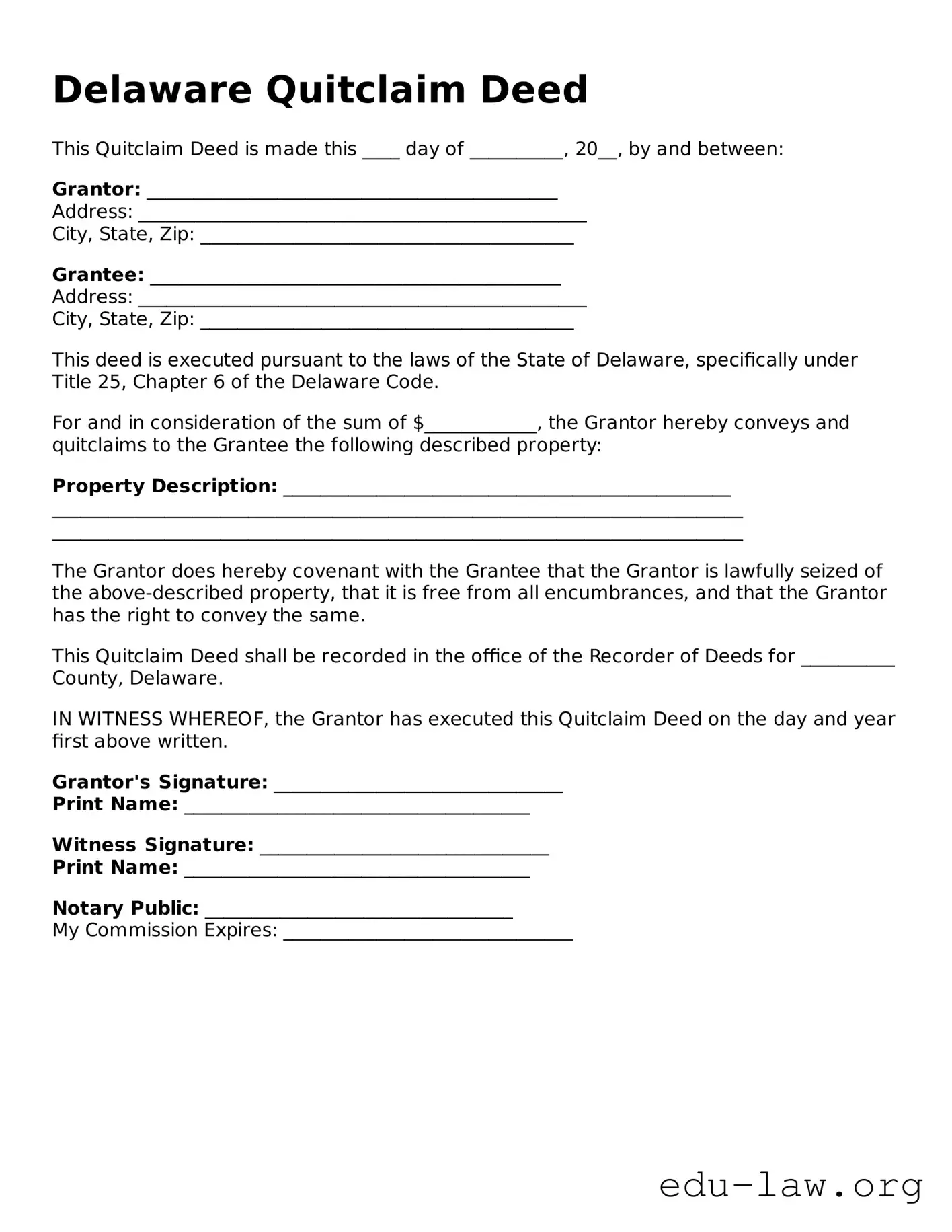
Delaware Quitclaim Deed
This Quitclaim Deed is made this ____ day of __________, 20__, by and between:
Grantor: ____________________________________________
Address: ________________________________________________
City, State, Zip: ________________________________________
Grantee: ____________________________________________
Address: ________________________________________________
City, State, Zip: ________________________________________
This deed is executed pursuant to the laws of the State of Delaware, specifically under Title 25, Chapter 6 of the Delaware Code.
For and in consideration of the sum of $____________, the Grantor hereby conveys and quitclaims to the Grantee the following described property:
Property Description: ________________________________________________
__________________________________________________________________________
__________________________________________________________________________
The Grantor does hereby covenant with the Grantee that the Grantor is lawfully seized of the above-described property, that it is free from all encumbrances, and that the Grantor has the right to convey the same.
This Quitclaim Deed shall be recorded in the office of the Recorder of Deeds for __________ County, Delaware.
IN WITNESS WHEREOF, the Grantor has executed this Quitclaim Deed on the day and year first above written.
Grantor's Signature: _______________________________
Print Name: _____________________________________
Witness Signature: _______________________________
Print Name: _____________________________________
Notary Public: _________________________________
My Commission Expires: _______________________________
| Fact Name | Description |
|---|---|
| Definition | A Delaware Quitclaim Deed is a legal document used to transfer ownership of real property without any warranties regarding the title. |
| Governing Law | This deed is governed by the Delaware Code, Title 25, Chapter 5001-5003. |
| Parties Involved | The form involves two main parties: the grantor (seller) and the grantee (buyer). |
| Consideration | While a monetary consideration is typically included, it is not required for the deed to be valid. |
| Recording | The deed must be recorded in the appropriate county office to provide public notice of the property transfer. |
| Signature Requirement | The grantor must sign the deed in the presence of a notary public for it to be legally binding. |
| Use Cases | Commonly used for transferring property between family members, divorces, or clearing up title issues. |
| Limitations | Because it offers no warranties, the grantee assumes the risk of any title defects or claims against the property. |
After you have gathered the necessary information, you are ready to fill out the Delaware Quitclaim Deed form. This document will require specific details about the property and the parties involved. Follow the steps below to ensure that you complete the form correctly.
What is a Delaware Quitclaim Deed?
A Delaware Quitclaim Deed is a legal document used to transfer ownership of real estate from one party to another without guaranteeing the title. This type of deed is often used in situations where the grantor (the person transferring the property) may not have a clear title or when the parties involved have a personal relationship, such as family members. It is important to note that a Quitclaim Deed does not provide any warranties or protections regarding the property’s title.
When should I use a Quitclaim Deed in Delaware?
You may consider using a Quitclaim Deed in several scenarios. Common situations include transferring property between family members, clearing up title issues, or during divorce settlements. If you are uncertain about the property’s title or if the transfer is informal, a Quitclaim Deed can be a suitable option. However, it is advisable to consult with a legal professional to ensure this method aligns with your specific needs.
How do I complete a Quitclaim Deed in Delaware?
To complete a Quitclaim Deed in Delaware, you need to gather the necessary information, including the names of the grantor and grantee, a legal description of the property, and the date of the transfer. You will then fill out the form, ensuring that all details are accurate. After signing the document in the presence of a notary public, you must file it with the appropriate county recorder’s office to make the transfer official.
Are there any fees associated with filing a Quitclaim Deed in Delaware?
Yes, there are typically fees associated with filing a Quitclaim Deed in Delaware. These fees can vary by county and may include recording fees and transfer taxes. It is essential to check with your local recorder’s office for the specific costs involved. Budgeting for these fees in advance will help avoid any surprises during the filing process.
Is a Quitclaim Deed the same as a Warranty Deed?
No, a Quitclaim Deed is not the same as a Warranty Deed. While a Quitclaim Deed transfers whatever interest the grantor has in the property without any guarantees, a Warranty Deed provides assurances that the title is clear and free of encumbrances. If you require protection against potential claims on the property, a Warranty Deed may be more appropriate. Understanding the differences can help you choose the right type of deed for your situation.
Can I revoke a Quitclaim Deed in Delaware?
Revoking a Quitclaim Deed is not straightforward. Once a Quitclaim Deed is executed and recorded, it typically cannot be undone unilaterally. However, the grantor and grantee may mutually agree to reverse the transaction by executing another deed. It is crucial to seek legal advice if you are considering revocation, as specific procedures must be followed to ensure compliance with Delaware law.
Not including the grantor and grantee names correctly. It's essential to ensure that the names are spelled accurately and match the official identification.
Failing to provide a proper legal description of the property. This description should be precise and may require referencing the property's deed or survey.
Not signing the deed. Both the grantor and grantee must sign the document for it to be valid.
Overlooking the need for witnesses. Depending on the situation, some states require the presence of witnesses during the signing.
Neglecting to have the deed notarized. A notary public must verify the identities of the parties involved and witness the signing.
Using outdated forms. Always ensure you are using the most current version of the Quitclaim Deed form.
Leaving out the date of the transfer. This date is crucial for establishing the timeline of ownership.
Not checking for any liens or encumbrances on the property. Before transferring ownership, it’s important to understand any existing claims against the property.
Filling out the form without consulting a professional. While it's possible to complete the form independently, seeking legal advice can help avoid mistakes.
Not recording the deed with the appropriate county office. After completing the form, it must be filed to ensure that the transfer is legally recognized.
The Delaware Quitclaim Deed is a legal document that transfers ownership of real property from one party to another without any warranties or guarantees. In addition to the Quitclaim Deed, there are several other forms and documents that are often used in conjunction with it to ensure a smooth property transfer process. Below is a list of five commonly associated documents.
These documents play a vital role in the property transfer process, ensuring that all legal requirements are met and that both parties are protected. Proper preparation and understanding of these forms can facilitate a successful transaction.
The Warranty Deed is similar to the Quitclaim Deed in that both are used to transfer property ownership. However, a Warranty Deed provides a guarantee that the grantor holds clear title to the property and has the right to sell it. In contrast, the Quitclaim Deed offers no such guarantees. It merely transfers whatever interest the grantor may have in the property, if any. This difference makes Warranty Deeds more secure for buyers, while Quitclaim Deeds are often used in less formal transactions or between parties who trust each other.
The Bargain and Sale Deed is another document akin to the Quitclaim Deed. Like the Quitclaim Deed, it transfers property ownership without warranties. However, the Bargain and Sale Deed implies that the grantor has some interest in the property, even if it does not guarantee clear title. This type of deed is often used in foreclosures or tax sales, where the seller may not have full knowledge of the property’s title status.
The Grant Deed shares similarities with the Quitclaim Deed in that it also transfers ownership of property. However, the Grant Deed provides some assurances to the buyer. It guarantees that the property has not been sold to anyone else and that the seller has not encumbered the property with any undisclosed liens. While both documents facilitate the transfer of property, the Grant Deed offers more protection for the buyer compared to a Quitclaim Deed.
The Special Warranty Deed is another document that resembles the Quitclaim Deed. This deed transfers property ownership but only warrants against defects that arose during the grantor's ownership. Unlike the Quitclaim Deed, which offers no warranties, the Special Warranty Deed provides some level of protection to the buyer, making it a more secure option for property transfers.
The Deed of Trust serves a different purpose but is similar in its role as a property document. It is used to secure a loan with real estate as collateral. While it does not transfer ownership like a Quitclaim Deed, it involves the property in a legal agreement. The Quitclaim Deed, in contrast, focuses solely on transferring ownership without any financial implications.
The Life Estate Deed is comparable in that it transfers property rights, but it does so with specific conditions. A Life Estate Deed allows the grantor to retain certain rights to the property during their lifetime, while transferring ownership to another party upon their death. This differs from the Quitclaim Deed, which transfers full ownership immediately without any conditions.
Finally, the Affidavit of Heirship is similar in that it deals with property ownership, but it is used to establish the heirs of a deceased individual. While a Quitclaim Deed transfers ownership outright, the Affidavit of Heirship helps clarify who is entitled to inherit the property. This document is often used when there is no will, and it can facilitate the transfer of property to heirs without the need for probate.
When filling out the Delaware Quitclaim Deed form, it is important to follow certain guidelines to ensure accuracy and compliance. Here are five things you should and shouldn't do:
By following these guidelines, you can help ensure that your Delaware Quitclaim Deed is filled out correctly and processed smoothly.
When it comes to the Delaware Quitclaim Deed form, several misconceptions often arise. Understanding these can help clarify its purpose and use.
Many believe that a Quitclaim Deed guarantees full ownership transfer. However, it only transfers the interest the grantor has in the property, if any. If the grantor has no legal claim, the recipient receives nothing.
While it's common to use Quitclaim Deeds among family members, they can be used in various situations. They are useful for clearing up title issues, transferring property to a trust, or even in divorce settlements.
This is a significant misunderstanding. A warranty deed provides guarantees about the title, ensuring the buyer is protected against any claims. A Quitclaim Deed offers no such protections, making it a riskier option for buyers.
Some people think that recording the Quitclaim Deed is unnecessary. However, recording it with the county is crucial. It provides public notice of the ownership change and protects the new owner’s rights.
Filling out and using a Delaware Quitclaim Deed form can be straightforward if you follow these key takeaways: