In the realm of financial agreements, the Delaware Promissory Note form serves as a vital tool for individuals and businesses alike, facilitating the borrowing and lending process. This document outlines the terms under which one party, the borrower, agrees to repay a specified sum of money to another party, the lender, within a defined timeframe. Key elements of the form include the principal amount, interest rate, repayment schedule, and any applicable late fees or penalties. Additionally, it often specifies the consequences of default, ensuring that both parties are aware of their rights and obligations. The clarity provided by this form can help prevent misunderstandings and disputes, fostering a sense of security for both lenders and borrowers. By adhering to the guidelines set forth in the Delaware Promissory Note, individuals can navigate the complexities of financial transactions with greater confidence and peace of mind.
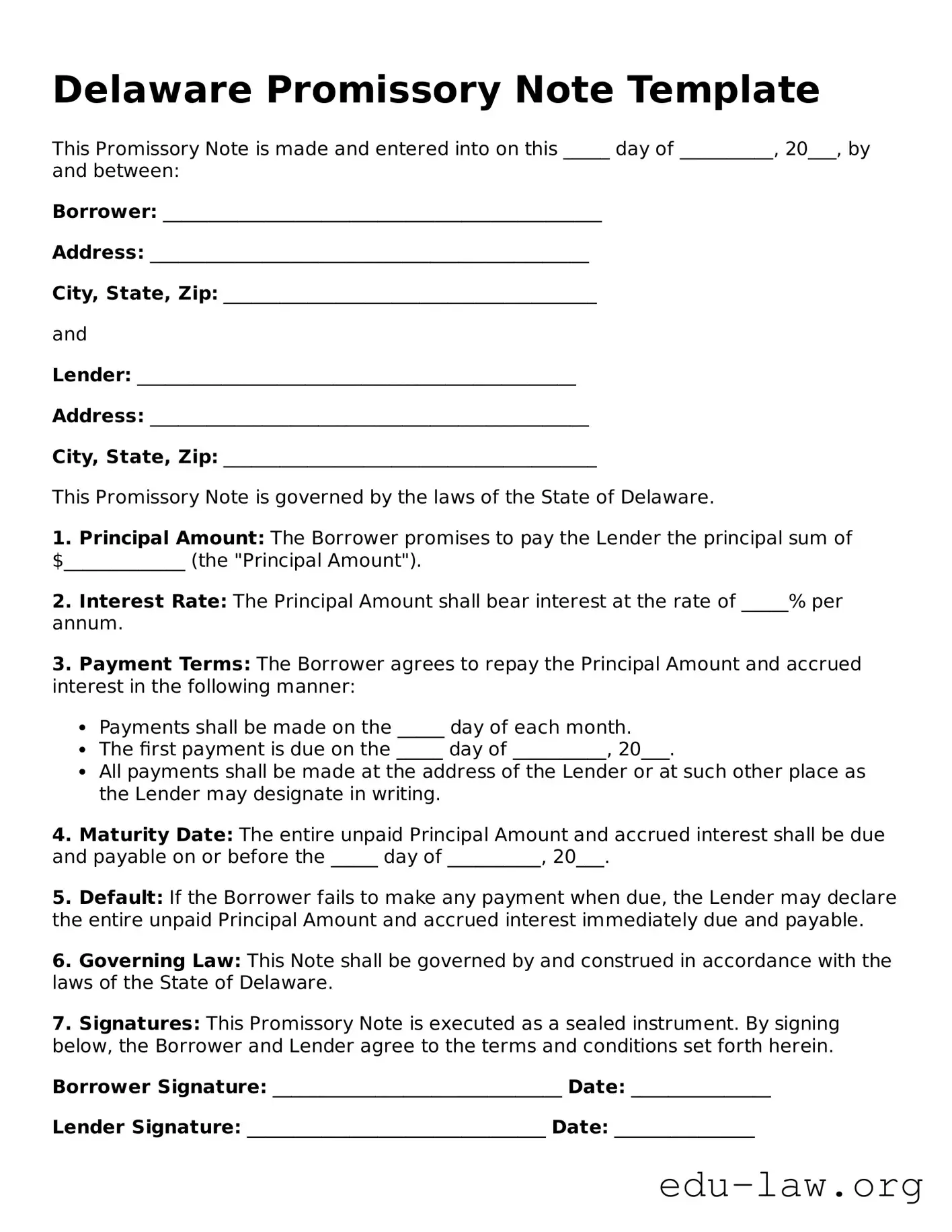
Delaware Promissory Note Template
This Promissory Note is made and entered into on this _____ day of __________, 20___, by and between:
Borrower: _______________________________________________
Address: _______________________________________________
City, State, Zip: ________________________________________
and
Lender: _______________________________________________
Address: _______________________________________________
City, State, Zip: ________________________________________
This Promissory Note is governed by the laws of the State of Delaware.
1. Principal Amount: The Borrower promises to pay the Lender the principal sum of $_____________ (the "Principal Amount").
2. Interest Rate: The Principal Amount shall bear interest at the rate of _____% per annum.
3. Payment Terms: The Borrower agrees to repay the Principal Amount and accrued interest in the following manner:
4. Maturity Date: The entire unpaid Principal Amount and accrued interest shall be due and payable on or before the _____ day of __________, 20___.
5. Default: If the Borrower fails to make any payment when due, the Lender may declare the entire unpaid Principal Amount and accrued interest immediately due and payable.
6. Governing Law: This Note shall be governed by and construed in accordance with the laws of the State of Delaware.
7. Signatures: This Promissory Note is executed as a sealed instrument. By signing below, the Borrower and Lender agree to the terms and conditions set forth herein.
Borrower Signature: _______________________________ Date: _______________
Lender Signature: ________________________________ Date: _______________
| Fact Name | Description |
|---|---|
| Definition | A Delaware Promissory Note is a written promise to pay a specified amount of money to a designated person or entity at a defined time. |
| Governing Law | The Delaware Promissory Note is governed by Delaware state law, specifically the Delaware Uniform Commercial Code. |
| Parties Involved | Typically, there are two parties involved: the borrower (maker) and the lender (payee). |
| Interest Rate | The interest rate can be fixed or variable, depending on the agreement between the parties. |
| Payment Terms | Payment terms outline when and how payments will be made, including any grace periods. |
| Default Conditions | The note should specify what constitutes a default and the remedies available to the lender. |
| Signatures | Both parties must sign the note for it to be legally binding. |
| Notarization | While notarization is not required, it can provide additional legal protection and verification. |
| Use Cases | Commonly used for personal loans, business financing, and real estate transactions. |
Once you have the Delaware Promissory Note form in hand, it’s time to fill it out carefully. Each section requires specific information to ensure clarity and enforceability. Follow the steps below to complete the form accurately.
After completing the form, review it for accuracy. Both parties should keep a signed copy for their records. This ensures that everyone is clear on the terms agreed upon.
What is a Delaware Promissory Note?
A Delaware Promissory Note is a legal document that outlines a borrower's promise to repay a specified amount of money to a lender under agreed-upon terms. It serves as a written record of the debt and can include details such as the interest rate, repayment schedule, and any collateral involved. This document is crucial for both parties as it provides clarity and security in the lending arrangement.
Who can use a Delaware Promissory Note?
Individuals, businesses, and organizations can all utilize a Delaware Promissory Note. Whether you are lending money to a friend, financing a business venture, or formalizing a loan between companies, this document can help establish clear terms and protect the interests of both parties involved.
What are the key components of a Delaware Promissory Note?
Typically, a Delaware Promissory Note includes several essential components: the names and addresses of the borrower and lender, the principal amount of the loan, the interest rate, the repayment schedule, and any late fees or penalties. Additionally, it may outline conditions for default and the governing law, which in this case would be Delaware law.
Is a Delaware Promissory Note legally binding?
Yes, a properly executed Delaware Promissory Note is legally binding. This means that if either party fails to adhere to the terms outlined in the note, the other party has the right to seek legal remedies. It is important that both parties understand their obligations and rights under the agreement to ensure enforceability.
Do I need a lawyer to create a Delaware Promissory Note?
While it is not legally required to have a lawyer draft a Delaware Promissory Note, consulting with one can be beneficial. A legal professional can help ensure that the document meets all legal requirements and adequately protects your interests. For straightforward loans, many individuals choose to use templates or online resources to create their notes.
Can a Delaware Promissory Note be modified after it is signed?
Yes, a Delaware Promissory Note can be modified, but both parties must agree to the changes. This usually involves drafting an amendment to the original note, which should be signed by both the borrower and the lender. It is crucial to document any modifications to avoid misunderstandings in the future.
What happens if the borrower defaults on the loan?
If the borrower defaults, meaning they fail to make payments as agreed, the lender has several options. They may pursue legal action to recover the owed amount, which could include filing a lawsuit. The terms of the Promissory Note often specify the lender's rights in the event of default, so it is important to review those provisions carefully.
Can a Delaware Promissory Note be used for business loans?
Absolutely! A Delaware Promissory Note is commonly used for business loans. It can help formalize the terms of the loan between a business and its lenders, whether those lenders are individuals or financial institutions. This formalization helps protect both the lender's investment and the borrower's business interests.
How do I ensure my Delaware Promissory Note is enforceable?
To ensure that your Delaware Promissory Note is enforceable, make sure it is clear, concise, and includes all necessary details. Both parties should sign the document, and it is advisable to have it witnessed or notarized. Keeping a copy of the signed note in a safe place is also important for future reference.
Failing to include the date of the agreement. This detail is crucial for establishing the timeline of the loan.
Not specifying the borrower's name accurately. Ensure that the full legal name is used to avoid confusion.
Omitting the lender's information. Just like the borrower, the lender's full name and contact details must be included.
Forgetting to state the loan amount clearly. This should be written in both numeric and word form to prevent disputes.
Neglecting to outline the interest rate. If applicable, this should be clearly defined to avoid misunderstandings later.
Not including the payment schedule. Specify when payments are due and the method of payment to ensure clarity.
Failing to address default terms. Clearly outline what happens if the borrower fails to make payments as agreed.
Not having the document witnessed or notarized. This step can add an extra layer of validity to the agreement.
Ignoring the importance of keeping copies of the signed document. Both parties should retain a copy for their records.
The Delaware Promissory Note is a crucial document for establishing a loan agreement between a lender and a borrower. However, it is often accompanied by several other forms and documents that help clarify the terms of the agreement and protect the interests of both parties. Below is a list of commonly used documents that may accompany the Delaware Promissory Note.
Understanding these additional documents can enhance the clarity of the loan process and ensure that both parties are protected. It is advisable to review each document carefully and consult with a professional if needed to ensure compliance with all applicable laws and regulations.
A promissory note is a financial instrument that reflects a promise to pay a specified amount of money at a designated time. Similar to the Delaware Promissory Note, a personal loan agreement serves as a written contract between a borrower and a lender. This document outlines the terms of the loan, including the principal amount, interest rate, repayment schedule, and any collateral involved. Both documents establish the legal obligations of the parties involved, ensuring that the lender has recourse if the borrower defaults.
A business loan agreement also shares similarities with the Delaware Promissory Note. This document is specifically tailored for business transactions, detailing the terms under which a lender provides funds to a business entity. Like a promissory note, it includes the loan amount, interest rate, repayment terms, and conditions for default. However, it may also contain additional clauses relevant to business operations, such as covenants that the borrower must adhere to throughout the loan period.
An IOU, or "I owe you," is another document akin to a promissory note. While an IOU is generally less formal and may not include detailed terms, it still serves as a written acknowledgment of a debt. Both documents signify a borrower's obligation to repay a specified amount, but an IOU may lack the structured repayment plan and interest terms that a promissory note typically includes.
A loan modification agreement is similar in that it alters the terms of an existing promissory note. This document is used when a borrower and lender agree to change aspects of the original loan, such as the interest rate or repayment schedule. Like a promissory note, it must be signed by both parties and serves to clarify the new terms of the agreement, ensuring that both parties understand their updated obligations.
A secured promissory note is another variation that involves collateral. This document not only outlines the borrower's promise to repay a loan but also specifies the assets that secure the loan. In this way, it is similar to the Delaware Promissory Note, as both establish a clear obligation to repay. However, the secured promissory note provides additional protection for the lender, as they have a claim on the collateral in the event of default.
A demand note is a type of promissory note that allows the lender to request repayment at any time. This document differs from a standard promissory note in that it does not have a fixed repayment schedule. However, both documents require the borrower to repay a specified amount and outline the terms of the loan, making them similar in purpose but distinct in flexibility.
A student loan agreement shares similarities with a promissory note, particularly in its structure and purpose. This document outlines the terms under which a borrower can access funds for educational expenses. Like a promissory note, it includes the loan amount, interest rate, and repayment terms. However, student loan agreements often include provisions for deferment or forgiveness, reflecting the unique nature of educational financing.
A credit agreement is another document that resembles a promissory note. This agreement outlines the terms of a line of credit extended to a borrower. It details the maximum amount available for borrowing, interest rates, and repayment terms. While a promissory note typically involves a single loan, a credit agreement can encompass multiple transactions, allowing for more flexible borrowing options.
Finally, a lease agreement can be compared to a promissory note in that both documents create financial obligations. A lease outlines the terms under which a tenant agrees to pay rent for a property. While it is not a loan, it establishes a similar obligation to make payments over time. Both documents require clear terms and conditions to protect the interests of the parties involved, ensuring that each party understands their responsibilities.
When filling out a Delaware Promissory Note form, it’s essential to approach the task with care. Here’s a list of things you should and shouldn’t do to ensure the document is accurate and legally binding.
By following these guidelines, you can create a Promissory Note that serves its purpose and protects the interests of both parties involved.
Understanding the Delaware Promissory Note form is essential for individuals and businesses engaging in lending agreements. However, several misconceptions exist that can lead to confusion. Below is a list of common misconceptions along with clarifications.
Recognizing these misconceptions can help individuals and businesses navigate the complexities of promissory notes more effectively. Understanding the true nature of these documents is vital for making informed financial decisions.
When dealing with a Delaware Promissory Note, understanding its key components can make the process smoother. Here are some essential takeaways:
By following these key points, you can ensure that your Delaware Promissory Note is properly filled out and utilized effectively.