When planning for a future together, couples often overlook the importance of a prenuptial agreement. In Delaware, this legal document serves as a proactive measure to outline each partner's rights and responsibilities in the event of a divorce or separation. The Delaware Prenuptial Agreement form is designed to address key aspects such as the division of property, spousal support, and the handling of debts. By clearly defining these elements before marriage, couples can minimize misunderstandings and conflicts down the line. This form not only protects individual assets but also fosters open communication about financial matters, which is essential for a healthy relationship. Furthermore, the agreement must be executed with certain formalities, ensuring that both parties fully understand and voluntarily consent to its terms. As you navigate this important step, it's crucial to consider how a well-structured prenuptial agreement can provide peace of mind and clarity for your future together.
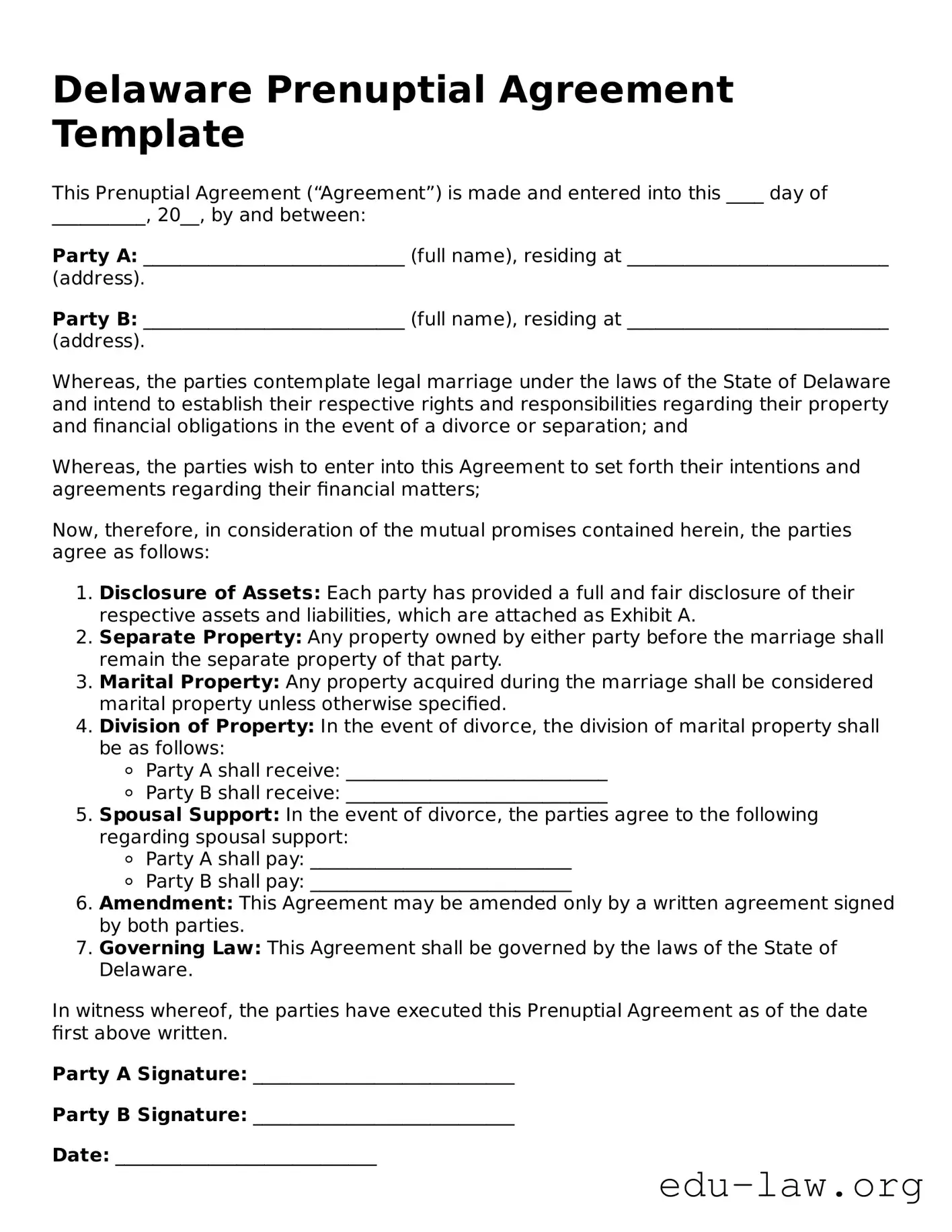
Delaware Prenuptial Agreement Template
This Prenuptial Agreement (“Agreement”) is made and entered into this ____ day of __________, 20__, by and between:
Party A: ____________________________ (full name), residing at ____________________________ (address).
Party B: ____________________________ (full name), residing at ____________________________ (address).
Whereas, the parties contemplate legal marriage under the laws of the State of Delaware and intend to establish their respective rights and responsibilities regarding their property and financial obligations in the event of a divorce or separation; and
Whereas, the parties wish to enter into this Agreement to set forth their intentions and agreements regarding their financial matters;
Now, therefore, in consideration of the mutual promises contained herein, the parties agree as follows:
In witness whereof, the parties have executed this Prenuptial Agreement as of the date first above written.
Party A Signature: ____________________________
Party B Signature: ____________________________
Date: ____________________________
| Fact Name | Description |
|---|---|
| Governing Law | The Delaware Prenuptial Agreement is governed by Delaware law, specifically under Title 13 of the Delaware Code. |
| Definition | A prenuptial agreement is a contract entered into by two individuals before marriage that outlines the distribution of assets and responsibilities in the event of divorce or separation. |
| Enforceability | For a prenuptial agreement to be enforceable in Delaware, it must be in writing and signed by both parties. |
| Full Disclosure | Delaware courts typically require both parties to fully disclose their financial situations for the agreement to be valid. |
| Legal Representation | While not mandatory, it is highly recommended that both parties seek independent legal advice before signing a prenuptial agreement to ensure fairness and understanding. |
Completing the Delaware Prenuptial Agreement form is an important step for couples looking to clarify their financial rights and responsibilities before marriage. By following these steps, you can ensure that all necessary information is accurately provided.
After completing these steps, you will have a comprehensive prenuptial agreement that reflects your mutual understanding and intentions. It is advisable to keep copies of the signed document in a safe place and to revisit the agreement periodically, especially if your circumstances change.
What is a prenuptial agreement in Delaware?
A prenuptial agreement, often called a prenup, is a legal document that couples create before getting married. It outlines how assets and debts will be divided in the event of a divorce or separation. In Delaware, this agreement can help clarify financial responsibilities and protect individual interests.
Why should I consider a prenuptial agreement?
There are several reasons to consider a prenup. If one partner has significantly more assets, a prenup can protect those assets. It can also be beneficial for couples with children from previous relationships, ensuring that their assets are passed on according to their wishes. Additionally, a prenup can reduce conflict and uncertainty in the event of a divorce.
How do I create a prenuptial agreement in Delaware?
To create a prenup in Delaware, both parties should discuss their financial situations and what they want the agreement to cover. It’s advisable to consult with a lawyer who specializes in family law to ensure that the agreement is legally sound and fair. Both parties must sign the agreement voluntarily, and it should be completed well before the wedding to avoid any claims of coercion.
What should be included in a Delaware prenuptial agreement?
A prenup can include various provisions, such as how to divide property, how to handle debts, and what happens to assets acquired during the marriage. It can also address spousal support or alimony. However, it cannot include terms that violate public policy, such as child custody arrangements or child support obligations.
Is a prenuptial agreement enforceable in Delaware?
Yes, a prenuptial agreement can be enforceable in Delaware as long as it meets certain legal requirements. These include being in writing, signed by both parties, and made voluntarily without any coercion. It’s also essential that both parties fully disclose their financial situations before signing the agreement.
Can a prenuptial agreement be changed after marriage?
Yes, a prenuptial agreement can be modified or revoked after marriage. Both parties must agree to the changes, and it’s recommended to document any modifications in writing and have them signed by both parties. This ensures clarity and helps avoid disputes in the future.
What happens if we don’t have a prenuptial agreement?
If a couple does not have a prenup and later decides to divorce, Delaware’s laws will govern the division of assets and debts. This may not align with the couple's wishes, potentially leading to disputes and complications during the divorce process. Having a prenup can provide peace of mind and clarity in these situations.
Can I get a prenup if I’m already married?
While prenuptial agreements are intended for couples before marriage, married couples can create a postnuptial agreement. This document serves a similar purpose as a prenup, outlining how assets and debts will be handled in the event of a divorce or separation. Like a prenup, a postnup must be in writing and signed by both parties to be enforceable.
Do I need a lawyer for a prenuptial agreement?
While it’s not legally required to have a lawyer to create a prenuptial agreement, it is highly recommended. An attorney can help ensure that the agreement is fair, legally binding, and tailored to your specific needs. Having independent legal advice can also help both parties feel confident about the agreement.
Inaccurate Personal Information: Many individuals fail to provide accurate names, addresses, or other personal details. This can lead to complications later on. Always double-check that all information is correct.
Incomplete Financial Disclosure: A common mistake is not fully disclosing all assets and debts. Full transparency is crucial, as hiding information can invalidate the agreement.
Not Considering Future Changes: Some people neglect to account for potential future changes in financial situations. It’s wise to include provisions for changes in income, inheritance, or property acquisition.
Failing to Sign in Front of Witnesses: The agreement may require signatures from witnesses or a notary. Omitting this step can render the document unenforceable.
Ignoring State Laws: Each state has specific requirements for prenuptial agreements. Failing to adhere to Delaware's laws can lead to legal challenges down the line.
Not Seeking Legal Advice: Some individuals attempt to fill out the form without consulting a lawyer. This can result in overlooking important legal implications that could affect both parties.
A Delaware Prenuptial Agreement is a crucial document for couples planning to marry, as it outlines the financial arrangements and property rights in the event of a divorce. However, several other forms and documents often accompany this agreement to ensure comprehensive legal protection and clarity. Below is a list of related documents that may be relevant.
These documents, when used in conjunction with a Delaware Prenuptial Agreement, can provide a more robust framework for managing the financial and legal aspects of marriage and potential divorce. Each document plays a specific role in ensuring that both parties are protected and that their rights are clearly defined.
A Cohabitation Agreement shares similarities with a Prenuptial Agreement, as both documents serve to outline the financial and personal responsibilities of partners. While a prenuptial agreement is designed for couples planning to marry, a cohabitation agreement is typically used by couples who choose to live together without formalizing their relationship through marriage. This document can specify how assets will be divided, how expenses will be shared, and what happens in the event of a breakup, thereby providing a clear framework for the relationship.
A Postnuptial Agreement, like a Prenuptial Agreement, is a legal document that addresses the financial arrangements between spouses. However, the key difference lies in the timing of the agreement's creation. A postnuptial agreement is drafted after the couple has already married, often in response to changes in circumstances or to clarify financial matters that were not addressed before the marriage. Both agreements aim to protect individual assets and outline financial responsibilities, but the postnuptial agreement can also address issues that arise during the marriage.
A Separation Agreement is another document that bears resemblance to a Prenuptial Agreement, as both are focused on the financial aspects of a relationship. However, a separation agreement comes into play when a couple has decided to live apart, whether temporarily or permanently. This document outlines how assets and debts will be divided, as well as arrangements for child custody and support if applicable. While a prenuptial agreement is preventative in nature, a separation agreement addresses issues that have already arisen within the relationship.
An Estate Plan is akin to a Prenuptial Agreement in that both documents help individuals manage their assets and protect their interests. An estate plan typically includes wills, trusts, and other documents that dictate how a person's assets will be distributed upon their death. Similar to a prenuptial agreement, an estate plan can clarify how assets acquired during a marriage will be handled, ensuring that the wishes of the individual are honored and reducing potential disputes among heirs.
Finally, a Living Will shares some characteristics with a Prenuptial Agreement in that both documents address important personal decisions. A living will specifies an individual's wishes regarding medical treatment and end-of-life care, while a prenuptial agreement focuses on financial matters within a marriage. Both documents serve to protect the individual’s preferences and ensure that their wishes are respected, whether in health-related situations or in the event of a divorce.
When filling out the Delaware Prenuptial Agreement form, there are some important dos and don’ts to keep in mind. Here’s a straightforward list to guide you.
Following these guidelines can help you create a fair and effective prenuptial agreement. Remember, this document is meant to protect both parties and clarify expectations for the future.
Misconception 1: Prenuptial agreements are only for the wealthy.
This is not true. Prenuptial agreements can benefit anyone entering a marriage, regardless of financial status. They help clarify financial responsibilities and protect individual assets, making them a useful tool for couples of all income levels.
Misconception 2: Prenuptial agreements are only enforceable if both parties have lawyers.
Misconception 3: Prenuptial agreements are unromantic and imply distrust.
Many couples view prenuptial agreements as a practical step. They can promote open communication about finances and expectations, which can strengthen a relationship rather than weaken it.
Misconception 4: A prenuptial agreement can cover anything.
While prenuptial agreements can address many financial matters, they cannot dictate child custody or support issues. Courts generally do not enforce provisions that concern children, as these decisions must prioritize the child's best interests.
When considering a Delaware Prenuptial Agreement, it's essential to understand the process and implications. Here are some key takeaways: