When it comes to ensuring the well-being of your child, having the right legal documents in place is crucial. One such important document is the Delaware Power of Attorney for a Child form. This form allows a parent or guardian to designate another trusted adult to make decisions on behalf of their child in various situations, such as medical emergencies or educational needs. By granting this authority, parents can ensure that their child is cared for by someone they trust, even when they are not available. The form typically includes details such as the duration of the power granted, specific powers being delegated, and any limitations on that authority. It is designed to be straightforward, allowing parents to fill it out with ease while still covering essential aspects of their child's care. Understanding how to properly utilize this form can provide peace of mind, knowing that your child's needs will be met in your absence.
Delaware Power of Attorney for a Child
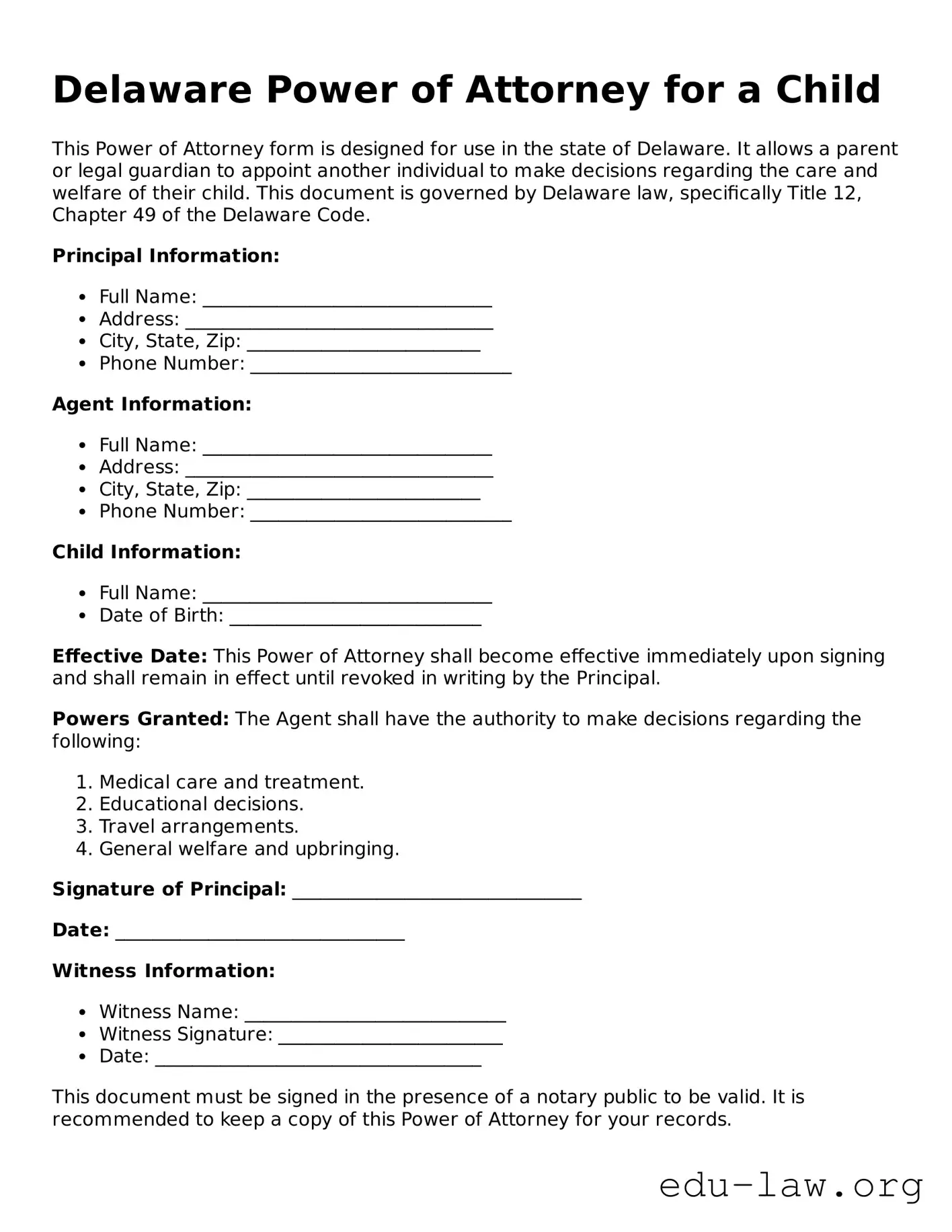
This Power of Attorney form is designed for use in the state of Delaware. It allows a parent or legal guardian to appoint another individual to make decisions regarding the care and welfare of their child. This document is governed by Delaware law, specifically Title 12, Chapter 49 of the Delaware Code.
Principal Information:
Agent Information:
Child Information:
Effective Date: This Power of Attorney shall become effective immediately upon signing and shall remain in effect until revoked in writing by the Principal.
Powers Granted: The Agent shall have the authority to make decisions regarding the following:
Signature of Principal: _______________________________
Date: _______________________________
Witness Information:
This document must be signed in the presence of a notary public to be valid. It is recommended to keep a copy of this Power of Attorney for your records.
| Fact Name | Description |
|---|---|
| Definition | The Delaware Power of Attorney for a Child form allows a parent or legal guardian to designate another adult to make decisions on behalf of their child. |
| Governing Law | This form is governed by Title 14, Chapter 901 of the Delaware Code, which outlines the legal framework for powers of attorney concerning minors. |
| Duration | The authority granted through this form can be set for a specific period or remain effective until revoked by the parent or guardian. |
| Signatures Required | The form must be signed by the parent or legal guardian and may require a witness signature or notarization to ensure its validity. |
| Usage Scenarios | This form is commonly used for temporary situations, such as travel, medical emergencies, or when a parent is unable to care for the child. |
Filling out the Delaware Power of Attorney for a Child form is an important step for parents or guardians who wish to designate someone else to make decisions on behalf of their child. After completing the form, ensure that it is signed and dated appropriately, as this will help in its acceptance by relevant parties.
What is a Delaware Power of Attorney for a Child form?
The Delaware Power of Attorney for a Child form is a legal document that allows a parent or legal guardian to grant authority to another adult to make decisions on behalf of their child. This can include decisions related to healthcare, education, and other important matters. It is particularly useful for parents who may be traveling, working long hours, or otherwise unable to care for their child temporarily.
Who can be appointed as an agent in the Power of Attorney for a Child?
Any adult can be appointed as an agent in the Power of Attorney for a Child form. This could be a relative, family friend, or trusted neighbor. It is essential to choose someone responsible and trustworthy, as they will have the authority to make significant decisions regarding your child's welfare.
How long is the Power of Attorney for a Child valid?
The Power of Attorney for a Child remains valid until it is revoked by the parent or guardian, or until the child reaches the age of majority, which is 18 years old in Delaware. It is advisable to specify an expiration date or conditions under which the authority will end to avoid any confusion.
Do I need to have the Power of Attorney for a Child form notarized?
Yes, the Power of Attorney for a Child form must be notarized to be legally binding in Delaware. This means that a notary public must witness the signing of the document. Notarization helps ensure the authenticity of the signatures and the intentions of the parties involved.
Can I revoke the Power of Attorney for a Child once it is established?
Yes, you can revoke the Power of Attorney for a Child at any time. To do so, you must provide written notice to the agent and any relevant parties, such as schools or healthcare providers. It is recommended to create a formal revocation document and have it notarized for clarity and legal standing.
Is the Power of Attorney for a Child form required for travel?
While it is not legally required, having a Power of Attorney for a Child form can be beneficial when traveling. If a parent or guardian is not accompanying the child, having this document can help ensure that the appointed agent can make decisions if needed. It can also assist in situations where medical care or educational decisions arise during the trip.
Failing to provide complete and accurate information about the child. This includes the child’s full name, date of birth, and any other identifying details.
Not including the full names and addresses of both the parent(s) and the designated agent. This information is crucial for identification purposes.
Overlooking the need for signatures. Both the parent(s) and the agent must sign the document to make it legally binding.
Neglecting to have the document notarized. A notary public’s acknowledgment is often required for the Power of Attorney to be valid.
Using outdated forms. Always ensure that you are using the most current version of the Delaware Power of Attorney for a Child form.
Not specifying the powers granted to the agent. Clearly outline what decisions the agent is authorized to make on behalf of the child.
Failing to include an expiration date for the Power of Attorney. Without this, the document may remain valid longer than intended.
Ignoring state-specific requirements. Each state may have unique regulations regarding Power of Attorney forms, so be sure to follow Delaware’s guidelines.
Not discussing the arrangement with the child. Depending on the child’s age, it’s important to involve them in the conversation about their care.
Assuming the Power of Attorney is permanent. Understand that this document can be revoked or modified as circumstances change.
When preparing a Power of Attorney for a Child in Delaware, it's important to consider other documents that may be necessary or helpful. These documents can provide additional clarity and support for the arrangement. Here’s a list of forms and documents that are often used in conjunction with the Power of Attorney for a Child:
Having these documents in place can provide peace of mind and ensure that your child's needs are met in various situations. It’s always a good idea to consult with a legal professional to ensure that everything is in order and tailored to your specific circumstances.
The Delaware Power of Attorney for a Child form is similar to a standard Power of Attorney document. Both documents allow an individual to appoint another person to make decisions on their behalf. In the case of the Power of Attorney for a Child, the focus is specifically on decisions related to a minor. This includes medical decisions, educational choices, and other important matters. The intent is to ensure that a trusted individual can act in the best interest of the child when the parent or legal guardian is unavailable.
A Medical Power of Attorney is another document that shares similarities with the Delaware Power of Attorney for a Child. This document specifically grants authority to a designated person to make medical decisions for an individual in the event they are unable to do so themselves. For children, this can be crucial during emergencies or when parents cannot be reached. The emphasis is on ensuring that a trusted individual can make health-related choices quickly and effectively.
The Child Care Authorization form is also akin to the Power of Attorney for a Child. This document allows parents to authorize another adult to care for their child temporarily. It may include permission for the caregiver to make decisions about the child's day-to-day needs, such as schooling and activities. The primary goal is to provide a legal framework for caregivers to act in the child's best interest when parents are not present.
A Guardianship Agreement is another relevant document. This agreement establishes a legal relationship between a guardian and a child. While a Power of Attorney is temporary and can be revoked, guardianship is more permanent. Guardianship grants the guardian the authority to make decisions regarding the child's welfare, including education and health, similar to the powers granted in a Power of Attorney for a Child.
The Temporary Custody Agreement is similar in that it allows for the temporary transfer of custody of a child to another adult. This document is often used when parents are unable to care for their child for a short period. It ensures that the child has a safe environment and that the temporary custodian has the authority to make necessary decisions on behalf of the child.
A Consent to Travel form is another document that shares commonalities with the Power of Attorney for a Child. This form allows a parent or guardian to grant permission for a child to travel with another adult. It is particularly useful for trips or vacations, ensuring that the accompanying adult has the authority to act in emergencies and make decisions during the trip.
The Affidavit of Custody is also similar. This document is often used in legal proceedings to establish who has custody of a child. While it serves a different purpose, it can complement the Power of Attorney for a Child by providing proof of custody arrangements when parents are not available to care for their child.
A Special Power of Attorney is another related document. This type of Power of Attorney is more limited in scope and can be tailored to specific tasks or decisions. For example, it may grant authority only for educational decisions or medical care, similar to how the Power of Attorney for a Child focuses on the child's needs.
The Child Medical Consent form is also relevant. This document allows a parent to authorize another adult to make medical decisions for their child. Like the Power of Attorney for a Child, it is designed to ensure that medical care can be provided promptly and without legal delays in the parent's absence.
Lastly, the Educational Power of Attorney is comparable. This document allows a parent to designate someone else to make educational decisions for their child. It can include decisions about school enrollment, special education needs, and other educational matters, paralleling the authority granted in the Power of Attorney for a Child.
When filling out the Delaware Power of Attorney for a Child form, it is essential to follow certain guidelines to ensure the document is valid and effective. Here are five things you should do and five things you should avoid.
Things You Should Do:
Things You Shouldn't Do:
Understanding the Delaware Power of Attorney for a Child form can be tricky. Many people have misconceptions about what this document entails. Here are seven common misunderstandings:
Clearing up these misconceptions can help parents make informed decisions about their child's care and well-being. Understanding the true purpose and limitations of the Power of Attorney for a Child is crucial for effective planning.
When filling out and using the Delaware Power of Attorney for a Child form, it is important to keep several key points in mind:
By following these guidelines, parents can ensure that their child's needs are met, even when they are not present.