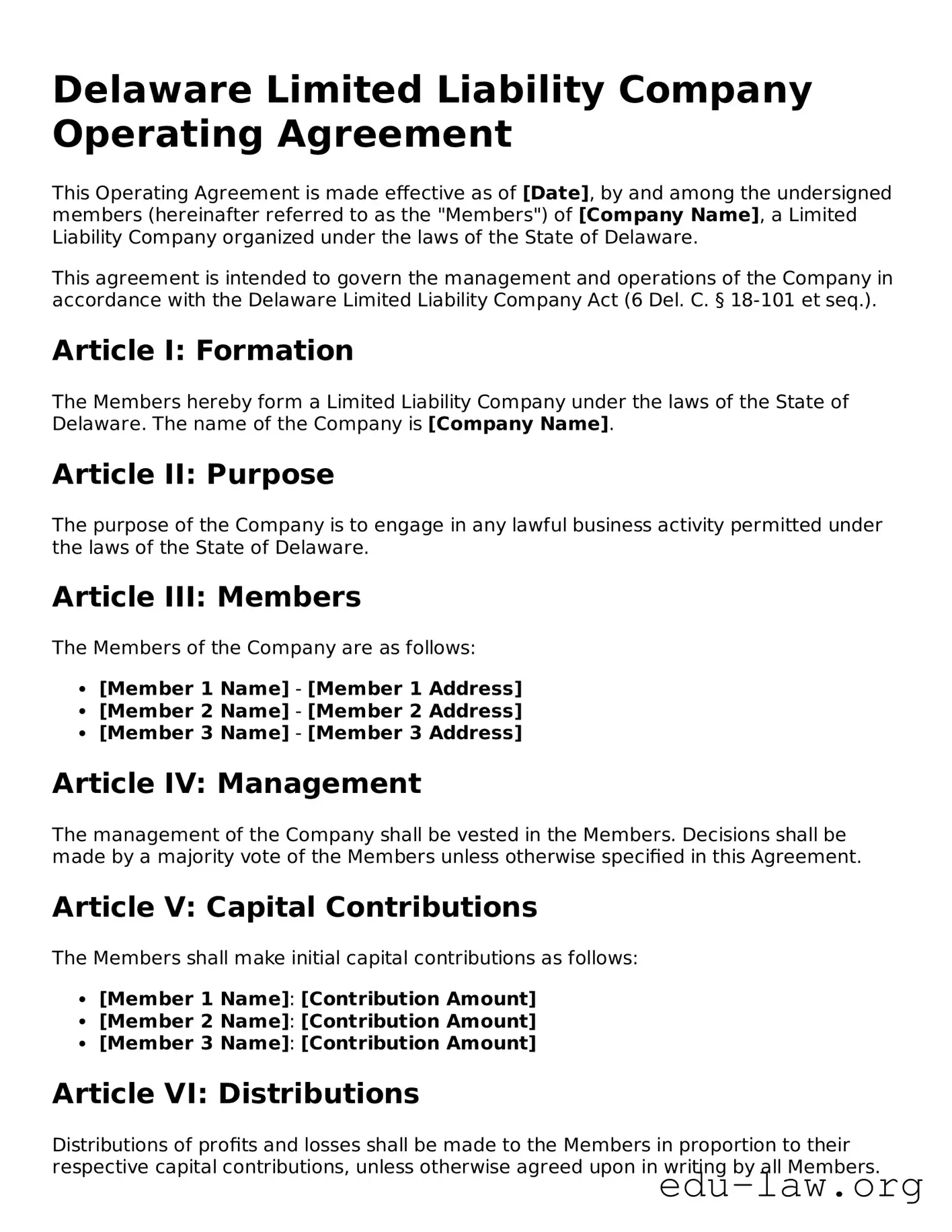
When forming a Limited Liability Company (LLC) in Delaware, one crucial document stands at the forefront: the Operating Agreement. This agreement serves as the backbone of the LLC, outlining the rights, responsibilities, and operational procedures for its members. It addresses key aspects such as management structure, voting rights, profit distribution, and member contributions. By clearly defining these elements, the Operating Agreement helps prevent disputes among members and provides a framework for decision-making. Additionally, it offers flexibility, allowing members to tailor the agreement to fit their specific needs and business goals. While Delaware law does not mandate an Operating Agreement, having one is highly recommended to ensure that all members are on the same page and to protect the limited liability status of the LLC. In this article, we will explore the essential components of the Delaware Operating Agreement form and discuss why it is a vital tool for any LLC operating in the state.
Delaware Limited Liability Company Operating Agreement
This Operating Agreement is made effective as of [Date], by and among the undersigned members (hereinafter referred to as the "Members") of [Company Name], a Limited Liability Company organized under the laws of the State of Delaware.
This agreement is intended to govern the management and operations of the Company in accordance with the Delaware Limited Liability Company Act (6 Del. C. § 18-101 et seq.).
Article I: Formation
The Members hereby form a Limited Liability Company under the laws of the State of Delaware. The name of the Company is [Company Name].
Article II: Purpose
The purpose of the Company is to engage in any lawful business activity permitted under the laws of the State of Delaware.
Article III: Members
The Members of the Company are as follows:
Article IV: Management
The management of the Company shall be vested in the Members. Decisions shall be made by a majority vote of the Members unless otherwise specified in this Agreement.
Article V: Capital Contributions
The Members shall make initial capital contributions as follows:
Article VI: Distributions
Distributions of profits and losses shall be made to the Members in proportion to their respective capital contributions, unless otherwise agreed upon in writing by all Members.
Article VII: Meetings
Meetings of the Members shall be held at least once a year. Notice of the meeting shall be given to each Member at least [Number of Days] days prior to the meeting date.
Article VIII: Amendments
This Operating Agreement may be amended only by a written agreement signed by all Members.
Article IX: Miscellaneous
This Agreement shall be governed by and construed in accordance with the laws of the State of Delaware. If any provision of this Agreement is found to be invalid or unenforceable, the remaining provisions shall continue in full force and effect.
IN WITNESS WHEREOF, the Members have executed this Operating Agreement as of the date first above written.
__________________________
[Member 1 Name]
__________________________
[Member 2 Name]
__________________________
[Member 3 Name]
| Fact Name | Description |
|---|---|
| Purpose | The Delaware Operating Agreement outlines the management structure and operating procedures of a limited liability company (LLC). |
| Governing Law | This agreement is governed by the laws of the State of Delaware. |
| Flexibility | Delaware law allows for a high degree of flexibility in how an LLC can be structured. |
| Membership | The agreement defines the rights and responsibilities of the members (owners) of the LLC. |
| Management | It can specify whether the LLC is member-managed or manager-managed. |
| Profit Distribution | The document outlines how profits and losses will be distributed among members. |
| Amendments | It provides a process for amending the agreement in the future. |
| Dispute Resolution | The agreement may include methods for resolving disputes among members. |
| Confidentiality | It can include clauses to protect the confidentiality of business information. |
Completing the Delaware Operating Agreement form is an important step in establishing your business. After filling out the form, you will be able to move forward with the necessary legal and operational aspects of your company.
What is a Delaware Operating Agreement?
A Delaware Operating Agreement is a document that outlines the management structure and operating procedures of a Limited Liability Company (LLC) formed in Delaware. It serves as a guide for the members of the LLC, detailing their rights, responsibilities, and how the business will be run.
Why do I need an Operating Agreement for my LLC?
Having an Operating Agreement is crucial for several reasons. It helps establish clear rules for the LLC, reduces misunderstandings among members, and protects your limited liability status. Additionally, some banks and investors may require an Operating Agreement before they will do business with your LLC.
Is an Operating Agreement required in Delaware?
While Delaware does not legally require LLCs to have an Operating Agreement, it is highly recommended. Without one, your LLC will be governed by Delaware's default rules, which may not align with your business goals or the wishes of the members.
What should be included in a Delaware Operating Agreement?
An Operating Agreement should include several key elements, such as the LLC's name, purpose, duration, member contributions, profit and loss distribution, management structure, and procedures for adding or removing members. It can also address dispute resolution and dissolution processes.
Can I create my own Operating Agreement?
Yes, you can create your own Operating Agreement. Many templates are available online, and you can customize them to fit your specific needs. However, it may be beneficial to consult with a legal professional to ensure that your document complies with Delaware law and adequately protects your interests.
How do I amend an Operating Agreement?
To amend an Operating Agreement, the members of the LLC must follow the amendment procedures outlined in the original document. Typically, this involves drafting the changes, obtaining member approval, and documenting the amendments in writing. Ensure that all members sign the amended agreement.
Do I need to file the Operating Agreement with the state?
No, you do not need to file your Operating Agreement with the state of Delaware. It is an internal document meant for the members of the LLC. However, it’s important to keep a copy on hand and ensure that all members have access to it.
How often should I review my Operating Agreement?
It is a good practice to review your Operating Agreement regularly, especially after significant changes in your business, such as adding or removing members, changes in management, or alterations in business strategy. Regular reviews help ensure that the document remains relevant and effective.
What happens if I don’t have an Operating Agreement?
If you do not have an Operating Agreement, your LLC will be subject to Delaware’s default rules. These rules may not reflect your intentions or the needs of your business. This can lead to confusion, disputes among members, and potential legal issues down the line.
Failing to include all members' names and addresses. Each member's information should be clearly listed to ensure transparency and accountability.
Not specifying the percentage of ownership. Clearly defining ownership stakes helps prevent disputes among members in the future.
Omitting the purpose of the business. Stating the business's purpose provides clarity and direction for the company.
Neglecting to outline the management structure. Whether the business is member-managed or manager-managed should be explicitly stated.
Forgetting to include provisions for decision-making. Establishing how decisions will be made can prevent conflicts and streamline operations.
Not addressing profit and loss distribution. Clearly detailing how profits and losses will be shared among members is essential for financial clarity.
Ignoring the procedures for adding or removing members. Setting forth guidelines for changes in membership helps maintain order and legal compliance.
Failing to review and update the agreement regularly. As the business evolves, so should the Operating Agreement to reflect current conditions and relationships.
When forming a limited liability company (LLC) in Delaware, the Operating Agreement is a crucial document. However, several other forms and documents are often used in conjunction with the Operating Agreement to ensure proper compliance and structure of the business. Below is a list of these important documents.
Understanding these documents is essential for anyone looking to establish a successful LLC in Delaware. Each form plays a vital role in ensuring that the business is organized, compliant, and well-managed.
The Delaware Limited Liability Company (LLC) Operating Agreement is similar to a Partnership Agreement. Both documents outline the structure, roles, and responsibilities of the parties involved. A Partnership Agreement typically details how profits and losses will be shared among partners, while an Operating Agreement does the same for members of an LLC. Both documents aim to prevent misunderstandings by clearly defining the terms of the partnership or LLC operation.
Another document comparable to the Operating Agreement is the Corporate Bylaws. While the Operating Agreement governs LLCs, Corporate Bylaws serve the same purpose for corporations. Both documents establish the rules for governance, including how decisions are made, how meetings are conducted, and how officers are appointed. They ensure that the organization operates smoothly and in accordance with its stated objectives.
The Shareholders Agreement is also similar to the Operating Agreement. This document is used in corporations and outlines the rights and obligations of shareholders. Like the Operating Agreement, it can address issues such as voting rights, transfer of shares, and dispute resolution. Both documents aim to protect the interests of the members or shareholders and provide a framework for decision-making.
A Joint Venture Agreement shares similarities with the Operating Agreement as well. This document is used when two or more parties collaborate on a specific project. It outlines the roles, contributions, and profit-sharing arrangements of each party involved. Like the Operating Agreement, it serves to clarify expectations and responsibilities, helping to avoid conflicts during the joint venture.
The LLC Membership Certificate resembles the Operating Agreement in that it identifies the members of the LLC and their respective ownership stakes. While the Operating Agreement details the operational aspects of the LLC, the Membership Certificate serves as proof of membership. Both documents are essential for establishing the legitimacy of the LLC and its members.
The Non-Disclosure Agreement (NDA) is another document that can be compared to the Operating Agreement. While an NDA focuses on confidentiality and protecting sensitive information, both documents are crucial for maintaining trust among parties. An Operating Agreement can include confidentiality clauses to protect proprietary information, thus reinforcing the need for both documents in business relationships.
The Employment Agreement is also similar in some respects. While it primarily focuses on the terms of employment between an employer and employee, it can include provisions related to confidentiality, non-compete clauses, and termination. Both documents aim to establish clear expectations and protect the interests of the parties involved, ensuring a smooth working relationship.
Lastly, the Business Plan can be considered similar to the Operating Agreement. A Business Plan outlines the goals, strategies, and operational plans for a business, while the Operating Agreement provides the legal framework for how the business will operate. Both documents serve as essential tools for guiding the organization and ensuring that all parties are aligned with the business objectives.
When filling out the Delaware Operating Agreement form, it’s important to keep a few key points in mind. Here’s a list of things you should and shouldn't do:
Following these guidelines will help ensure that your Operating Agreement is filled out correctly and effectively. Good luck!
When forming a Limited Liability Company (LLC) in Delaware, the Operating Agreement is a crucial document. However, several misconceptions exist about this form. Here are eight common misunderstandings:
Understanding these misconceptions can help ensure that you create a comprehensive and effective Operating Agreement for your Delaware LLC.
When it comes to establishing a Limited Liability Company (LLC) in Delaware, the Operating Agreement is a crucial document. Here are some key takeaways to consider when filling out and utilizing this form:
By keeping these key points in mind, you can create a comprehensive Operating Agreement that supports the smooth operation of your Delaware LLC.