In the realm of legal documentation, the Delaware Notary Acknowledgement form plays a crucial role in affirming the authenticity of signatures on various documents. This form serves as a formal declaration by a notary public, confirming that the individual who signed the document did so willingly and in their presence. Typically utilized in transactions involving property, contracts, and other significant agreements, the form ensures that the signatory is properly identified and understands the implications of their actions. The Delaware Notary Acknowledgement includes essential details such as the date of acknowledgment, the name of the signatory, and the notary's signature and seal, which together lend credibility and legal weight to the document. By providing a clear and standardized process for notarial acts, this form helps to prevent fraud and misunderstandings, thereby fostering trust in legal transactions across the state. Understanding its components and significance is vital for anyone engaged in legal or financial dealings in Delaware.
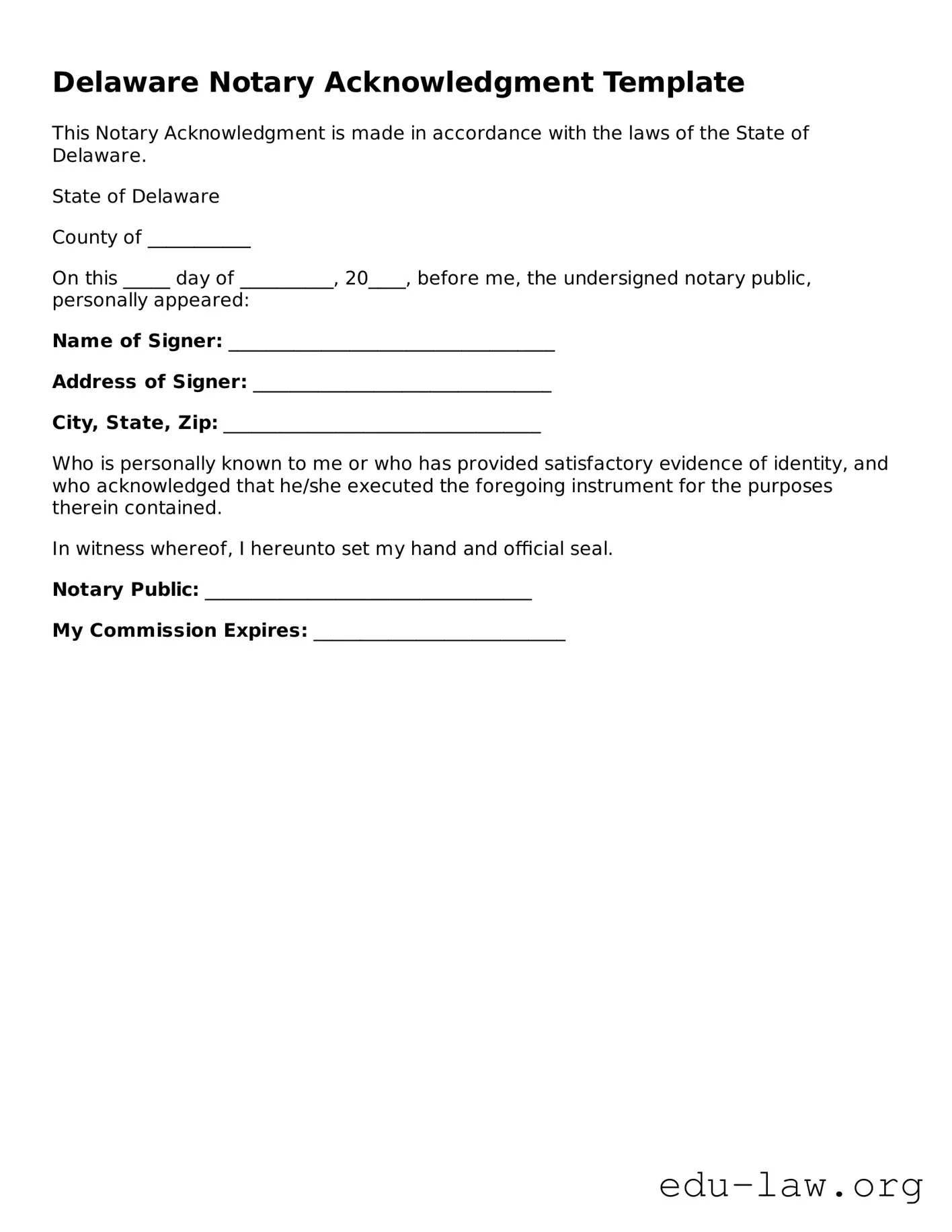
Delaware Notary Acknowledgment Template
This Notary Acknowledgment is made in accordance with the laws of the State of Delaware.
State of Delaware
County of ___________
On this _____ day of __________, 20____, before me, the undersigned notary public, personally appeared:
Name of Signer: ___________________________________
Address of Signer: ________________________________
City, State, Zip: __________________________________
Who is personally known to me or who has provided satisfactory evidence of identity, and who acknowledged that he/she executed the foregoing instrument for the purposes therein contained.
In witness whereof, I hereunto set my hand and official seal.
Notary Public: ___________________________________
My Commission Expires: ___________________________
| Fact Name | Description |
|---|---|
| Purpose | The Delaware Notary Acknowledgment form is used to verify the identity of a signer and confirm that they signed a document willingly. |
| Governing Law | This form is governed by the Delaware Code, Title 29, Chapter 4325. |
| Signature Requirement | The signer must personally appear before the notary public at the time of the acknowledgment. |
| Identification | The notary must verify the signer's identity using a government-issued ID or another approved form of identification. |
| Notary Seal | A notary public must affix their official seal to the acknowledgment form to validate it. |
| Record Keeping | Notaries are required to keep a record of all acknowledgments in their notary journal. |
| Document Types | This form can be used for various documents, including deeds, contracts, and affidavits. |
| Expiration | The acknowledgment does not expire, but the notary's commission must be active for the form to be valid. |
| Fee Structure | Notaries may charge a fee for their services, which varies by jurisdiction within Delaware. |
| Witness Requirement | Delaware does not require witnesses for a notary acknowledgment to be valid. |
Completing the Delaware Notary Acknowledgement form is a straightforward process. After filling it out, you will need to submit it as required for your specific situation. Be sure to double-check all entries for accuracy before finalizing the document.
What is a Delaware Notary Acknowledgement form?
The Delaware Notary Acknowledgement form is a legal document used to verify the identity of individuals signing a document. It serves as proof that the signer appeared before a notary public, who confirmed their identity and willingness to sign. This form is often required for documents such as deeds, mortgages, and contracts to ensure their validity and enforceability.
When is a Notary Acknowledgement required in Delaware?
A Notary Acknowledgement is typically required when a document needs to be recorded with a government office, such as a county recorder or court. This includes real estate transactions, powers of attorney, and other legal documents where proof of identity and consent is necessary. Not all documents require notarization, but it is advisable to check the specific requirements for each type of document.
How does one complete a Notary Acknowledgement form in Delaware?
To complete a Notary Acknowledgement form, the signer must appear before a notary public. The notary will ask for identification to confirm the signer's identity. After verifying identity, the notary will have the signer complete the form by signing it in the notary's presence. The notary will then complete the acknowledgment section, which includes their signature, seal, and the date of the acknowledgment. It is essential that the document is signed in front of the notary to ensure its validity.
Are there any fees associated with notarization in Delaware?
Yes, notaries in Delaware may charge a fee for their services. The maximum fee that a notary can charge for an acknowledgment is set by state law. As of the latest updates, this fee is typically around $5 per acknowledgment. However, it is advisable to confirm the exact fee with the notary before the service is rendered, as some notaries may have different pricing structures based on their experience or additional services offered.
Failing to include the notary's signature. Without this, the acknowledgment is incomplete.
Not providing the date of the acknowledgment. This is crucial for the validity of the document.
Leaving out the name of the signer. Ensure that the full name is clearly printed.
Using an incorrect notary seal. The seal must match the one registered with the state.
Not indicating the capacity in which the signer is acting, if applicable. This adds clarity to the document.
Failing to check the jurisdiction. Make sure it is appropriate for the document being notarized.
Providing an incomplete address for the signer. Full addresses help identify the individual.
Not confirming the identity of the signer. Proper identification is essential for the notarization process.
Neglecting to fill out the notary's commission expiration date. This is important for maintaining validity.
Using illegible handwriting or unclear printing. All entries must be easy to read to avoid confusion.
When dealing with legal documents in Delaware, the Notary Acknowledgement form is often accompanied by several other important forms. Each of these documents serves a specific purpose in ensuring that transactions are valid and legally binding. Below is a list of commonly used forms that you may encounter alongside the Notary Acknowledgement.
Understanding these documents can help streamline your legal processes and ensure that everything is in order. Each serves its own unique purpose, and knowing when to use them can make a significant difference in your legal dealings.
The Affidavit is a sworn statement made under oath. Like the Delaware Notary Acknowledgement form, it requires the presence of a notary public to verify the identity of the signer. Both documents serve to authenticate the legitimacy of the signatures and the statements contained within them. The primary difference lies in the purpose; affidavits are often used in legal proceedings to provide evidence, while acknowledgements confirm that a document was signed willingly and knowingly.
The Power of Attorney (POA) document grants one person the authority to act on behalf of another. Similar to the Notary Acknowledgement, a POA must be notarized to be valid in many jurisdictions. The notary's role is to confirm the identity of the individual granting the authority, ensuring that the document is executed without coercion. Both documents require the notary's seal and signature to affirm their authenticity.
The Deed is a legal document that conveys ownership of property. Like the Notary Acknowledgement, it often requires notarization to be enforceable. The notary verifies the identities of the parties involved and ensures that they understand the contents of the deed before signing. This process helps prevent fraud and protects the interests of all parties involved in the transaction.
The Jurat is a type of notarial act where the signer swears to the truth of the contents of a document. Like the Notary Acknowledgement, a jurat requires the notary to verify the identity of the signer. Both processes involve the notary witnessing the signing, but the jurat specifically involves an oath or affirmation regarding the truthfulness of the document's contents.
The Signature Verification form is used to confirm that a signature on a document is genuine. This document shares similarities with the Notary Acknowledgement in that it requires a notary to verify the identity of the signer. Both forms aim to prevent fraud by ensuring that the signature is authentic and that the signer is aware of what they are signing.
The Living Will is a document that outlines a person's wishes regarding medical treatment in case they become unable to communicate. Similar to the Delaware Notary Acknowledgement, a living will can be notarized to ensure its validity. The notary confirms the identity of the person creating the living will, ensuring that their wishes are documented and respected.
The Last Will and Testament is a legal document that specifies how a person's assets should be distributed after their death. Like the Notary Acknowledgement, it often requires notarization to be considered valid. The notary's role is to verify the identity of the testator and ensure that they are signing the will willingly and without undue pressure.
The Consent Form is used to obtain permission for various actions, such as medical procedures or participation in research studies. Similar to the Delaware Notary Acknowledgement, a consent form may require notarization to ensure that the signer understands what they are consenting to. The notary verifies the identity of the signer and confirms that they are providing informed consent.
The Bill of Sale is a document that transfers ownership of personal property from one party to another. Like the Notary Acknowledgement, it may require notarization to protect against disputes regarding ownership. The notary's role is to confirm the identities of both parties and ensure that the transfer is conducted fairly and transparently.
When filling out the Delaware Notary Acknowledgement form, it's essential to approach the task with care. Here’s a list of things you should and shouldn't do to ensure the process goes smoothly.
By following these guidelines, you can help ensure that your Delaware Notary Acknowledgement form is completed correctly and efficiently.
Understanding the Delaware Notary Acknowledgement form is essential for ensuring proper documentation and compliance. However, several misconceptions may lead to confusion. Below are some common misconceptions and clarifications regarding this important form:
Awareness of these misconceptions can help individuals navigate the notarization process more effectively. It is always best to consult with a professional if there are any uncertainties regarding notary services.
When using the Delaware Notary Acknowledgment form, it's important to follow specific guidelines to ensure the document is valid. Here are key takeaways to consider:
By adhering to these guidelines, individuals can ensure that their use of the Delaware Notary Acknowledgment form is both effective and legally sound.