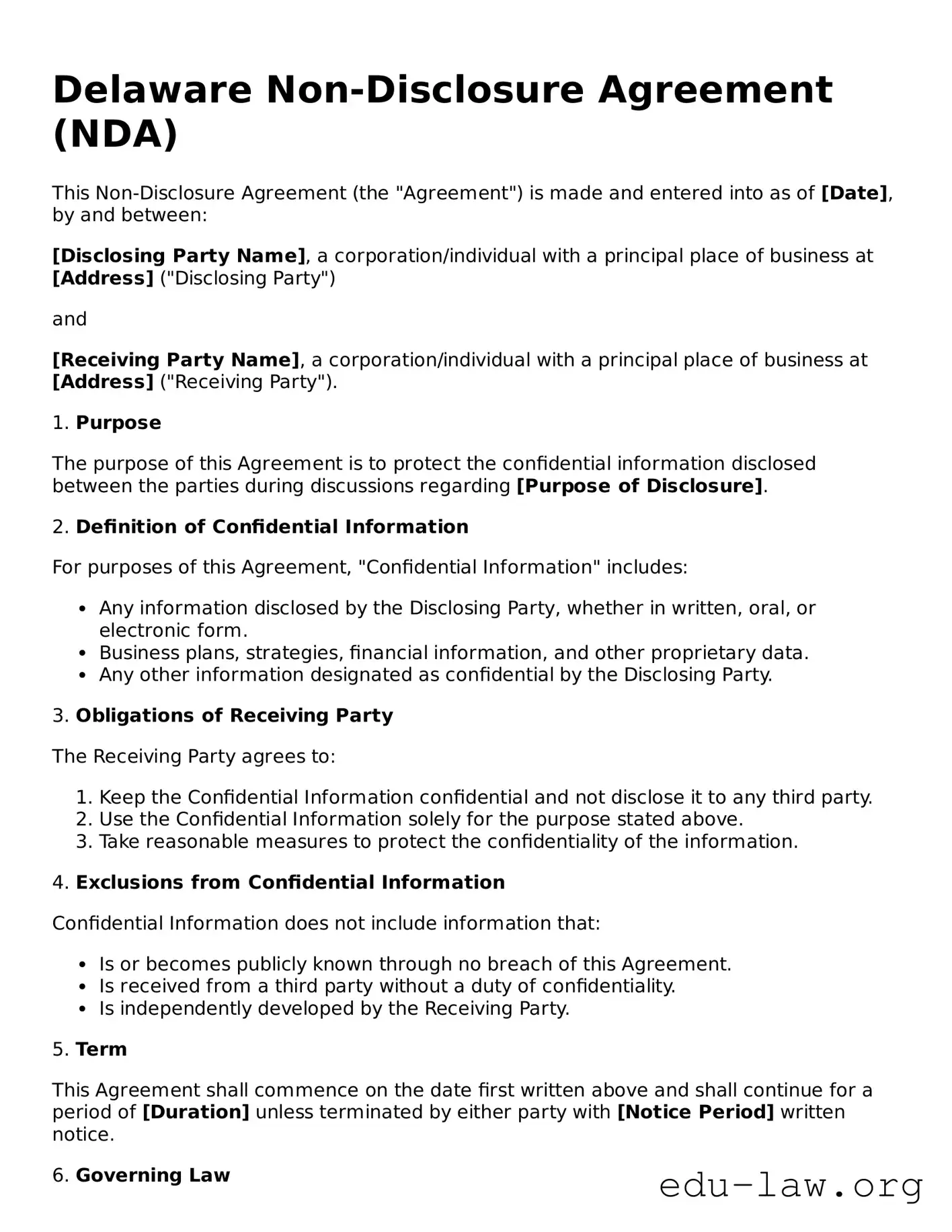
In the realm of business transactions, confidentiality is paramount. The Delaware Non-disclosure Agreement (NDA) serves as a vital tool for protecting sensitive information shared between parties. This legal document establishes a clear framework for the handling of proprietary data, trade secrets, and other confidential materials. By defining the scope of what constitutes confidential information, the NDA helps prevent unauthorized disclosure and misuse. Typically, the form outlines the obligations of each party, the duration of confidentiality, and the consequences of breach. Additionally, it may include provisions for the return or destruction of information upon termination of the agreement. Understanding these components is essential for businesses seeking to safeguard their interests while fostering trust in collaborative ventures.
Delaware Non-Disclosure Agreement (NDA)
This Non-Disclosure Agreement (the "Agreement") is made and entered into as of [Date], by and between:
[Disclosing Party Name], a corporation/individual with a principal place of business at [Address] ("Disclosing Party")
and
[Receiving Party Name], a corporation/individual with a principal place of business at [Address] ("Receiving Party").
1. Purpose
The purpose of this Agreement is to protect the confidential information disclosed between the parties during discussions regarding [Purpose of Disclosure].
2. Definition of Confidential Information
For purposes of this Agreement, "Confidential Information" includes:
3. Obligations of Receiving Party
The Receiving Party agrees to:
4. Exclusions from Confidential Information
Confidential Information does not include information that:
5. Term
This Agreement shall commence on the date first written above and shall continue for a period of [Duration] unless terminated by either party with [Notice Period] written notice.
6. Governing Law
This Agreement shall be governed by and construed in accordance with the laws of the State of Delaware.
7. Entire Agreement
This Agreement constitutes the entire understanding between the parties regarding the subject matter hereof and supersedes all prior discussions and agreements.
IN WITNESS WHEREOF, the parties have executed this Non-Disclosure Agreement as of the date first above written.
Disclosing Party:
______________________________
[Name and Title]
Receiving Party:
______________________________
[Name and Title]
| Fact Name | Description |
|---|---|
| Purpose | The Delaware Non-disclosure Agreement (NDA) is designed to protect confidential information shared between parties. |
| Governing Law | This agreement is governed by the laws of the State of Delaware. |
| Parties Involved | The NDA typically involves at least two parties: the disclosing party and the receiving party. |
| Duration | NDAs can specify a duration for confidentiality, often ranging from one to five years. |
| Exclusions | Common exclusions from confidentiality include information that is publicly available or independently developed. |
| Enforcement | Infringement of the NDA can lead to legal action, including injunctions and monetary damages. |
Filling out the Delaware Non-disclosure Agreement form is a straightforward process that helps protect sensitive information. Once completed, this form can help ensure that both parties understand their obligations regarding confidentiality.
What is a Delaware Non-disclosure Agreement (NDA)?
A Delaware Non-disclosure Agreement is a legal contract designed to protect sensitive information shared between parties. It ensures that the recipient of confidential information cannot disclose it to unauthorized individuals or use it for purposes other than those specified in the agreement. NDAs are commonly used in business settings to safeguard trade secrets, proprietary information, and other sensitive data during negotiations or collaborations.
Who typically uses a Delaware NDA?
Various parties may utilize a Delaware NDA, including businesses, freelancers, and contractors. Companies often require employees and partners to sign an NDA to protect their intellectual property. Startups may also use NDAs when discussing ideas with potential investors or collaborators. Essentially, anyone who needs to share confidential information can benefit from this type of agreement.
What should be included in a Delaware NDA?
An effective Delaware NDA should clearly outline the definition of confidential information, the obligations of both parties regarding the handling of that information, and the duration of confidentiality. It may also specify any exclusions, such as information that is publicly available or independently developed. Additionally, the agreement should include provisions for dispute resolution and the governing law, which in this case would be Delaware law.
How is a Delaware NDA enforced?
Enforcement of a Delaware NDA typically involves legal action if one party breaches the agreement. The injured party may seek remedies such as damages or an injunction to prevent further disclosure. Courts in Delaware are generally supportive of NDAs, provided they are reasonable and not overly broad. It is essential for both parties to understand their rights and obligations under the agreement to ensure effective enforcement.
Failing to identify all parties involved. It's crucial to clearly list all individuals or entities bound by the agreement. Omitting a party can lead to confusion and potential disputes.
Not defining confidential information adequately. A vague description of what constitutes confidential information can result in misunderstandings. Specificity is key to ensuring all parties understand what is protected.
Using overly broad terms. While it’s important to protect sensitive information, using terms that are too broad can make the agreement unenforceable. Clarity and precision are essential.
Neglecting to specify the duration of confidentiality. Without a clear timeline, it can be unclear how long the obligations last. Parties should agree on a reasonable period for maintaining confidentiality.
Overlooking the consequences of breach. The agreement should outline the repercussions of violating the terms. This helps establish the seriousness of the commitments made by all parties.
Failing to include governing law. Specifying which state’s laws will govern the agreement can help resolve disputes more efficiently. This is especially important in multi-state situations.
Not having the agreement reviewed by legal counsel. A legal expert can provide valuable insights and ensure that the agreement meets all necessary legal standards. This step can prevent future issues.
Forgetting to sign and date the agreement. An unsigned document lacks legal enforceability. All parties must sign and date the agreement to make it valid.
A Delaware Non-disclosure Agreement (NDA) is an important document used to protect confidential information shared between parties. When drafting or executing an NDA, there are often other forms and documents that complement its purpose. Below is a list of five commonly used documents that may accompany a Delaware NDA.
Understanding these accompanying documents can help ensure that all parties are adequately protected when sensitive information is shared. Each document serves a specific purpose and collectively enhances the security of confidential dealings.
A Mutual Non-Disclosure Agreement (MNDA) is similar to a Delaware Non-Disclosure Agreement. Both documents protect confidential information shared between parties. The key difference lies in the fact that an MNDA is designed for situations where both parties may disclose sensitive information to each other, making it a more balanced approach. This mutuality encourages open communication while ensuring that both sides remain protected from potential misuse of shared information.
A Confidentiality Agreement serves a similar purpose to a Delaware Non-Disclosure Agreement. It outlines the terms under which sensitive information can be shared and establishes the obligations of the receiving party. The primary focus is on protecting proprietary information, trade secrets, or any other sensitive data. Both agreements aim to prevent unauthorized disclosure, but a Confidentiality Agreement may be broader in scope and can cover various types of confidential information.
An Employment Non-Disclosure Agreement is also comparable. This document is often used when hiring employees, ensuring that they do not disclose any confidential information they may encounter during their employment. Like a Delaware Non-Disclosure Agreement, it seeks to protect the employer's sensitive information. However, it specifically targets the employer-employee relationship, emphasizing the duty of loyalty and confidentiality that employees owe to their employers.
A Non-Circumvention Agreement shares similarities with the Delaware Non-Disclosure Agreement in that it prevents one party from bypassing another to engage directly with a third party. This type of agreement is often used in business transactions where introductions to potential clients or partners are made. Both agreements aim to protect relationships and sensitive information, but the Non-Circumvention Agreement focuses more on the prevention of direct dealings that could undermine the original party's interests.
A Licensing Agreement can be likened to a Delaware Non-Disclosure Agreement in that both documents involve the sharing of proprietary information. A Licensing Agreement grants permission to use certain intellectual property, often including terms for confidentiality. While a Non-Disclosure Agreement primarily protects information, a Licensing Agreement encompasses broader terms regarding the use and distribution of that information or property.
An Intellectual Property Agreement is another document that resembles a Delaware Non-Disclosure Agreement. This type of agreement specifically addresses the ownership and protection of intellectual property rights. Both agreements emphasize confidentiality, but an Intellectual Property Agreement often includes terms about the rights and responsibilities of the parties regarding the creation, use, and protection of intellectual property.
A Service Agreement may also share similarities with a Delaware Non-Disclosure Agreement. While primarily focused on the terms of service delivery, it can include confidentiality clauses to protect sensitive information exchanged during the service. Both agreements aim to safeguard proprietary information, but a Service Agreement has a broader focus on the overall relationship and obligations between the parties.
A Partnership Agreement can be compared to a Delaware Non-Disclosure Agreement as it often includes confidentiality provisions to protect shared business interests. In a partnership, parties typically exchange sensitive information to collaborate effectively. Both agreements aim to ensure that confidential information is not disclosed to outsiders, but a Partnership Agreement encompasses a wider range of terms regarding the relationship and responsibilities of the partners.
A Franchise Agreement is another document that bears similarities to a Delaware Non-Disclosure Agreement. This agreement includes terms that protect the franchisor's proprietary information and trade secrets. Both agreements are designed to prevent the unauthorized sharing of sensitive information. However, a Franchise Agreement also outlines the rights and obligations of both the franchisor and franchisee, making it more comprehensive in nature.
When filling out the Delaware Non-disclosure Agreement form, it’s important to be careful and thorough. Here’s a list of things to do and avoid:
When it comes to the Delaware Non-disclosure Agreement (NDA), several misconceptions can cloud understanding and lead to missteps. Here are six common myths surrounding this important legal document:
Understanding these misconceptions is essential for effectively navigating the complexities of non-disclosure agreements in Delaware. Properly crafted NDAs can serve as powerful tools for protecting sensitive information when utilized correctly.
When filling out and using the Delaware Non-disclosure Agreement (NDA) form, there are several important points to consider. The NDA is a legal document designed to protect confidential information. Here are key takeaways to keep in mind:
By keeping these key points in mind, individuals and businesses can effectively use the Delaware Non-disclosure Agreement to safeguard their confidential information.