In the competitive landscape of business, protecting proprietary information and maintaining a loyal workforce is crucial for success. The Delaware Non-compete Agreement form serves as a vital tool for employers aiming to safeguard their interests while providing clarity to employees regarding their post-employment obligations. This form outlines the specific terms under which an employee agrees not to engage in similar work or start a competing business within a designated geographical area and timeframe after leaving their current position. Key elements include the duration of the non-compete clause, the geographic limitations, and the types of activities that are restricted. By ensuring that these components are clearly defined, both parties can better understand their rights and responsibilities, fostering a professional relationship built on mutual respect and transparency. Furthermore, the enforceability of such agreements in Delaware is shaped by state laws, which require that the terms be reasonable and not overly restrictive, balancing the interests of the employer with the employee's right to work. Understanding these aspects is essential for anyone navigating the complexities of employment contracts in Delaware.
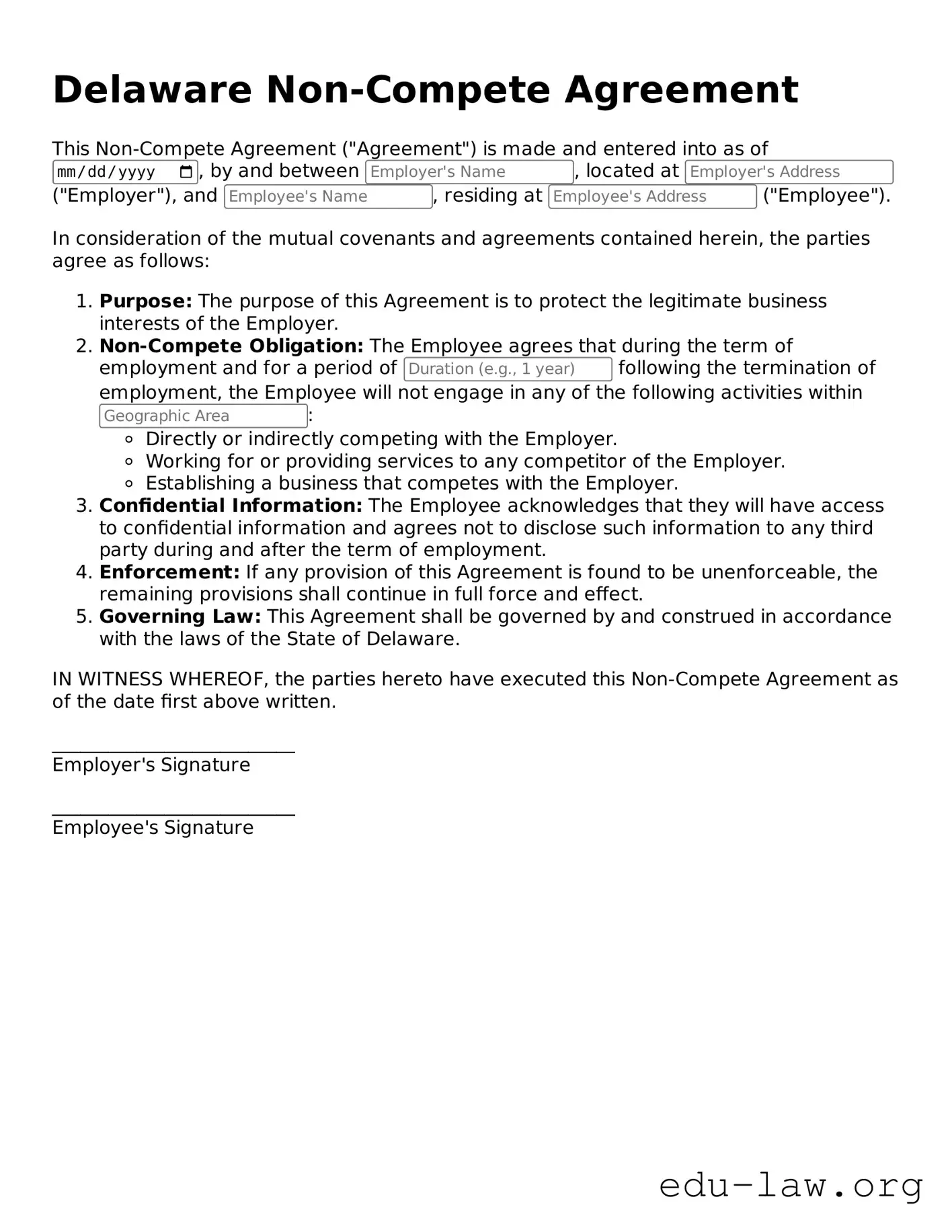
Delaware Non-Compete Agreement
This Non-Compete Agreement ("Agreement") is made and entered into as of , by and between , located at ("Employer"), and , residing at ("Employee").
In consideration of the mutual covenants and agreements contained herein, the parties agree as follows:
IN WITNESS WHEREOF, the parties hereto have executed this Non-Compete Agreement as of the date first above written.
__________________________
Employer's Signature
__________________________
Employee's Signature
| Fact Name | Description |
|---|---|
| Governing Law | The Delaware Non-compete Agreement is governed by Delaware state law, specifically under Title 19, Chapter 703 of the Delaware Code. |
| Enforceability | Non-compete agreements in Delaware are enforceable, but they must be reasonable in scope, duration, and geographic area. |
| Duration Limitations | Delaware courts generally favor non-compete agreements that last for one to two years, depending on the specific circumstances of the employment. |
| Geographic Scope | The geographic area covered by the non-compete must be clearly defined and should not be overly broad, focusing on areas where the employee worked. |
| Consideration Requirement | For a non-compete agreement to be valid, there must be adequate consideration, such as a job offer or a promotion. |
| Public Policy | Delaware courts may refuse to enforce non-compete agreements that are deemed contrary to public policy, particularly if they unduly restrict an individual's right to work. |
| Judicial Review | Non-compete agreements can be challenged in court. Judges have the discretion to modify or void agreements that they find unreasonable. |
After obtaining the Delaware Non-compete Agreement form, you will need to provide specific information to ensure it is filled out correctly. This process will involve entering details about the parties involved, the terms of the agreement, and any other relevant information. Follow these steps carefully to complete the form.
What is a Delaware Non-compete Agreement?
A Delaware Non-compete Agreement is a legal document that restricts an employee from engaging in activities that compete with their employer after leaving the company. This agreement helps protect the employer's business interests, confidential information, and customer relationships.
Why are Non-compete Agreements important?
Non-compete Agreements are crucial for businesses as they safeguard proprietary information and trade secrets. By preventing former employees from joining competitors or starting similar businesses, these agreements help maintain a competitive edge in the market.
Are Non-compete Agreements enforceable in Delaware?
Yes, Non-compete Agreements are generally enforceable in Delaware, but they must meet specific criteria. The agreement should be reasonable in scope, duration, and geographic area. Courts will evaluate these factors to determine enforceability.
What are the typical restrictions in a Non-compete Agreement?
Common restrictions include limitations on the employee's ability to work for competitors, start their own competing business, or solicit clients or employees from the former employer. These restrictions usually have a defined time period and geographic range.
How long can a Non-compete Agreement last?
The duration of a Non-compete Agreement can vary. In Delaware, a period of six months to two years is often considered reasonable. However, the specifics depend on the nature of the business and the employee's role.
Can I negotiate the terms of a Non-compete Agreement?
Yes, employees can negotiate the terms of a Non-compete Agreement before signing. It is advisable to discuss any concerns with the employer and seek modifications to ensure the agreement is fair and reasonable.
What happens if I breach a Non-compete Agreement?
If an employee breaches a Non-compete Agreement, the employer may take legal action. This could result in financial penalties, injunctions to prevent the employee from working with competitors, or other legal remedies. Understanding the consequences is essential before signing.
Are there exceptions to Non-compete Agreements?
Yes, there are exceptions. For instance, some agreements may not be enforceable if they are overly broad or if the employee was terminated without cause. Additionally, certain professions may have specific regulations that limit the enforceability of Non-compete Agreements.
Can a Non-compete Agreement apply to independent contractors?
Yes, Non-compete Agreements can apply to independent contractors. However, the terms should be clearly outlined in the contract. It is essential to ensure that the restrictions are reasonable and tailored to the contractor's specific role.
Should I consult a lawyer before signing a Non-compete Agreement?
Consulting a lawyer before signing a Non-compete Agreement is highly recommended. A legal professional can help clarify the terms, assess enforceability, and ensure that the agreement does not unfairly restrict your future employment opportunities.
Inadequate Identification of Parties: Failing to clearly identify the employer and employee can lead to confusion. Both parties' full legal names should be included.
Vague Definitions of Competition: Not specifying what constitutes competition can render the agreement unenforceable. Clear definitions help prevent misunderstandings.
Undefined Geographic Scope: Omitting the geographic area in which the non-compete applies may lead to disputes. It is essential to specify the locations where the restrictions are enforced.
Unclear Duration of Restrictions: Not stating how long the non-compete lasts can create ambiguity. A specific time frame is necessary for clarity.
Failure to Consider State Laws: Ignoring Delaware's specific laws regarding non-compete agreements can lead to invalid provisions. Understanding local regulations is crucial.
Not Including Consideration: Failing to provide something of value in exchange for the non-compete can make the agreement unenforceable. Consideration is a necessary element.
Overly Broad Restrictions: Imposing overly broad restrictions can lead to legal challenges. Limitations should be reasonable and necessary to protect legitimate business interests.
Lack of Signature and Date: Not signing or dating the agreement can invalidate it. Both parties must sign and date the document to confirm their consent.
Neglecting to Review the Agreement: Failing to review the agreement thoroughly before signing can result in unforeseen consequences. It is advisable to consult legal counsel for guidance.
When entering into a Delaware Non-compete Agreement, several other documents and forms may be relevant to ensure clarity and legal compliance. Each of these documents serves a specific purpose in the context of employment relationships and can help protect both the employer's and employee's interests.
Understanding these documents can help both employers and employees navigate the complexities of employment relationships in Delaware. It is essential to ensure that all agreements are clear and mutually understood to avoid potential disputes in the future.
A Non-disclosure Agreement (NDA) serves a similar purpose as a Non-compete Agreement by protecting sensitive information. While a Non-compete Agreement restricts an employee from working for competitors, an NDA prevents them from sharing confidential business information. Both documents aim to safeguard a company’s intellectual property and trade secrets, ensuring that proprietary knowledge remains within the organization. The focus here is on confidentiality rather than employment restrictions, but both are essential tools for protecting business interests.
A Non-solicitation Agreement is another document closely related to the Non-compete Agreement. This type of agreement restricts an employee from soliciting clients or customers of the business after leaving. While a Non-compete Agreement may prevent an employee from joining a competing firm, a Non-solicitation Agreement directly addresses the potential loss of business by prohibiting the former employee from reaching out to existing clients. Together, these agreements help to maintain a company’s customer base and market position.
An Employment Agreement often includes elements similar to those found in a Non-compete Agreement. This document outlines the terms of employment, including job responsibilities, compensation, and any restrictions on post-employment activities. While the primary focus is on the employment relationship, it can incorporate clauses that limit an employee’s ability to compete or disclose confidential information after leaving the company. This dual purpose makes it a comprehensive tool for employers seeking to protect their interests.
A Confidentiality Agreement is similar to a Non-compete Agreement in that it seeks to protect sensitive information. This document obligates employees to keep proprietary information private, which may include trade secrets, business strategies, and client lists. While a Non-compete Agreement restricts where an employee can work, a Confidentiality Agreement focuses on what they can disclose. Both are essential for maintaining a competitive edge in the market.
A Severance Agreement may also contain provisions that echo those found in a Non-compete Agreement. This document outlines the terms under which an employee will receive severance pay upon leaving the company. Often, it includes clauses that restrict the employee from working for competitors or soliciting clients for a specified period. By linking severance benefits to compliance with these restrictions, companies can protect their interests while providing a safety net for departing employees.
An Offer Letter can sometimes include terms similar to those found in a Non-compete Agreement. This document outlines the initial terms of employment and may contain clauses that address post-employment restrictions. While primarily focused on the job offer itself, it sets the stage for understanding the expectations and obligations of the employee, including any limitations on future employment that the company deems necessary for its protection.
A Partnership Agreement can also bear resemblance to a Non-compete Agreement, particularly in the context of business partnerships. This document outlines the terms of the partnership, including roles, responsibilities, and any restrictions on competition among partners. By incorporating non-compete clauses, partners can ensure that they do not undermine each other’s business interests after the partnership ends. This helps maintain the integrity of the business and its competitive position.
A Franchise Agreement often includes provisions similar to those in a Non-compete Agreement. This document governs the relationship between a franchisor and franchisee, detailing the rights and responsibilities of both parties. It may impose restrictions on the franchisee regarding competing businesses, ensuring that the franchisor's brand and market presence are protected. By establishing clear boundaries, both parties can work together more effectively while safeguarding their respective interests.
A Release of Claims Agreement can also contain elements akin to a Non-compete Agreement. This document is typically signed when an employee leaves a company, releasing the employer from any future claims. It may include clauses that restrict the employee from competing with the company or soliciting its clients. By doing so, it provides a layer of protection for the business while offering the departing employee a clear understanding of their obligations post-employment.
When filling out the Delaware Non-compete Agreement form, it is important to approach the task with care. Here are ten essential do's and don'ts to keep in mind:
Following these guidelines can help protect your interests and ensure that you are making informed decisions regarding the agreement.
Understanding the Delaware Non-compete Agreement can be challenging due to several misconceptions. Here are eight common misunderstandings that people often have:
Being aware of these misconceptions can help individuals make informed decisions about their employment agreements and rights. It is always advisable to seek legal counsel if there are any uncertainties regarding a non-compete agreement.
Filling out and using the Delaware Non-compete Agreement form requires careful consideration. Here are some key takeaways to keep in mind: