In the state of Delaware, the Motor Vehicle Power of Attorney form serves as a vital tool for individuals who need to authorize another person to handle specific vehicle-related transactions on their behalf. This form is particularly useful when the vehicle owner is unable to be present for the necessary paperwork, whether due to travel, health issues, or other commitments. By completing this document, the vehicle owner grants the designated agent the authority to perform various tasks, such as signing titles, registering vehicles, and transferring ownership. It is essential to ensure that the form includes the names and signatures of both the vehicle owner and the appointed agent, as well as a clear description of the powers being granted. Additionally, the form may require notarization to enhance its legal validity. Understanding the implications and requirements of the Motor Vehicle Power of Attorney form can simplify the process of managing vehicle transactions, providing peace of mind for both the vehicle owner and their chosen representative.
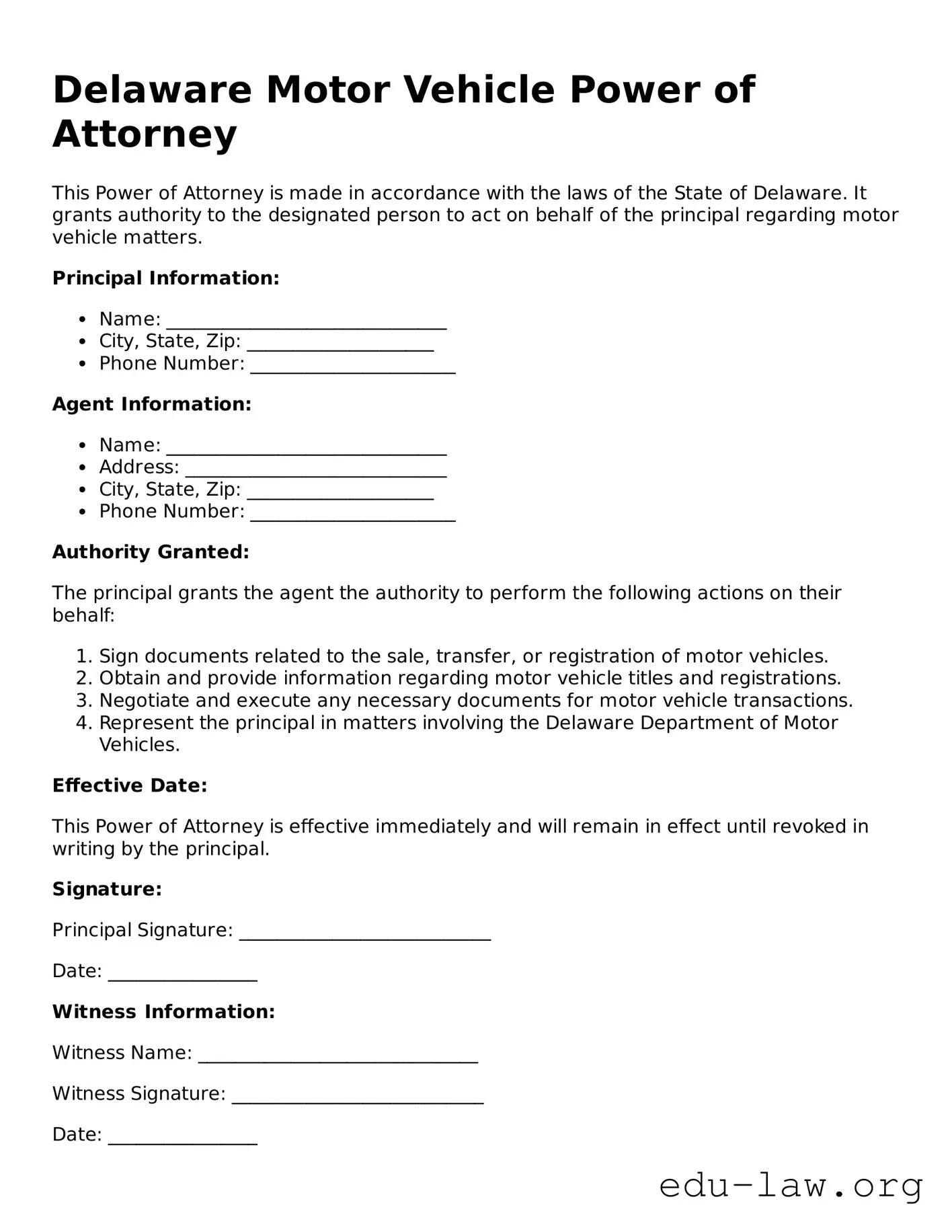
Delaware Motor Vehicle Power of Attorney
This Power of Attorney is made in accordance with the laws of the State of Delaware. It grants authority to the designated person to act on behalf of the principal regarding motor vehicle matters.
Principal Information:
Agent Information:
Authority Granted:
The principal grants the agent the authority to perform the following actions on their behalf:
Effective Date:
This Power of Attorney is effective immediately and will remain in effect until revoked in writing by the principal.
Signature:
Principal Signature: ___________________________
Date: ________________
Witness Information:
Witness Name: ______________________________
Witness Signature: ___________________________
Date: ________________
| Fact Name | Description |
|---|---|
| Purpose | The Delaware Motor Vehicle Power of Attorney form allows an individual to designate another person to handle motor vehicle transactions on their behalf. |
| Governing Law | This form is governed by the Delaware Code, specifically Title 21, Chapter 2301. |
| Signature Requirement | The form must be signed by the principal (the person granting authority) in the presence of a notary public. |
| Duration | The authority granted through this form remains effective until revoked or until the specified expiration date, if applicable. |
| Uses | Common uses include transferring vehicle titles, registering vehicles, and obtaining duplicate titles. |
Completing the Delaware Motor Vehicle Power of Attorney form is an important step for those who need to designate someone to act on their behalf regarding motor vehicle matters. After filling out the form, you will need to submit it to the appropriate authorities to ensure it is valid and recognized.
Once the form is filled out and notarized, ensure you keep a copy for yourself. The attorney-in-fact should also receive a copy to present when needed.
What is the Delaware Motor Vehicle Power of Attorney form?
The Delaware Motor Vehicle Power of Attorney form is a legal document that allows one person to authorize another individual to act on their behalf in matters related to motor vehicles. This can include tasks such as transferring ownership, registering a vehicle, or obtaining title documents. Essentially, it grants specific powers to the designated person, known as the agent, to handle vehicle-related transactions without the principal needing to be present.
Who can use the Delaware Motor Vehicle Power of Attorney form?
Any individual who owns a vehicle and wishes to delegate authority can use this form. This is particularly useful for those who may be unable to attend to vehicle-related matters due to distance, health issues, or scheduling conflicts. Whether you are a busy professional, a senior citizen, or someone who is temporarily out of state, this form can help ensure that your vehicle matters are managed efficiently.
How do I complete the Delaware Motor Vehicle Power of Attorney form?
To complete the form, you will need to provide specific information, including your name and contact details, as well as those of your designated agent. You must also describe the powers you are granting. It is crucial to be clear about what actions the agent can take on your behalf. After filling out the form, both you and your agent will need to sign it. Depending on the requirements, you may also need to have it notarized to ensure its validity.
Is the Delaware Motor Vehicle Power of Attorney form permanent?
This form is not necessarily permanent. The powers granted can be limited to specific transactions or a defined period. You can revoke the power of attorney at any time, as long as you notify your agent and any relevant parties, such as the Delaware Division of Motor Vehicles. If your circumstances change, you may also choose to create a new form to reflect your current wishes.
Where can I obtain the Delaware Motor Vehicle Power of Attorney form?
You can typically find the Delaware Motor Vehicle Power of Attorney form on the official website of the Delaware Division of Motor Vehicles or at their local offices. Additionally, legal stationery stores or online legal service providers may offer templates for this form. Always ensure that you are using the most current version of the form to comply with state regulations.
Incomplete Information: Many individuals fail to provide all required details. Ensure that all sections of the form are filled out completely.
Wrong Signature: Some people forget that the form must be signed by the principal. The signature should match the name on the form.
Not Notarizing the Document: A common oversight is neglecting to have the form notarized. This step is crucial for the document’s validity.
Choosing the Wrong Agent: Selecting an agent who is not trustworthy or capable can lead to issues. It is important to choose someone who understands the responsibilities.
Failing to Specify Powers: Some people do not clearly outline the powers granted to the agent. Be specific about what the agent can and cannot do.
Ignoring State Requirements: Each state has its own rules. Make sure to follow Delaware’s specific guidelines for the Power of Attorney form.
When dealing with the Delaware Motor Vehicle Power of Attorney form, it is often necessary to consider additional documents that may accompany it. These documents serve various purposes, ensuring that all legal aspects of vehicle transactions are addressed. Below is a list of commonly used forms and documents that can complement the Power of Attorney in Delaware.
Understanding these documents and their purposes can facilitate smoother transactions when handling vehicle matters in Delaware. Each form plays a crucial role in ensuring that all legal requirements are met, protecting the interests of both buyers and sellers.
The Delaware Motor Vehicle Power of Attorney form shares similarities with the General Power of Attorney. Both documents grant authority to an individual to act on behalf of another person. In the case of a General Power of Attorney, the scope can be much broader, allowing the agent to handle various financial and legal matters. This flexibility makes it suitable for situations where comprehensive management of affairs is necessary, such as during medical incapacitation or extended travel. However, the General Power of Attorney may not be as specific to vehicle-related transactions, which is where the Motor Vehicle Power of Attorney comes into play.
Another document that resembles the Delaware Motor Vehicle Power of Attorney is the Limited Power of Attorney. This type of power of attorney is designed to grant specific, limited powers to an agent, often for a particular transaction or purpose. For example, if someone needs assistance with the sale of a vehicle, a Limited Power of Attorney can be used to authorize an agent to complete that specific transaction. Like the Motor Vehicle Power of Attorney, it confines the agent's authority to a defined area, ensuring that the principal retains control over other aspects of their affairs.
The Durable Power of Attorney is also similar to the Delaware Motor Vehicle Power of Attorney in that it remains effective even if the principal becomes incapacitated. This document is particularly useful for individuals who want to ensure that their financial and legal matters continue to be managed in the event they can no longer make decisions for themselves. While the Durable Power of Attorney can cover a wide range of responsibilities, the Motor Vehicle Power of Attorney focuses solely on vehicle-related matters, making it a more targeted option for those specific needs.
The Vehicle Title Transfer form is another document that parallels the Delaware Motor Vehicle Power of Attorney. This form is used to officially transfer ownership of a vehicle from one party to another. While the Motor Vehicle Power of Attorney allows an agent to sign documents on behalf of the principal, the Vehicle Title Transfer form requires the actual transfer of title to complete the transaction. Both documents are crucial in facilitating vehicle transactions, but they serve different roles in the process.
Lastly, the Bill of Sale is comparable to the Delaware Motor Vehicle Power of Attorney in the context of vehicle transactions. A Bill of Sale serves as a legal document that records the sale of a vehicle, providing proof of ownership transfer. While the Motor Vehicle Power of Attorney enables an agent to act on behalf of the principal during such transactions, the Bill of Sale serves as a record of the agreement reached between the buyer and seller. Together, these documents play vital roles in ensuring that vehicle transactions are conducted legally and efficiently.
When filling out the Delaware Motor Vehicle Power of Attorney form, it is essential to follow specific guidelines to ensure the process goes smoothly. Below are some dos and don'ts to consider:
When dealing with the Delaware Motor Vehicle Power of Attorney form, several misconceptions can arise. Understanding these can help individuals navigate the process more effectively.
While the form is often associated with transferring ownership, it can also grant authority for various tasks, such as registering a vehicle, obtaining title documents, and handling other motor vehicle-related matters.
Many people believe that legal assistance is necessary to fill out the Power of Attorney. However, individuals can complete the form themselves as long as they understand the requirements and instructions.
This form does not grant indefinite power. The authority granted can be revoked at any time by the principal, and it typically ends when the specific task is completed or upon the principal's death.
The Delaware Motor Vehicle Power of Attorney form is specific to Delaware law. If you need to perform similar actions in another state, you must check that state's requirements and use the appropriate form.
While it is common for the vehicle owner to appoint an agent, other individuals with a legal interest in the vehicle may also have the authority to do so, depending on the circumstances.
Filling out and using the Delaware Motor Vehicle Power of Attorney form can be straightforward if you keep a few key points in mind. Here are some important takeaways: