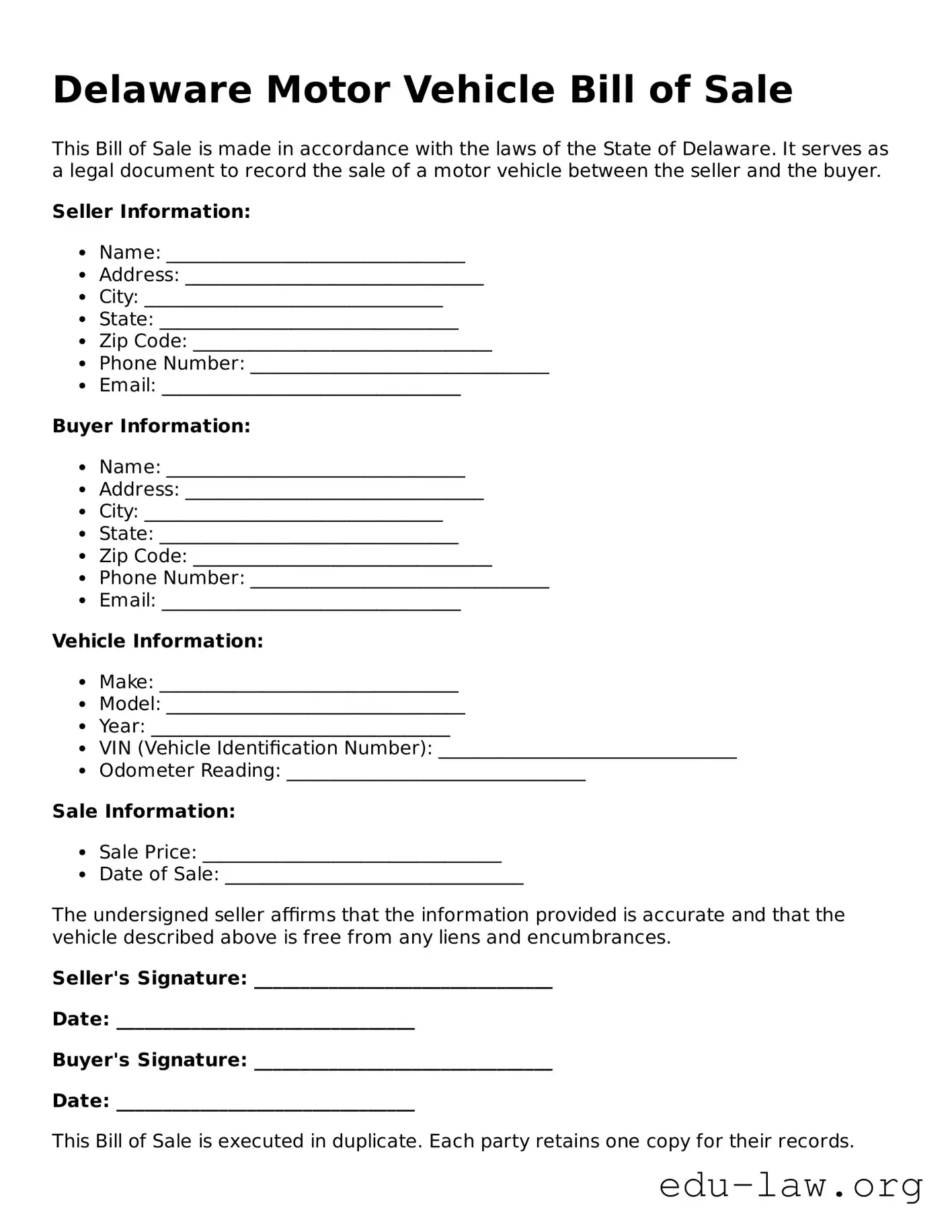
When buying or selling a vehicle in Delaware, having the right paperwork is essential to ensure a smooth transaction. One of the key documents involved in this process is the Delaware Motor Vehicle Bill of Sale form. This form serves as proof of the sale and includes important details such as the vehicle's make, model, year, and Vehicle Identification Number (VIN). It also captures the buyer's and seller's names and addresses, along with the sale price. By completing this form, both parties can protect their interests and provide a clear record of the transaction. Additionally, the Bill of Sale can be useful for registering the vehicle with the Delaware Division of Motor Vehicles, making it a vital step in the buying or selling process. Understanding the components of this form can help ensure that you have everything you need for a successful vehicle transfer.
Delaware Motor Vehicle Bill of Sale
This Bill of Sale is made in accordance with the laws of the State of Delaware. It serves as a legal document to record the sale of a motor vehicle between the seller and the buyer.
Seller Information:
Buyer Information:
Vehicle Information:
Sale Information:
The undersigned seller affirms that the information provided is accurate and that the vehicle described above is free from any liens and encumbrances.
Seller's Signature: ________________________________
Date: ________________________________
Buyer's Signature: ________________________________
Date: ________________________________
This Bill of Sale is executed in duplicate. Each party retains one copy for their records.
| Fact Name | Description |
|---|---|
| Purpose | The Delaware Motor Vehicle Bill of Sale is used to document the sale of a motor vehicle between a buyer and a seller. |
| Governing Law | This form is governed by Delaware state law, specifically under Title 21 of the Delaware Code. |
| Required Information | The form requires details such as the vehicle's make, model, year, VIN, and the sale price. |
| Signatures | Both the seller and buyer must sign the form to validate the transaction. |
| Notarization | Notarization is not required for the Bill of Sale in Delaware, but it is recommended for added security. |
| Usage | The Bill of Sale serves as proof of ownership transfer and can be used for registration purposes. |
| Record Keeping | It is advisable for both parties to keep a copy of the Bill of Sale for their records. |
| Form Availability | The Delaware Motor Vehicle Bill of Sale can be obtained online or from the Delaware Division of Motor Vehicles. |
| Additional Considerations | Buyers should verify the vehicle's title status and history before completing the sale. |
Once you have the Delaware Motor Vehicle Bill of Sale form, it is essential to fill it out accurately. This document is crucial for transferring ownership of a vehicle. Follow the steps below to ensure that all necessary information is provided correctly.
After completing the form, keep a copy for your records. The buyer may need this document for registration purposes. Ensure that all information is legible and accurate to avoid any issues during the transfer process.
What is a Delaware Motor Vehicle Bill of Sale form?
The Delaware Motor Vehicle Bill of Sale form is a document that serves as proof of the sale of a vehicle. It includes essential information about the buyer, the seller, and the vehicle being sold. This form is important for both parties as it provides a record of the transaction and can help in the transfer of ownership.
Why do I need a Bill of Sale when buying or selling a vehicle in Delaware?
A Bill of Sale is crucial for several reasons. First, it protects both the buyer and the seller by documenting the sale. Second, it helps the buyer establish ownership and register the vehicle with the Delaware Division of Motor Vehicles (DMV). Lastly, it can serve as proof of the transaction in case of any disputes or issues that arise later.
What information is required on the Delaware Motor Vehicle Bill of Sale form?
The form typically requires the following information: the names and addresses of both the buyer and the seller, the vehicle's make, model, year, and VIN (Vehicle Identification Number), the sale price, and the date of the transaction. Both parties should sign the form to validate it.
Do I need to have the Bill of Sale notarized?
No, in Delaware, notarization is not required for the Bill of Sale. However, having it notarized can add an extra layer of security and authenticity to the document, which may be beneficial if there are future disputes.
Where do I submit the Bill of Sale after completing it?
After filling out the Bill of Sale, the buyer should keep a copy for their records. The seller should also retain a copy. The buyer must present the Bill of Sale when registering the vehicle with the Delaware DMV. It is advisable to submit the form along with any other required documents during the registration process.
Incorrect Vehicle Information: One common mistake is failing to accurately fill in the vehicle details, such as the make, model, year, and Vehicle Identification Number (VIN). Double-checking this information is crucial.
Omitting Seller and Buyer Information: Both parties must provide their names and addresses. Leaving out any details can lead to confusion or issues during the transfer process.
Not Including the Sale Price: The bill of sale must state the sale price clearly. Forgetting to include this information can result in complications, especially for tax purposes.
Neglecting Signatures: Both the seller and buyer need to sign the document. If either signature is missing, the bill of sale may not be valid.
Failing to Date the Document: It’s important to include the date of the sale. A missing date can create ambiguity regarding when the transaction occurred.
Not Keeping Copies: After completing the bill of sale, both parties should keep a copy for their records. Failing to do so can lead to disputes in the future.
Ignoring State Requirements: Each state has specific requirements for a bill of sale. Not checking Delaware's regulations can lead to problems later on.
Using Incorrect Form: Ensure you are using the correct version of the Delaware Motor Vehicle Bill of Sale. Using an outdated or incorrect form can invalidate the transaction.
Not Providing Additional Documentation: Sometimes, additional documents, like a title transfer or emissions certificate, are necessary. Failing to include these can delay the registration process.
When buying or selling a vehicle in Delaware, several forms and documents may accompany the Motor Vehicle Bill of Sale. These documents help ensure that the transaction is legally sound and that both parties are protected. Below is a list of common forms that you might need.
Having these documents ready can streamline the buying or selling process and help avoid potential issues down the line. Always ensure that you understand the requirements specific to your situation to facilitate a smooth transaction.
The Delaware Motor Vehicle Bill of Sale form shares similarities with the General Bill of Sale. Both documents serve as a legal record of a transaction between a buyer and a seller. They outline essential details such as the item being sold, the purchase price, and the identities of both parties involved. While the General Bill of Sale can apply to various goods, the Motor Vehicle Bill of Sale is specifically tailored for vehicles, ensuring compliance with state regulations regarding vehicle ownership transfer.
Another document akin to the Motor Vehicle Bill of Sale is the Vehicle Title. The Vehicle Title is a legal document that proves ownership of a vehicle. When a vehicle is sold, the title must be signed over to the new owner, often accompanying the Bill of Sale. Both documents are critical in the transfer process, as the title provides proof of ownership while the Bill of Sale serves as a receipt for the transaction.
The Odometer Disclosure Statement is also similar to the Motor Vehicle Bill of Sale. This document is required in many states, including Delaware, when a vehicle is sold. It records the vehicle’s mileage at the time of sale, protecting buyers from odometer fraud. While the Bill of Sale documents the sale itself, the Odometer Disclosure Statement ensures transparency regarding the vehicle’s condition, thus safeguarding the interests of the buyer.
Lastly, the Application for Title is comparable to the Motor Vehicle Bill of Sale. This document is submitted to the state’s motor vehicle department to obtain a new title after a vehicle has been purchased. It requires information about the buyer, seller, and the vehicle itself. The Bill of Sale acts as proof of the transaction, while the Application for Title is the formal request to register the new owner. Both documents work in tandem to facilitate a smooth transfer of ownership.
When filling out the Delaware Motor Vehicle Bill of Sale form, it's essential to be careful and thorough. Here are some guidelines to help you navigate the process effectively.
By following these dos and don'ts, you can help ensure a smooth transaction and avoid potential complications down the line.
Understanding the Delaware Motor Vehicle Bill of Sale form can be challenging. Here are ten common misconceptions about this form, along with clarifications to help clear up any confusion.
This is not true. While it is commonly used for private transactions, the Bill of Sale can also be utilized in dealership sales and other formal transactions.
While it may not be legally required for every transaction, having a Bill of Sale is highly recommended as it provides proof of the transaction and details about the vehicle.
In Delaware, notarization is not required for the Bill of Sale, although having it notarized can add an extra layer of protection for both parties.
This is a misconception. While it is advisable to document sales, certain informal transactions may not require a Bill of Sale.
The Bill of Sale form can vary depending on the type of vehicle, such as cars, motorcycles, or boats. Ensure the correct form is used for the specific vehicle type.
Both the buyer and seller should sign the Bill of Sale to acknowledge the transaction and protect their interests.
This is incorrect. The Bill of Sale is a separate document and does not replace the vehicle title, which is necessary for ownership transfer.
While it typically documents completed sales, it can also be used to outline terms for pending transactions or deposits.
A Bill of Sale can still be used for vehicles with liens, but it is essential to disclose the lien status to the buyer.
This is a misconception. The Bill of Sale should include important vehicle details, such as the VIN, make, model, and year, to ensure clarity in the transaction.
By addressing these misconceptions, individuals can better navigate the process of buying or selling a vehicle in Delaware.
When completing and utilizing the Delaware Motor Vehicle Bill of Sale form, it is essential to keep several key points in mind: