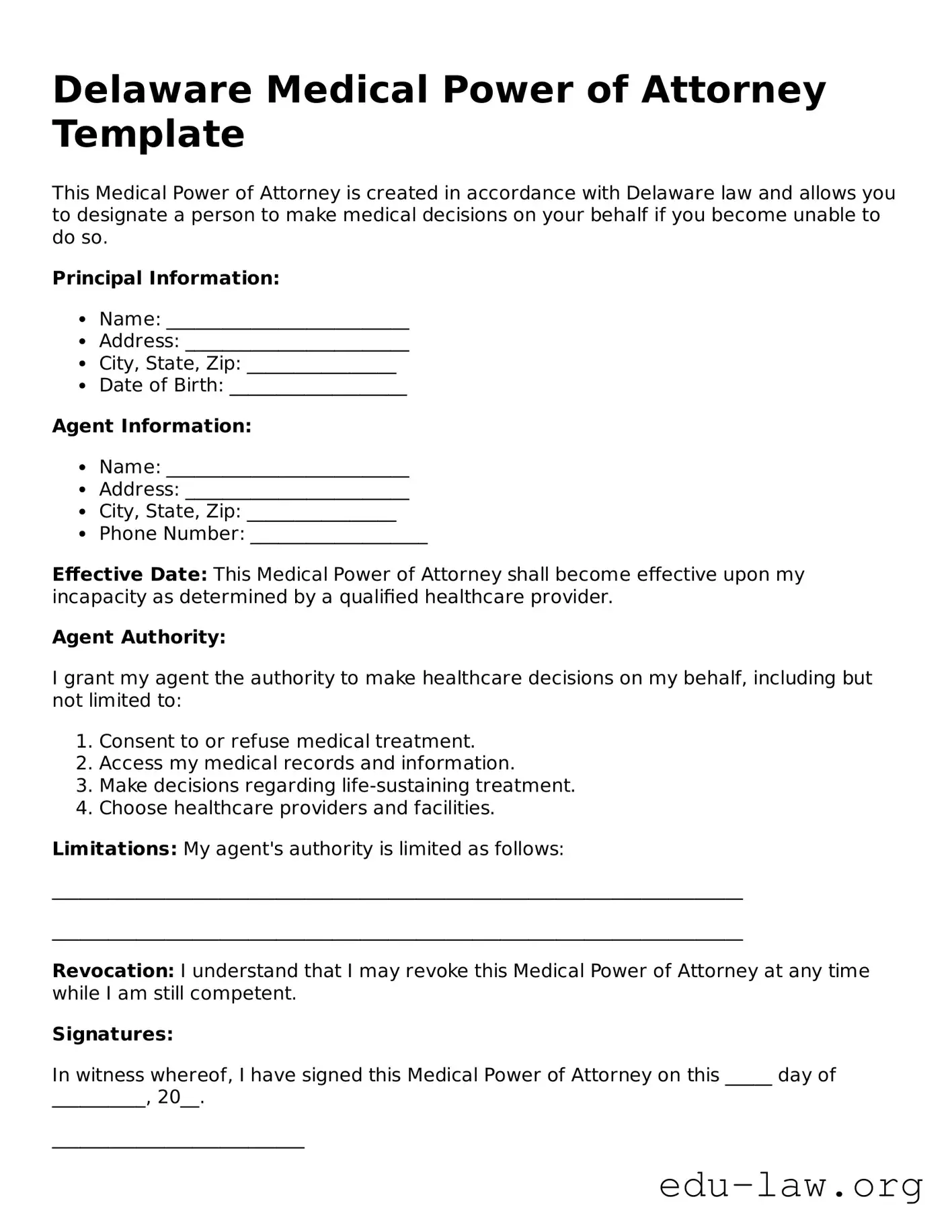
In Delaware, the Medical Power of Attorney form plays a crucial role in healthcare decision-making, especially when individuals are unable to communicate their wishes due to illness or injury. This legal document allows a person, known as the principal, to designate a trusted individual, referred to as the agent, to make medical decisions on their behalf. The form encompasses various aspects, including the scope of authority granted to the agent, which can range from making routine medical decisions to consenting to more significant procedures. It also addresses the importance of understanding the principal’s values and preferences, ensuring that the agent acts in accordance with their wishes. Importantly, the form can be tailored to include specific instructions or limitations, providing clarity in times of uncertainty. Completing this document requires careful consideration and should ideally involve discussions with both the chosen agent and healthcare professionals to ensure that all parties understand the principal's desires. By having a Medical Power of Attorney in place, individuals can secure peace of mind, knowing that their healthcare choices will be respected and upheld, even when they cannot voice them themselves.
Delaware Medical Power of Attorney Template
This Medical Power of Attorney is created in accordance with Delaware law and allows you to designate a person to make medical decisions on your behalf if you become unable to do so.
Principal Information:
Agent Information:
Effective Date: This Medical Power of Attorney shall become effective upon my incapacity as determined by a qualified healthcare provider.
Agent Authority:
I grant my agent the authority to make healthcare decisions on my behalf, including but not limited to:
Limitations: My agent's authority is limited as follows:
__________________________________________________________________________
__________________________________________________________________________
Revocation: I understand that I may revoke this Medical Power of Attorney at any time while I am still competent.
Signatures:
In witness whereof, I have signed this Medical Power of Attorney on this _____ day of __________, 20__.
___________________________
Signature of Principal
Witness Information:
Notary Public:
State of Delaware
County of _______________
Subscribed, sworn to, and acknowledged before me this _____ day of __________, 20__.
___________________________
Notary Public Signature
My Commission Expires: ______________
| Fact Name | Details |
|---|---|
| Definition | The Delaware Medical Power of Attorney form allows an individual to appoint someone to make healthcare decisions on their behalf if they are unable to do so. |
| Governing Law | This form is governed by the Delaware Code, Title 16, Chapter 2501. |
| Requirements | The form must be signed by the principal and witnessed by two individuals or acknowledged before a notary public. |
| Revocation | The principal can revoke the Medical Power of Attorney at any time, as long as they are competent to do so. |
Filling out the Delaware Medical Power of Attorney form is a straightforward process. Once completed, this document will allow you to designate someone to make medical decisions on your behalf if you are unable to do so. Follow the steps below to ensure the form is filled out correctly.
What is a Delaware Medical Power of Attorney?
A Delaware Medical Power of Attorney is a legal document that allows an individual, referred to as the principal, to designate another person, known as the agent, to make healthcare decisions on their behalf. This document becomes crucial in situations where the principal is unable to communicate their wishes due to illness or incapacity.
Who can be appointed as an agent in a Delaware Medical Power of Attorney?
Any competent adult can be appointed as an agent in a Delaware Medical Power of Attorney. This includes family members, friends, or trusted individuals. It is important to choose someone who understands the principal's values and healthcare preferences, as this person will be responsible for making significant medical decisions.
How does one create a Delaware Medical Power of Attorney?
To create a Delaware Medical Power of Attorney, the principal must complete the form provided by the state. This form must be signed by the principal in the presence of two witnesses or a notary public. The witnesses cannot be the appointed agent or related to the principal by blood or marriage. After completion, the document should be stored in a safe place, and copies should be provided to the agent and healthcare providers.
Can a Delaware Medical Power of Attorney be revoked?
Yes, a Delaware Medical Power of Attorney can be revoked at any time by the principal. To revoke the document, the principal must notify the agent and any healthcare providers who have a copy of the original form. It is advisable to create a new Medical Power of Attorney if the principal wishes to appoint a different agent or make changes to their healthcare preferences.
What decisions can an agent make under a Delaware Medical Power of Attorney?
The agent can make a wide range of healthcare decisions on behalf of the principal. This includes decisions about medical treatments, surgeries, end-of-life care, and more. The agent must act in accordance with the principal's wishes and best interests, as outlined in the Medical Power of Attorney document.
Is a Delaware Medical Power of Attorney the same as a Living Will?
No, a Delaware Medical Power of Attorney and a Living Will are not the same. A Medical Power of Attorney designates an agent to make healthcare decisions, while a Living Will outlines the principal's preferences regarding medical treatment in specific situations, particularly at the end of life. Both documents can work together to ensure that an individual's healthcare wishes are honored.
Not Choosing an Appropriate Agent: Individuals often select someone who may not be the best fit for making medical decisions. It is essential to choose someone trustworthy and capable of handling medical situations.
Failing to Specify Preferences: Many people neglect to clearly outline their healthcare preferences. Providing detailed instructions helps guide the agent in making decisions aligned with the individual's wishes.
Inadequate Witness Signatures: The form requires signatures from witnesses. Some individuals mistakenly think that just signing the document is enough, but proper witnessing is crucial for the document’s validity.
Not Updating the Document: Life circumstances change, yet many forget to update their Medical Power of Attorney. Regularly reviewing and revising the document ensures it reflects current wishes and relationships.
Ignoring State-Specific Requirements: Each state has unique regulations regarding medical powers of attorney. Failing to adhere to Delaware's specific requirements can render the document ineffective.
The Delaware Medical Power of Attorney form is an essential document that allows individuals to designate someone to make healthcare decisions on their behalf if they become unable to do so. However, several other forms and documents can complement this form, ensuring comprehensive planning for medical and financial matters.
Having these documents in place, alongside the Delaware Medical Power of Attorney, can provide peace of mind. They ensure that your healthcare and financial decisions align with your values and preferences, even when you cannot voice them yourself.
The Delaware Medical Power of Attorney form shares similarities with the Durable Power of Attorney. Both documents allow individuals to designate someone to make decisions on their behalf. However, while the Durable Power of Attorney can cover a broad range of decisions, including financial and legal matters, the Medical Power of Attorney specifically focuses on healthcare decisions. This distinction is crucial, as it ensures that the appointed agent can make informed medical choices when the principal is unable to do so, without extending authority into other areas of life.
Another document similar to the Delaware Medical Power of Attorney is the Living Will. A Living Will outlines an individual's preferences regarding medical treatment in situations where they cannot communicate their wishes. While the Medical Power of Attorney designates an agent to make decisions, the Living Will provides specific instructions on what treatments should or should not be administered. Together, these documents ensure that an individual's healthcare preferences are respected, whether through direct decision-making or pre-established guidelines.
The Advance Healthcare Directive is also comparable to the Delaware Medical Power of Attorney. This document combines elements of both the Medical Power of Attorney and the Living Will. It allows individuals to appoint a healthcare agent while also specifying their treatment preferences. This comprehensive approach ensures that the appointed agent has clear guidance on the individual’s wishes, making it easier for them to make decisions that align with the principal’s values and desires.
Lastly, the Healthcare Proxy is another document that serves a similar purpose. Like the Medical Power of Attorney, a Healthcare Proxy appoints someone to make medical decisions on behalf of another person. However, the term "proxy" often emphasizes the relationship between the principal and the agent, highlighting the trust placed in the appointed individual. Both documents aim to ensure that medical decisions reflect the wishes of the person who is unable to communicate, but the terminology and nuances may vary depending on state laws and personal preferences.
When filling out the Delaware Medical Power of Attorney form, it is essential to follow certain guidelines to ensure that the document is valid and reflects your wishes accurately. Below is a list of things you should and shouldn't do.
Understanding the Delaware Medical Power of Attorney form is crucial for making informed healthcare decisions. However, several misconceptions exist that can lead to confusion. Below are four common misconceptions along with clarifications.
This is not true. Anyone over the age of 18 can benefit from having a Medical Power of Attorney. Accidents or sudden illnesses can happen at any age, making it important for all adults to have a plan in place.
This is incorrect. A Medical Power of Attorney specifically pertains to healthcare decisions. Financial matters are addressed through a separate legal document, such as a Durable Power of Attorney.
This is a common misunderstanding. In Delaware, a Medical Power of Attorney does not require notarization. However, it must be signed by the principal and witnessed by two individuals who are not related to the principal or beneficiaries.
This is false. The principal can revoke or modify the Medical Power of Attorney at any time, as long as they are mentally competent. It is advisable to review the document periodically to ensure it reflects current wishes.
Here are some important points to consider when filling out and using the Delaware Medical Power of Attorney form: