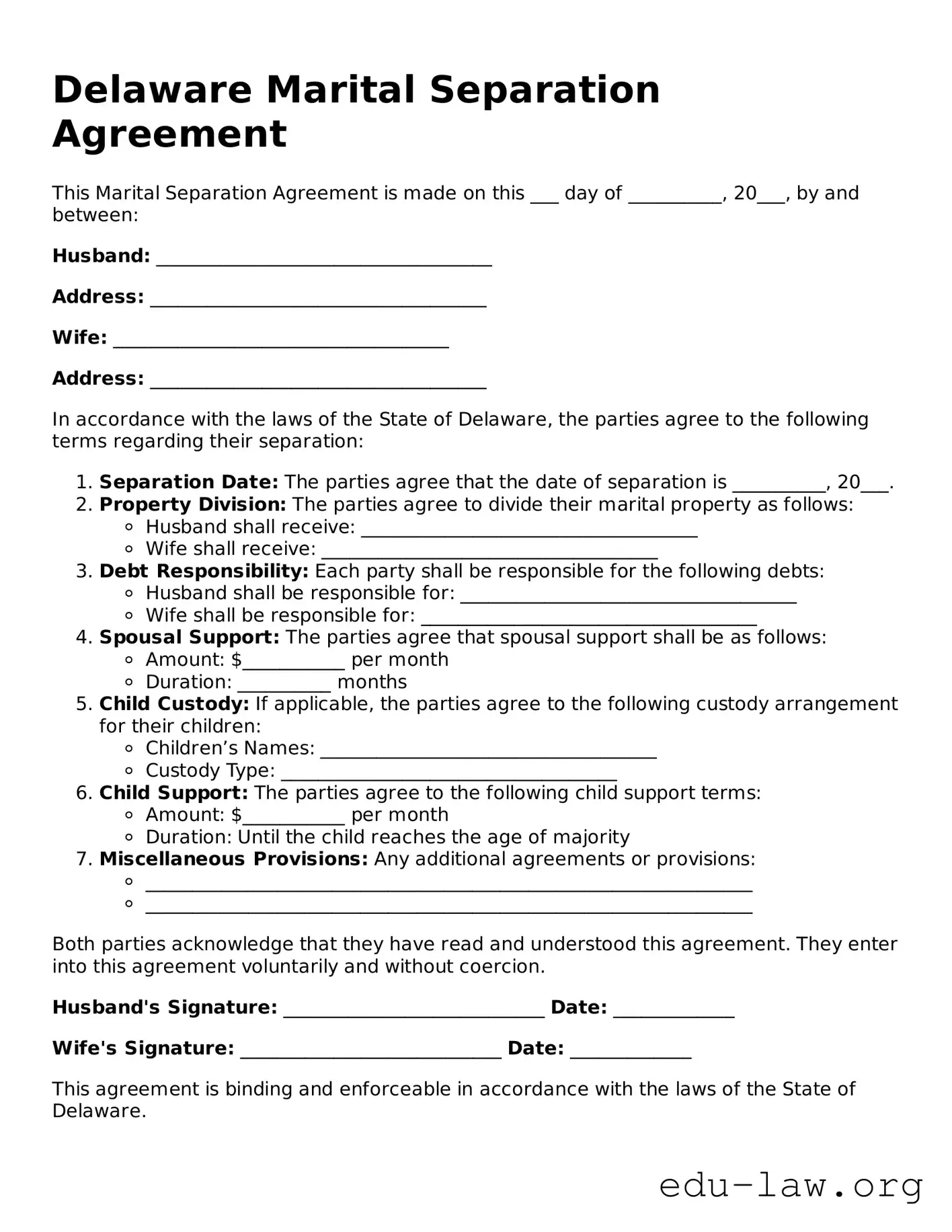
When couples in Delaware decide to live apart but wish to remain legally married, a Marital Separation Agreement can be a crucial step in defining their rights and responsibilities. This form serves as a comprehensive document that outlines the terms of separation, addressing key aspects such as the division of property, financial obligations, and child custody arrangements. By clearly specifying how assets will be divided and detailing any spousal support that may be necessary, the agreement helps to minimize misunderstandings and conflicts during what can be an emotionally charged time. Additionally, it provides a framework for co-parenting, ensuring that both parties are on the same page regarding their children's welfare. The Marital Separation Agreement is not just a legal formality; it represents a mutual understanding that can foster cooperation and communication between separating spouses as they navigate their new circumstances.
Delaware Marital Separation Agreement
This Marital Separation Agreement is made on this ___ day of __________, 20___, by and between:
Husband: ____________________________________
Address: ____________________________________
Wife: ____________________________________
Address: ____________________________________
In accordance with the laws of the State of Delaware, the parties agree to the following terms regarding their separation:
Both parties acknowledge that they have read and understood this agreement. They enter into this agreement voluntarily and without coercion.
Husband's Signature: ____________________________ Date: _____________
Wife's Signature: ____________________________ Date: _____________
This agreement is binding and enforceable in accordance with the laws of the State of Delaware.
| Fact Name | Description |
|---|---|
| Purpose | The Delaware Marital Separation Agreement form outlines the terms of separation between spouses, covering issues like property division, child custody, and support obligations. |
| Governing Law | This agreement is governed by Delaware law, specifically Title 13 of the Delaware Code, which addresses family law matters. |
| Mutual Agreement | Both spouses must agree to the terms outlined in the form for it to be valid and enforceable. This ensures that both parties have a say in the separation process. |
| Filing Requirements | While the agreement itself does not need to be filed with the court, it may be required in divorce proceedings to demonstrate the terms both parties have accepted. |
Once you have gathered all necessary information and documents, you can proceed to fill out the Delaware Marital Separation Agreement form. This form will guide you through outlining the terms of your separation, ensuring that both parties are clear on their responsibilities and rights.
After completing the form, it is advisable to review it carefully. Make sure all information is correct and that both parties understand and agree to the terms. Once confirmed, consider having the document notarized to add an extra layer of authenticity. After notarization, you can file the agreement with the appropriate court if required.
What is a Delaware Marital Separation Agreement?
A Delaware Marital Separation Agreement is a legal document that outlines the terms of a couple's separation. It typically covers issues like division of property, child custody, visitation rights, and financial support. This agreement allows both parties to clarify their rights and responsibilities while living apart, helping to prevent misunderstandings and disputes in the future.
How do I create a Marital Separation Agreement in Delaware?
To create a Marital Separation Agreement in Delaware, both parties should discuss and agree on the terms of their separation. It’s advisable to list all relevant issues, such as asset division and child arrangements, in detail. While you can draft the agreement yourself, consulting with a lawyer can ensure that the document meets legal standards and adequately protects your interests. Once both parties have agreed, the document should be signed and, if desired, notarized for added legal weight.
Is a Marital Separation Agreement legally binding?
Yes, a Marital Separation Agreement can be legally binding if it is properly executed. This means that both parties must voluntarily agree to the terms, and the agreement should be in writing and signed. However, it is important to note that if the agreement includes provisions related to child support or custody, a court may need to approve those terms to ensure they serve the best interests of the child.
Can a Marital Separation Agreement be modified?
Yes, a Marital Separation Agreement can be modified if both parties agree to the changes. It is essential to document any modifications in writing and have both parties sign the updated agreement. If the changes involve child custody or support, it may be necessary to seek court approval to ensure that the new terms are legally enforceable.
Incomplete Information: One common mistake is failing to provide all required personal information. Ensure that both parties' names, addresses, and other relevant details are accurately filled out.
Missing Signatures: It's essential that both spouses sign the agreement. Omitting one signature can lead to complications and delays in the process.
Vague Terms: Using unclear or ambiguous language can create misunderstandings later. Clearly define terms, especially regarding property division and custody arrangements.
Ignoring State Requirements: Each state has specific requirements for separation agreements. Failing to adhere to Delaware's regulations can invalidate the document.
Not Considering Future Changes: Life circumstances can change. It's important to include provisions for potential modifications to the agreement in the future.
Neglecting Financial Disclosure: Both parties should fully disclose their financial situations. Omitting assets or debts can lead to disputes down the line.
Rushing the Process: Taking the time to review and discuss the agreement thoroughly is crucial. Rushing can result in overlooked details that may cause issues later.
When navigating the complexities of marital separation, several forms and documents often accompany the Delaware Marital Separation Agreement. Each document plays a vital role in ensuring that the separation process is clear and legally binding. Below is a list of commonly used forms that can help facilitate this process.
Utilizing these forms alongside the Delaware Marital Separation Agreement can help ensure a smoother transition during a challenging time. Each document serves a specific purpose, addressing different aspects of the separation and protecting the rights and interests of both parties involved.
The Delaware Marital Separation Agreement is similar to the Divorce Settlement Agreement. Both documents outline the terms of a couple's separation, addressing issues such as property division, child custody, and support payments. While the Marital Separation Agreement may be used when a couple decides to live apart without formally ending the marriage, the Divorce Settlement Agreement is finalized when the marriage is legally dissolved.
Another document akin to the Delaware Marital Separation Agreement is the Child Custody Agreement. This document focuses specifically on the arrangements regarding the care and custody of children following a separation. It details visitation rights, decision-making responsibilities, and other important aspects of co-parenting, ensuring that the children's best interests are prioritized.
The Property Settlement Agreement shares similarities with the Marital Separation Agreement as it deals with the division of marital assets and debts. This document specifies how property will be divided between spouses, including real estate, bank accounts, and personal belongings. Both agreements aim to reach an amicable resolution regarding financial matters during separation.
The Spousal Support Agreement is also comparable. It addresses financial support one spouse may provide to the other after separation. This document outlines the amount and duration of support payments, ensuring that both parties understand their financial obligations during this transitional period.
The Parenting Plan is another related document. It provides a detailed framework for how parents will raise their children post-separation. This plan includes schedules for visitation, holidays, and communication methods, similar to the child custody provisions found in a Marital Separation Agreement.
The Non-Marital Separation Agreement can be likened to the Delaware Marital Separation Agreement as it is used by couples who are not legally married but wish to formalize their separation. This document addresses similar issues, such as asset division and child custody, but is tailored for cohabiting partners rather than married couples.
The Legal Separation Agreement is also relevant. It allows couples to formalize their separation without pursuing divorce immediately. This document includes terms regarding property, support, and child custody, similar to the Marital Separation Agreement, but it does not terminate the marriage.
The Cohabitation Agreement shares similarities as well. While typically used by unmarried couples, it can outline the rights and responsibilities of partners living together. This agreement can address property division and support, similar to the financial aspects covered in a Marital Separation Agreement.
Lastly, the Mediation Agreement is comparable. It may result from mediation sessions where couples negotiate the terms of their separation. This document captures the agreements reached during mediation and serves as a guide for both parties, similar to the terms outlined in a Marital Separation Agreement.
When filling out the Delaware Marital Separation Agreement form, it is important to follow certain guidelines to ensure accuracy and completeness. Below are five things you should and shouldn't do.
Following these guidelines can help avoid delays and complications in the separation process.
A marital separation agreement is a legal document that outlines the terms of separation but does not dissolve the marriage. Divorce formally ends the marriage, while separation allows couples to live apart without terminating their legal relationship.
While it’s possible to draft a separation agreement without legal help, having an attorney ensures that your rights are protected and that the document meets all legal requirements.
When properly executed, a separation agreement is legally binding. It can be enforced in court, so it’s crucial to take the process seriously.
A separation agreement does not automatically transition into a divorce. Couples must file for divorce separately if they wish to end the marriage.
Asset and debt division must be explicitly stated in the agreement. If not addressed, disputes may arise later, leading to complications.
While it is true that a signed agreement is binding, it can be modified if both parties agree to the changes. Documenting any modifications is essential to avoid future disputes.
Separation agreements are useful for all couples, regardless of whether children are involved. They help clarify financial responsibilities and living arrangements during separation.
When filling out and using the Delaware Marital Separation Agreement form, consider the following key takeaways: