Creating a Delaware Living Will is an essential step for anyone looking to ensure their healthcare wishes are honored in the event of a medical emergency. This legal document allows individuals to outline their preferences regarding medical treatment when they are unable to communicate these wishes themselves. It typically addresses critical decisions, such as whether to receive life-sustaining treatments or to be kept comfortable through palliative care. By specifying preferences for end-of-life care, individuals can relieve their loved ones from the burden of making difficult choices during emotionally challenging times. Additionally, the form must be signed and witnessed to be valid, ensuring that it meets Delaware's legal requirements. Understanding how to properly complete and execute this document is crucial for anyone who wants to maintain control over their medical decisions, even when they are unable to voice them directly.
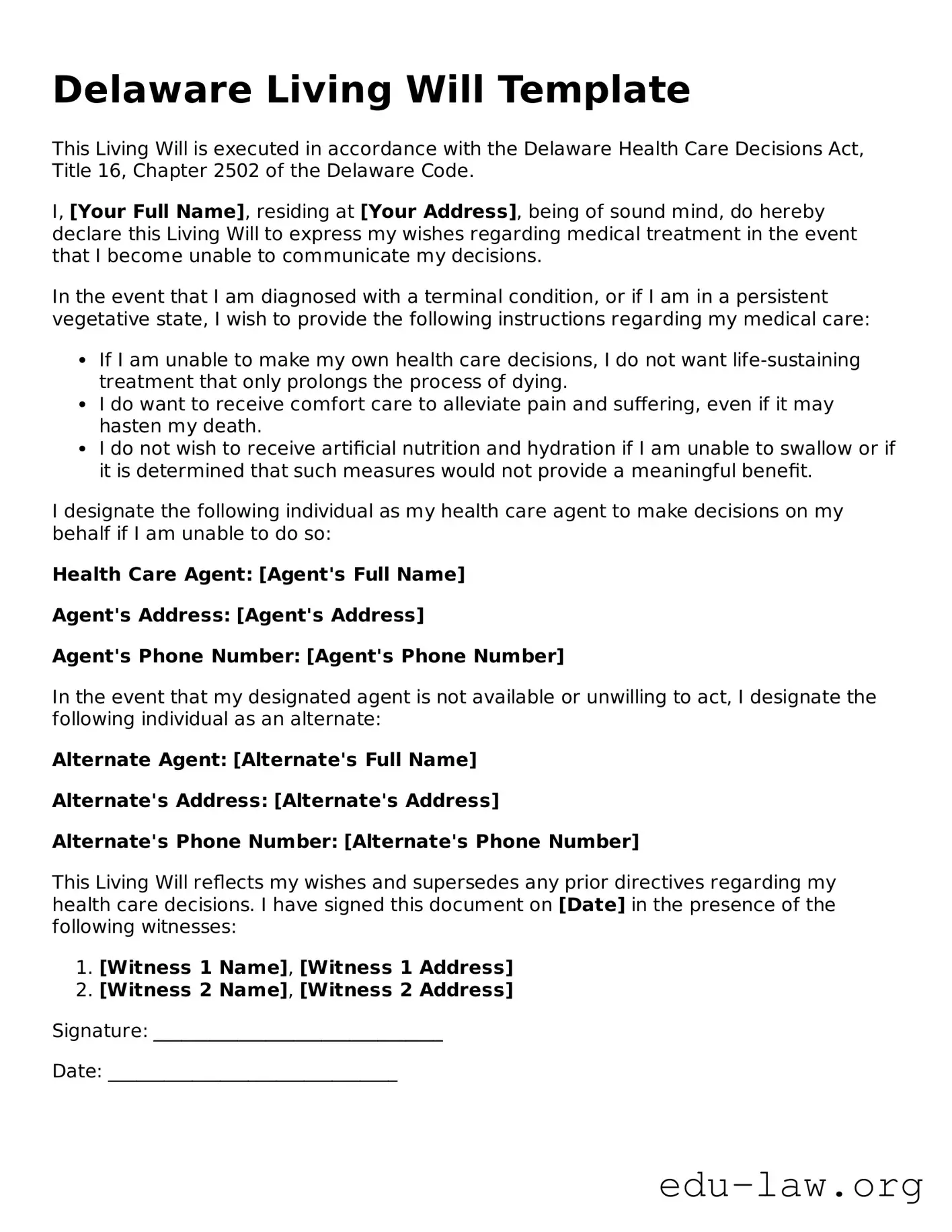
Delaware Living Will Template
This Living Will is executed in accordance with the Delaware Health Care Decisions Act, Title 16, Chapter 2502 of the Delaware Code.
I, [Your Full Name], residing at [Your Address], being of sound mind, do hereby declare this Living Will to express my wishes regarding medical treatment in the event that I become unable to communicate my decisions.
In the event that I am diagnosed with a terminal condition, or if I am in a persistent vegetative state, I wish to provide the following instructions regarding my medical care:
I designate the following individual as my health care agent to make decisions on my behalf if I am unable to do so:
Health Care Agent: [Agent's Full Name]
Agent's Address: [Agent's Address]
Agent's Phone Number: [Agent's Phone Number]
In the event that my designated agent is not available or unwilling to act, I designate the following individual as an alternate:
Alternate Agent: [Alternate's Full Name]
Alternate's Address: [Alternate's Address]
Alternate's Phone Number: [Alternate's Phone Number]
This Living Will reflects my wishes and supersedes any prior directives regarding my health care decisions. I have signed this document on [Date] in the presence of the following witnesses:
Signature: _______________________________
Date: _______________________________
| Fact Name | Description |
|---|---|
| Governing Law | The Delaware Living Will is governed by Title 16, Chapter 2501 of the Delaware Code. |
| Purpose | This form allows individuals to express their wishes regarding medical treatment in the event they become unable to communicate. |
| Requirements | The form must be signed by the individual and witnessed by two adults, neither of whom can be a relative or entitled to any part of the estate. |
| Revocation | A Living Will can be revoked at any time by the individual, either verbally or in writing. |
Completing a Delaware Living Will form is an important step in ensuring that your healthcare wishes are respected in the event that you are unable to communicate them yourself. This process involves careful consideration and clarity about your preferences regarding medical treatment. Below are the steps to guide you through filling out the form.
What is a Delaware Living Will?
A Delaware Living Will is a legal document that allows individuals to express their wishes regarding medical treatment in the event they become unable to communicate those wishes themselves. This document is particularly important for situations involving terminal illness or irreversible conditions. By outlining preferences for life-sustaining treatment, individuals can ensure that their healthcare aligns with their values and desires, even when they cannot voice them directly.
How do I create a Living Will in Delaware?
Creating a Living Will in Delaware involves several straightforward steps. First, you should consider your preferences regarding medical treatment and end-of-life care. Once you have a clear understanding of your wishes, you can draft the Living Will document. While there are templates available online, it may be beneficial to consult with a healthcare professional or an attorney to ensure that the document meets all legal requirements. After completing the document, it must be signed in the presence of two witnesses, who cannot be your immediate family members or beneficiaries. Finally, it is advisable to share copies of the Living Will with your healthcare providers and loved ones to ensure that your wishes are known and respected.
Can I change or revoke my Living Will in Delaware?
Yes, individuals in Delaware have the right to change or revoke their Living Will at any time, as long as they are mentally competent to do so. To revoke a Living Will, you can simply destroy the document or create a new one that explicitly states your updated wishes. It is essential to communicate any changes to your healthcare providers and family members to avoid confusion regarding your treatment preferences. Keeping your Living Will up to date ensures that it reflects your current values and desires, particularly as circumstances in your life may change.
What happens if I do not have a Living Will in Delaware?
If an individual does not have a Living Will in place, medical decisions may be made by family members or healthcare providers without knowing the person's specific wishes. This can lead to uncertainty and potential conflict among family members about what the individual would have wanted. In Delaware, the law provides a hierarchy of individuals who can make medical decisions on behalf of someone who is incapacitated, but this may not always align with the person's preferences. Therefore, having a Living Will is a proactive way to ensure that your medical care aligns with your values, providing clarity and peace of mind for both you and your loved ones.
Not understanding the purpose of the Living Will. Many individuals fill out the form without fully grasping its significance. A Living Will is designed to express your wishes regarding medical treatment in the event that you become unable to communicate. Without a clear understanding, one may inadvertently omit crucial details.
Failing to discuss wishes with family. It’s common for people to fill out the form in isolation. Not discussing your preferences with family members can lead to confusion or disagreements later. Open conversations can ensure that your loved ones understand your desires.
Not being specific enough. Vague language can lead to misinterpretation. When filling out the form, it’s important to be as specific as possible about your wishes. General statements may not adequately convey your intentions.
Overlooking signature requirements. A Living Will is not valid unless it is properly signed. Individuals sometimes forget to sign or date the document, rendering it ineffective. Always double-check that all necessary signatures are in place.
Neglecting to update the document. Life circumstances change, and so can your preferences regarding medical treatment. Failing to review and update your Living Will can lead to outdated instructions that no longer reflect your current wishes.
Not designating a healthcare proxy. While a Living Will outlines your wishes, it may also be beneficial to appoint someone as your healthcare proxy. This person can make decisions on your behalf if you are unable to do so. Omitting this step can complicate situations in critical moments.
Forgetting to store the document safely. After completing the Living Will, it’s essential to keep it in a secure yet accessible location. If the document cannot be found when needed, your wishes may not be honored. Consider giving copies to trusted family members or your healthcare provider.
In addition to the Delaware Living Will form, several other documents can complement an individual's advance care planning. These documents help ensure that a person's healthcare preferences are respected and provide clarity in various situations. Below is a list of commonly used forms and documents.
Understanding these documents can significantly impact an individual's ability to communicate their healthcare preferences effectively. Each document serves a specific purpose, contributing to a comprehensive approach to advance care planning.
A Health Care Proxy is a document that allows you to designate someone to make medical decisions on your behalf if you become unable to do so. Like a Living Will, it focuses on your healthcare preferences, but it emphasizes appointing a trusted individual rather than detailing specific medical treatments. Both documents work together to ensure your wishes are honored when you cannot communicate them directly.
An Advance Directive combines elements of a Living Will and a Health Care Proxy. It provides instructions for medical care while also appointing a person to make decisions for you. This dual approach ensures that your healthcare preferences are clear and that someone is empowered to act on your behalf, making it a comprehensive option for end-of-life planning.
A Do Not Resuscitate (DNR) Order is a specific type of advance directive that instructs healthcare providers not to perform CPR if your heart stops or you stop breathing. While a Living Will covers a broader range of medical decisions, a DNR focuses solely on resuscitation efforts. Both documents express your wishes regarding life-sustaining treatment, but they do so in different contexts.
An Organ Donation Consent form allows you to specify your wishes regarding organ donation after death. While a Living Will addresses your medical treatment preferences, it may also include your intentions about organ donation. Both documents reflect your values and desires concerning end-of-life issues, ensuring that your choices are respected.
A Physician Orders for Life-Sustaining Treatment (POLST) form is a medical order that specifies your preferences for life-sustaining treatments. It is similar to a Living Will but is more actionable, as it is signed by a physician and serves as a medical order in emergencies. Both documents aim to communicate your healthcare wishes, but a POLST is designed for immediate use in clinical settings.
A Mental Health Advance Directive allows individuals to outline their preferences for mental health treatment in the event they are unable to make decisions. Like a Living Will, it ensures that your wishes are known and respected. Both documents provide guidance to healthcare providers, but a Mental Health Advance Directive specifically addresses mental health scenarios.
A Funeral Planning Directive provides instructions regarding your funeral and burial preferences. While it may not directly relate to medical treatment, it is part of end-of-life planning. Similar to a Living Will, it allows you to express your wishes and relieve your loved ones from the burden of making difficult decisions during a challenging time.
An End-of-Life Care Plan outlines your preferences for care as you approach the end of life. It encompasses various aspects of your treatment and comfort, similar to a Living Will. Both documents serve to communicate your values and desires, ensuring that your care aligns with your beliefs and preferences.
A Guardianship Designation is a legal document that appoints someone to care for your minor children or dependents if you become incapacitated. While it does not address medical decisions, it is part of a comprehensive approach to planning for unforeseen circumstances. Both documents emphasize the importance of having trusted individuals in place to make decisions aligned with your wishes.
When filling out the Delaware Living Will form, it is essential to approach the task with care and consideration. This document outlines your preferences for medical treatment in the event that you become unable to communicate your wishes. Here are some important dos and don'ts to keep in mind:
By following these guidelines, you can ensure that your Living Will accurately reflects your desires and can be effectively utilized when needed.
Understanding a Delaware Living Will is important for making informed decisions about healthcare preferences. Here are ten common misconceptions about this document:
A Living Will specifically addresses healthcare decisions, while a Last Will and Testament deals with the distribution of assets after death.
A Living Will can be created at any time, as long as you are of sound mind. It's best to prepare it before a health crisis occurs.
People of all ages can benefit from having a Living Will. Unexpected health issues can arise at any time.
To be valid, a Living Will must be signed and witnessed according to Delaware state laws.
You can update or revoke your Living Will at any time, as long as you are mentally competent to do so.
While it provides guidance, healthcare providers may still consider other factors. It’s important to communicate your wishes to family and doctors.
It’s crucial to discuss your Living Will with family members. They should understand your preferences to advocate for you effectively.
It can also cover preferences for medical treatments and interventions in various health situations, not just at the end of life.
A Living Will is just one part of a complete healthcare plan. Consider also appointing a healthcare proxy to make decisions on your behalf.
While each state has its own laws, many states recognize Living Wills created in other states, provided they meet specific criteria.
When it comes to filling out and using the Delaware Living Will form, there are several important points to keep in mind. This document is essential for expressing your healthcare wishes in case you become unable to communicate them. Here are key takeaways to consider:
Filling out a Living Will is a proactive step in planning for your future healthcare needs. Taking the time to consider and document your wishes can provide peace of mind for both you and your loved ones.