For families considering homeschooling in Delaware, the process begins with the completion of a Homeschool Letter of Intent form. This essential document serves as a formal notification to the state that a parent or guardian intends to educate their child at home. It is important to include specific details, such as the child's name, age, and the educational approach that will be used. The form also requires the parent or guardian to affirm their commitment to providing a comprehensive educational experience. Submitting this letter is a crucial step in complying with Delaware's homeschooling laws, ensuring that families can begin their educational journey with clarity and confidence. Additionally, understanding the requirements and implications of this form can help parents navigate the homeschooling landscape more effectively, setting the stage for a successful educational experience tailored to their child's needs.
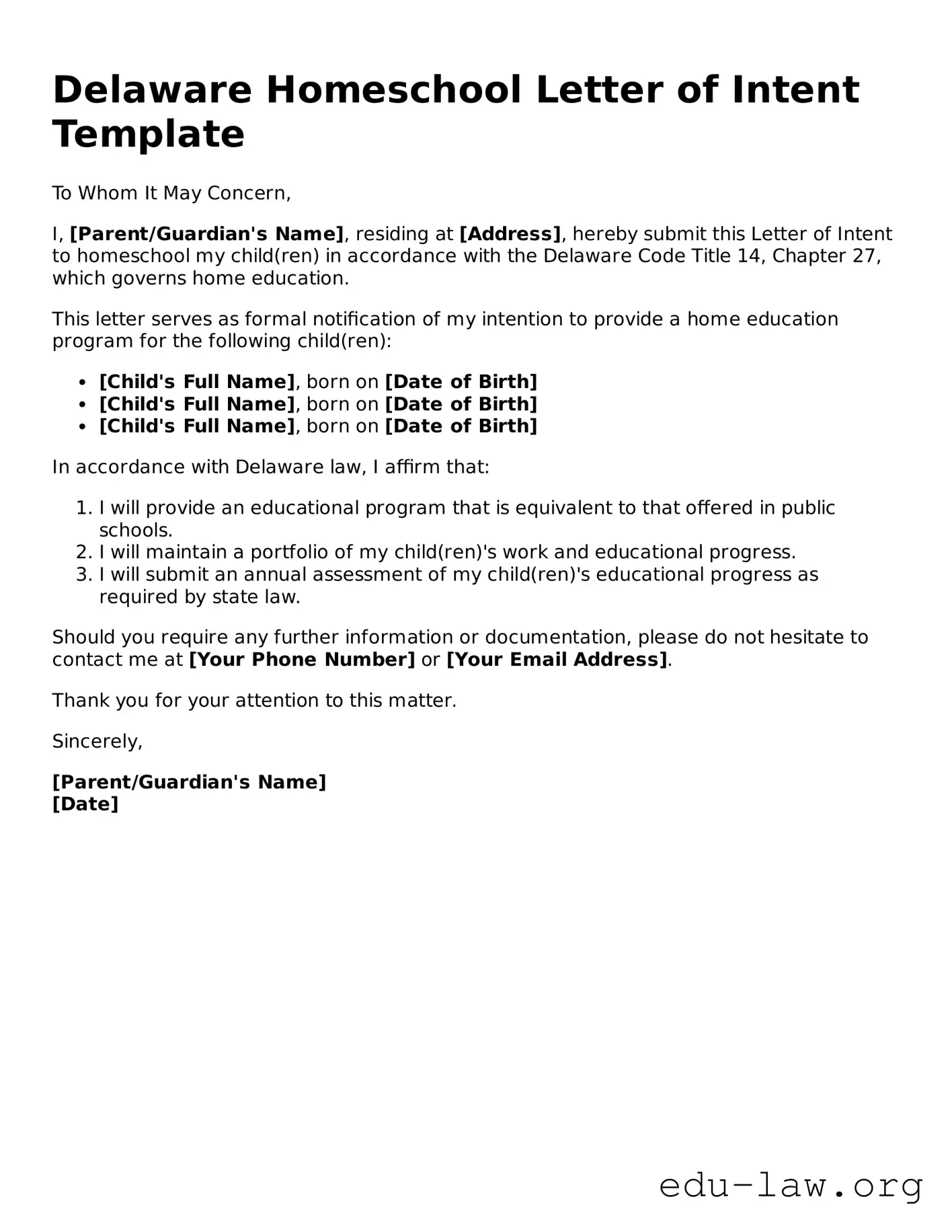
Delaware Homeschool Letter of Intent Template
To Whom It May Concern,
I, [Parent/Guardian's Name], residing at [Address], hereby submit this Letter of Intent to homeschool my child(ren) in accordance with the Delaware Code Title 14, Chapter 27, which governs home education.
This letter serves as formal notification of my intention to provide a home education program for the following child(ren):
In accordance with Delaware law, I affirm that:
Should you require any further information or documentation, please do not hesitate to contact me at [Your Phone Number] or [Your Email Address].
Thank you for your attention to this matter.
Sincerely,
[Parent/Guardian's Name]
[Date]
| Fact Name | Description |
|---|---|
| Purpose | The Delaware Homeschool Letter of Intent form is used to officially notify the state of a parent's intent to homeschool their child. |
| Governing Law | The form is governed by Delaware Code Title 14, Chapter 270, which outlines the requirements for homeschooling in the state. |
| Submission Deadline | Parents must submit the Letter of Intent at least 15 days before beginning their homeschool program. |
| Required Information | The form requires basic information, including the child's name, age, and the educational plan being proposed. |
| Annual Review | Families must submit an annual assessment of the child's progress to the state after the first year of homeschooling. |
| Notification of Changes | If there are any changes to the homeschooling plan or the child's status, parents must notify the state promptly. |
| Resources | Delaware provides resources and support for homeschooling families, including local support groups and educational materials. |
After you complete the Delaware Homeschool Letter of Intent form, you'll submit it to your local school district. The district will then review your submission and confirm that you have met the necessary requirements to begin homeschooling your child.
What is the Delaware Homeschool Letter of Intent form?
The Delaware Homeschool Letter of Intent form is a document that parents or guardians must submit to the state to officially notify them of their decision to homeschool their children. This form serves as a formal declaration that you are choosing to educate your child at home rather than in a traditional school setting.
Who needs to file the Letter of Intent?
Any parent or guardian who intends to homeschool a child in Delaware must file this letter. This includes children who are entering kindergarten as well as those who are already enrolled in public or private schools. It’s essential to file the letter at the beginning of your homeschooling journey.
When should I submit the Letter of Intent?
The Letter of Intent should be submitted at least 14 days before you begin homeschooling. If your child is currently enrolled in a public school, it’s advisable to file the letter before withdrawing them from that school. This ensures that you meet the state's requirements and allows for a smooth transition to homeschooling.
What information is required on the form?
The form typically requires basic information such as the name and age of the child, the address of the homeschooling family, and the name of the parent or guardian. You may also need to provide details about the educational curriculum you plan to use, although this can vary by district.
Is there a fee to file the Letter of Intent?
No, there is no fee associated with filing the Delaware Homeschool Letter of Intent. This form is a simple notification process, and the state does not charge parents for submitting it. However, you may incur costs related to educational materials or resources as you begin your homeschooling journey.
What happens after I submit the Letter of Intent?
Once you submit the Letter of Intent, the state will acknowledge your notification. You are then free to begin homeschooling your child. It’s important to keep a copy of the letter for your records. Additionally, you should be prepared to maintain educational records and assessments as required by Delaware law.
Can I change my mind after submitting the Letter of Intent?
Yes, you can change your mind after submitting the Letter of Intent. If you decide to enroll your child back into a traditional school, simply notify the school and follow their enrollment procedures. It's a good idea to communicate with both the school and any homeschooling organizations you may be involved with to ensure a smooth transition.
When filling out the Delaware Homeschool Letter of Intent form, it’s important to be thorough and accurate. Here are eight common mistakes that people often make:
Each of these mistakes can lead to delays or complications in the homeschooling process. It’s essential to double-check all information before submission to ensure a smooth experience.
When parents decide to homeschool their children in Delaware, they must submit a Homeschool Letter of Intent. This form initiates the homeschooling process, but several other documents may also be necessary to ensure compliance with state regulations and to facilitate a smooth homeschooling experience. Below is a list of additional forms and documents often used in conjunction with the Homeschool Letter of Intent.
These documents collectively support the homeschooling process and help ensure that educational standards are met. By being organized and prepared, parents can create a successful and enriching learning environment for their children.
The Delaware Homeschool Letter of Intent form shares similarities with the Parent's Notice of Intent to Homeschool, commonly used in various states. This document serves as a formal declaration by parents or guardians to educate their children at home. Much like the Delaware form, it requires basic information about the child, including their name and age, as well as the educational plan that will be implemented. Both documents emphasize the parents' commitment to providing an adequate education, reflecting a shared goal of ensuring that children receive quality learning experiences outside of traditional schools.
Another document that resembles the Delaware Homeschool Letter of Intent is the Educational Plan Submission form. This form is often required in states where parents must outline their curriculum and teaching methods. Similar to the Letter of Intent, the Educational Plan Submission focuses on the educational framework that parents intend to follow. It highlights subjects to be taught, resources to be used, and the overall approach to learning. Both documents aim to ensure that parents are prepared and organized in their homeschooling efforts, providing reassurance to educational authorities about the child's learning environment.
The Notification of Intent to Homeschool is another document that parallels the Delaware form. This notification is typically sent to local school districts to inform them of the parents' decision to homeschool. Like the Delaware Homeschool Letter of Intent, this notification often requires basic information about the child and the parents’ educational philosophy. The purpose of both documents is to maintain transparency between families and educational authorities, ensuring that children are receiving an appropriate education while respecting the parents' rights to choose their educational path.
Lastly, the Homeschool Registration Form bears resemblance to the Delaware Homeschool Letter of Intent. This form is often used in states that require parents to register their homeschooling status with local education agencies. Both documents seek to establish a formal record of the parents' intent to homeschool. They typically include information such as the child's name, age, and the educational approach the family will take. By submitting either form, parents demonstrate their dedication to fulfilling educational requirements while exercising their right to choose how their children are educated.
When filling out the Delaware Homeschool Letter of Intent form, it’s important to follow certain guidelines to ensure a smooth process. Here are some things you should and shouldn't do:
By following these guidelines, you can help ensure that your homeschooling journey starts off on the right foot. It's essential to stay organized and informed throughout the process.
When considering homeschooling in Delaware, many parents encounter various misconceptions about the Homeschool Letter of Intent form. Understanding these misconceptions can help clarify the process and ensure compliance with state regulations. Below is a list of nine common misunderstandings:
This is false. Homeschooling is legal in Delaware, provided parents follow the appropriate guidelines and submit the required documentation.
While the Letter of Intent is essential, it is not the sole requirement. Parents must also maintain educational records and submit an annual assessment.
Delaware law does not require parents to have teaching credentials, but they must ensure their children receive a quality education.
This is misleading. Parents can withdraw their intent to homeschool at any time, but they must notify the state.
While the form must include specific information, there is flexibility in how it is presented. As long as the necessary details are included, the format can vary.
This is incorrect. Parents can modify their educational plans as needed, but they should keep the state informed of any significant changes.
Delaware does not actively monitor homeschooling families. However, parents are responsible for keeping accurate records and assessments.
This is a misconception. Families from all walks of life can choose to homeschool, regardless of their background or educational philosophy.
While it can be a rewarding experience, homeschooling requires careful planning, commitment, and organization to ensure educational success.
By dispelling these misconceptions, parents can approach homeschooling in Delaware with a clearer understanding of their responsibilities and the opportunities available to them.
When filling out and using the Delaware Homeschool Letter of Intent form, several important points should be considered: