The Delaware Hold Harmless Agreement is a vital legal document that plays a significant role in various transactions and agreements, particularly in real estate and construction. This form serves to protect one party from liability for any damages or injuries that may occur during the execution of a project or activity. By signing this agreement, one party agrees to assume responsibility for certain risks, thereby shielding the other party from potential legal claims. Key elements of the form include the identification of the parties involved, a clear outline of the activities covered, and specific language detailing the extent of the liability being waived. Additionally, the agreement often includes provisions for indemnification, which further clarifies the responsibilities of each party in the event of an incident. Understanding the nuances of the Delaware Hold Harmless Agreement is essential for individuals and businesses looking to navigate the complexities of liability and risk management effectively.
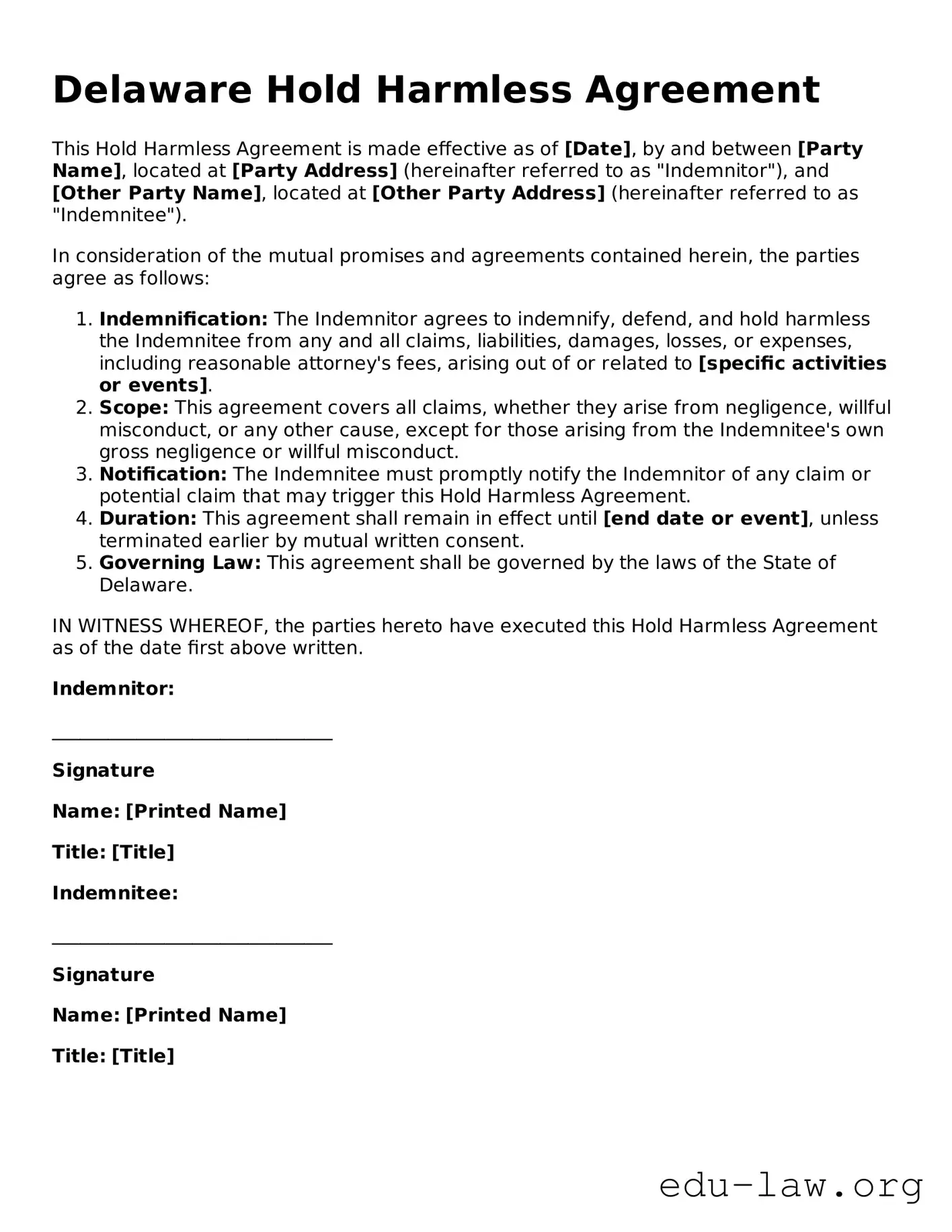
Delaware Hold Harmless Agreement
This Hold Harmless Agreement is made effective as of [Date], by and between [Party Name], located at [Party Address] (hereinafter referred to as "Indemnitor"), and [Other Party Name], located at [Other Party Address] (hereinafter referred to as "Indemnitee").
In consideration of the mutual promises and agreements contained herein, the parties agree as follows:
IN WITNESS WHEREOF, the parties hereto have executed this Hold Harmless Agreement as of the date first above written.
Indemnitor:
______________________________
Signature
Name: [Printed Name]
Title: [Title]
Indemnitee:
______________________________
Signature
Name: [Printed Name]
Title: [Title]
| Fact Name | Description |
|---|---|
| Purpose | The Delaware Hold Harmless Agreement is designed to protect one party from legal liability for damages or injuries incurred by another party. |
| Governing Law | This agreement is governed by the laws of the State of Delaware. |
| Parties Involved | Typically, the agreement involves at least two parties: the indemnitor (the party agreeing to hold harmless) and the indemnitee (the party being protected). |
| Scope of Agreement | The agreement may cover various liabilities, including property damage, personal injury, and legal fees, depending on the specific terms outlined. |
| Enforceability | For the agreement to be enforceable, it must be clear, specific, and voluntarily signed by both parties. |
| Limitations | Certain limitations may apply, such as exclusions for gross negligence or willful misconduct, which are often not covered by these agreements. |
| Use Cases | This form is commonly used in various situations, including construction projects, rental agreements, and events where one party may be exposed to risk. |
| Legal Advice | It is advisable for parties to seek legal counsel before entering into a Hold Harmless Agreement to ensure their rights and obligations are fully understood. |
After obtaining the Delaware Hold Harmless Agreement form, you will need to complete it accurately to ensure its effectiveness. Following these steps will help you fill out the form properly, allowing you to proceed with your intentions smoothly.
Once the form is filled out and signed, ensure that all parties receive their copies. Keeping a record of the agreement is essential for future reference.
What is a Delaware Hold Harmless Agreement?
A Delaware Hold Harmless Agreement is a legal document designed to protect one party from liability or claims arising from specific activities or events. This agreement ensures that one party agrees not to hold the other party responsible for any damages, injuries, or losses that may occur. It is commonly used in various situations, such as rental agreements, construction contracts, or event planning, where one party may face risks associated with the actions of another party.
Who typically uses a Hold Harmless Agreement in Delaware?
Individuals and businesses often use Hold Harmless Agreements in Delaware. Property owners, contractors, event organizers, and service providers are among the most common users. For example, a property owner may require tenants to sign this agreement to limit their liability for accidents that occur on the premises. Similarly, a contractor may ask clients to sign one to protect against claims arising from construction-related activities.
What are the key components of a Hold Harmless Agreement?
A typical Hold Harmless Agreement includes several important elements. First, it identifies the parties involved in the agreement. Next, it outlines the specific activities or situations covered by the agreement. Additionally, it clarifies the extent of liability that is being waived and may include any relevant terms or conditions. Finally, it usually requires the signatures of both parties to indicate their agreement to the terms.
Is a Hold Harmless Agreement enforceable in Delaware?
Yes, Hold Harmless Agreements are generally enforceable in Delaware, provided they are drafted clearly and comply with state laws. However, courts may not enforce these agreements if they are deemed overly broad or if they attempt to waive liability for gross negligence or intentional misconduct. It is essential to ensure that the agreement is reasonable and specific to the circumstances involved.
Can a Hold Harmless Agreement be modified after it is signed?
Yes, a Hold Harmless Agreement can be modified after it has been signed, but both parties must agree to the changes. Any modifications should be documented in writing and signed by both parties to ensure clarity and enforceability. It is advisable to consult with a legal professional when making changes to ensure that the revised agreement remains valid and effective.
What are the potential risks of signing a Hold Harmless Agreement?
Signing a Hold Harmless Agreement can carry risks. By signing, an individual or business may be waiving their right to seek compensation for damages or injuries that occur due to the actions of the other party. It is crucial to fully understand the terms of the agreement and the potential implications before signing. Seeking legal advice can help clarify any concerns and ensure that the agreement is fair and reasonable.
How can one create a Hold Harmless Agreement in Delaware?
Creating a Hold Harmless Agreement in Delaware can be done by drafting a document that includes the necessary components discussed earlier. It is advisable to use clear and straightforward language to avoid ambiguity. While templates are available online, customizing the agreement to fit the specific circumstances is important. Consulting with a legal professional can provide guidance and ensure that the agreement meets all legal requirements.
Incomplete Information: One of the most common mistakes is failing to provide all necessary details. This includes names, addresses, and any relevant dates. Omitting this information can lead to confusion and potential legal issues down the line.
Incorrect Signatures: Signatures must be clear and match the names provided in the agreement. Sometimes, individuals sign with initials or use a different name, which can invalidate the agreement.
Not Understanding the Terms: Some individuals sign the agreement without fully understanding what they are agreeing to. It is crucial to read and comprehend each section to avoid unintended liabilities.
Missing Dates: Dates are essential for the validity of the agreement. Failing to include the date of signing or the effective date can create complications, especially if disputes arise later.
Not Keeping a Copy: After filling out the form, individuals often forget to keep a signed copy for their records. Retaining a copy is vital for future reference and can help protect your rights.
The Delaware Hold Harmless Agreement is a crucial document for protecting parties from liability in various situations. However, it is often used in conjunction with other forms and documents that further clarify responsibilities and expectations. Below is a list of related documents that may be necessary when drafting or executing a Hold Harmless Agreement.
Each of these documents plays a vital role in managing risk and clarifying responsibilities. When used together, they create a comprehensive framework that protects all parties involved.
The Indemnity Agreement is similar to the Delaware Hold Harmless Agreement in that both documents aim to protect one party from liability. In an Indemnity Agreement, one party agrees to compensate another for any losses or damages that may arise from specific actions or events. Like the Hold Harmless Agreement, it is often used in contracts to allocate risk and ensure that one party is not held responsible for the actions of another. Both agreements require clear language regarding the scope of protection and the responsibilities of each party.
The Liability Waiver is another document that shares similarities with the Delaware Hold Harmless Agreement. A Liability Waiver releases one party from legal liability for injuries or damages that may occur during an activity or event. While the Hold Harmless Agreement often involves indemnification, the Liability Waiver focuses more on preventing claims from being filed in the first place. Both documents are crucial in situations where there is a potential for risk, particularly in recreational or professional settings.
The Release of Liability form also bears resemblance to the Delaware Hold Harmless Agreement. This document allows an individual to waive their right to sue another party for injuries or damages incurred. Like the Hold Harmless Agreement, it is designed to protect the party being released from future claims. However, the Release of Liability typically requires the individual to acknowledge the risks involved, while the Hold Harmless Agreement may not always require such acknowledgment.
The Service Agreement can be compared to the Delaware Hold Harmless Agreement, especially when it includes clauses related to liability. In a Service Agreement, one party may agree to perform services for another while outlining the responsibilities and liabilities associated with those services. Similar to the Hold Harmless Agreement, it often includes provisions that limit liability or require one party to indemnify the other for certain risks associated with the services provided.
Finally, the Contractor Agreement shares common elements with the Delaware Hold Harmless Agreement. This document typically outlines the terms under which a contractor will perform work for a client, including liability clauses. Like the Hold Harmless Agreement, it may include provisions that protect one party from claims arising from the contractor's actions. Both documents emphasize the importance of clearly defining the responsibilities and risks involved in a business relationship.
When filling out the Delaware Hold Harmless Agreement form, it's essential to approach the task with care. Here are some important dos and don'ts to keep in mind:
There are several misconceptions surrounding the Delaware Hold Harmless Agreement form. Understanding these can help clarify its purpose and use. Here are six common misconceptions:
Many believe that signing a Hold Harmless Agreement means that one party is completely free from any liability. In reality, these agreements typically limit liability but do not eliminate it entirely. Certain situations, such as gross negligence or willful misconduct, may still result in liability.
While businesses often use Hold Harmless Agreements, individuals can also benefit from them. For example, a homeowner may use this form when allowing someone to use their property for an event.
Not every Hold Harmless Agreement is enforceable. The specific language used and the context in which it is applied can affect its validity. Courts may not enforce an agreement that is deemed unfair or unclear.
Some people think that a Hold Harmless Agreement protects against any claim that might arise. However, these agreements usually cover only specific types of claims or liabilities, as outlined in the document.
While having a Hold Harmless Agreement notarized can add an extra layer of authenticity, it is not a legal requirement for the agreement to be valid. As long as both parties understand and agree to the terms, the document can be enforceable.
People often assume that a standard Hold Harmless Agreement can be used in any situation. In reality, these agreements should be tailored to fit the specific circumstances and needs of the parties involved.
When dealing with the Delaware Hold Harmless Agreement, it's important to understand its purpose and how to fill it out correctly. Here are some key takeaways: