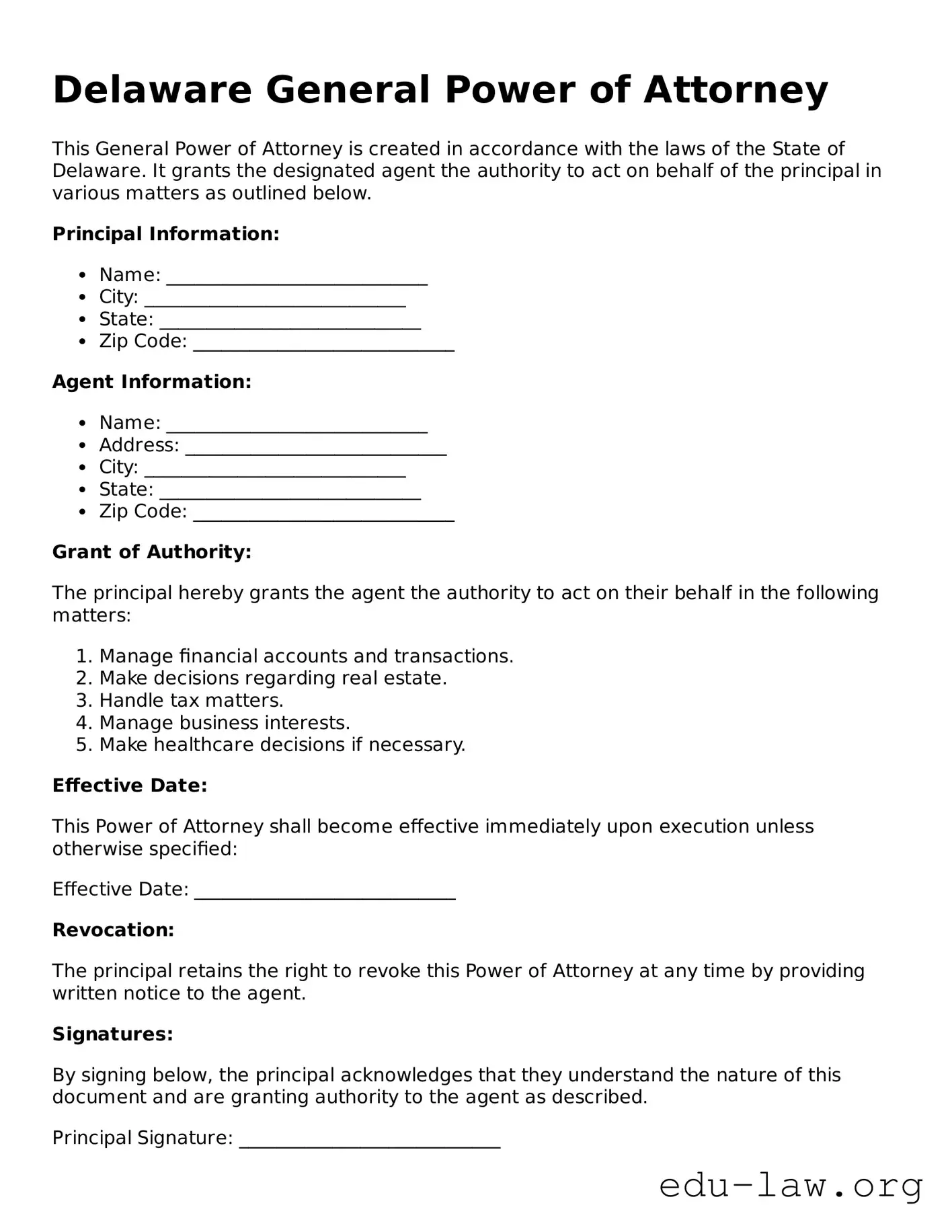
The Delaware General Power of Attorney form serves as a crucial legal document that empowers an individual, known as the principal, to designate another person, referred to as the agent, to make decisions on their behalf. This form is particularly valuable in situations where the principal may become incapacitated or unable to manage their affairs due to health issues or other circumstances. It grants the agent broad authority, which can include handling financial transactions, managing real estate, and making healthcare decisions, depending on the specific powers granted. Importantly, the form must be executed with certain formalities, such as being signed by the principal and witnessed or notarized, to ensure its validity. This document not only helps in planning for unforeseen events but also provides peace of mind, knowing that trusted individuals can act in the principal's best interests. Understanding the nuances of this form is essential for anyone considering establishing a power of attorney in Delaware, as it can significantly impact personal and financial well-being.
Delaware General Power of Attorney
This General Power of Attorney is created in accordance with the laws of the State of Delaware. It grants the designated agent the authority to act on behalf of the principal in various matters as outlined below.
Principal Information:
Agent Information:
Grant of Authority:
The principal hereby grants the agent the authority to act on their behalf in the following matters:
Effective Date:
This Power of Attorney shall become effective immediately upon execution unless otherwise specified:
Effective Date: ____________________________
Revocation:
The principal retains the right to revoke this Power of Attorney at any time by providing written notice to the agent.
Signatures:
By signing below, the principal acknowledges that they understand the nature of this document and are granting authority to the agent as described.
Principal Signature: ____________________________
Date: ____________________________
Witness Signature: ____________________________
Date: ____________________________
Notary Public Signature: ____________________________
Date: ____________________________
My Commission Expires: ____________________________
| Fact Name | Description |
|---|---|
| Governing Law | The Delaware General Power of Attorney is governed by Title 18, Chapter 1701 of the Delaware Code. |
| Purpose | This form allows an individual to grant another person the authority to act on their behalf in financial matters. |
| Durability | The Delaware General Power of Attorney can be durable, meaning it remains effective even if the principal becomes incapacitated. |
| Signature Requirements | The form must be signed by the principal and acknowledged before a notary public. |
| Revocation | A principal can revoke the power of attorney at any time, as long as they are competent to do so. |
| Agent's Authority | The agent's authority can be limited or broad, depending on the specific powers granted in the document. |
After obtaining the Delaware General Power of Attorney form, the next steps involve carefully filling out the document to ensure it accurately reflects your intentions. Follow the instructions below to complete the form correctly.
What is a Delaware General Power of Attorney form?
A Delaware General Power of Attorney form is a legal document that allows one person, known as the "principal," to grant another person, called the "agent," the authority to make decisions on their behalf. This authority can cover a wide range of matters, including financial transactions, property management, and legal affairs. It is important to choose a trusted individual as your agent, as they will have significant power to act in your name.
When should I use a General Power of Attorney?
You might consider using a General Power of Attorney if you anticipate being unable to manage your affairs due to illness, travel, or other reasons. This document ensures that someone you trust can handle important decisions and tasks for you when you are not able to do so. It can be particularly useful for financial matters, such as paying bills, managing investments, or selling property.
Can I revoke a General Power of Attorney in Delaware?
Yes, you can revoke a General Power of Attorney at any time, as long as you are mentally competent. To do this, you should create a written revocation notice and inform your agent and any relevant institutions. It is also a good idea to destroy any copies of the original Power of Attorney document to prevent confusion. Remember, once revoked, your agent will no longer have the authority to act on your behalf.
Does a General Power of Attorney remain valid if I become incapacitated?
In Delaware, a General Power of Attorney typically ends if the principal becomes incapacitated, unless it is specifically designated as a "durable" Power of Attorney. A durable Power of Attorney remains in effect even if you lose the ability to make decisions for yourself. If you want your agent to continue acting on your behalf during incapacitation, it is essential to ensure that your document is durable.
What should I consider before signing a General Power of Attorney?
Before signing a General Power of Attorney, consider the level of trust you have in your chosen agent. They will have significant power over your financial and legal matters. It is also important to think about the scope of authority you want to grant. You can limit the powers to specific tasks or give broad authority. Lastly, consult with a legal professional if you have any questions or concerns about the implications of this document.
Failing to clearly identify the principal. It is crucial to include the full name and address of the person granting the power of attorney.
Not specifying the powers granted. Be explicit about the financial or legal powers the agent will have. Vague language can lead to confusion.
Neglecting to date the document. A date is necessary to establish when the power of attorney becomes effective.
Overlooking the agent's information. Include the full name and address of the agent who will act on behalf of the principal.
Not signing in the appropriate places. The principal must sign the document, and witnesses or notaries may also be required depending on the situation.
Ignoring state-specific requirements. Each state has its own rules regarding power of attorney forms, so it’s important to follow Delaware's regulations.
Failing to discuss the document with the agent. Open communication ensures that the agent understands their responsibilities and the principal's wishes.
Not keeping copies of the signed document. It is wise to make copies for both the principal and the agent to avoid any disputes later.
Assuming the power of attorney is permanent. Understand that a general power of attorney can be revoked or may become invalid under certain circumstances.
When creating a Delaware General Power of Attorney, several other forms and documents may be necessary to ensure comprehensive legal coverage. Each document serves a specific purpose and can enhance the effectiveness of your power of attorney. Below is a list of commonly used forms that you might consider.
Each of these documents plays a vital role in ensuring that your wishes are respected and that your affairs are managed according to your preferences. Consulting with a legal professional can help you determine which documents are most appropriate for your situation.
The Durable Power of Attorney is similar to the General Power of Attorney, but it remains effective even if the principal becomes incapacitated. This means that the agent can continue to make decisions on behalf of the principal, ensuring that their affairs are managed without interruption. The durable aspect provides peace of mind for those who want their chosen representative to have authority during difficult times.
A Medical Power of Attorney focuses specifically on healthcare decisions. While a General Power of Attorney allows for a broad range of financial and legal decisions, the Medical Power of Attorney grants an agent the authority to make medical choices on behalf of the principal. This document is crucial for individuals who want to ensure their health care preferences are honored when they cannot communicate them directly.
The Limited Power of Attorney is another similar document, but it restricts the agent's authority to specific tasks or for a limited time. Unlike the General Power of Attorney, which provides wide-ranging powers, the Limited Power of Attorney is tailored for particular situations, such as handling a real estate transaction or managing a bank account. This specificity can be beneficial for those who want to maintain control over their affairs while delegating certain responsibilities.
The Springing Power of Attorney activates only under certain conditions, typically when the principal becomes incapacitated. This is different from the General Power of Attorney, which is effective immediately upon signing. A Springing Power of Attorney can provide reassurance, as it ensures that the agent's authority is only triggered when necessary.
The Financial Power of Attorney is closely related to the General Power of Attorney, as it specifically deals with financial matters. This document allows an agent to manage the principal's financial affairs, such as paying bills, managing investments, and filing taxes. While both documents may cover financial decisions, the Financial Power of Attorney emphasizes this aspect more clearly.
The Trust is another document that can serve similar purposes, particularly in managing assets. A trust allows a trustee to manage property for the benefit of the beneficiaries. While a General Power of Attorney grants authority to an agent to act on behalf of the principal, a trust can provide a structured way to manage and distribute assets, often avoiding probate and providing greater control over how assets are handled after death.
The Living Will is a document that outlines an individual’s wishes regarding medical treatment in the event they become incapacitated. While it does not appoint an agent like the General Power of Attorney, it works in conjunction with a Medical Power of Attorney to ensure that healthcare decisions align with the principal's values and desires. Together, these documents can provide comprehensive guidance for medical care.
Lastly, the Revocable Living Trust offers flexibility and control over assets during the principal's lifetime and can ease the transfer of those assets after death. Similar to the General Power of Attorney, it allows for the management of assets but does so in a way that can avoid probate. This can simplify the process for heirs and ensure that the principal's wishes are followed regarding asset distribution.
When filling out the Delaware General Power of Attorney form, it is important to follow specific guidelines to ensure that the document is valid and effective. Below is a list of dos and don'ts to consider:
Understanding the Delaware General Power of Attorney form is crucial for anyone considering its use. However, several misconceptions can lead to confusion. Here are eight common misconceptions explained:
By addressing these misconceptions, individuals can make informed decisions about the use of the Delaware General Power of Attorney form.
When filling out and using the Delaware General Power of Attorney form, it is important to understand the following key points:
Taking these steps can help you create a General Power of Attorney that meets your needs and protects your interests.