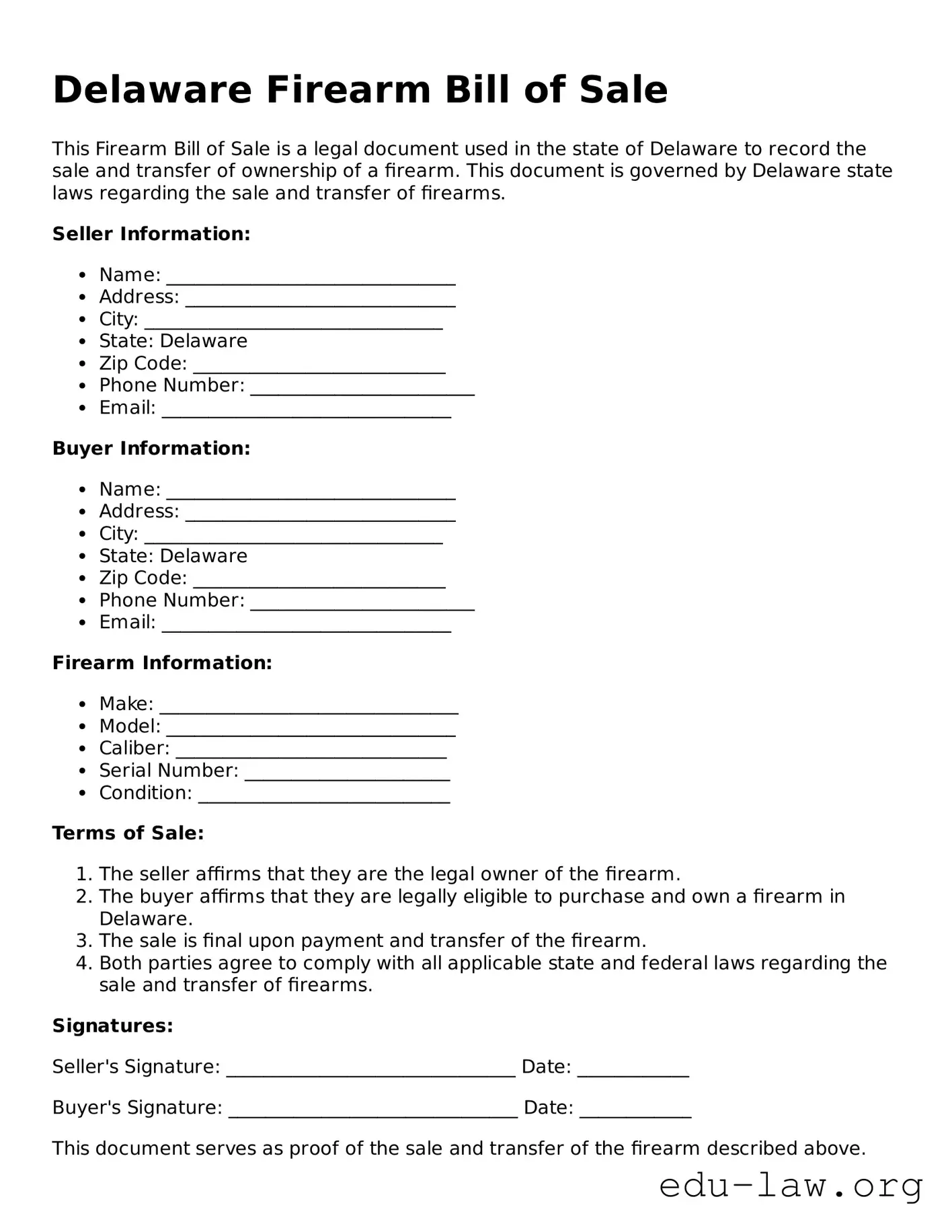
The Delaware Firearm Bill of Sale form serves as an important document for individuals engaging in the sale or transfer of firearms within the state. This form not only provides a written record of the transaction but also helps ensure that both the buyer and seller comply with state laws. Key elements of the form typically include details about the firearm being sold, such as its make, model, and serial number, as well as the names and contact information of both parties involved. Additionally, the form may require the seller to affirm that they are legally allowed to sell the firearm, while the buyer acknowledges that they are legally permitted to purchase it. By documenting the transaction, this form can protect both parties in case of future legal issues or disputes. Overall, the Delaware Firearm Bill of Sale form plays a crucial role in maintaining transparency and legality in firearm transactions, making it an essential tool for responsible gun ownership in the state.
Delaware Firearm Bill of Sale
This Firearm Bill of Sale is a legal document used in the state of Delaware to record the sale and transfer of ownership of a firearm. This document is governed by Delaware state laws regarding the sale and transfer of firearms.
Seller Information:
Buyer Information:
Firearm Information:
Terms of Sale:
Signatures:
Seller's Signature: _______________________________ Date: ____________
Buyer's Signature: _______________________________ Date: ____________
This document serves as proof of the sale and transfer of the firearm described above.
| Fact Name | Description |
|---|---|
| Purpose | The Delaware Firearm Bill of Sale form is used to document the sale or transfer of firearms between private parties. |
| Governing Law | This form is governed by Delaware Code Title 11, Chapter 144, which outlines regulations regarding firearms. |
| Parties Involved | The form requires information from both the seller and the buyer, including names and addresses. |
| Firearm Details | Specific details about the firearm must be included, such as make, model, and serial number. |
| Legal Age | Both parties must be at least 18 years old to legally engage in the sale of a firearm in Delaware. |
| Record Keeping | It is recommended that both parties retain a copy of the completed Bill of Sale for their records. |
Filling out the Delaware Firearm Bill of Sale form is an important step in the process of transferring ownership of a firearm. Ensure that all information is accurate and complete to avoid any potential issues in the future.
Once the form is completed, keep a copy for your records. The buyer should also retain a copy for their documentation. This form serves as proof of the transaction and helps ensure compliance with local laws.
What is a Delaware Firearm Bill of Sale form?
A Delaware Firearm Bill of Sale form is a document that serves as proof of the sale or transfer of a firearm between two parties. This form includes essential details such as the names and addresses of the buyer and seller, the make and model of the firearm, the serial number, and the date of the transaction. It is important for both parties to keep a copy for their records.
Is the Firearm Bill of Sale form required in Delaware?
While a Firearm Bill of Sale is not legally required in Delaware, it is highly recommended. Having this document can help protect both the buyer and the seller by providing a record of the transaction. It may also serve as evidence of ownership in case of any disputes or legal issues in the future.
What information should be included in the Firearm Bill of Sale form?
The form should include the following information: the full names and addresses of both the buyer and seller, the description of the firearm (including make, model, and serial number), the date of the transaction, and the purchase price. Both parties should sign the document to acknowledge the sale and transfer of ownership.
Can I use a generic Bill of Sale for firearms in Delaware?
While a generic Bill of Sale can be used, it is advisable to use a specific Firearm Bill of Sale form. This ensures that all necessary details related to the firearm transaction are included. A dedicated form helps to avoid any misunderstandings and provides clarity regarding the terms of the sale.
Where can I obtain a Delaware Firearm Bill of Sale form?
A Delaware Firearm Bill of Sale form can be obtained from various sources, including online legal document providers, firearm retailers, or local gun clubs. It is important to ensure that the form complies with Delaware state laws and contains all required information for a valid transaction.
Incomplete Information: One of the most common mistakes is failing to fill out all required fields. Each section of the form is crucial for establishing a clear record of the transaction. Missing details can lead to complications down the line.
Incorrect Identification: Buyers and sellers must provide accurate identification. This includes full names, addresses, and any other identifying information. Errors in this area can create confusion and may even render the bill of sale invalid.
Omitting Signatures: Both parties must sign the document for it to be legally binding. Forgetting to sign or having only one party sign can lead to disputes about the transaction later on.
Not Keeping Copies: After completing the form, it’s essential to make copies for both the buyer and seller. Failing to do so can result in a lack of proof of the sale, which can be problematic if questions arise in the future.
The Delaware Firearm Bill of Sale form is essential for documenting the sale or transfer of firearms between parties. However, several other forms and documents may accompany this transaction to ensure compliance with state and federal laws. Below is a list of commonly used documents that complement the Firearm Bill of Sale.
Using these documents alongside the Delaware Firearm Bill of Sale can help ensure a smooth and legally compliant transaction. Always verify the specific requirements based on individual circumstances and local regulations.
The Delaware Firearm Bill of Sale form shares similarities with a Vehicle Bill of Sale. Both documents serve as proof of transfer of ownership from one party to another. Just like a firearm, a vehicle requires a formal acknowledgment of sale to establish legal ownership. This document typically includes details such as the buyer's and seller's names, the vehicle identification number (VIN), and the sale price. This ensures that both parties have a clear understanding of the transaction, protecting their rights and interests.
Another document akin to the Firearm Bill of Sale is the Personal Property Bill of Sale. This form is used when selling items other than real estate, such as electronics, furniture, or collectibles. It outlines the specifics of the item being sold, including its condition and any warranties, if applicable. Much like the firearm sale, it provides a legal record of the transaction and helps prevent disputes between the buyer and seller regarding ownership and condition after the sale.
A Lease Agreement can also be compared to the Firearm Bill of Sale. While a lease involves renting property rather than selling it, both documents establish terms and conditions between parties. The Lease Agreement details the rights and responsibilities of the landlord and tenant, similar to how a Firearm Bill of Sale outlines the rights of the buyer and seller. Both documents are essential in ensuring that all parties are aware of their obligations and can refer back to the agreement if any issues arise.
The Rental Agreement is another document that resembles the Firearm Bill of Sale. While it typically pertains to the rental of property or equipment, it also serves to clarify the terms of the transaction. The Rental Agreement specifies the duration of the rental, payment terms, and responsibilities for maintenance. Like the Firearm Bill of Sale, it protects both parties by ensuring that everyone understands their rights and obligations, thus minimizing potential conflicts.
Lastly, a Business Bill of Sale can be compared to the Firearm Bill of Sale, as it involves the transfer of ownership of a business or business assets. This document includes details such as the names of the buyer and seller, the purchase price, and a description of the assets being sold. Similar to the firearm sale, it acts as a legal record of the transaction, ensuring that both parties are protected and that the sale is conducted in a transparent manner.
When filling out the Delaware Firearm Bill of Sale form, it’s important to follow certain guidelines to ensure everything is completed correctly. Here are some dos and don'ts to keep in mind:
Misconceptions about the Delaware Firearm Bill of Sale form can lead to confusion for buyers and sellers. Here are five common misunderstandings:
When filling out and using the Delaware Firearm Bill of Sale form, it is important to keep several key points in mind. Below are essential takeaways that can help ensure the process is smooth and legally compliant.
By following these guidelines, individuals can navigate the process of completing and using the Delaware Firearm Bill of Sale form more effectively.