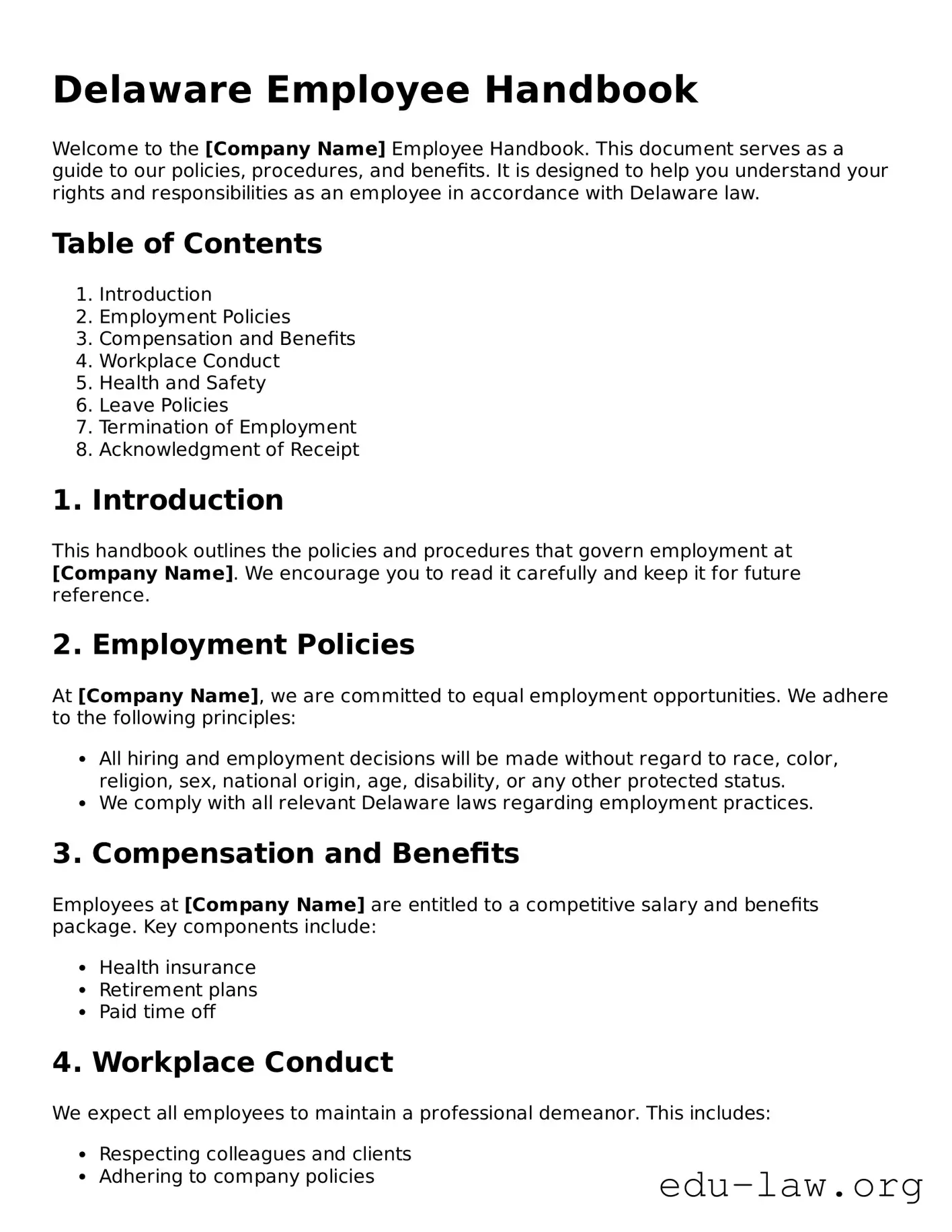
Creating an employee handbook is an essential step for businesses in Delaware, as it sets clear expectations and guidelines for employees while ensuring compliance with state laws. The Delaware Employee Handbook form serves as a foundational document that outlines key policies and procedures, including workplace conduct, attendance, and leave policies. It also addresses important topics such as anti-discrimination policies, employee benefits, and safety protocols. By utilizing this form, employers can communicate their values and expectations effectively, fostering a positive work environment. Additionally, the handbook can help protect the company by providing a reference point in case of disputes or misunderstandings. Having a well-structured employee handbook not only benefits the organization but also empowers employees by informing them of their rights and responsibilities within the workplace.
Delaware Employee Handbook
Welcome to the [Company Name] Employee Handbook. This document serves as a guide to our policies, procedures, and benefits. It is designed to help you understand your rights and responsibilities as an employee in accordance with Delaware law.
Table of Contents
1. Introduction
This handbook outlines the policies and procedures that govern employment at [Company Name]. We encourage you to read it carefully and keep it for future reference.
2. Employment Policies
At [Company Name], we are committed to equal employment opportunities. We adhere to the following principles:
3. Compensation and Benefits
Employees at [Company Name] are entitled to a competitive salary and benefits package. Key components include:
4. Workplace Conduct
We expect all employees to maintain a professional demeanor. This includes:
5. Health and Safety
Your safety is our priority. We follow all state regulations to ensure a safe work environment. Employees are encouraged to:
6. Leave Policies
We recognize the importance of work-life balance. Our leave policies include:
7. Termination of Employment
Termination may occur for various reasons, including performance issues or company restructuring. Employees are encouraged to speak with their supervisor if they have concerns.
8. Acknowledgment of Receipt
Please sign below to acknowledge that you have received and understood the [Company Name] Employee Handbook.
Employee Name: ___________________________
Date: ___________________________
Thank you for being a part of [Company Name]. We look forward to working together to create a positive and productive work environment.
| Fact Name | Description |
|---|---|
| Purpose | The Delaware Employee Handbook serves as a guide for employees, outlining company policies, procedures, and expectations. |
| Legal Requirement | While not mandated by law, having an employee handbook is considered best practice for employers in Delaware. |
| Governing Laws | The handbook should comply with Delaware employment laws, including the Delaware Code Title 19, which governs labor and employment. |
| Content Recommendations | It is advisable to include sections on anti-discrimination policies, workplace safety, and employee benefits. |
| Employee Acknowledgment | Employers often require employees to sign an acknowledgment form indicating they have received and understood the handbook. |
| Updates and Revisions | Regular updates are necessary to reflect changes in laws or company policies, ensuring the handbook remains relevant. |
| Confidentiality Clause | Including a confidentiality clause helps protect sensitive company information and sets expectations for employee behavior. |
| Dispute Resolution | Employers may include a dispute resolution process in the handbook to address conflicts and grievances effectively. |
Filling out the Delaware Employee Handbook form is a straightforward process that helps ensure your workplace policies are clearly communicated. Follow these steps to complete the form efficiently.
What is the Delaware Employee Handbook form?
The Delaware Employee Handbook form is a document designed to provide employees with essential information about workplace policies, procedures, and expectations. It serves as a guide for both employers and employees, outlining rights and responsibilities within the workplace. This handbook can help foster a clear understanding of company culture and operational standards.
Who needs to use the Delaware Employee Handbook form?
Employers in Delaware who wish to establish clear communication with their employees should utilize this form. It is particularly beneficial for new businesses, as it sets foundational policies that can help prevent misunderstandings. Additionally, existing companies may find it useful for updating or revising their current employee handbooks.
What information should be included in the Employee Handbook?
The Employee Handbook should include various sections such as company mission and values, employee conduct expectations, anti-discrimination policies, benefits information, leave policies, and disciplinary procedures. Each section should be tailored to reflect the specific practices and culture of the organization.
Is the Delaware Employee Handbook form legally required?
While there is no legal requirement for Delaware employers to provide an employee handbook, it is highly recommended. Having a well-structured handbook can help protect the company from potential legal disputes by clearly outlining policies and procedures. It also aids in compliance with state and federal labor laws.
How often should the Employee Handbook be updated?
It is advisable to review and update the Employee Handbook regularly, at least once a year. Changes in laws, company policies, or organizational structure may necessitate revisions. Keeping the handbook current ensures that employees have access to the most relevant information.
Can employees provide input on the Employee Handbook?
Yes, employees can and should be encouraged to provide feedback on the Employee Handbook. Their insights can help identify areas that may need clarification or adjustment. Involving employees in the process fosters a sense of ownership and can lead to a more inclusive workplace culture.
How can employers distribute the Employee Handbook to employees?
Employers can distribute the Employee Handbook in several ways. Options include providing printed copies during onboarding, sharing it electronically via email or the company intranet, or making it accessible through a shared drive. It is essential to ensure that all employees receive a copy and understand its contents.
Incomplete Information: Many individuals forget to fill out all required fields. This can lead to delays or even rejection of the form. Always double-check that every section is complete.
Incorrect Dates: Entering the wrong dates can cause confusion. Ensure that all dates, especially start dates and review dates, are accurate and clearly written.
Not Following Instructions: Each form comes with specific instructions. Ignoring these can result in mistakes. Read the guidelines carefully before starting.
Using Abbreviations: Abbreviations can be unclear. It’s best to write out full terms to avoid misunderstandings. Clarity is key.
Neglecting Signatures: Forgetting to sign the form is a common error. A signature is often required to validate the document. Always sign where indicated.
When establishing a comprehensive workplace environment, several forms and documents complement the Delaware Employee Handbook. Each of these documents serves a specific purpose, ensuring that both employers and employees understand their rights and responsibilities. Below is a list of essential documents that often accompany the Employee Handbook.
Each of these documents plays a crucial role in fostering a transparent and organized work environment. By understanding and utilizing these forms, both employers and employees can navigate their professional relationship more effectively, ensuring clarity and mutual respect.
The Delaware Employee Handbook form shares similarities with the Employee Manual, which serves as a comprehensive guide for employees regarding company policies and procedures. Like the handbook, the manual outlines expectations for employee behavior, workplace rules, and the benefits offered by the employer. Both documents aim to create a clear understanding of the workplace environment, ensuring that employees are aware of their rights and responsibilities. This fosters a culture of transparency and accountability, which is vital for maintaining a harmonious workplace.
Another document akin to the Delaware Employee Handbook is the Code of Conduct. This code outlines the ethical standards and expectations for employee behavior within the organization. It often addresses issues such as conflicts of interest, harassment, and confidentiality. Both the Code of Conduct and the Employee Handbook emphasize the importance of maintaining a respectful and professional work environment, serving as a framework for acceptable behavior and decision-making in the workplace.
The Orientation Guide closely resembles the Delaware Employee Handbook in that it provides new employees with essential information about the company. This guide typically includes an overview of company culture, policies, and procedures, similar to the handbook's role in onboarding. While the Employee Handbook is a more comprehensive resource that employees can reference throughout their employment, the Orientation Guide focuses on helping new hires acclimate to their roles and understand the organization's expectations from the outset.
The Policy Manual is another document that aligns with the Delaware Employee Handbook. This manual details specific policies related to various aspects of employment, such as leave policies, disciplinary procedures, and safety regulations. Like the handbook, the Policy Manual serves as a reference point for employees seeking clarity on specific issues. Both documents aim to ensure that employees have access to the necessary information to navigate their workplace effectively and understand the implications of their actions.
Similar to the Delaware Employee Handbook is the Training Manual, which focuses on the skills and knowledge required for specific job roles. This manual often includes procedures, best practices, and performance expectations that are crucial for job success. While the Employee Handbook provides a broader overview of company policies, the Training Manual dives deeper into the specific tasks and responsibilities associated with particular positions, ensuring that employees are well-equipped to perform their jobs effectively.
Lastly, the Benefits Guide is comparable to the Delaware Employee Handbook in that it outlines the various benefits available to employees, such as health insurance, retirement plans, and paid time off. Both documents play a critical role in informing employees about their entitlements and how to access them. While the Employee Handbook may provide a general overview of benefits, the Benefits Guide typically offers more detailed information, including eligibility criteria and enrollment procedures, helping employees make informed decisions about their benefits options.
When filling out the Delaware Employee Handbook form, it’s important to follow certain guidelines to ensure accuracy and compliance. Here are four things you should and shouldn't do:
Understanding the Delaware Employee Handbook is essential for both employers and employees. However, several misconceptions can lead to confusion. Here are nine common misunderstandings regarding the Delaware Employee Handbook form:
Many believe that the Employee Handbook can be used universally across all businesses. In reality, each handbook should be tailored to the specific needs and culture of the organization, reflecting its unique policies and practices.
Some assume that the handbook is merely a suggestion. However, once distributed, it can create expectations and obligations for both the employer and employees, potentially leading to legal implications if policies are not followed.
There is a misconception that an Employee Handbook is a static document. In truth, it should be regularly updated to reflect changes in laws, company policies, or organizational structure.
Small business owners often think they can operate without a handbook. However, having clear policies can help prevent misunderstandings and provide guidance for employees, regardless of the company's size.
Some believe that every possible policy must be detailed in the handbook. While it should cover essential topics, it is not necessary to include every policy. Focus on the most relevant and critical aspects of employment.
Many think that the handbook is only relevant for new employees. In reality, it serves as a reference for all staff, ensuring everyone is aware of the company's policies and procedures.
Some individuals believe that once an Employee Handbook is distributed, it cannot be altered. In fact, employers can update the handbook as needed, but they should communicate these changes to employees effectively.
Some assume that simply providing an Employee Handbook eliminates the need for training. However, while the handbook can provide valuable information, training is essential for ensuring employees understand and can apply the policies.
Lastly, many think the handbook solely focuses on rules. While it includes policies, it can also convey the company culture, values, and expectations, fostering a positive work environment.
By addressing these misconceptions, employers can better utilize the Delaware Employee Handbook as a tool for communication and guidance, ultimately benefiting the entire organization.
When filling out and using the Delaware Employee Handbook form, consider the following key takeaways:
By keeping these points in mind, you can create an effective Employee Handbook that serves both the organization and its employees well.