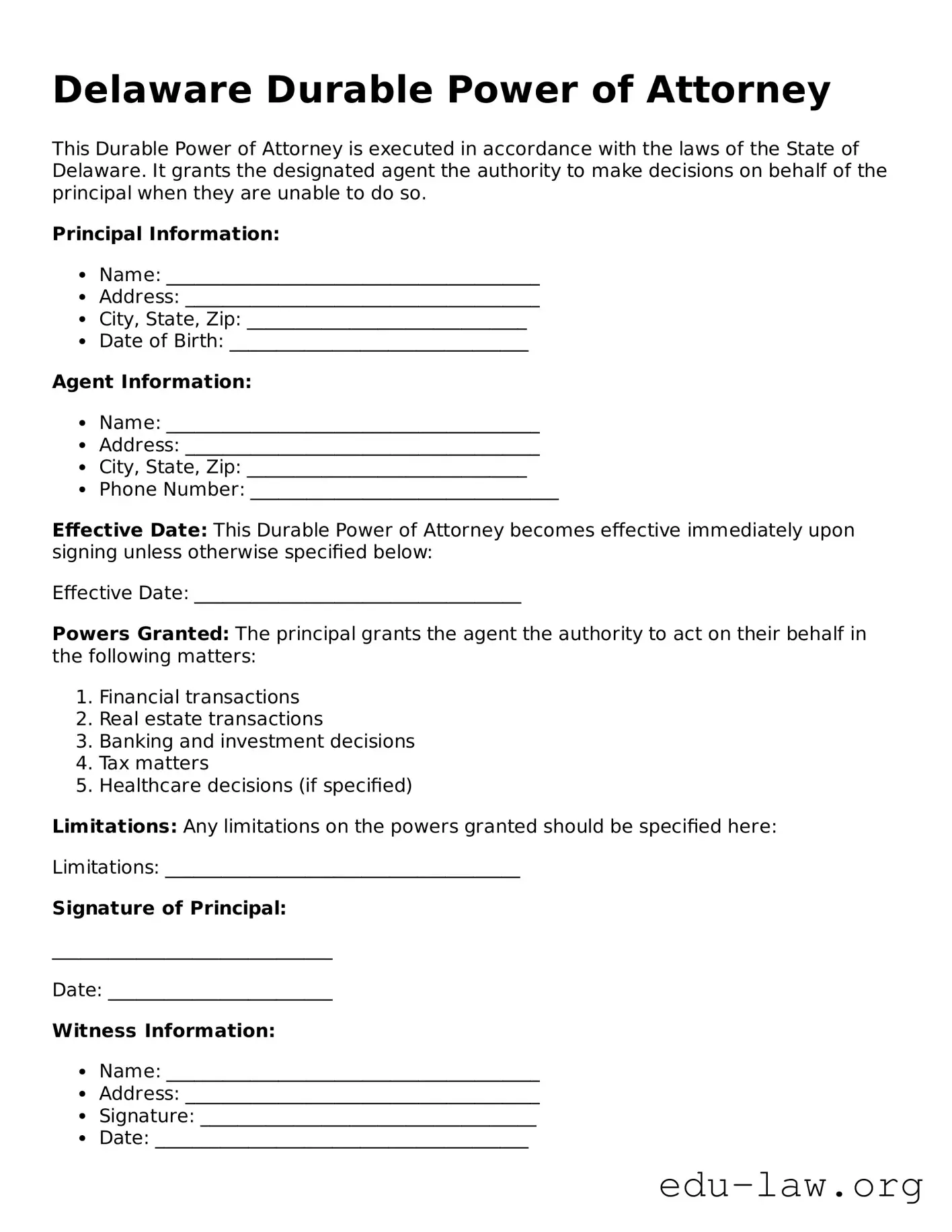
The Delaware Durable Power of Attorney form is a crucial legal document that empowers individuals to designate someone they trust to make decisions on their behalf in various situations. This form remains effective even if the principal becomes incapacitated, ensuring that their financial and medical affairs can be managed without interruption. It allows the appointed agent to handle a wide range of responsibilities, from managing bank accounts to making healthcare decisions, depending on the specific powers granted. By completing this form, individuals can provide clear guidance on their preferences and ensure their wishes are respected. It’s important to understand the implications of granting such authority, as the chosen agent will have significant control over the principal's affairs. This document not only protects the principal’s interests but also offers peace of mind, knowing that someone reliable will act in their best interest when they cannot do so themselves.
Delaware Durable Power of Attorney
This Durable Power of Attorney is executed in accordance with the laws of the State of Delaware. It grants the designated agent the authority to make decisions on behalf of the principal when they are unable to do so.
Principal Information:
Agent Information:
Effective Date: This Durable Power of Attorney becomes effective immediately upon signing unless otherwise specified below:
Effective Date: ___________________________________
Powers Granted: The principal grants the agent the authority to act on their behalf in the following matters:
Limitations: Any limitations on the powers granted should be specified here:
Limitations: ______________________________________
Signature of Principal:
______________________________
Date: ________________________
Witness Information:
Notarization:
State of Delaware
County of ________________________
Subscribed and sworn before me this ____ day of __________, 20__.
______________________________
Notary Public
My Commission Expires: ________________
| Fact Name | Description |
|---|---|
| Definition | A Delaware Durable Power of Attorney allows an individual to appoint someone to make financial and legal decisions on their behalf, even if they become incapacitated. |
| Governing Law | This form is governed by the Delaware Uniform Power of Attorney Act, specifically Title 12, Chapter 49 of the Delaware Code. |
| Durability | The term "durable" means that the power of attorney remains effective even if the principal becomes mentally incapacitated. |
| Agent Authority | The appointed agent can manage a variety of financial matters, including banking, real estate transactions, and tax matters. |
| Revocation | The principal can revoke the power of attorney at any time, as long as they are mentally competent to do so. |
| Signing Requirements | The form must be signed by the principal and witnessed by two individuals or notarized to be valid. |
After obtaining the Delaware Durable Power of Attorney form, it is essential to carefully fill it out to ensure that your wishes are clearly stated. Once completed, this document will need to be signed and possibly notarized, depending on your specific needs.
What is a Delaware Durable Power of Attorney?
A Delaware Durable Power of Attorney is a legal document that allows you to appoint someone to make decisions on your behalf if you become unable to do so. This can include financial decisions, healthcare choices, and other important matters. The term "durable" means that the authority continues even if you become incapacitated.
Who can I appoint as my agent?
You can choose anyone you trust to act as your agent, often referred to as your attorney-in-fact. This person can be a family member, friend, or even a professional, such as an attorney or financial advisor. It’s important to select someone who understands your values and wishes.
What powers can I give to my agent?
You can grant your agent a wide range of powers, depending on your needs. Common powers include managing bank accounts, paying bills, buying or selling property, and making healthcare decisions. You can specify which powers you want to include or limit, giving you control over what your agent can do on your behalf.
How do I create a Durable Power of Attorney in Delaware?
To create a Durable Power of Attorney in Delaware, you must complete a specific form that meets state requirements. You’ll need to sign the document in front of a notary public. It’s advisable to keep the original in a safe place and provide copies to your agent and any relevant institutions, like banks or healthcare providers.
Can I revoke or change my Durable Power of Attorney?
Yes, you can revoke or change your Durable Power of Attorney at any time, as long as you are mentally competent. To revoke it, you should create a new document stating that you are revoking the previous one and notify your agent and any institutions that have a copy of the original document. Always keep your records updated to avoid confusion.
Not Selecting the Right Agent: One common mistake is failing to choose someone trustworthy and capable. The agent will have significant authority over financial and legal decisions, so it’s crucial to select someone who understands your wishes and can act responsibly.
Omitting Specific Powers: People often overlook the importance of specifying the powers granted to the agent. If the form lacks clarity about what the agent can and cannot do, it can lead to confusion and potential misuse of authority.
Not Signing or Dating the Form: A Durable Power of Attorney is not valid unless it is signed and dated. Forgetting this step can render the document useless, leaving your affairs unmanaged in critical times.
Failing to Inform the Agent: It’s essential to communicate with the chosen agent about their responsibilities and your expectations. Many individuals make the mistake of assuming the agent knows their wishes without any prior discussion.
Not Reviewing the Document Regularly: Life circumstances change, and so do relationships. Failing to review and update the Durable Power of Attorney can result in outdated information, which may not reflect your current situation or desires.
When considering the Delaware Durable Power of Attorney form, it is essential to understand that several other documents may complement it. Each of these documents serves a specific purpose and can help streamline the management of affairs, especially in times of incapacity or when assistance is needed. Below is a list of commonly used forms and documents that often accompany the Durable Power of Attorney.
Understanding these additional documents can provide clarity and assurance when creating a comprehensive plan for managing personal and financial affairs. Each document plays a vital role in ensuring that an individual's wishes are honored and that their interests are protected.
The Delaware Durable Power of Attorney form is similar to the General Power of Attorney. Both documents allow an individual, known as the principal, to designate another person, called the agent, to make decisions on their behalf. The key difference lies in durability; the General Power of Attorney becomes ineffective if the principal becomes incapacitated, while the Durable Power of Attorney remains in effect even if the principal loses the ability to make decisions. This makes the Durable Power of Attorney particularly useful for long-term planning and ensuring that decisions can be made when the principal is unable to do so.
Another document similar to the Delaware Durable Power of Attorney is the Healthcare Power of Attorney. This form specifically grants an agent the authority to make medical decisions for the principal if they are unable to communicate their wishes. While the Durable Power of Attorney covers a broader range of financial and legal matters, the Healthcare Power of Attorney focuses solely on health-related decisions. Both documents empower an agent to act in the best interest of the principal, but they serve different purposes in terms of the types of decisions that can be made.
The Living Will is also comparable to the Delaware Durable Power of Attorney, particularly in the context of healthcare decisions. A Living Will outlines the principal’s wishes regarding medical treatment and end-of-life care. Unlike the Durable Power of Attorney, which appoints an agent to make decisions, a Living Will provides specific instructions that must be followed. Both documents are essential for ensuring that an individual’s preferences are respected when they cannot communicate their desires, but they approach the issue from different angles—one through direct agent authority and the other through explicit directives.
Lastly, the Revocable Trust shares similarities with the Delaware Durable Power of Attorney in that both can be used for estate planning. A Revocable Trust allows a person to manage their assets during their lifetime and designate how those assets will be distributed after death. While the Durable Power of Attorney grants authority to an agent to manage financial matters, a Revocable Trust places assets in a trust for management and distribution purposes. Both documents provide flexibility and control over one’s financial affairs, but they operate through different mechanisms and legal structures.
When filling out the Delaware Durable Power of Attorney form, it is essential to approach the task with care and attention to detail. Here is a list of important things to do and avoid:
By following these guidelines, individuals can help ensure that their Durable Power of Attorney accurately reflects their intentions and provides the necessary authority to their chosen agent.
When it comes to the Delaware Durable Power of Attorney (DPOA) form, several misconceptions can lead to confusion. Understanding these misconceptions can help individuals make informed decisions regarding their legal affairs. Below are four common misconceptions:
This is not true. While many people associate DPOAs with older adults, anyone can create a DPOA at any age. Unexpected events, such as accidents or sudden illnesses, can happen to anyone, making it essential for all adults to consider having this document in place.
This misconception arises because both documents deal with future health care decisions. However, they serve different purposes. A DPOA allows someone to manage financial and legal matters on your behalf, while a Living Will specifically outlines your wishes regarding medical treatment if you become unable to communicate those wishes.
Many people believe that a DPOA becomes effective only when the person who created it is incapacitated. In reality, a DPOA can be set up to take effect immediately, allowing the designated agent to act on behalf of the principal right away, as long as the principal is competent.
This is a common misunderstanding. A DPOA can be revoked at any time by the principal, as long as they are mentally competent. It is important to communicate this revocation to the designated agent and any institutions that may have a copy of the DPOA.
Clarifying these misconceptions can empower individuals to make better choices regarding their legal documents and ensure that their wishes are honored.
When filling out and using the Delaware Durable Power of Attorney form, keep the following key takeaways in mind: